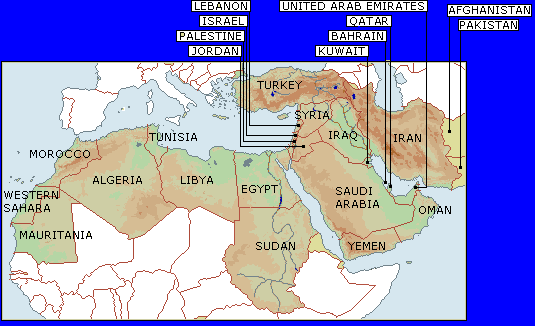
Hezbullah, with a green light from Iran, has already allowed 10-15 al Qaeda operatives infiltrate Gaza.
Hezbullah and Iranian allies planning to take over Ein Hilweh.
A base on the Lebanese coast under the protection of Beirut’s Syrian overlords would enable Teheran to project power southwards towards Israel, northwards towards Turkey and westwards towards Europe. #msg-4476762
Both al Qaeda and China have moved to the south of Israel.
Egypt cognizant of the fact that they are marked for infiltration by the United States and quite probably Israel who wish to tighten control over them announces they are ready to promote ties with China. This seems a means by which Egypt might also benefit from China’s protection. Egypt is very important to China as Chinese enterprises could see Egypt as a springboard for expanding their businesses in Africa, the Middle East and Europe. #msg-4246778
Al-Qaeda has become extremely aggressive not only in Pakistan but in the Middle East and North Africa the same areas in which China desires to expand their businesses. China is a long time supporter of al Qaeda. #msg-4317507
Israel accuses al-Qaeda of masterminding the chain of blasts targeting Israeli tourists in Egypt's Red Sea resorts instead of the usual radical Palestinian militant groups. #msg-4246778
In addition to Hezbullah and Iranian allies planning to take over Ein Hilweh in Lebanon, China in essence a major supporter of Iran by way of the recently signed $100 billion plus gas deal with Iran plans to further army-to-army ties with Lebanon.
This puts China, al Qaeda and Iran to the north and south of Israel.
Thus we have Israeli Foreign Minister Silvan Shalom arriving in Beijing on Friday for a four-day visit to China.
-Am
China and Lebanon to further army-to-army ties.
Senior Chinese military officer meets chief of staff of Lebanese army
UPDATED: 08:05, October 26, 2004
A senior Chinese military officer said in Beijing Monday that the Chinese People's Liberation Army (PLA) attaches great importance to developing relations with the Lebanese armed forces and is eager to promote bilateral exchange and cooperation in various fields.
Xu Caihou, vice-chairman of the Chinese Central Military Commission, made the remark during a meeting with Ramzy Abou Hamzy, chief of staff of the Lebanese armed forces, and his party.
Xu, also member of the Secretariat of the CPC Central Committee, said that the relationship has progressed smoothly since the two countries established diplomatic relations, adding that vigorous cooperation has been conducted in the fields of politics, economy and culture.
Xu thanked the support of the Lebanese government on the one-China policy, China's reunification cause and China's human rights record.
Ramzy said the exchange of visits between the Lebanon-China military leaders have deepened understanding and friendship between the two countries.
Ramzy also acknowledged China's generous support to Lebanon and said Lebanon is ready to further army-to-army ties.
Also present at the meeting were Deputy Chief of the General Staff of the PLA Ge Zhenfeng and Lebanese Ambassador to China Sleiman Rassi.
BEIJING, Nov. 4 (Xinhuanet) -- Israeli Foreign Minister Silvan Shalom will arrive in Beijing on Friday for a four-day visit to China.
Israeli Foreign Minister Silvan Shalom has stressed the importance of strategic relations between Israel and China ahead of his arrival in Beijing on Friday.
The foreign minister says during his four-day visit, he will discuss with his Chinese counterpart the global war against terrorism, the situation in the Middle East and closer economic ties.
Shalom, who will sign an agricultural cooperative agreement with China during his trip, noted China has become Israel's largest trade partner in Asia, with the total volume of trade reaching 1.6 billion US dollars in 2003.
Hmmm... China increases its oil and gas interest in Tehran 100 billion in he same time frame that Washington wants more submarines in the neighborhood to combat "Terrorism". Hmm... China and Russia now with sizable interests in Iran. I wonder how long "terrorist" can hold their breath underwater? BTW what strategic target would terrorists be likely to bomb in he middle of the South Pacific? Tonga? Maybe we are going to protect French polynesia? Somoa?
Iran wins key backing from China in nuclear stand-off AFP: 11/6/2004 TEHRAN (AFP) - Iran was given crucial backing from China in its stand-off with the UN's nuclear watchdog, with Beijing saying it opposed US efforts to have the Islamic republic referred to the United Nations Security Council.
"There is no reason to send the issue to the Security Council," Chinese Foreign Minister Li Zhaoxing said in a press conference with his Iranian counterpart, Kamal Kharazi.
"It would only make the issue more complicated and difficult to work out," Li said, contradicting Washington by saying "the Iranian government is having a very positive attitude in its cooperation" with the International Atomic Energy Agency (IAEA).
Li refused to speculate on whether China would use its veto in the Security Council in the event of Iran's case being sent there. He did say he had told US Secretary of State Colin Powell and British Foreign Secretary Jack Straw "that China supports a solution in framework of the IAEA".
The United States accuses Iran of secretly trying to develop nuclear weapons under cover of its civilian atomic energy program and wants the UN watchdog International Atomic Energy Agency (IAEA) to take Iran before the UN Security Council when the IAEA meets in Vienna on November 25.
Tehran denies that charge, insisting it only wants to generate electricity.
Russia, another permanent and veto-wielding Security Council member, has also voiced its strong opposition to Iran's case being referred there by the IAEA. The country is helping Iran build its first nuclear power plant in a deal worth some 800 million dollars.
Li's comments add yet another layer of diplomatic difficulty for the European Union, which is trying avert the matter being sent to the Security Council by getting Iran to suspend uranium enrichment.
The sensitive part of the fuel cycle makes fuel for civilian reactors but which can also be used to manufacture the material for the explosive core of atomic weapons.
Tehran has until now resisted Europe's demand for an indefinite suspension, arguing that it would infringe its right to maintain a civilian nuclear power programme.
Europe's three powers are offering Iran nuclear technology, including access to nuclear fuel, increased trade and help with Tehran's regional security concerns if the Islamic Republic halts enrichment.
Official sources here said talks with Britain, France and Germany were set to continue in Paris on Saturday, amid reports of a deadlock between the EU's so-called "big three" and Iranian officials.
The negotiations, which began Friday, were said to have stalled over the duration of a suspension as well as the timing or scope of incentives that the EU could offer Iran.
"Negotiations are going on between the representatives of Iran and the three European countries in Paris. They are complicated and very difficult. Both sides are intending to continue the negotiations and we have to wait and see what the outcome will be," Iran's foreign minister said.
"I think it would be to the benefit of both sides to reach a consensus," Kharazi added. "Iran is determined to use nuclear technology for peaceful purposes. This is Iran's legitimate right and nobody can deprive us of this right."
Kharazi also gave Iran's first formal reaction to George W. Bush's re-election, urging the US president to undergo a "change of behaviour" in his second term.
Although he said the election was "an internal matter for the United States and the American people," he added that "what is important to us is a change of behaviour. In that respect, we hope for positive developments in the second part of Mr. Bush's presidency."
In 2002, Bush famously lumped Iran into an "axis of evil" along with Saddam Hussein's Iraq and Stalinist North Korea.
Another official also suggested a US-Iran contact was possible.
The United States has not had formal diplomatic relations with the Islamic republic since the 1980 hostage crisis and only intermittent contacts since then.
This change in U.S. policy if it comes to pass could be the product of Iran’s nuclear program and the quagmire that has stuck us in Iraq but more recently and perhaps the bigger reason is the new Iran/China alliance which has rocked the geopolitical boat.
This is in reference to the signing of a mega-gas deal between Beijing and Tehran worth $100 billion. Billed as the "deal of century" by various commentators, this agreement is likely to increase by another $50 billion to $100 billion, bringing the total close to $200 billion, when a similar oil agreement, currently being negotiated, is inked not too far from now.
Note: Israel has in fact found itself increasingly surrounded by China’s influence. #msg-4487525
-Am
US may use Iraq meet to engage Iran
WASHINGTON: Secretary of State Colin Powell may use a conference on Iraq later this month as an opportunity to engage directly with Iran, officials said on Friday, despite a looming nuclear crisis.
While insisting “nothing at this moment is planned,” one senior official told Reuters “there may be opportunities” for Powell to speak about US concerns “more directly” than just in the conference’s general meeting, set for Sharm el-Sheik, Egypt’s Red sea resort, on Nov. 22 and 23.
Another official also suggested a US-Iran contact was possible. “Stay tuned. The secretary will be there and Iran will be there,” he said, declining to be more specific.
The United States has not had formal diplomatic relations with the Islamic republic since the 1980 hostage crisis and only intermittent contacts since then, despite Tehran’s growing ability to thwart some of President George W. Bush’s major objectives, like stability in Iraq.
Bush has been under pressure from many in the US foreign policy establishment to begin a dialogue with Tehran but his administration has been divided over whether and to what degree the United States might reach out. US officials said that debate continued and they indicated any gesture by Powell would be modest.
The administration has refused to participate in European negotiations that aim to persuade Tehran to abandon a nuclear program that Washington insists is aimed at producing weapons.
Iraq’s neighbors, the United Nations, the Organization of the Islamic Conference and the Group of Eight leading industrialized countries are expected at this month’s conference. reuters
Some political analysts say the competition for energy will severely test the relations of China and Japan in particular. But energy diplomacy also raises new challenges for the West, as the economic and political center in Asia shifts from the United States and Japan to China.
This reiterates what I have been saying. Bush will go down in history as the fool that lost America’s dominance. There is no bigger sin a president can commit. Bush has lost it. Granted China was on a roll before Bush took office. However during these past four years the dragon has roared even louder, watch and learn how China sets up in the next four years. Bush is not a match for them.
China is "throwing around its economic muscle like crazy," said David Lampton, head of China studies at Johns Hopkins University's School of Advanced International Studies. "The Chinese are throwing incredible amounts of money to lock up long-term [energy] contracts. … It's going to be a real topic of U.S.-China relations."
The communists are better capitalists than the capitalists.
The U.S. is not interested in Caspian oil to supply its own internal industry. The U.S. is grabbing for control of the Caspian oil fields because other countries need this oil--and because the U.S. wants to control them. Other imperialist rivals--including Germany and Japan--are "energy poor" and need access to oilfields outside their borders. Most Third World countries are heavily dependent on imported oil. #msg-3775550
What is even more depressing is that Bush has the audacity to think he can control all of the oil in the world as a means by which the United States can act as overlords to other nations.
If he screws up any further China will control what oil we require.
-Am
China Barrels Ahead in Oil Market
The country's hunt for the energy it needs to fuel its economy has led to deals in political hotspots, riling the U.S.
By Don Lee, Times Staff Writer November 14, 2004
SHANGHAI — About a three-hour drive south of Shanghai, along the East China Sea, workers are building 52 gigantic tanks, each capable of holding more than 25 million gallons of oil — enough to supply every driver in China with gasoline for a month.
The storage tanks will help accommodate China's thirst for oil as it looks to fuel its booming economy. And it has plans to stockpile much, much more.
China, the world's second-largest consumer of oil after the United States, has plenty of cash to secure sources of petroleum and natural gas. But as aggressively as any nation, it is also cutting deals and forging alliances to get the energy it needs.
In South America and Africa, the Chinese government is helping build roads and ports in exchange for oil supply contracts. Beijing pledged to support oil-rich Russia in its bid to join the World Trade Organization as the two countries agreed that Russia would boost its exports of crude by rail to China.
And after a Chinese company's deal to develop an oil field in Iran, Beijing tacitly offered political support for Tehran's budding nuclear program. That put China in direct cross hairs of the Bush administration. The hunt for energy in the former Soviet Union and political hotspots such as Sudan is making China few friends in Washington.
China is "throwing around its economic muscle like crazy," said David Lampton, head of China studies at Johns Hopkins University's School of Advanced International Studies. "The Chinese are throwing incredible amounts of money to lock up long-term [energy] contracts. … It's going to be a real topic of U.S.-China relations."
Some Chinese officials dismiss the threat of increased friction over energy.
"Although oil trade plays an important role in every field, it has a limited influence in Sino-American relations," said Han Wenke, vice director of the energy institute affiliated with the National Development and Reform Commission, an important regulatory agency of the Chinese central government.
Beijing's pursuit of energy is all about maintaining the nation's strong economic growth, which Communist Party leaders believe is the linchpin to social stability and ultimately their legitimacy. Oil and natural gas, and lots of both, are needed to keep factories running and to power all the new cars hitting freshly paved streets.
Only a decade ago, China shipped out more crude than it imported. This year it has sharply reduced exports to meet domestic needs — and it is now the world's second-largest importer of oil after the U.S.
Rising Demand
Surging Chinese demand, which has helped drive up oil prices to record levels in the last year, is expected to rise by double-digit growth rates annually for the next 15 years.
Although crude prices have settled back in recent days to less than $50 a barrel, China's rapid economic expansion is almost certain to add pricing pressure over the long haul. The country accounts for about 6% of world consumption; that's projected to rise to more than 9% in 2020, as Chinese oil fields dry up. (One-fifth of global oil demand comes from the United States.)
Wary of its increasing reliance on a few foreign oil suppliers, China has formulated a "go-out" strategy to diversify and expand its energy capabilities. The plan involves cooperating with 27 countries for oil exploration.
Beijing also is pouring money into developing its own pipelines and liquid natural gas terminals and launching an array of energy conservation programs at home, including imposing fuel economy standards on new cars.
One of China's biggest and latest energy ventures involves Iran, which the United States has sought to isolate for its alleged development of a covert nuclear arms program.
Late last month, Chinese and Iranian officials signed a preliminary deal in which China's Sinopec Group would develop Iran's Yadavarn oil field in exchange for Sinopec agreeing to buy millions of tons of Iranian liquefied natural gas. The Chinese government media valued the deal at $70 billion.
A few days later, Chinese Foreign Minister Li Zhaoxing gave Iran important political support in the standoff over the Islamic republic's nuclear program. Li said Beijing opposed efforts to have the matter referred to the United Nations Security Council, although he stopped short of saying China would use its veto power if the case were sent there.
U.S. diplomatic sources have been reluctant to comment on the deal. Some analysts said it was unlikely that Beijing would jeopardize U.S. relations over an energy pact with Iran.
But others aren't so sure.
"There is a rationale from Beijing that is very dominant: If you can supply oil and do business, we would like to sign a deal," said Wenran Jiang, a political scientist at the University of Alberta in Canada. "China is very non-ideological in that sense. They will think about it, but they're not driven by the strategic interest in Washington."
Sudan is another example. Among China's African energy partners, which together provide about 20% of the country's oil and natural gas, the single largest is Sudan. Since the late '90s, Chinese oil companies have poured hundreds of millions of dollars into developing oil fields, a pipeline and a refinery.
No Apologies
Despite long-running criticisms by the United States and international groups about human rights abuses in Sudan, Beijing makes no apologies. When pressed on the issue, Chinese foreign officials have been quoted as saying simply that business is business.
In Africa, China has also signed deals to buy oil from Nigeria, Gabon, Cameroon and Angola. Last year China extended a $2-billion loan to Angola in exchange for 10,000 barrels of crude oil a day.
He Jun, a senior analyst at Beijing-based Anbound Strategic Consulting Co., doesn't think China will let itself become involved too heavily in sensitive African nations such as Sudan.
"China's main purpose is still to develop its economy under a peaceful circumstance," he said. Others note that the U.S. and other big consumers of oil also have bought energy supplies from unsavory governments.
For China, more promising are its efforts closer to home. In September, construction crews began work on a 770-mile pipeline running from the oil-abundant Caspian Sea coast in Kazakhstan to China's western border, connecting with another trunk line all the way to China's east coast. The pipeline's initial capacity would be about 10 million tons of crude a year, said Matthew Cairns of Economy .com in Sydney, Australia.
Earlier, during a visit to Russia by Chinese Premier Wen Jiabao, the two countries reached the agreement about Russia exporting more crude to China. Cairns said it was no coincidence then that Wen promised to give Russia support for its WTO bid.
"It's a very cunning political maneuver," Cairns said.
In Russia, China also has sought a crude oil pipeline from eastern Siberia to Daqing in northeast China, to have ready access to supplies. But Japan appears to have won its bid to have the pipeline routed to the Russian port city of Nakhodka on the Sea of Japan.
Japanese and Chinese companies have clashed more openly over the exploration of natural gas in the East China Sea. Tokyo is worried that China would siphon gas from the Japanese side of the ocean bed, and has insisted that China provide details about the natural gas field.
Some political analysts say the competition for energy will severely test the relations of China and Japan in particular. But energy diplomacy also raises new challenges for the West, as the economic and political center in Asia shifts from the United States and Japan to China.
Heightened geopolitical tensions over China's oil imports comes as little surprise to Jeffrey Logan, China program manager at the Paris-based International Energy Agency.
"It's only natural," he said. "The world is struggling to learn more about China. As China enters the world more and more, it's going to depend on the world's resources more and more."


 Market Data
  Markets


 AI
AI