you may be interested in this one - Britain is 'designer drugs' capital of Europe, says EU agency
Potent synthetic drugs proving hard to control as chemists produce alternatives quicker than authorities can ban them
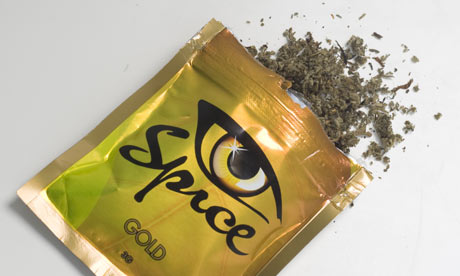
Spice Gold, a herbal drug soon to be banned in the UK. Photograph: Alicia Canter
Alan Travis in Brussels Thursday 5 November 2009
Britain has become the online "designer drugs" capital of Europe with more than a third of all internet retailers that sell "legal highs" based in the UK, according to a report from the European Union's drug agency.
This new generation of online "head shops" is at the centre of a rapidly growing market in highly potent synthetic drugs, such as Spice, that mimic the effects of illegal substances such as cannabis and ecstasy.
European drug agency officials are also alarmed by the way the online retailers are reacting to moves to ban individual "legal highs" by rapidly marketing alternatives. Officials say it is like trying to hit a moving target.
Britain is poised to ban Spice, a cannabis substitute that can be more potent than skunk, which is sold as a "herbal smoking mixture" , but already the online head shops are selling 27 alternative "herbal smoking blends" based on the active ingredient in cannabis synthesised by chemists in Asia.
Wolfgang Gotz, the director of the European monitoring centre for drugs and drug addiction, said the use of the legal highs market to circumvent controls on illicit drugs was the most challenging development over the past year.
"While this practice itself is not new, what is new is the wide range of substances now on offer, the growing use of the internet, the aggressive and sophisticated marketing of products and the very speed with which the market reacts to controls."
He said that Spice was an example of the global nature of the drugs problem with a product designed and marketed in Europe but produced in Asia and targeted at the potentially large group of consumers who were interested in cannabis.
"If Spice is a taste of things to come, both our monitoring systems and our drug control mechanisms will have to evolve in order to meet the new challenges that this kind of market innovation is presenting us with."
The annual report from the European drugs agency cites the case of BZP, a "designer stimulant" that was banned across Europe earlier this year, as an example of how rapidly this new British-based market reacts to attempts to ban legal highs.
A whole range of alternative "energy party pills" is already being marketed and advertised as BZP-free and sold under names such as Charged, Turbo III – The Next Generation and Cranked. They promise to make you feel "energetic, alert, and lively for five to six hours". Charged is promoted as "the perfect power source to fuel your long days and big nights". Snuff products or herbal powders, claiming to contain caffeine and a range of other plant-based ingredients, are also being sold as a legal alternatives to cocaine and amphetamines.
The 2009 survey of online shops selling these "psychoactive" drugs found 115 retailers operating from 17 European countries, but the majority were based in the UK (37%) and Germany (15%). Nearly half the sites selling Spice were located in Britain. Germany, France and Austria made selling Spice illegal in March this year and Britain is poised to follow suit as soon as the measure is approved by parliament.
Paul Griffiths, of the European drugs agency, said that Spice contained a new compound, JWH-018, which was the first synthetic cannabinoid – the active ingredient in marijuana – and which was very potent even at low doses. In the face of the growing crackdown on Spice, research chemists have already developed a range of nine other cannabis-like drugs that would not be covered by the ban.
"Detecting these compounds is very difficult. Sometimes they are masked by spraying with other substances. We have no knowledge of their toxicity and overdoses are possible," he said.
The difficulties for the law enforcement authorities in dealing with these new drugs was highlighted earlier this week when a British "transporter", Steve Marsden, 50, was freed from a Maltese jail after serving only three years of a 25-year prison sentence for importing 50,000 "ecstasy" tablets into the island. His appeal succeeded when it was proved that the active ingredient in his tablets was not the illegal chemical MDMA, but a new legal synthetic drug mCPP, or Piperazine, which has similar effects.
The annual report confirms that Britain and Spain remain at the top of the Euro-league table for cocaine consumption and also shows that the decline in cannabis consumption among British schoolchildren has continued despite the downgrading of its legal status. In the mid-1990s, 42% of British teenagers aged 15-16 reported to have used cannabis but this has now fallen to 29% of the age group.
AMA Calls for Review of Medical Marijuana’s Legal Status New Policy Marks Historic Shift From Prior Stance
FOR IMMEDIATE RELEASE November 10, 2009 10:47 AM
HOUSTON - November 10 - In a move considered historic by supporters of medical marijuana, the American Medical Association's House of Delegates today adopted a new policy position calling for the review of marijuana's status as a Schedule I drug in the federal Controlled Substances Act. The old language in Policy H-95.952 had previously recommended that "marijuana be retained in Schedule I," which groups marijuana with drugs such as heroin, LSD and PCP that are deemed to have no accepted medical uses and to be unsafe for use even under medical supervision.
The revised policy, adopted today, states, "Our AMA urges that marijuana's status as a federal Schedule I controlled substance be reviewed with the goal of facilitating the conduct of clinical research and development of cannabinoid-based medicines, and alternate delivery methods." It goes on to explain that this position should not be construed as an endorsement of state medical marijuana programs.
"This shift, coming from what has historically been America's most cautious and conservative major medical organization, is historic," said Aaron Houston, director of government relations for the Marijuana Policy Project, who attended the AMA meeting. "Marijuana's Schedule I status is not just scientifically untenable, given the wealth of recent data showing it to be both safe and effective for chronic pain and other conditions, but it's been a major obstacle to needed research."
Drugs listed in Schedule II, for which medical use is permitted with strict controls, include cocaine, morphine and methamphetamine. A pill containing THC, the component responsible for marijuana's "high," is classed in Schedule III, whose looser requirements allow phoned-in prescriptions.
###
With more than 26,000 members and 100,000 e-mail subscribers nationwide, the Marijuana Policy Project is the largest marijuana policy reform organization in the United States. MPP believes that the best way to minimize the harm associated with marijuana is to regulate marijuana in a manner similar to alcohol. For more information, please visit http://MarijuanaPolicy.org.


 Market Data
  Markets


 AI
AI