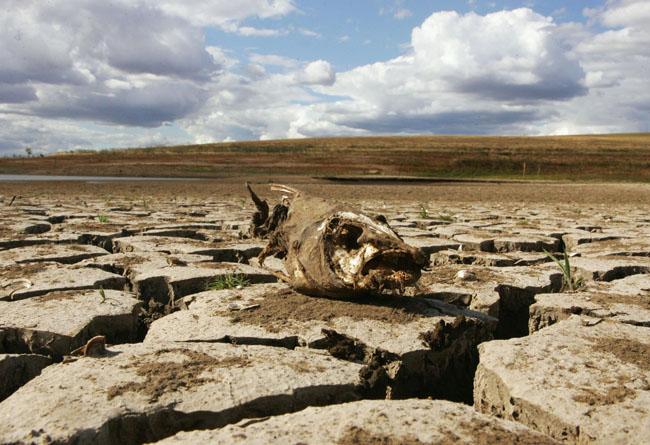
Australia Records Warmest-Ever Decade as Heat Waves Increase January 05, 2010
By James Paton
Jan. 5 (Bloomberg) -- Australia has experienced the warmest decade since records started in 1910, ending the period with extreme bushfires, dust storms and record-breaking heat waves, the nation’s bureau of meteorology said.
The average temperature between 2000 and 2009 was 22.3 degrees Celsius (72.1 Fahrenheit), compared with the 1961-1990 average of 21.8 Celsius, Dean Collins, a senior climatologist with the Australian Bureau of Meteorology, said by phone today.
Prime Minister Kevin Rudd plans to reintroduce legislation next month that would establish a carbon emissions trading system aimed at fighting climate change. The upper-house Senate rejected the draft law for a second time in December. Each decade in Australia since the 1940s has been warmer than the previous one, while figures from the first decades on record fail to show a trend, the bureau said in a report.
“It’s very unlikely that could happen by chance,” Collins said. “Clearly Australia’s climate is warming in line with the rest of the world.”
Australia experienced its second-warmest year in 2009, with the average temperature 0.9 degrees Celsius above the 1961-1990 average, the bureau said. Melbourne, the second-biggest city, last year set a new record temperature of 46.4 degrees Celsius.
“There are clear upward trends in the number of hot events and downward trends in the number of cold events, consistent with the background of global warming,” according to the report.
The Water Corporation has urged people to use water sparingly as Perth continues its longest dry spell for 15 years.
This week, daily water usage topped one gigalitre for the first time this year with supplies set to be strained further with sizzling temperatures forecast for this weekend.
Today marks 56 days since rain was recorded in Perth, the longest break since 1994, and the Weather Bureau forecasts no change for at least a week.
With no let-up in sight, the dry spell is set to enter Perth's all-time top 10 on Wednesday, which will mark two months to the day since Perth last saw rain on November 20.
Water Corporation spokeswoman Clare Lugar said although dam levels were at 47 per cent - higher than at the same time last year - the forecast heatwave over the next few days could lead to a spike in consumption.
Homeowners should stick to their watering days and sprinklers, which account for 70 per cent of usage, should be used only before 9am and after 6pm, she said.
Water use tends to rise in line with temperatures, meaning more days this week could break the one gigalitre mark, an event that happens just a handful of times each summer.
Ms Lugar said dam levels at the start of summer were higher than previous years because of healthy winter rains and the sprinkler ban.
The corporation was taking more water from dams than from groundwater in an attempt to preserve the health of aquifers.
Weather Bureau statistician John Relf said the dry spell was set to continue for the foreseeable future and could test the record. "I would give it a few more days and then things will start to get interesting," he said.
The all-time record is the 83-day dry spell from December 1974 to March 1975. "That was an amazing one," he said.
Temperatures had been 1.6C above the January average so far and this month's average should be raised further by the coming heatwave.
Bureau meteorologist Patrick Ward said the forecast was for dry conditions for the next seven days and that the three-month forecast for January to March had predicted a summer that was likely to be hotter and drier than average. Although typical of Perth's Mediterranean climate, the dry weather did not usually persist unbroken this long, Mr Ward said.
Farmer Marshall Rodda (left) and farmhand Gilbert Fryatt (right) stand on the parched earth of an empty dam northwest of Melbourne on November 14, 2006.
La Niña conditions in the Pacific, often associated with heavy rain in Australia,failed to fill water catchments in the Murray-Darling River Basin this year. .. [2007] .. [...]
No thank yous, at all, to those suffering from Anti Science Syndrome, the ASS-wholes, amongst us.
It's hot ..
and windy .. http://www.weatherzone.com.au/ .. yet, it is minor inconvenience for most, when we consider the terrible tragedy in Haiti .. Quake aftershock sparks terror on the streets ..


 Market Data
  Markets


 AI
AI