Rosner's Domain: Should Abbas stay or go? SHMUEL ROSNERT ..Oct 08, 2009
Rami Khouri writes:
Abbas' weakness, like Arafat's before him in the latter's last decade of life, has been an infatuation with two elements that are addictive but nonproductive: the trappings of power, privilege and incumbency; and a direct line to the American president. Both of these are enticing elements, but they lead to a situation of total powerlessness of the Palestinian leadership and equally severe marginalization of the Palestinian people.
The Palestinian presidency has become an international embarrassment. It generates no respect among the four principal constituencies where it should matter: the Palestinian people, the Israeli people and government, the Arab people and governments, and the rest of the world. It is shocking - unbelievable, in fact - that Abbas should have totally wasted away the last bits of credibility and respect that Yasser Arafat had left him.
Therefore...
He should act with honor and confidence by stepping down as Palestinian president, calling a new election to bring in a more legitimate and capable leadership, and focusing his energy on where he started his days decades ago when he still had credibility and courage - by reconstituting the PLO as the coordinating body for all Palestinians.
This makes life more complicated for Abbas, but will also make it more complicated for Netanyahu, as it will force the US into putting some pressure on Israel to save the Palestinian President:
In response to the question of Abbas' current power and ability to yield results, Mitchell's aides said the Palestinian president is not too weak and that the Palestinian Authority is a partner for talks with Israel.
Will pressure on Netanyahu really save him? (one should also ask: is it worth saving him) - it's too early to predict. But an American rescue mission will definitely expose him to another round of Khouri-like allegations of being "too close" to the US administration (or, as harsher critics make sure to call him, "the American puppet Mahmoud Abbas").
Israel rejects UN council backing for Gaza war crimes report
UN human rights council passes resolution endorsing Goldstone report, which accused Israel and Hamas of war crimes
* Rory McCarthy in Jerusalem * guardian.co.uk, Friday 16 October 2009
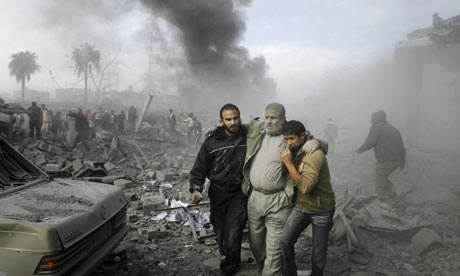
The Goldstone report accused Israel of a disproportionate attack designed to punish, humiliate and terrorise a civilian population. Photograph: Hatem Omar/AP
Israel has angrily rejected what it called a "one-sided" resolution by the UN human rights council today that backed a highly critical report on the Gaza war and opened the way to possible international war crimes investigations.
The council voted to endorse the report by a South African judge, Richard Goldstone, which accused both Israel and Hamas of committing war crimes and possible crimes against humanity during the three-week war in Gaza in January. Goldstone, whose work was hailed by leading international human rights groups, found there may be individual criminal responsibility over the killing of civilians.
The report will go to the UN general assembly and could lead to a rare international criminal court investigation if Israel and Hamas fail to mount their own credible independent inquiries into the war crimes allegations within six months.
Today's vote carries major implications for the Middle East conflict. It is the first time such serious investigations have been contemplated at such a high level. It may encourage reconciliation between the rival Palestinian factions, but it is also likely to complicate US efforts to restart Israeli-Palestinian peace talks. And in the end it may result in a US veto at the UN security council to protect Israel from scrutiny.
"Israel rejects the one-sided resolution adopted in Geneva by the UN human rights council and calls upon all responsible states to reject it as well," the Israeli foreign ministry said. The resolution "provides encouragement for terrorist organisations worldwide and undermines global peace". Israel has criticised the council in the past for an anti-Israel bias.
In Ramallah, a spokesman for the Palestinian president, Mahmoud Abbas, welcomed the result but said he wanted to see action. "What is important now is to translate words into deeds in order to protect our people in the future from any new aggression," said Nabil Abu Rdeneh.
Hamas for its part welcomed the resolution as "the beginning of the prosecution of the leaders of the occupation," even though it too risks international investigations.
The resolution not only dealt with the Goldstone report but condemned Israel's policies in east Jerusalem, particularly over access to Muslim holy sites, demolitions of Palestinian homes and excavation work near the Haram al-Sharif, also known as the Temple Mount.
It was passed with 25 votes in favour, six against and 11 abstentions. The US voted against the resolution, while Britain and France did not take part after failing to secure a delay. Neither Israel nor the Palestinians sit on the 47-member council, which is dominated by countries in the developing world, but both worked hard to influence the outcome of the vote.
Intense US pressure initially led Abbas to drop his efforts to secure a vote endorsing the Goldstone report. Abbas had wanted to put the vote off for six months, but that was greeted with such an outcry among Palestinians who demanded accountability for the hundreds of civilians killed in Gaza that he quickly backtracked and called for this special council session.
Goldstone had recommended that the human rights council pass his report to the UN security council, the UN general assembly and the international criminal court. He proposed that both Israel and Hamas should be given six months to conduct their own "appropriate investigations that are independent and in conformity with international standards". If either side failed to investigate properly, then he said the security council should pass the case on to the prosecutor of the international criminal court.
Hamas looks unlikely to investigate its actions during the war and Israel's prime minister, Binyamin Netanyahu, has already insisted he will not allow any Israelis to face war crimes trials. Around 1,400 Palestinians and 13 Israelis died in the three-week war.
The US diplomat at the council in Geneva, Douglas Griffiths, criticised the Goldstone report for an "unbalanced focus on Israel, the overly broad scope of its recommendations and its sweeping conclusions in law". However, he also said Washington had wanted more time before the vote to allow the two sides to conduct their own investigations into war crimes allegations. That suggests the US may yet put pressure on Israel to hold a credible inquiry. Western countries may be concerned that they too could face the threat of similar investigations in future over their conduct in wars in Iraq and Afghanistan.
The UN high commissioner for human rights, Navi Pillay, called on both sides to hold "impartial, independent, prompt and effective investigations".
Gordon Brown reportedly had a heated telephone call on Wednesday with Netanyahu, who pressed him to vote against the resolution. Brown spoke again with Netanyahu this morning, hours before the vote, and Britain then decided not to take part at all. A Downing Street spokesman said: "We did not participate in the vote. We were involved in discussions with Israel and the Palestinians about potentially substantive improvements in the situation on the ground and therefore asked for a delay to the vote."
How they voted
In favour (25): Argentina, Bahrain, Bangladesh, Bolivia, Brazil, Chile, China, Cuba, Djbouti, Egypt, Ghana, India, Indonesia, Jordan, Mauritius, Nicaragua, Nigeria, Pakistan, Philippines, Qatar, Russia, Saudi Arabia, Senegal, South Africa, Zambia.
Against (6): US, Italy, Holland, Hungary, Slovakia, Ukraine.
Mahmoud Abbas will not seek re-election as Palestinian president
Leader of Fatah movement, seen as a moderate by the west, to sit out forthcoming election according to reports in West Bank
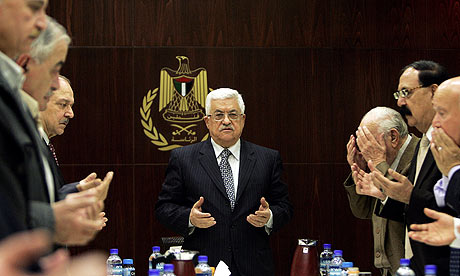
The Palestinian president, Mahmoud Abbas (c), heads a meeting of the Fatah party's executive committee in Ramallah
Thursday 5 November 2009
The Palestinian president, Mahmoud Abbas, has decided not to run for the presidency in elections next year, according to reports from Ramallah.
Abbas, who was elected nearly five years ago, had been expected to run again, despite the deep factional divisions among his own people and the deadlock in returning to peace talks with the Israelis.
"The president insists on not running in the upcoming election," an official from the executive committee of the Palestine Liberation Organisation told Reuters. Abbas announced his decision today at a meeting of the PLO, which he chairs.
He was expected to give a speech later in the day, but some senior Palestinian figures said they were still trying to dissuade him from stepping down.
It is not clear if Abbas intends to go ahead with his decision or whether it is an attempt to encourage the US administration to apply more pressure on Israel so that peace talks can resume.
Presidential and parliamentary elections are scheduled for January next year, but are widely expected to be delayed until June at the earliest because of a deep rift between the West Bank, run by Abbas's Fatah movement, and Gaza, run by its Islamist rival, Hamas. An election in both areas is unlikely without a reconciliation between the factions, but that has proved increasingly elusive.
If Abbas does not run in the next elections that might open the way for Marwan Barghouti, a popular leader from the same Fatah party who is now serving five life terms in an Israeli jail. Barghouti, who was elected to Fatah's central committee this summer, has always balked at running against Abbas, but is widely regarded by Palestinians as one of their most popular leaders. He was jailed in 2002 for involvement in the killing of four Israelis and a Greek monk during the Palestinian second intifada.
Abbas is a moderate who has tied his political career, first as prime minister then as president, to a negotiated two-state peace agreement. He has refused to resume talks with the Israelis until all settlement construction is halted, an Israeli obligation under the 2003 US road map, which remains the basis of Middle East peace talks.
Earlierthis year, Washington also insisted Israel stop all settlement activity, but has since significantly softened its position, asking instead for Israeli "restraint". That change in approach culminated last weekend in when Hillary Clinton, the US secretary of state, provoking Palestinian and Arab anger by praising as "unprecedented" a partial settlement freeze offer from Israel.
Israel says it will offer a temporary freeze but with significant caveats, including the continued construction of 3,000 settler homes, as well as continued building in east Jerusalem settlements and of all public projects in settlements. The Israeli prime minister, Binyamin Netanyahu, leads a rightwing cabinet that is largely supportive of the settlement project.
Yesterday, the Palestinian chief negotiator, Saeb Erekat, said the Israeli proposal effectively meant more settlement homes would be built in the next two years than in 2008 and 2009. There are now nearly 500,000 Jewish settlers living in east Jerusalem and the West Bank, although settlement on occupied land is illegal under international law.
Erekat said the international community faced a "critical moment" in the Middle East and that it may be time for the Palestinians to start arguing in favour of a one-state solution, a bi-national state of Jews and Arabs on the same land. Israel bitterly opposes such an idea.
"President Abbas will have to come to his moment of truth and tell that to his people, tell them that we tried but now it's not an option to talk about two states because Israel destroyed it with settlements and walls," Erekat said. He said the Palestinians were not walking away from negotiations, but wanted the US to create a "realistic political track" for two-state peace talks.
Abbas has seen his credibility among Palestinians damaged in recent months. First, he agreed to meet Netanyahu in New York in September, just days after insisting there would be no meeting without an Israeli settlement freeze. Then last month, under US pressure, he withdrew Palestinian support for a UN human rights council resolution endorsing a report into the Gaza war, by the South African judge Richard Goldstone. Within days, Abbas reversed his decision and the report was endorsed by the council and is also likely to be endorsed by the UN general assembly this week.
Please, who could ever respect this man ? oh yeah , us .... he lost an election and took power anyway with our encouragement and blessings ..AND - it's been a worse disaster ever since, if that's possible. He was corrupt to begin with and worse now ...I'm glad to see him going .. IF they released Marwan Barghouti ...what deals would he have to make ? ... I just can't see it, all though, there has been talk of this off and on forever ....


 Market Data
  Markets


 AI
AI