F6, what absolutely fantasmagorical colors .. sorry should have searched El Nino here before i posted my last one to you ..
now what do i say? .. ummm ..
changing times and lolol topics .. metaphorical wind
big bottoms .. small hands reach out in hope .. old pocket holes .. kinda ..
lastly .. social costs .. price .. cigarettes .. leaked for discussion i guess .. $20 a packet of 25? .. shorter than some of yours, too
must remember to batten down .. look over shoulder .. be responsible, that's good .. to save .. and to search before posting, sometimes ..
chuckle .. when the dust settles a packet of 20 which i tend to as always going to quit .. lol .. guessing from now about $10/pkt in a tobacconist to around $12.
These are terrible and darn sad. El Nino inspired or terrorist contrived, doesn't matter.
UPDATE 5-California wildfire more than doubles on sixth day Mon Aug 31, 2009 9:53pm EDT
* More than 70 dwellings confirmed destroyed
* Over 6,000 homes under evacuation orders
* Fire crews retreat from key mountain summit (Updates with new damage toll, evacuees, news conference)
By Steve Gorman
LOS ANGELES, Aug 31 (Reuters) - A massive wildfire roaring through mountains north of Los Angeles forced some firefighters to retreat on Monday as the toll of engulfed homes rose sharply and flames menaced Mount Wilson, a broadcasting hub and site of a historic observatory.
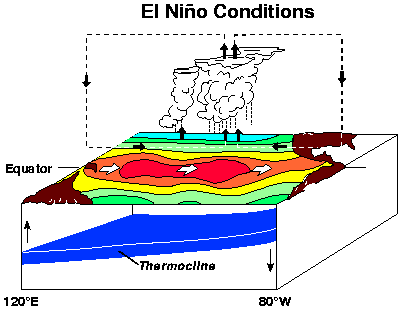
El Niño is the result of an on-going "dialog" between the ocean and atmosphere in the tropical Pacific Ocean. It's part of a natural, combined oceanic-atmospheric cycle referred to as El Nino-Southern Oscillation (ENSO)
* El Niño is one extreme (warm phase) .. *La Niña is the other extreme (cold phase)
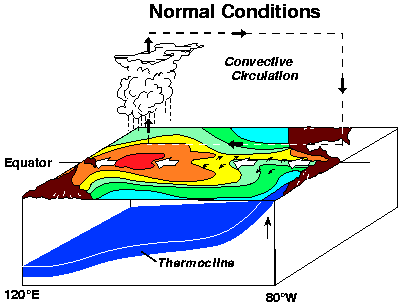
"Normal" Patterns in the Pacific
1. In normal years when there is no El Niño or La Niña, atmospheric pressure is greater in the eastern Pacific than in the western Pacific. Because wind flows from higher to lower pressure, the trade winds blow from east to west.
2. Warm water "piles up" in the western Pacific and sea level is higher (by ~ 30 cm) than it is in the east.
3. Upwelling of cold, nutrient-rich water occurs along the western coast of South America.
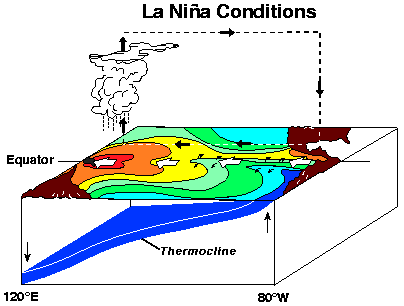
4. In some years, this pattern intensifies, so that sea-surface temperatures are colder than usual in the central and western Pacific. This condition is referred to as La Niña and is similar to normal patterns, except that circulation is increased and convection is enhanced over Indonesia. Southern Oscillation
The Southern Oscillation (S0) is an irregular "see-saw" in which atmospheric pressure and wind patterns shift across the Pacific. When normally high pressure in the eastern Pacific decreases and normally low pressure over Australia and northern Indonesia rises, conditions are right for an El Niño event to develop.
As warm water shifts eastward, so do the convection and heavy rains caused by the increased buoyancy of air warmed by the underlying water. As warm water piles up in the east, upwelling of cold, nutrient-rich water is inhibited.
Latent heat of condensation further warms the air, which further decreases atmospheric pressure in the east, etc. The thunderstorms that have shifted from the western to the central and eastern Pacific disrupt high-level jet stream circulation by pumping warm air and moisture high into the atmosphere. This has a far-reaching effect on weather patterns. Hazard/Impact
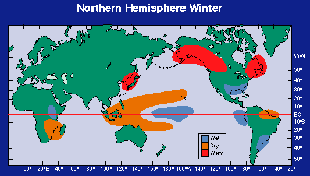
Although El Niño (and La Niña) are generated in the tropical Pacific, their effects are felt all over the world. The process by which Earth system events in one location are related to events in a different part of the world is called teleconnections.
* Because each El Niño event is different, their effects vary. * At temperate latitudes, the effects show up most clearly during the winter.
General impacts:
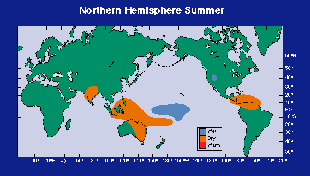
* Heavy rains on islands of Pacific and the west coast of South America * Drought in Australia, Indonesia, and the Philippines * Warmer-than-normal winters in northern US and Canada * Drought in Africa and India * Weakening of Atlantic hurricanes * Greater precipitation in SW United States
Impact on California
El Niño's storm track affects the location of jet streams, which are a major factor in producing winter weather patterns at mid-latitudes. Instead of coming ashore in the Pacific Northwest as usual, the southern jet stream hits California, carrying moisture and storms. In general, the effect of El Niño on California is increased rainfall with accompanying floods, landslides, and coastal erosion. The effects are variable across the state and are more predictable in Southern California.
Effects of El Niño on the Biosphere
* Diminished upwelling of cold, nutrient-rich water upon which phytoplankton depend. This affects fish, birds, etc. * Coral bleaching * Human health: famine, water pollution, diseases such as malaria, dengue fever, and cholera


 Market Data
  Markets


 AI
AI