Iran Uprising: Historic Parallels To Today's Protests
Huffington Post | Stuart Whatley
The massive socio-political movement in Iran, following the highly controversial announcement Saturday declaring Mahmoud Ahmadinejad the victor of that state's presidential election, is reminiscent of a number of other such uprisings during the past few decades -- with some being notably more violent than others. However, it should be noted, the situation in Iran is by no means a "revolution" at this junction, and experts and pundits aplenty agree that such an appellation would be both premature and inappropriate. Nevertheless, a look back is merited, given the situational picture painted by images, video and reports that have made their way out of Iran thus far.
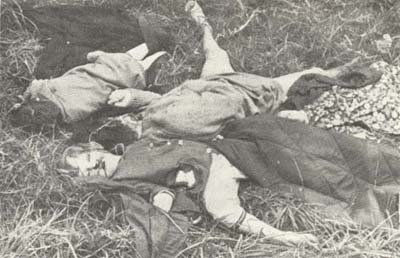
An especially violent historical parallel is Rhodesia's (now Zimbabwe) Second Chimurenga, that began in 1964 and lasted until 1979, which began as a civil disobedience movement, but escalated into civil war against the minority white colonial ruling faction. The eventual result was Zimbabwean independence, with Robert Mugabe taking power over the new Republic of Zimbabwe in 1980. Read more here. http://www.state.gov/r/pa/ei/bgn/5479.htm
Second Chimurenga
A more peaceful example is Portugal's 1974 Carnation Revolution, which saw thousands of civilian dissidents take to the streets to side with military insurgents in the country's two-year-long civil war. The eventual result was an almost bloodless coup whereby an authoritarian regime was supplanted by democracy. Read more here http://www.state.gov/r/pa/ei/bgn/3208.htm
Carnation Revolution
A very obvious parallel to Iran today is of course the Iranian Islamic Revolution of 1979, when demonstrators brought the country to a standstill and forced the US-backed Shah to flee. The result was that the monarchy was replaced with the current Islamic Republican system. Read more here. http://www.state.gov/r/pa/ei/bgn/5314.htm
Islamic Revolution
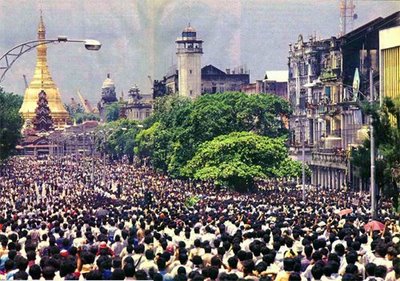
A popular uprising that saw far more bloodshed, however, is the 8888 Uprising in Burma (also known as Myanmar), when on August 8, 1988 student protesters joined with monks, doctors, housewives and even children in a call for democracy. The movement ended with the slaughter of thousands of protesters by the Tatmadaw (Burmese Armed Forces). This is also when opposition leader Aung San Suu Kyi, now on trial, entered politics. Read more here. http://www.abitsu.org/?p=32
8888 Uprising
Another uprising in Burma came in September 2007, when tens of thousands of monks marched through the streets of all major cities to demand political change and better living conditions. The movement, called the Saffron Revolution because of the monks' red robes, grew to include Burma's former student leaders called the '88 generation as well as a new generation of dissidents. The protesters used new media tools like cell phones and Google Chat to send information on their uprising to the international community. However, like in 1988, the army quickly sent in troops, killing dozens if not hundreds of protesters and arresting thousands.
Saffron Revolution
Perhaps the most well-known (despite government efforts) similar example, however, is China's Tiananmen Square protests of 1989. The protests saw upward of one million people -- many of whom were students and intellectuals -- gather in and around Tiananmen square following the death of pro-democracy, pro-capitalism opposition leader Hu Yaobang. The protests grew into a larger outcry against government corruption and ended in a massacre. Read more here. http://www.state.gov/r/pa/ei/bgn/18902.htm
Tiananmen Square Massacre
Less violent and also in 1989 was Czechoslovakia's Velvet Revolution against the ruling Communist party. Thousands of students took to the streets, only to be suppressed by armed police. Their suppression, consequently, led to even larger demonstrations and nationwide strikes, eventually forcing the Communist government to step down. Read more here. http://www.state.gov/r/pa/ei/bgn/3237.htm
Velvet Revolution
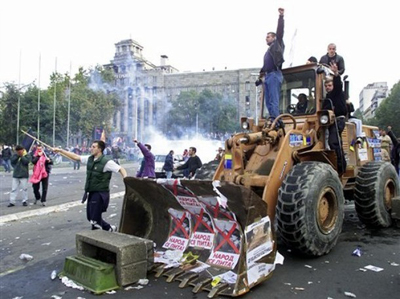
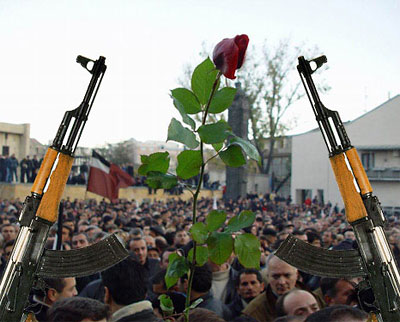
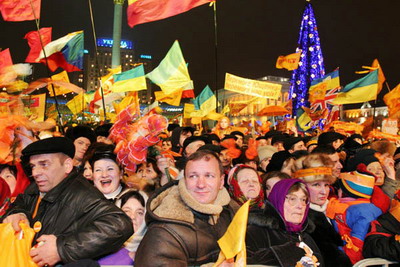
Similarly, what has become known by many as the Colour Revolutions took place in four countries and were characterized by mostly non-violent demonstrations in post-Communist Eurasia. They are: the Bulldozer Revolution in Serbia in 2000; the Rose Revolution in Georgia in 2003; the Orange Revolution in Ukraine in 2004; and the Tulip Revolution (also known as the Pink Revolution) in Kyrgyzstan in 2005.
Bulldozer Revolution
Rose Revolution
Orange Revolution
Tulip Revolution
It should be stressed that no two "revolutions"/uprisings/mass demonstrations can ever be the same. However, reflecting Mark Twain's insight -- that, though history never repeats itself, it can sometimes rhyme -- there are often notable parallels. The Colour Revolutions shared a mostly nonviolent approach centered around a symbolic color (much as we are seeing now in Iran with Mousavi's "Green Wave"). And Tiananmen and Burma were begun by students and young intellectuals from the universities (also similar to the current Iranian demonstrations, though Iran expert Trita Parsi points out that it is far more heterogeneous than that which is assumed).
Historical examples cannot possibly tell us definitively what will happen in Iran as the demonstrations and consequential crackdowns continue. However, past mass movements to effect social and political change are surely serving as motivation and inspiration now, given the reformist mentality of Mousavi and his supporters. Only the coming days will tell us more.
What protests or uprising had an impact on you? Leave your ideas and reflections in the comments below.
Key players in Iran’s disputed election Bureau News .. June 17th, 2009
SUPREME LEADER AYATOLLAH ALI KHAMENEI: Wields control over every major decision either directly or through network of hand-picked loyalists and institutions, including the powerful Revolutionary Guards, the judiciary and intelligence services. Khamenei, 70, succeeded the father of Iran’s 1979 Islamic revolution, Ayatollah Ruhollah Khomeini, after his death in 1989. Before Khomeini died, he made it known that he wanted Khamenei to succeed him as religious leader.
GUARDIAN COUNCIL: Group of 12 experts in Islamic law who approve all candidates for high elected office, certify election results and can veto parliamentary bills considered in violation of Iran’s Islamic constitution. The supreme leader directly picks six council members and has effective veto-power over six other members selected by parliament.
ASSEMBLY OF EXPERTS: A body of 86 clerics elected by direct public vote given the role of overseeing the supreme leader’s performance. But the assembly’s main job is to select a successor after his death.
REVOLUTIONARY GUARDS: An elite military corps of more than 200,000 members that is independent of the regular armed forces and controlled directly by the supreme leader. The Guards oversee vital interests such as oil and natural gas installations and the nation’s missile arsenal.
BASIJ: A powerful volunteer militia directed by the Revolutionary Guards. Basiji played a high-profile role as “morality” police after the Islamic Revolution and now are often used in crackdowns of dissidents. Some estimates place the membership at 10 million, or about 15 percent of the population.
PRESIDENT MAHMOUD AHMADINEJAD: Officially the second-highest ranking official in Iran, but answers to the supreme leader on all major initiatives. Ahmadinejad, a 53-year-old hard-liner and former Tehran mayor, was first elected in June 2005 to a four-year term and was the reported winner in the June 12 vote. The president helps direct economic policies, domestic social programs, education plans and some public works. The president also has some voice in the level of freedoms such as media and political openness, but can be overruled by the ruling clerics using the judiciary or Revolutionary Guard. The president represents Iran in many high-profile international forums and talks, but the ruling clerics set all important foreign and defense policies.
REFORMISTS: Iranians who favor more social freedoms and improved ties with the West. The group, which has a significant number of young people, has rallied around Mir Hossein Mousavi, the pro-reform candidate who claims to have won the June 12 election over Ahmadinejad.
MIR HOSSEIN MOUSAVI: Served as Iran’s last prime minister from 1981 to 1989, when the post was eliminated. Before entering the presidential race, the 67-year-old was widely identified with his leadership role during the hardships and bloodshed of the 1980-88 war with Iraq.
MOHAMMAD KHATAMI: A former reform-minded president who has also alleged vote fraud in the June 12 election. Khatami’s landslide victory in 1997 defeated hard-liners who had ruled since the 1979 Islamic Revolution. The 65-year-old was credited with relaxing some rigid restrictions on cultural and social activities before left office in 2005, but hard-line clerics stifled bulk of his reform program.
HASHEMI RAFSANJANI: Powerful former president and rival of the supreme leader who has alleged vote fraud in the June 12 election. Rafsanjani, 74, is currently head of the Assembly of Experts and another powerful unelected council. He is conservative but also seen as pragmatic, often willing to cut deals with other factions.


 Market Data
  Markets


 AI
AI