Post coverage of the worst terrorist attack on American soil. September 11, 2001
previous: Stress laughed at that remark, when it was later recounted. “Blocher’s Switzerland is people in the mountains making cheese,” he said. “But you also have a Switzerland where people struggle to make ends meet. His party doesn’t represent the Switzerland where I grew up, which is made up of people who came to build the country, literally to build its buildings and streets. The Swiss People’s Party campaigns by using Osama bin Laden in posters about the threat of immigration. For me this is just unfair.”
He added: “Swiss people are not used to speaking their minds. The left wing parties haven’t wanted to lower themselves by reacting to Blocher’s tactics. So I just felt there had to be some reaction.”
The first mention of Osama bin Laden in The New York Times came deep within a 1994 story on Algeria, which described him as "a wealthy Saudi financier who bankrolls Islamic militant groups from Algeria to Saudi Arabia." Two years later, the paper devoted more than 3,000 words to an article about the role of wealthy Saudi businessmen in financing terrorism that focused in large part on Mr. bin Laden. "Officials in several countries, including the United States, say Mr. Bin Laden's money, as well as money he has raised, paid for terrorist acts in Europe, Africa and the Middle East against Americans and other Westerners," the article said. Still, he remained little known to the general public until the bombings of embassies in Africa in 1998 and of the destroyer the U.S.S. Cole in 1999 established him and his group, Al Qaeda, as the preeminent terrorist threat to American interests.
By now, of course, Mr. bin Laden's life story is all too well known: his childhood in one of Saudi Arabia's wealthiest families, his decision to join the Islamic resistance to the Soviet invasion of Afghanistan; the growth of Al Qaeda; the failed American attempts to kill him in the late 1990's; his backing of a plot hatched by a lieutenant, Khalid Sheik Mohammed, that grew into the Sept. 11th attacks; his escape from Tora Bora in the mountains of eastern Afghanistan after an American invasion routed the Taliban, his protectors; his success at evading capture ever since. Mr. bin Laden is generally believed to be hiding in the wilds of the Waziristan region of Pakistan, occasionally issuing new threats against the United States. -- Sept. 10, 2007 http://topics.nytimes.com/topics/reference/timestopics/people/b/osama_bin_laden/index.html
Bin Laden finds recruits in the new Saudi underclass From Richard Beeston in Jeddah July 18, 2003
IT IS probably no surprise that the sprawling suburb of Qarantina does not appear on any of Jeddah’s tourist maps, because the concrete shantytown is an eyesore that the authorities probably wish had never existed.
Just a short distance from this port city’s thriving commercial centre, and a few minutes’ drive by car from the palaces and villas owned by Jeddah’s many multimillionaires, Qarantina, and other slums like it, presents a problem that this oil-rich country refused to recognise until recently. http://www.timesonline.co.uk/tol/news/world/article1059840.ece
Al-Qaida faces recruitment crisis, anti-terrorism experts say
Eight years after 9/11, Osama bin Laden is still at large but willing fighters and ideological support are in short supply
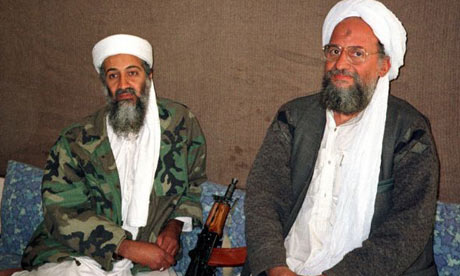
Al-Qaida leader, Osama bin Laden, left, with his second in command, Ayman al-Zawahiri, in 2001.


 Market Data
  Markets


 AI
AI