High Civilian Toll Seen in U.S. Raid in Afghanistan
Afghan men searched for belongings amid the rubble of their destroyed houses after an airstrike, in Farah province on Tuesday.
By CARLOTTA GALL and TAIMOOR SHAH Published: May 6, 2009
KABUL, Afghanistan — American airstrikes that Afghan officials and villagers said Wednesday had killed dozens and perhaps more than 100 civilians in western Afghanistan threaten to stiffen Afghan opposition to the war just as the Obama administration is sending 20,000 more troops to the country.
Villagers looked at the destruction after air strikes in Ganj Abad, in the Bala Buluk district of Afghanistan, on Tuesday. Abdul Malek/Associated Press
A wounded woman from the Bala Baluk district in western Afghanistan on Tuesday in a hospital in Farah Province.
The reports offered a grim backdrop to talks on Wednesday afternoon in Washington between President Obama and President Hamid Karzai of Afghanistan, whose office called the civilian deaths “unjustifiable and unacceptable.”
If the toll is verified, it will make the bombardment, which took place late Monday, almost certainly the single worst case of civilian casualties since the American intervention began in 2001. Secretary of State Hillary Rodham Clinton said there would be a joint investigation and expressed regret, although she cautioned that the full circumstances were not known. Defense Department officials said investigators were looking into the possibility that the Taliban were responsible for the civilian deaths.
One villager reached by telephone, Sayed Ghusuldin Agha, described body parts littered around the landscape. “It would scare a man if he saw it in a dream,” he said.
The civilian toll — more than 2,000 Afghans were killed last year alone, the United Nations says — http://www.nytimes.com/2009/02/19/world/asia/19afghan.html has been a decisive factor in souring many Afghans on the war. The International Committee of the Red Cross confirmed dozens dead so far in this bombing in the western province of Farah.
The American military confirmed that it had conducted airstrikes aimed at the Taliban, but not the number of deaths or their cause.
“We have some other information that leads us to distinctly different conclusions about the cause of the civilian casualties,” said the senior American commander in Afghanistan, Gen. David D. McKiernan. He would not elaborate but said American and Afghan investigators were already on the ground trying to sort out what had happened.
In a phone call played on a loudspeaker on Wednesday to outraged members of the Afghan Parliament, the governor of Farah Province, Rohul Amin, said that as many as 130 civilians had been killed, according to a legislator, Mohammad Naim Farahi. Afghan lawmakers immediately called for an agreement regulating foreign military operations in the country.
“The governor said that the villagers have brought two tractor trailers full of pieces of human bodies to his office to prove the casualties that had occurred,” Mr. Farahi said. “Everyone at the governor’s office was crying, watching that shocking scene.”
Mr. Farahi said he had talked to someone he knew personally who had counted 113 bodies being buried, including those of many women and children. Later, more bodies were pulled from the rubble and some victims who had been taken to the hospital died, he said.
Early reports from American military forensic investigators at the scene raised questions about the Afghan account, according to a United States military official briefed on the inquiry.
Defense Department officials said late Wednesday that investigators were looking into reports from witnesses that the Afghan civilians were killed by grenades hurled by Taliban militants, and that they then drove the bodies around the village claiming the dead were victims of an American airstrike.
The initial examination of the site and of some of the bodies suggested the use of armaments more like grenades than the much larger bombs used by attack planes, said the official, who requested anonymity because the investigation was continuing.
“We cannot confirm the report that the Taliban executed these people,” said Capt. John Kirby, the spokesman for the Joint Chiefs of Staff at the Pentagon. “We don’t know if it’s true, and we also don’t know how many civilians were killed as a result of this operation.”
Col. Greg Julian, a spokesman for the United States military in Kabul, confirmed that United States Special Operations forces had called in close air support in the area on Monday night, including bombs and strafing with heavy machine guns. “There is a heavy insurgent presence there,” he said.
Villagers reached by telephone said many were killed by aerial bombing. Muhammad Jan, a farmer, said fighting had broken out in his village, Shiwan, and another, Granai, in the Bala Baluk district. An hour after it stopped, the planes came, he said.
In Granai, he said, women and children had sought shelter among orchards and in houses. “Six houses were bombed and destroyed completely, and people in the houses still remain under the rubble,” he said, “and now I am working with other villagers trying to excavate the dead bodies.”
He said that villagers, crazed with grief, were collecting mangled bodies in blankets and shawls and piling them on three tractors. People were still missing, he said.
Mr. Agha, who lives in Granai, said the bombing started at 5 p.m. on Monday and lasted until late into the night. “People were rushing to go to their relatives’ houses, where they believed they would be safe, but they were hit on the way,” he said.
Jessica Barry, a spokeswoman for the International Committee of the Red Cross, said the organization had sent a team to the scene on Tuesday. It saw houses destroyed and dozens of bodies.
“It’s not the first time,” Ms. Barry said, but “really this is one of the very serious and biggest incidents for a very long time.” The dead included a volunteer for the Afghan Red Crescent and 13 of his relatives, she said.
She and Afghan officials worry that with the increase of American troops this year, the conflict is likely to intensify. “With more troops coming in, there is a risk that civilians will be more and more vulnerable,” she said.
United States and NATO forces have sought to reduce civilian casualties. After a prominent episode last year in Azizabad, General McKiernan issued a directive in December saying that “all responses must be proportionate.”
The United Nations has said that figures in the first three months of this year have declined from the same period last year. Yet the concern remains.
One Western diplomat said that United States Special Operations forces should stop missions until after presidential elections in August.
The forces have often been blamed for night-time raids on villages, detentions and airstrikes that have brought the population in southern Afghanistan to the point of revolt.
The chairman of the Afghan Parliament, Yunus Qanooni, called on the government to present a draft of a new agreement for the foreign forces in Afghanistan within a week, in order to “legalize their presence.”
Mr. Farahi, the Afghan lawmaker, blamed local officials for calling in the American forces without giving them more guidance. But he saved his most stinging criticism for Mr. Karzai’s government. “People are ready to rise against the government,” he said.
Carlotta Gall reported from Kabul, and Taimoor Shah from Kandahar, Afghanistan. Reporting was contributed by Sangar Rahimi and Thom Shanker from Kabul, and Eric Schmitt and Elisabeth Bumiller from Washington.
one more ........... Buner refugees travel by road as they flee fighting on May 6, 2009 near Swabi, Pakistan. Hundreds of thousands of Pakistani people have fled their homes due to fighting between the Pakistan army and Taliban forces in the Northwest Frontier Province.
Inside the Taliban's besieged Swat fortress as battle rages
The Pakistani army is raining fire on Mingora in an attempt to oust militants from their regional stronghold. Sana ul Haq, inside the town, and Declan Walsh in Islamabad report on a battle whose outcome is crucial to the future of the country
* Sana ul Haq and Declan Walsh * The Observer, Sunday 10 May 2009
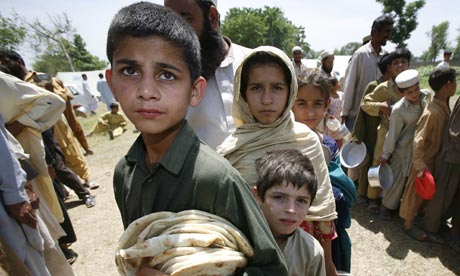
Children line up to receive food in a refugee camp near Mardan. Photograph: Greg Baker/AP
The skiing season at Malam Jabba, Pakistan's only ski resort, is over. Yesterday the pistes echoed with the sound of explosions as fighter jets screamed overhead, part of the Pakistan military's intensifying campaign to dislodge the Taliban from the Swat valley.
An hour's drive away in Mingora, the war-racked valley's main town, the Taliban and army are readying for an urban battle unprecedented in the short history of Pakistan's battle against the Taliban.
Pakistan's prime minister, Yousaf Raza Gilani, yesterday said the army was fighting for "the survival of the country", speaking after an emergency cabinet meeting.
The country's leaders, encouraged by the United States, launched the full-scale offensive in Swat last week in order to halt the spread of Taliban control which had reached districts within 60 miles of the capital, Islamabad. The battle has now been taken to the heart of the north-west region of the country which the Taliban has seized as its power base, and in particular to the beleaguered, frightened town of Mingora.
This once bustling riverside community, nestled between orchards and rolling mountains, has become a hub of the dispossessed and the desperate. Since fighting erupted last Tuesday, following the collapse of a fragile peace deal, tens of thousands of frantic residents have fled, scrambling on to buses, cars and even rickshaws. They left behind a ghost city controlled by the Taliban, under siege from army mortar fire and helicopter-gunship assaults, and tensed in the expectation of an army ground offensive that could lead to urban warfare reminiscent of Russian bids to clear Grozny, Chechnya, in 1999 and 2000.
At Mingora hospital yesterday embattled medics struggled to tend to dozens of residents injured by army shelling and stray gunfire. Riaz Khan, a 36-year-old teacher, his wife and two daughters occupied four of the beds, suffering shrapnel wounds to the arms and legs. His two other daughters were killed by an army mortar last week, he told an Associated Press reporter.
If, as expected, the army launches a major ground offensive to dislodge the Taliban, casualties are expected to rise on all sides. Yesterday the army said it had killed 55 fighters in clashes over the previous 24 hours. The Taliban have laid mines under bridges and along roads across the city. In some cases, wires trail from the bombs into houses where fighters, some of them fresh-faced teenagers, lie in wait.
Others have seized the tallest buildings, mounting rocket launchers on rooftops and taking cover behind water tanks. At the Continental Hotel, a former haunt of local and foreign journalists, the rooms are occupied by fighters, the walls are pocked with bullet holes and many windows have shattered.
Education has always been a hot issue for the Taliban – last January they ordered the closure of all girls' schools – so it is perversely appropriate that the war is being fought between schools. On Thursday, the Observer visited the Pamir building, which until recently housed the Educators School and College. It was filled with Taliban, their weapons trained on a contingent of soldiers located in a deserted school a few streets away.
The target is the last military bastion in the otherwise Taliban-controlled city, and the soldiers hunkered down inside also face fire from a second position: the Mullababa high school, on the far side of a desiccated riverbed. The army says that 15,000 members of the security forces are located in Swat, many under siege in two camps across the river Swat in Kanju village. One is located on the city golf course, where heavy artillery booms from the rutted greens; the other is inside an unused air strip that has been the target of several Taliban assaults.
The Taliban are bringing in fresh fighters, drawing others back from the nearby Buner valley, where they have been engaged in fierce combat for two weeks. To reach Mingora they pass along a mountain road that runs by the White Palace, a luxury hotel where the Queen stayed during a visit to Swat in 1961.
The army has scored some successes. Yesterday the body of Taliban commander Akbar Ali laid unclaimed in no man's land, a day after he was killed. An earlier rocket assault targeted Taliban fighters in a nearby emerald mine a few kilometres from the city. The mine was reopened a few months ago by Sirajuddin, a local commander with a scraggly grey beard whose previous job was as Taliban spokesman. He laid down strict rules – miners would pray at the appointed times, suffer the loss of an arm and a leg if they attempted to steal gemstones, and give one third of their takings to the Beit ul Mal, or Taliban treasury.
The mine provided rich, illicit pickings. One commander told the Observer he had sold half a million rupees (£4,200) worth of emeralds to a trader, one of about two dozen who came to the mine from Peshawar for a weekly auction. But the Taliban gravy train ground to a halt last Thursday when helicopter gunships pounded the mine, killing 35 militants, the army said.
On the plains to the south of the valley, in Mardan and Swabi districts, a humanitarian nightmare is brewing. More than 200,000 people have fled, another 300,000 are on the move or about to leave, according to the UN, adding to another 550,000 people displaced by earlier fighting in the tribal belt and North West Frontier province.
As aid workers rush to erect camps, supplies are limited and tempers quickly fray. Yesterday afternoon a riot briefly erupted in Sheikh Shahzad camp, near Mardan, as angry villagers looted UN supplies. Gilani has appealed for international help with the ballooning humanitarian crisis that affects up to one million people, according to the UN. He promised the army would strive to end the crisis quickly – an outcome that appeared highly unlikely. Not everyone has escaped. An unknown number of besieged residents remain trapped, unwilling or unable to leave their homes. Hunkered behind thin walls they survive with no electricity, dwindling water supplies and in fear of stray bombs and gunfire.
Those left behind fear what lies ahead. Reached by phone Khaista Bibi, 55, a resident, said she had hardly eaten in two days. "The situation seems impossible."


 Market Data
  Markets


 AI
AI