Hawala (also known as hundi) is an informal value transfer system based on performance and honor of a huge network of money brokers which are primarily located in the Middle East, Africa and Asia.
Origins
Hawala has its origins in classical Islamic law, and is mentioned in texts of Islamic jurisprudence as early as the 8th century. Hawala itself later influenced the development of the agency in common law and in civil laws such as the aval in French law and the avallo in Italian law. The words aval and avallo were themselves derived from Hawala. The transfer of debt, which was "not permissible under Roman law but became widely practiced in medieval Europe, especially in commercial transactions", was due to the large extent of the "trade conducted by the Italian cities with the Muslim world in the Middle Ages." The agency was also "an institution unknown to Roman law" as no "individual could conclude a binding contract on behalf of another as his agent." In Roman law, the "contractor himself was considered the party to the contract and it took a second contract between the person who acted on behalf of a principal and the latter in order to transfer the rights and the obligations deriving from the contract to him." On the other hand, Islamic law and the later common law "had no difficulty in accepting agency as one of its institutions in the field of contracts and of obligations in general."
Hawala is believed to have arisen in the financing of long-distance trade around the emerging capital trade centers in the early medieval period. In South Asia, it appears to have developed into a fully-fledged money market instrument, which was only gradually replaced by the instruments of the formal banking system in the first half of the 20th century. Today hawala is probably used mostly for migrant workers' remittances to their countries of origin.
How Hawala Works
In the most basic variant of the hawala system, money is transferred via a network of hawala brokers, or hawaladars. A customer approaches a hawala broker in one city and gives a sum of money to be transferred to a recipient in another, usually foreign, city. The hawala broker calls another hawala broker in the recipient's city, gives disposition instructions of the funds (usually minus a small commission), and promises to settle the debt at a later date.
The unique feature of the system is that no promissory instruments are exchanged between the hawala brokers; the transaction takes place entirely on the honor system. As the system does not depend on the legal enforceability of claims, it can operate even in the absence of a legal and juridical environment. No records are produced of individual transactions; only a running tally of the amount owed by one broker to another is kept. Settlements of debts between hawala brokers can take a variety of forms, and need not take the form of direct cash transactions.
In addition to commissions, hawala brokers often earn their profits through bypassing official exchange rates. Generally the funds enter the system in the source country's currency and leave the system in the recipient country's currency. As settlements often take place without any foreign exchange transactions, they can be made at other than official exchange rates.
Hawala is attractive to customers because it provides a fast and convenient transfer of funds, usually with a far lower commission than that charged by banks. Its advantages are most pronounced when the receiving country applies distortive exchange rate regulations (as has been the case for many typical receiving countries such as Pakistan or Egypt) or when the banking system in the receiving country is less complex (e.g. due to differences in legal environment in places such as Afghanistan, Yemen, Somalia).
Furthermore, the transfers are informal and not effectively regulated by governments, which is a major advantage to customers with tax, currency control, immigration, or other legal concerns. For the same reasons, governments do not favor the system, and accusations have been made in recent years that terrorist funding often changes hands through hawala networks.
Hundis (The Bill of Exchange)
On a similar note, Hundis referred to legal financial instruments evolved on the Indian sub-continent. These were used in trade and credit transactions; they were used as remittance instruments for the purpose of transfer of funds from one place to another. In the era of bygone kings and the British Raj these Hundis served as Travellers Cheques. They were also used as credit instruments for borrowing and as bills of exchange for trade transactions. Technically, a Hundi is an unconditional order in writing made by a person directing another to pay a certain sum of money to a person named in the order. Being a part of an informal system, hundis now have no legal status and were not covered under the Negotiable Instruments Act, 1881. They were mostly used as cheques by indigenous bankers.
Angadia
The word angadia means courier (in Hindi) but it is also used for people who act as Hawaladars within the country (India). These people mostly act as a parallel banking system for businessmen. They charge a commission of around 0.2-0.5% per transaction from transferring money from one city to another.
Hawala after September 11, 2001
After the September 11 terrorist attacks, the American government suspected that some hawala brokers may have helped terrorist organizations to transfer money to fund their activities. The 9/11 Commission Report has since confirmed that the bulk of the funds used to finance the assault were not sent through the hawala system, but rather by inter-bank wire transfer to a SunTrust Bank in Florida, where two of the conspirators had opened a personal account. However as a result of intense pressure from the US authorities, widespread efforts are currently being made to introduce systematic anti-money laundering initiatives on a global scale, the better to curb the activities of the financiers of terrorism and those engaged in laundering the profits of drug smuggling. Whether these initiatives will have the desired effect of curbing such activities has yet to be seen; although a number of hawala networks have been closed down and a number of hawaladars have been successfully prosecuted for money laundering, there is little sign that these actions have brought the authorities any closer to identifying and arresting a significant number of terrorists or drug smugglers.
In November, 2001, the Bush administration froze the assets of Al Barakat, a Somali remittance hawala company used primarily by the large Somali Diaspora. Many of its agents in several countries were initially arrested, though later freed after no concrete evidence against them was found. In August 2006 the last Al Barakat representatives were taken off the U.S. terror list, though some assets remain frozen.
Hawala has been made illegal in some US states and other countries[citation needed] as it is seen to be a form of money laundering and can be used to move wealth anonymously.
See also * Hawala scandal, 1990s political scandal in India The Hawala scandal or hawala scam was an Indian political scandal involving payments allegedly received by politicians through hawala brokers, the Jain brothers. It was a US$18 million dollar bribery scandal that implicated some of the country's leading politicians. There were also alleged connections with payments being channelled to Hizbul Mujahideen militants in Kashmir.
Those accused included Lal Krishna Advani who was then Leader of opposition. He and others were acquitted in 1997 and 1998, partly because the hawala records (including diaries) were judged in court to be inadequate as the main evidence.[2] The failure of this prosecution by the Central Bureau of Investigation was widely criticised. http://en.wikipedia.org/wiki/Hawala_scandal
* Islamic Banking * Riba * The Ripple monetary system is a software project for a peer-to-peer distributed social network service with a monetary honor system based on trust that already exists between people in real-world social networks.
'It's gonna be a bloodbath,' fallen soldier told father By Emanuella Grinberg
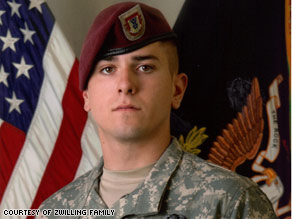
(CNN) -- Cpl. Gunnar Zwilling suspected that his days were numbered last week, while he and his band of brothers in the 173rd Airborne Brigade Combat Team prepared for a mission near Wanat, Afghanistan.
First Lt. Jonathan P. Brostrom surprised his mother, Mary Jo, on Mother's Day at his parents' Hawaii home.
Cpl. Gunnar Zwilling had a bad feeling about his final mission in Afghanistan, said his father, Kurt.
"It's gonna be a bloodbath," he told his father, Kurt Zwilling, on the phone in what would be their last conversation.
Kurt Zwilling braced himself for the worst but held out hope that his son would make it home.
"They were in the most dangerous place on Earth. They were in mortal danger, and there was nothing they could do about it," he said. "But they were soldiers, so they had to do their job."
With just a few days left in their 15-month tour, Gunnar Zwilling and eight of his comrades were killed July 13 in a clash with as many as 200 Taliban militants during a mission to set up an outpost near Wanat. It was the deadliest attack on U.S. troops in Afghanistan in three years.
In the wake of their deaths, the paratroopers have become symbols of what many say is a forgotten war, prompting the U.S. military to draw up plans for putting more troops and resources into the war in Afghanistan.
But before they were national heroes, the young soldiers were beloved sons, brothers, fathers and husbands who were drawn to the Army for different reasons.
Cpl. Jason D. Hovater, 24, of Clinton, Tennessee, joined the Army against his family's wishes with the intention of jump-starting his college education.
U.S. soldiers killed The Defense Department on Wednesday identified the U.S. soldiers killed Sunday when their outpost was overrun in Afghanistan. • 1st Lt. Jonathan P. Brostrom, 24, of Aiea, Hawaii. • Sgt. Israel Garcia, 24, of Long Beach, California. • Cpl. Jonathan R. Ayers, 24, of Snellville, Georgia. • Cpl. Jason M. Bogar, 25, of Seattle, Washington. • Cpl. Jason D. Hovater, 24, of Clinton, Tennessee. • Cpl. Matthew B. Phillips, 27, of Jasper, Georgia. • Cpl. Pruitt A. Rainey, 22, of Haw River, North Carolina. • Cpl. Gunnar W. Zwilling, 20, of Florissant, Missouri. • Pfc. Sergio S. Abad, 21, of Morganfield, Kentucky.
Before joining the service in 2006, Hovater was a "man of God" who divided his time between his father-in-law's landscaping company and playing songs of worship with his family.
"Everything that God deposited in that boy came out when he played the piano," said his mother, Kathy Hovater, who home-schooled her son and his three siblings.
Shortly after Hovater joined his combat team in Italy, his sister said, he called home and said he had made a mistake but was committed to following through with his service.
"He was a dedicated soldier. He did what he was supposed to do because he said if he weren't over there, all that horror and torment that was going on in the war, it would be over here," said his sister, Jessica Davis.
Cpl. Pruitt A. Rainey, 22, of Haw River, North Carolina, also joined the Army as a means to pay for his college education so he could become a teacher, according to Jeff Terrell, the leader of the youth group at the Glen Hope Baptist Church.
"He wasn't going to be a career military guy, but he believed in what he was doing," said Terrell, who knew Rainey since his teen years. "He felt like this would help him. He enjoyed it, but he had other plans.
"He really wanted to teach. He had a good way with kids. Kids flocked to him."
Before joining the Army, Rainey spent his time doing martial arts, a pastime that came naturally to the high school wrestling star, and volunteering for his church's youth ministry.
"The kids loved to jump on him like he was a big bear," Terrell said. "He was a big kid, but he was gentle."
Cpl. Jonathan R. Ayers, 24, of Snellville, Georgia, seemed destined for military service since childhood.
"Jon was just very military since he was 3 years old. He looked at your shoes, and if they weren't perfect, they were no good," said his father, Bill Ayers. "He loved the regiment of the military; he loved order and schedule."
Despite his fastidious tendencies, Ayers' father remembers him as a "cutup" who never failed to amuse with his Jeff Foxworthy impersonation.
"He loved to see people smile and laugh," Ayers said. "He was not a prankster, but he loved to tell jokes."
For the free-spirited Cpl. Matthew B. Phillips, 27, of Jasper, Georgia, the armed forces satisfied a need for adventure while providing a service to his country.
"Matt had a very individualistic personality. He loved living life," said his father, Michael Phillips. "Even though he was afraid at times, in every photo from Afghanistan, he had a big smile on his face."
Phillips, who left a wife behind, died on the same day his sister gave birth to her first son, whom she named after him.
Like other grieving relatives, Phillips' father is attempting to reconcile his emotions with concerns over how the military handled the situation.
"We're torn between incredible pride and anger. We're having a difficult time reconciling that after 14 months, someone who served his country well and paid his dues, why would he be placed in such a perilous situation?" Phillips said.
"There have to be some answers for the family."
Dean Bogar, the grandfather of Cpl. Jason M. Bogar, 25, of Seattle, Washington, said he was troubled by the fact that his grandson was fighting in a Taliban stronghold with little reinforcements.
"That's a big question mark," he said.
Even so, he said, he is proud of his grandson for bringing "valor" to the Bogar name.
"He was a nifty boy. He had a great sense of humor and was outgoing and very bright and upfront with everything," he said. "Kind of clever little imp."
In the beginning, Kurt Zwilling said, his son enjoyed the camaraderie, discipline and excitement that Army life offered.
"Everything he did, he did with a passion," Kurt Zwilling said of his son, who graduated from high school in Florissant, Missouri. "That's why he wanted to join the paratroopers: He wanted to go into the toughest thing and be with the best."
Even as the deteriorating situation in Afghanistan became apparent, Zwilling said, his son applied the same determination to his service that had carried him through high school theater, sports and music.
"He walked into the valley of death and didn't flinch. He knew what was going to happen, and he went anyway. That's bravery," he said.
For the parents of 1st Lt. Jonathan P. Brostrom, 24, of Aiea, Hawaii, knowing that their son died doing what he felt was right brings some sense of closure.
"He was very happy doing what he was doing, and he wouldn't have had it any other way," said his mother, Mary Jo Brostrom. "That was what he wanted to do, defend our freedom and serve with his brothers."
Brostrom's parents said they are grateful they had the chance to spend time with their son in May, when he showed up unexpectedly at their door on Mother's Day with a bouquet of flowers.
He spent the next few weeks surfing, fishing and spending every waking moment with his parents and his 6-year-old son, Jase.
"When he came home, he would wrestle around and try and make us laugh," Mary Jo Brostrom said. "He had a beautiful smile and a beautiful heart, and that's what we'll miss."
Pakistani lorry drivers supplying Nato troops in Afghanistan go on strike December 16, 2008
Pakistani Taleban fighters (pictured) have vowed to step up attacks on supply convoys in the Khyber Pass Jeremy Page in Islamabad
Hamid Karzai: we are fighting the same terrorist disease
An association of Pakistani lorry owners and drivers refused yesterday to resume delivering supplies to foreign troops in Afghanistan after a series of militant attacks on convoys plying the main supply route via the Khyber Pass.
An international shipping company that handles US military supplies through Pakistan also said that there was now "a large backlog of military freight" across the country from Karachi, where the cargo arrives by ship, to the Afghan border, "Clearly the security situation is very difficult," Kevin Speers, a spokesman for Maersk Lines Ltd, told The Times. "Movement through the Pass has been severely restricted."
Pakistani authorities closed the Khyber Pass route nine days ago after militants carried out their biggest attack yet on the supply line, torching around 260 vehicles on two consecutive nights in the northwestern city of Peshawar. Related Links
There were another three smaller attacks in Peshawar last week.
Pakistan's Government re-opened the route yesterday, hoping to restore a lifeline that accounts for about 70 per cent of all supplies to the 67,000 Nato, US and other foreign troops in Afghanistan.
But the Khyber Transport Association, which claims to represent the owners of 3,500 trucks, tankers and other vehicles, said that its members would no longer ply the route because of the recent security problems.
"They're on strike," said a representative of one large Pakistani haulage company that handles supplies to foreign troops in Afghanistan.
"It's because of the security situation," he told The Times. "No trucks crossed the border [yesterday], but we hope to move about 30-40 across tomorrow."
He said that the association represented about 60 per cent of the lorry owner-drivers who work on the route from Peshawar, via the Khyber Pass and the border town of Torkham to Kabul, the Afghan capital.
The strike came as US President George Bush made a surprise visit to Afghanistan, warning of a "long struggle" ahead amid plans to deploy another 20,000 American troops to the country.
Nato and US officials admit that they are concerned about the recent attacks but insist they are insignificant in strategic terms, and have had no effect on military operations in Afghanistan.
"Our logistics people at Nato are aware of the strike," Lieutenant Commander James Gater, a spokesman for Nato-led forces in Afghanistan, told The Times.
"The Khyber Association is on strike but the flow of trucks of Nato equipment across Torkham has been relatively good. This has not had any impact on our operations, nor has this had any impact on our logistical effort. They don't provide the majority of our goods."
However, military analysts and logistics specialists say that a stoppage of more than two weeks could start to affect operations on the ground — as well as hampering efforts to distribute food aid.
Even when the route reopens, the Frontier Corps, which provides armed escorts for the convoys, can take only about 80 trucks a day — 20 at a time — compared to about 300-400 a day before the attacks began.
The Pakistani haulage firms that handle the supplies say that last week's attacks have caused a backlog of more than 1,000 containers in Peshawar, and increased haulage costs by up to 70 per cent.
Truck drivers are now demanding 100,000 Pakistani rupees (£865) to drive from Peshawar to Bagram Airbase, just outside Kabul, compared with 60,000 rupees (£513) before the security problems began last month, sources in the firms say.
Pakistani authorities have now told haulage companies to move their cargo terminals outside Peshawar and into the central province of Punjab, they say.
Most Nato and US supplies are currently shipped into Karachi and driven to Peshawar, where they wait overnight before being driven on to Kabul via the Khyber Pass the next day.
Some are driven from Karachi to southern Afghanistan via the border town of Chaman — but that route is also considered unsafe because of the strong Taleban presence around the southern Afghan city of Kandahar.
Nato and Russian officials told The Times last week that Nato planned to open a new supply route through Russia and the Central Asian states of Uzbekistan and Kazakhstan within two months.
Nato and the United States are also in talks on opening a third route through Georgia, Azerbaijan and Turkmenistan to prevent Russia from gaining a stranglehold on supplies to Afghanistan.
General David McKiernan, commander of Nato-led troops in Afghanistan, revealed on Sunday that most fuel for foreign forces in Afghanistan already comes from Uzbekistan and Turkmenistan.
The US military also confirmed that it receives 350,000 gallons (1.6 million litres) of fuel via Afghanistan's northern neighbours.
"As a military leader I think it's very important to have multiple lines of re-supply, but I would also say that's very important for the future economic interests of Afghanistan as well," General McKiernan said.


 Market Data
  Markets


 AI
AI