E.U. Eases Off on Economic Threats After Russia Suggests Troop Pullback Philip P. Pan Washington Post Foreign Service September 2, 2008
.. slideshow inside ..
MOSCOW, Sept. 1 -- The European Union on Monday backed off threats to impose economic sanctions on Russia but said it would suspend talks on a wide-ranging partnership agreement with Moscow until Russian troops withdraw from positions inside Georgia.
The decision, made at an emergency summit of European leaders in Brussels, followed Russian statements suggesting a renewed willingness to pull back its troops if international forces replaced them and guaranteed the security of the two breakaway Georgian republics at the center of the crisis.
Britain and some Eastern European nations had called for tougher action against Russia after it recognized the two republics, South Ossetia and Abkhazia, as independent states last week. But other nations urged further dialogue with the Kremlin, arguing that trying to isolate Russia would be counterproductive, especially given Europe's dependence on Russian oil and natural gas.
"I think we found an excellent compromise, not going back to business as usual but still making clear that we want to maintain contact with Russia," German Chancellor Angela Merkel told reporters in Brussels after the meeting.
She added that Russian President Dmitry Medvedev told his French counterpart, Nicolas Sarkozy, by telephone that Russia planned to pull its troops back to positions they held before their five-day rout of the Georgian army last month.
The Reuters news agency quoted Merkel as saying that troops were expected to withdraw from Poti and Senaki, two key cities in western Georgia that are still patrolled by Russian soldiers.
The European decision came as huge crowds in Georgia rallied in solidarity against Russia in cities across the country, including Poti. Some of the protests occurred near Russian checkpoints.
In Tbilisi, the capital, residents held hands to form human chains, recalling the 1989 protests in which residents of Lithuania, Latvia and Estonia lined up to protest Soviet occupation. "We came here to show the world that we are a strong nation," said Sophio Jikidze, 31, whose 7-year-old daughter was among the multitude waving red-and-white Georgian flags.
Russia, which sent troops deep into Georgia during the war, has withdrawn from most of the territory it seized but is keeping troops in what it calls security zones around South Ossetia and Abkhazia. The United States and Europe say that violates cease-fire terms, but Russia says the troops are necessary to deter further Georgian attacks and are allowed under the terms.
Before the European leaders' decision, the Russian Foreign Ministry declared that Moscow did not want to keep its forces on Georgian soil beyond Abkhazia and South Ossetia permanently. In a statement, the ministry said that up to 100 European military observers were expected in Georgia soon, and added, "Russia is ready for further enlargement of this number."
The statement also proposed an "international police presence" in the Georgian security zones. "Once the international mechanisms are ready and start to function," it said, Russia would reexamine the need for its troops in the buffer zone.
In tougher remarks, though, Russian Foreign Minister Sergei Lavrov warned the West to stop supporting the government of Georgian President Mikheil Saakashvili, whom Moscow blames for starting the war and has portrayed as an unstable war criminal. "If instead of choosing their national interests and the interests of the Georgian people, the United States and its allies choose the Saakashvili regime, this will be a mistake of truly historic proportions,"Lavrov said.
But European leaders seized on the possible softening of Russia's position on the troop withdrawal and adopted a resolution saying "the urgent issue at the moment is to finalize the international monitoring mechanism . . . so as to replace the Russian additional security measures."
The resolution also condemned Moscow's "disproportionate" military response to Georgia's attempt to seize South Ossetia and the Kremlin's formal recognition of the two republics. It said nothing about economic sanctions, announcing instead a thorough review of Europe's relations with Russia as well as its dependence on Russian energy supplies. Russia supplies as much as a third of the E.U.'s oil and about 40 percent of its natural gas.
"The European Union doesn't want to create an insurmountable obstacle in its relationship with Russia," said Vladimir Chizhov, the Russian ambassador to the European Union. "That is only sensible."
Special correspondent Temo Bardzimashvil in Tbilisi contributed to this report.
Slovakia has called a state of emergency amid plunging gas supply
Russian gas company Gazprom says it has held talks with its Ukrainian counterpart to try to end the row which has disrupted gas supplies in Europe.
The dispute - over prices and new contracts - has led to a suspension of supplies of Russian gas via Ukraine to several European countries
There are no details of the overnight talks between the two chief executives.
They are due in Brussels as the European Union seeks to broker an end to the row.
The meeting between Alexei Miller, chief of Russian gas monopoly Gazprom, and Ukrainian state gas company head Oleh Dubyna is the first sign of possible progress in ending this bitter dispute, the BBC's James Rodgers reports from Moscow, where the meeting took place.
A Gazprom spokesman said only that the two met to try to find a way to deal with what he called the current "critical" situation.
Supplies cut
Some EU states are getting no gas at all or have seen supplies sharply cut.
Ukraine denies Russian accusations that it is stealing gas passing through export pipelines on its territory.
Russia cut gas to Ukraine itself a week ago as a row over allegedly unpaid bills escalated.
The EU depends on Russia for about a quarter of its total gas supplies, some 80% of which are pumped via Ukraine.
Brussels has so far avoided taking sides in the dispute, calling only for deliveries to resume urgently, the BBC's Gabriel Gatehouse reports from Kiev.
Apart from the immediate question of who is to blame, Kiev and Moscow have fundamental disagreements over how much Ukraine owes Russia for last year's gas and how much it should pay this year, our correspondent adds.
Blame game
European Commission President Jose Manuel Barroso has accused Moscow and Kiev of both taking the EU's gas supply "hostage" and urged them to resume supplies immediately.
Graph showing EU's gas supplies Dependence on Russia for gas: 100% dependent on Russia: Latvia, Slovakia, Finland, Estonia More than 80% dependent: Bulgaria, Lithuania, Czech Republic More than 60% dependent: Greece, Austria, Hungary Source: European Council on Foreign Relations, 2006 figures
He said the EU was ready to send monitors to the Russian-Ukrainian border and Ukrainian exit points to determine where gas shortfalls originated.
Ukrainian Deputy Prime Minister Grigory Nemyria placed the blame for the row squarely at Russia's door.
"If there is something to transit of course Ukraine was committed to ensure uninterrupted transit of the Russian gas to Europe but there is no gas at all as we found out today then it speaks for itself,' he told the BBC.
Moscow counters that Kiev is to blame, saying that Ukraine has blocked the pipelines that transport gas further west and has been syphoning off gas for its own use.
Nuclear U-turn?
On Wednesday, heating systems shut down in some parts of central Europe, as outdoor temperatures plunged to -10C or lower.
The list of countries that reported a total halt of Russian supplies via Ukraine included Romania, the Czech Republic, Slovakia, Bosnia-Hercegovina, Bulgaria, Croatia, Greece, Hungary, Macedonia, Serbia, and Austria.
Italy said it had received only 10% of its expected supply.
Many other countries are now tapping strategic reserves, built up to cope with just such a development, says the BBC's central Europe correspondent, Nick Thorpe.
Power stations have been told to switch to fuel oil where possible, while big industrial users have been told to prepare to limit or halt use.
There have also been calls for Soviet-era nuclear plants to be restarted in Bulgaria and Slovakia.
Positive vs negatives??? .. US abrogation of the Anti-Ballistic missile treaty .. the treaty ..
The treaty did, however, allow both sides to build defenses against short- and medium-range ballistic missiles.
Over time, most countries, including the United States until Bush took office, referred to the treaty as a “cornerstone of strategic stability” because it facilitated later agreements limiting and reducing U.S. and Russian deployed strategic nuclear arsenals.
Yet, the treaty’s demise met largely with silence. Even Russia, which had repeatedly criticized the prospect of a U.S. withdrawal, said almost nothing June 13, although the Kremlin announced the next day that it would no longer be bound by the START II offensive arms reduction treaty. ............................ .. Bush and Putin .. Last month, President Vladimir Putin and I agreed that Russia and the United States would look for ways to cooperate on missile defenses, including expanding military exercises, sharing early-warning data, and exploring potential joint research and development of missile defense technologies. Over the past year, our countries have worked hard to overcome the legacy of the Cold War and to dismantle its structures. The United States and Russia are building a new relationship based on common interests and, increasingly, common values. Under the Treaty of Moscow, the nuclear arsenals of our nations will be reduced to their lowest levels in decades. Cooperation on missile defense will also make an important contribution to furthering the relationship we both seek. http://www.armscontrol.org/act/2002_07-08/abmjul_aug02 ////////////////////////////// Russia, U.S.: Putin Tells Bush Where to Put His Missile Defense System .. June 7, 2007
After meeting with U.S. President George W. Bush on June 7 on the sidelines of the G-8 summit, Russian President Vladimir Putin gave a surprising suggestion for U.S. anti-ballistic missile facilities: Rather than locate them in Poland and the Czech Republic, install them in the former Soviet republic of Azerbaijan.
Analysis
In the aftermath of a direct meeting at the G-8 summit with U.S. President George W. Bush on June 7, Russian President Vladimir Putin said Russia would not feel as threatened if the planned U.S. anti-ballistic missile facilities were located south of Russia rather than to its west.
The United States asserts that its ballistic missile defense (BMD) program is not about deterring the Russians, and that its proposed location in Poland and the Czech Republic was chosen because those states are directly on the flight path from Iran.
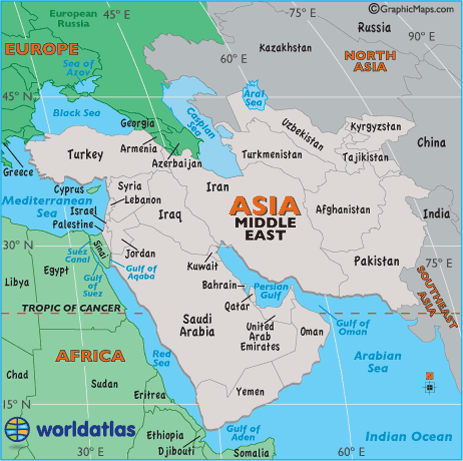
In the Russian mind, any new weapons system in Europe -- particularly the BMD interceptors and radars the United States plans to station in Poland and the Czech Republic -- is a direct threat to the strength of the Russian deterrent. Extending this logic, Putin suggested the United States instead station its facility in Azerbaijan -- a former Soviet republic directly abutting northwest Iran. If the United States were to take the offer, Putin said, Moscow would drop its opposition to the U.S. plans.
Technically, an Azerbaijan-focused system would be far superior to a Poland-focused system. It is far easier to shoot down a ballistic missile in its boost phase; any interceptor based in Poland would have to strike an Iranian missile once it had already ditched its lower stages, and likely after it had already left the atmosphere -- meaning that, among other things, it would be much smaller and moving much faster than during its boost phase. Speeding matters along could be possible cooperation with the Americans on a pre-existing Soviet-era radar already in Azerbaijan that is still Russian-operated.
Most critically, since BMD radars need to be closer to the target than any interceptors, any BMD system based in Azerbaijan would be pointed away from Russia. In theory, a Polish/Czech system could counter a limited Russian strike against Europe.
So, from a purely technical and military stance, Putin's proposal is both logical and constructive. And if the United States truly wants an effective anti-Iranian system in place, there is no better place in the world than southern Azerbaijan.
Geopolitically, it is a shot out of the blue.
The Russian government has long fought U.S. efforts to encroach into what the Russians think of as their near abroad: the former Soviet states themselves. Giving the Americans a green light to build interceptor and radar facilities deep in the Caucasus -- complete with U.S. military personnel -- could result in the ceding of that entire region to the West. Sure, a Russian attack against any such facilities would be child's play, but the mere thought of having hard NATO military assets in Azerbaijan is a geopolitical sea change.
It soothes frayed nerves over a possible confrontation within NATO, it eases Western-Russian relations -- which have not been this cold since before Mikhail Gorbachev -- and it lights the way to the most functional missile defense possible. By any measure, this is a deal that is far too good for the United States to even consider passing up.
Except, perhaps, at the current moment.
Russian approval of such a deployment -- even if it never happens -- burns one of the most effective geopolitical bridges that the Russians have had in the post-Cold War era: its relations with Iran. Any BMD system in Azerbaijan could only be about the Iranians, and the Russians not just taking an active role but actually instigating the plan will leave Tehran's jaw flat on the floor.
Right now, the Americans and the Iranians are in the final stages of piecing together a deal on the future of Iraq that would allow the United States to draw down its forces and remove itself from day-to-day security operations. However, if the United States starts installing anti-missile weaponry on Iran's northern border, the strategic calculus for Iran changes dramatically. No longer would the United States be on the ropes, and no longer would Iran feel that the United States had no choice but to sue for terms. Iran may well now have no choice but to keep the United States pinned down in Iraq.
Russia arguably has the most to lose from a U.S.-Iranian deal over the future of Iraq, as such a deal would revitalize Iranian power and give the Americans a free hand to act elsewhere (read: in Russia's sphere of influence). The Azerbaijan BMD offer, while risking ceding a region directly abutting Russia, could well be just the ticket to derail the Iranian-American understanding and keep the Iraq war raging. http://www.stratfor.com/russia_u_s_putin_tells_bush_where_put_his_missile_defense_system //////////////////////////// .. Azerbaijan vs Poland .. //////////////////////////// .. Bush and Putin and Obama .. In its full-throttle pursuit of systems to protect against possible ballistic missile attacks, the Bush administration adopted a "spiral development" strategy. That approach entails fielding technologies, even if rudimentary, as soon as practical and then updating them incrementally. The general rationale was that to have something was better than nothing.
Obama's public statements suggest his administration will take another approach. Although saying he supports missile defense, Obama stresses that systems must be affordable and proven and not siphon money away from efforts to deal with more prevalent threats.
To the chagrin of top Polish officials, Obama has indicated that plans and systems already underway will not be exempted from scrutiny. Polish President Lech Kaczyński initially claimed after a phone conversation with Obama that the president-elect had said the proposed deployment of 10 missile interceptors to Poland would proceed. An Obama aide told the press that no such assurance had been given, reiterating previous statements that deployment of systems depended on them being "proved to be workable." Congress has already proscribed procurement and deployment of the Polish-based interceptors until they are certified by the secretary of defense as passing operationally realistic testing.
The interceptors expected to be stationed in Poland have yet to be flight-tested. Prototypes of the interceptors-a two-stage version of the three-stage silo-based interceptors already deployed by the United States in Alaska and California-are supposed to be flight-tested next year and then fired against targets twice in 2010. Models of the roughly two dozen fielded U.S. interceptors have scored seven hits in 12 intercept attempts since 1999.
Government officials from Poland and the Czech Republic, where a missile tracking radar is slated to be deployed, are urging Obama not to abandon the plan, particularly in light of steady Russian threats. Witold Waszczykowski, deputy head of Poland's National Security Bureau, told the Polish paper Nasz Dziennik that "if a decision to discontinue this program is made under pressure from Russia, it would be a political defeat." The Kremlin has reacted angrily to the U.S. plan, charging it targets Russia, not Iran, as the Bush administration claims.
Polish Foreign Minister Radek Sikorski delivered a Nov. 19 speech in Washington declaring that "naturally, we would like to see this project to be continued." Sikorski, who asserted that the "Russian leadership does not hide from the fact of its preference for pushing America out of Europe," made clear that Poland views the deployment as a means to ward off Russia by drawing closer to the United States, particularly as Sikorski contends that "NATO has neglected us." Poland joined the alliance in 1999, but Sikorski complained that his country only has "one unfinished conference center" to show for the move.


 Market Data
  Markets


 AI
AI