Beneath Booming Cities, China’s Future Is Drying Up By JIM YARDLEY September 28, 2007
SHIJIAZHUANG, China — Hundreds of feet below ground, the primary water source for this provincial capital of more than two million people is steadily running dry. The underground water table is sinking about four feet a year. Municipal wells have already drained two-thirds of the local groundwater.
Above ground, this city in the North China Plain is having a party. Economic growth topped 11 percent last year. Population is rising. A new upscale housing development is advertising waterfront property on lakes filled with pumped groundwater. Another half-built complex, the Arc de Royal, is rising above one of the lowest points in the city’s water table.
“People who are buying apartments aren’t thinking about whether there will be water in the future,” said Zhang Zhongmin, who has tried for 20 years to raise public awareness about the city’s dire water situation.
For three decades, water has been indispensable in sustaining the rollicking economic expansion that has made China a world power. Now, China’s galloping, often wasteful style of economic growth is pushing the country toward a water crisis. Water pollution is rampant nationwide, while water scarcity has worsened severely in north China — even as demand keeps rising everywhere.
China is scouring the world for oil, natural gas and minerals to keep its economic machine humming. But trade deals cannot solve water problems. Water usage in China has quintupled since 1949, and leaders will increasingly face tough political choices as cities, industry and farming compete for a finite and unbalanced water supply.
One example is grain. The Communist Party, leery of depending on imports to feed the country, has long insisted on grain self-sufficiency. But growing so much grain consumes huge amounts of underground water in the North China Plain, which produces half the country’s wheat. Some scientists say farming in the rapidly urbanizing region should be restricted to protect endangered aquifers. Yet doing so could threaten the livelihoods of millions of farmers and cause a spike in international grain prices.
For the Communist Party, the immediate challenge is the prosaic task of forcing the world’s most dynamic economy to conserve and protect clean water. Water pollution is so widespread that regulators say a major incident occurs every other day. Municipal and industrial dumping has left sections of many rivers “unfit for human contact.”
Cities like Beijing and Tianjin have shown progress on water conservation, but China’s economy continues to emphasize growth. Industry in China uses 3 to 10 times more water, depending on the product, than industries in developed nations.
“We have to now focus on conservation,” said Ma Jun, a prominent environmentalist. “We don’t have much extra water resources. We have the same resources and much bigger pressures from growth.”
In the past, the Communist Party has reflexively turned to engineering projects to address water problems, and now it is reaching back to one of Mao’s unrealized plans: the $62 billion South-to-North Water Transfer Project to funnel more than 12 trillion gallons northward every year along three routes from the Yangtze River basin, where water is more abundant. The project, if fully built, would be completed in 2050. The eastern and central lines are already under construction; the western line, the most disputed because of environmental concerns, remains in the planning stages.
The North China Plain undoubtedly needs any water it can get. An economic powerhouse with more than 200 million people, it has limited rainfall and depends on groundwater for 60 percent of its supply. Other countries, like Yemen, India, Mexico and the United States, have aquifers that are being drained to dangerously low levels. But scientists say those below the North China Plain may be drained within 30 years.
“There’s no uncertainty,” said Richard Evans, a hydrologist who has worked in China for two decades and has served as a consultant to the World Bank and China’s Ministry of Water Resources. “The rate of decline is very clear, very well documented. They will run out of groundwater if the current rate continues.”
Outside Shijiazhuang, construction crews are working on the transfer project’s central line, which will provide the city with infusions of water on the way to the final destination, Beijing. For many of the engineers and workers, the job carries a patriotic gloss.
Yet while many scientists agree that the project will provide an important influx of water, they also say it will not be a cure-all. No one knows how much clean water the project will deliver; pollution problems are already arising on the eastern line. Cities and industry will be the beneficiaries of the new water, but the impact on farming is limited. Water deficits are expected to remain.
“Many people are asking the question: What can they do?” said Zheng Chunmiao, a leading international groundwater expert. “They just cannot continue with current practices. They have to find a way to bring the problem under control.”
A Drying Region
On a drizzly, polluted morning last April, Wang Baosheng steered his Chinese-made sport utility vehicle out of a shopping center on the west side of Beijing for a three-hour southbound commute that became a tour of the water crisis on the North China Plain.
Mr. Wang travels several times a month to Shijiazhuang, where he is chief engineer overseeing construction of three miles of the central line of the water transfer project. A light rain splattered the windshield, and he recited a Chinese proverb about the preciousness of spring showers for farmers. He also noticed one dead river after another as his S.U.V. glided over dusty, barren riverbeds: the Yongding, the Yishui, the Xia and, finally, the Hutuo. “You see all these streams with bridges, but there is no water,” he said.
A century or so ago, the North China Plain was a healthy ecosystem, scientists say. Farmers digging wells could strike water within eight feet. Streams and creeks meandered through the region. Swamps, natural springs and wetlands were common.
Today, the region, comparable in size to New Mexico, is parched. Roughly five-sixths of the wetlands have dried up, according to one study. Scientists say that most natural streams or creeks have disappeared. Several rivers that once were navigable are now mostly dust and brush. The largest natural freshwater lake in northern China, Lake Baiyangdian, is steadily contracting and besieged with pollution.
What happened? The list includes misguided policies, unintended consequences, a population explosion, climate change and, most of all, relentless economic growth. In 1963, a flood paralyzed the region, prompting Mao to construct a flood-control system of dams, reservoirs and concrete spillways. Flood control improved but the ecological balance was altered as the dams began choking off rivers that once flowed eastward into the North China Plain.
The new reservoirs gradually became major water suppliers for growing cities like Shijiazhuang. Farmers, the region’s biggest water users, began depending almost exclusively on wells. Rainfall steadily declined in what some scientists now believe is a consequence of climate change.
Before, farmers had compensated for the region’s limited annual rainfall by planting only three crops every two years. But underground water seemed limitless and government policies pushed for higher production, so farmers began planting a second annual crop, usually winter wheat, which requires a lot of water.
By the 1970s, studies show, the water table was already falling. Then Mao’s death and the introduction of market-driven economic reforms spurred a farming renaissance. Production soared, and rural incomes rose. The water table kept falling, further drying out wetlands and rivers.
Around 1900, Shijiazhuang was a collection of farming villages. By 1950, the population had reached 335,000. This year, the city has roughly 2.3 million people with a metropolitan area population of 9 million.
More people meant more demand for water, and the city now heavily pumps groundwater. The water table is falling more than a meter a year. Today, some city wells must descend more than 600 feet to reach clean water. In the deepest drilling areas, steep downward funnels have formed in the water table that are known as “cones of depression.”
Groundwater quality also has worsened. Wastewater, often untreated, is now routinely dumped into rivers and open channels. Mr. Zheng, the water specialist, said studies showed that roughly three-quarters of the region’s entire aquifer system was now suffering some level of contamination.
“There will be no sustainable development in the future if there is no groundwater supply,” said Liu Changming, a leading Chinese hydrology expert and a senior scholar at the Chinese Academy of Sciences.
A National Project
Three decades ago, when Deng Xiaoping shifted China from Maoist ideology and fixated the country on economic growth, a generation of technocrats gradually took power and began rebuilding a country that ideology had almost destroyed. Today, the top leaders of the Communist Party — including Hu Jintao, China’s president and party chief — were trained as engineers.
Though not members of the political elite, Wang Baosheng, the engineer on the water transfer project, and his colleague Yang Guangjie are of the same background. This spring, at the site outside Shijiazhuang, bulldozers clawed at a V-shaped cut in the dirt while teams of workers in blue jumpsuits and orange hard hats smoothed wet cement over a channel that will be almost as wide as a football field.
“I’ve been to the Hoover Dam, and I really admire the people who built that,” said Mr. Yang, the project manager. “At the time, they were making a huge contribution to the development of their country.”
He compared China’s transfer project to the water diversion system devised for southern California in the last century. “Maybe we are like America in the 1920s and 1930s,” he said. “We’re building the country.”
China’s disadvantage, compared with the United States, is that it has a smaller water supply yet almost five times as many people. China has about 7 percent of the world’s water resources and roughly 20 percent of its population. It also has a severe regional water imbalance, with about four-fifths of the water supply in the south.
Mao’s vision of borrowing water from the Yangtze for the north had an almost profound simplicity, but engineers and scientists spent decades debating the project before the government approved it, partly out of desperation, in 2002. Today, demand is far greater in the north, and water quality has badly deteriorated in the south. Roughly 41 percent of China’s wastewater is now dumped in the Yangtze, raising concerns that siphoning away clean water northward will exacerbate pollution problems in the south.
The upper reaches of the central line are expected to be finished in time to provide water to Beijing for the Olympic Games next year. Mr. Evans, the World Bank consultant, called the complete project “essential” but added that success would depend on avoiding waste and efficiently distributing the water.
Mr. Liu, the scholar and hydrologist, said that farming would get none of the new water and that cities and industry must quickly improve wastewater treatment. Otherwise, he said, cities will use the new water to dump more polluted wastewater. Shijiazhuang now dumps untreated wastewater into a canal that local farmers use to irrigate fields.
For years, Chinese officials thought irrigation efficiency was the answer for reversing groundwater declines. Eloise Kendy, a hydrology expert with The Nature Conservancy who has studied the North China Plain, said that farmers had made improvements but that the water table had kept sinking. Ms. Kendy said the spilled water previously considered “wasted” had actually soaked into the soil and recharged the aquifer. Efficiency erased that recharge. Farmers also used efficiency gains to irrigate more land.
Ms. Kendy said scientists had discovered that the water table was dropping because of water lost by evaporation and transpiration from the soil, plants and leaves. This lost water is a major reason the water table keeps dropping, scientists say.
Farmers have no choice. They drill deeper.
Difficult Choices Ahead
For many people living in the North China Plain, the notion of a water crisis seems distant. No one is crawling across a parched desert in search of an oasis. But every year, the water table keeps dropping. Nationally, groundwater usage has almost doubled since 1970 and now accounts for one-fifth of the country’s total water usage, according to the China Geological Survey Bureau.
The Communist Party is fully aware of the problems. A new water pollution law is under consideration that would sharply increase fines against polluters. Different coastal cities are building desalination plants. Multinational waste treatment companies are being recruited to help tackle the enormous wastewater problem.
Many scientists believe that huge gains can still be reaped by better efficiency and conservation. In north China, pilot projects are under way to try to reduce water loss from winter wheat crops. Some cities have raised the price of water to promote conservation, but it remains subsidized in most places. Already, some cities along the route of the transfer project are recoiling because of the planned higher prices. Some say they may just continue pumping.
Tough political choices, though, seem unavoidable. Studies by different scientists have concluded that the rising water demands in the North China Plain make it unfeasible for farmers to continue planting a winter crop. The international ramifications would be significant if China became an ever bigger customer on world grain markets. Some analysts have long warned that grain prices could steadily rise, contributing to inflation and making it harder for other developing countries to buy food.
The social implications would also be significant inside China. Near Shijiazhuang, Wang Jingyan’s farming village depends on wells that are more than 600 feet deep. Not planting winter wheat would amount to economic suicide.
“We would lose 60 percent or 70 percent of our income if we didn’t plant winter wheat,” Mr. Wang said. “Everyone here plants winter wheat.”
Another water proposal is also radical: huge, rapid urbanization. Scientists say converting farmland into urban areas would save enough water to stop the drop in the water table, if not reverse it, because widespread farming still uses more water than urban areas. Of course, large-scale urbanization, already under way, could worsen air quality; Shijiazhuang’s air already ranks among the worst in China because of heavy industrial pollution.
For now, Shijiazhuang’s priority, like that of other major Chinese cities, is to grow as quickly as possible. The city’s gross domestic product has risen by an average of 10 percent every year since 1980, even as the city’s per capita rate of available water is now only one thirty-third of the world average.
“We have a water shortage, but we have to develop,” said Wang Yongli, a senior engineer with the city’s water conservation bureau. “And development is going to be put first.”
Mr. Wang has spent four decades charting the steady extinction of the North China Plain’s aquifer. Water in Shijiazhuang, with more than 800 illegal wells, is as scarce as it is in Israel, he said. “In Israel, people regard water as more important than life itself,” he said. “In Shijiazhuang, it’s not that way. People are focused on the economy.”
Jake Hooker contributed reporting from north China. Huang Yuanxi contributed research from Beijing.
A group of ancient tombs was discovered in Shangzhuang County of Fengcheng City in Jiangxi Province, exciting archaeologists. Unfortunately they only found two broken pieces of porcelain after thoroughly searching the tombs because almost all of the sites had been robbed.
Just as they were thinking about giving up the search, having discovered that the last tomb they checked was empty of relics, the scientists located a new, hidden tomb linked to the empty one via a side grave room. At first when they perceived the big hole, they thought that it was a tunnel dug by tomb robbers.
But when they explored through the tunnel, they found a well-protected tomb with more than a dozen exquisite celadon pieces of porcelain laid inside a coffin. Actually it is quite rare to find these kinds of connected twin tombs. Experts have guessed that they were a set built specifically for a husband and wife.
The archaeologists explained that ancient people spent a great amount of time building their tombs while alive. Construction could last from several months to dozens of years. These two tombs were apparently built together; coffins were placed inside after the owners died.
Shivered stones surrounded the newly discovered coffin. Over time these stones formed a protective layer for the coffin.
Archaeologists said that the empty tomb linked to this one was not definitely robbed. Since shivered stones protected the inner tomb and the outer tomb did not have that kind of shield, and because they couldn't find the tunnel dug by robbers, archaeologists now surmise that the host of the tomb may have died in a place far away from his hometown after the tomb was finished.
There are many pieces of celadon porcelain in the well-protected, inner tomb, including an ink stone, calyx, plate, spittoon, fruit plate, pot, bowl, cup and counterweight. This ceramic ware, although some is broken, displays a glaze technique of a high level so it's quite valuable.
A porcelain pot, with two circle veins on its neck and a concave vein on the bottom, was found in the tomb. This is the first time a pot of this shape has been found.
A porcelain counterweight was also discovered in the tomb. Counterweights are not rare in China, but a celadon one is really a new find in China's archaeology history.
Now that the excavation work has finished, archaeologists are starting to study and repair these celadon pieces. The site is under government protection. It's the first time such a large scale group of tombs around Fengcheng City has been found.
This porcelain counterweight, the first of its kind in Jiangxi, was found in the tomb.
A porcelain vessal, with two circle veins on its neck, was discovered in the tomb. This is the first time a pot of this shape has been found in the province.
Global warming brings big problems to Giant's Causeway
* Matthew Weaver and agencies * guardian.co.uk, * Tuesday January 22 2008
Coastal erosion in Northern Ireland
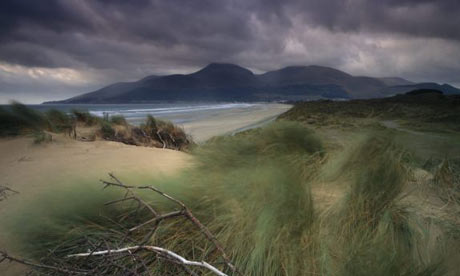
At Murlough Nature Reserve in County Down wetter winters and drier summers could put important dune and heath plants at risk as invasive scrub thrives Photograph: Paul Wakefield/National Trust
Northern Ireland's biggest tourist attraction, the Giant's Causeway, could fall victim to global warming, the National Trust warned today.
The province's only World Heritage site is threatened by rising water levels and coastal erosion, says a report for the trust, which is the guardian of the site.
The report, by Queen's University and the University of Ulster, warned that part of Middle and Little Causeway could be under water for much of the winter by the end of the century.
The Grand Causeway could also suffer serious erosion by 2080 and new approach routes for visitors would probably have to be built, it said.
In the shorter term, predicted stormier weather at the site over the next decade would require greater safety measures to be introduced to stop people falling from the cliff next to the famous octagonal basalt stones.
In the medium term – from 2050 to 2080 – many more of the stones will be under the waves.
The causeway is one of three of the trust's properties in the province that are threatened by water levels which could rise by a metre by the end of the century, the charity said.
Murlough national nature reserve and Strangford Lough, both in County Down, are also at risk from coastal erosion and flooding.
At Strangford Lough, sea levels are predicted to rise by 25cm by 2050 with a "worst case scenario" prediction of a one-metre rise by the turn of the century.
The Lough, which is internationally important for its birds and other wildlife, is designated a marine nature reserve and a special area of conservation.
The greater the sea level rise, the greater the loss of its important tidal mud flats. This would have a significant impact on the availability of food for the tens of thousands of Brent geese and other birds that winter there.
As more of the Lough's islands disappear under water, there would also be a detrimental impact on the summer breeding of seabirds, including terns, ringed plovers and cormorants, and the population of seals.
The Murlough reserve could see 50-400 metres of the existing dune frontage eroded away, together with a serious loss of vegetation.
The report, Shifting Shores: Living with a Changing Coastline, also highlights the challenges potentially facing all of Northern Ireland's coastline in decades to come.
Likely changes in Northern Ireland's climate highlighted in the report include: • Warmer annual temperatures • Wetter winters and drier summers • Sea level rises of between 85 and 100 cm by 2100 • Increased frequency of extreme storm surges and of extreme waves.
The National Trust director for Northern Ireland, Hilary McGrady, called for government help to protect the coastline.
"Our planning system and, in particular, development plans and planning policy statements must take predicted coastal change into account to ensure coastal landscapes are adequately protected in the future," she said.
Professor Julian Orford, from Queen's University, who led the research, said: "Northern Ireland's coastline will be a changing, and indeed challenging, environment in the 21st century. The National Trust and many other bodies must prepare now to meet the uncertain challenges ahead."


 Market Data
  Markets


 AI
AI