Labor and Coalition vow PBS will not be bargained over in US trade war
"Taxes are not tariffs, yet Trump's WH claims they are to justify Trump's fetish for tariffs. US president Trump promises ‘reciprocal tariffs’ to VAT [...]... VAT is a consumer tax and, in any event, it is in line with World Trade Organization (WTO) rules, in that it applies indiscriminatory to products irrespective of whether these are imported or locally produced. Second, the idea that the US may apply different tariffs to the same product depending on its provenance, breaches the WTO's ‘most favoured nation’ principle, which requires members to offer the same tariff to all WTO members, other than in specific circumstances such as where a bilateral or plurilateral comprehensive trade agreement is in place or where trade-defence measures are justified under WTO rules – which won't be the case here.” P - “There's an additional concern in that, if the US proceeds with its threat to raise tariffs on this basis, the EU is likely to retaliate one way or another. Depending on the exact measures that the US takes, the EU could seek to rely on its Anti-Coercion Instrument (ACI) to impose targeted retaliatory measures that hurt for example, US strategic industries and swing states,” he said."
By political reporter Jake Evans 19 hours ago
Anthony Albanese and Peter Dutton have both said the PBS will not be touched as a United States trade campaign continues. (ABC News: Matt Roberts)
In short:
Labor and the Coalition offer a full-throated defence of the PBS after it was put in the spotlight for a next round of tariffs by US drug companies.
Both major parties have vowed it will not be bargained on, even if tariffs are imposed on Australian pharmaceuticals.
What's next?
US President Donald Trump is expected to decide on a further round of tariffs next month.
The prime minister and opposition leader have presented a united front against a US drug company attack on the PBS, vowing the medicines subsidy scheme will never become a bargaining chip in US President Donald Trump's ongoing tariff campaign.
The powerful pharmaceutical lobby in the United States has targeted Australia's Pharmaceutical Benefits Scheme in a letter to the White House as Mr Trump considers a next round of tariffs on goods.
The industry's lobbying body, PhRMA, urged Mr Trump to slap tariffs on Australian pharmaceutical imports to the US as a "reciprocal" measure, claiming the PBS subsidies are an "egregious and discriminatory" trade instrument.
Under the shadow of an imminent federal election campaign, the major parties have both rushed to the defence of the PBS, which knocks hundreds and even thousands of dollars off the cost of many medications for Australians, saying there is no way that PhRMA will get its wish to "eliminate" the PBS.
Prime Minister Anthony Albanese said the PBS was "not for sale", and Coalition frontbencher James Paterson told Sky News the scheme was "sacrosanct" and "not on the table" in any negotiations on tariffs.
"What we're going to do is continue to advocate for Australia's national interests, not the interests of big pharma," Mr Albanese said on Thursday morning.
Speaking at the Lowy Institute, Opposition Leader Peter Dutton said the PBS was "the envy of the world".
"We will fight against any big drug company imposing tariffs," Mr Dutton said.
In a sign that neither party will shy away from continued investment into the PBS, Mr Albanese on Thursday promised a further $690 million over four years to lower the price for PBS listed medications from $31.60 to $25, which the Coalition has promised to match.
Big pharma revives decades old war on PBS
More than 20 years ago the pharmaceutical giants lobbied against the PBS during Australia's free trade negotiations with the US, with then-health minister Tony Abbott saying the drug companies did not like the PBS because it kept down the price of medicines.
The price the government pays to purchase medications to be listed on the PBS is negotiated between the Department of Health and the supplier of the drug — with rules that set the maximum wholesale price of a drug or any comparable to it, that mean those drugs are generally sold to Australia much cheaper than in other major markets.
Drug companies argue higher prices are necessary to fund further medicines research, and that Australia is enjoying the benefits of that research without helping to pay for it; though the companies are not short on cash — a US Senate inquiry last year found the 10 largest American drug companies made more than $US112 billion ($176 billion) in profits in 2022.
Even during those negotiations two decades ago, the Australian government argued that the PBS was not a trade instrument because it did not discriminate between whether drugs were produced in America or Australia.
The former Howard government also faced a campaign against the PBS by pharmaceutical companies. (AAP: Alan Porritt)
On Thursday morning, Health Minister Mark Butler recalled that dispute, saying just like then, the government would ensure the PBS was protected.
"This is not a new position from big pharma in the US, obviously they want to sell their medicines at top dollar, we want to make them cheaper, so there is an inherent conflict there," Mr Butler told SKy News.
Mr Dutton said the protection of the PBS in free trade agreements had been "paramount", and would continue to be in future trade negotiations.
The health minister said Australia would seek an exemption if tariffs were imposed, and would again make the case that America had a trade surplus with Australia on pharmaceuticals — an argument that failed to secure Australia an exemption from US tariffs on steel and aluminium imposed last week.
Mr Butler said Australia sells about $2 billion worth of pharmaceuticals to the US, while the US sells about $3.5 billion to Australia.
Mr Trump has signalled pharmaceuticals among other goods are in his sights for a next round of tariffs to be decided next month, but has not confirmed whether the sector will be subject to import duties.
A tariff on Australian pharmaceuticals would impose an additional cost at the US border, paid by the purchaser of those products.
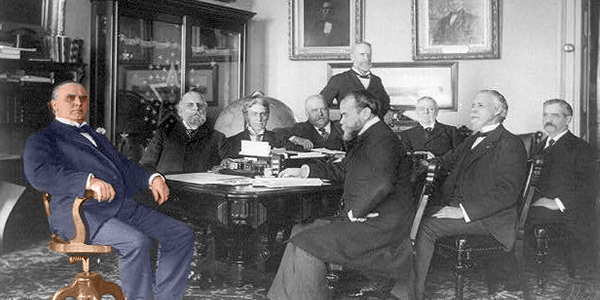
Att: B402 - President McKinley’s Tariff Mishap Could Be a Warning Sign for Trump’s Trade War
Related: Did the market crash today? Tariffs have worked well for america....look up McKinley s speech the the day before he was killed The trick is not to use them too long......They may be the only hope to even out the class warfare in the US and that's why they were used before https://investorshub.advfn.com/boards/read_msg.aspx?message_id=175984540
LOLOL To even out the class warfare. If there is worth at all in that claim of yours, the tariffs didn't work to cut the class warfare in the long run, did they.
"Taxes are not tariffs, yet Trump's WH claims they are to justify Trump's fetish for tariffs. US president Trump promises ‘reciprocal tariffs’ to VAT"
Author: mary Date Posted: February 28, 2025 Read time: 36 min
More than a century ago, then-Representative William McKinley pursued an aggressive tariff strategy that sought to protect American industry and reduce reliance on foreign imports. The McKinley Tariff Act of 1890 raised import duties to an average of 50%, one of the highest levels in U.S. history.
The logic was simple: If foreign goods were more expensive, Americans would buy domestic products, fueling economic expansion.
But the results were not so simple. Instead of strengthening America’s trade position, the tariff triggered retaliation from other nations. Prices rose, particularly for middle- and lower-income Americans, and political backlash followed. In the 1890 midterm elections, voters revolted: McKinley lost his seat, and Democrats took control of the House.
At the time, some Republicans dreamed of annexing Canada, believing that the economic pressure would push Canadians to seek statehood. Instead, the tariff had the opposite effect—Canadian nationalists rallied against what they saw as economic coercion. The country deepened its ties with the British Empire, reinforcing the very trade barriers the U.S. sought to disrupt.
Tariffs, Trade Deficits and Consumer Confidence
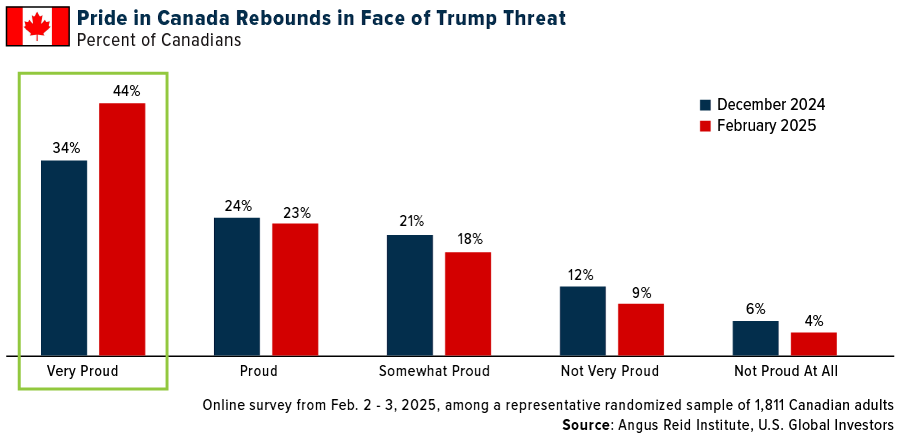
Fast-forward to today, and we’re seeing some eerily similar trends, starting with an increase in Canadian pride. Due to some of President Donald Trump’s antagonistic rhetoric, we saw Canadians boo the U.S. national anthem during the 4 Nations Face-Off hockey game last week, and a recent poll shows that Canadian pride has jumped 10 points since December 2024.
Trump has made tariffs a cornerstone of his economic strategy, arguing they will bring jobs back to America and reduce the trade deficit. But just like in McKinley’s time, history suggests tariffs don’t actually reduce trade deficits—they often increase them. Why? Because tariffs discourage trade on both sides, leading to fewer exports and fewer imports.
The data backs this up. According to the Peterson Institute for International Economics (PIIE), countries with higher tariffs tend to have larger trade deficits .. https://www.piie.com/blogs/realtime-economics/2025/why-higher-tariffs-wont-shrink-trade-deficit , not smaller ones. And while tariffs may benefit specific industries in the short term, they also raise costs for American consumers and businesses, leading to lower consumer spending and weaker confidence in the economy.
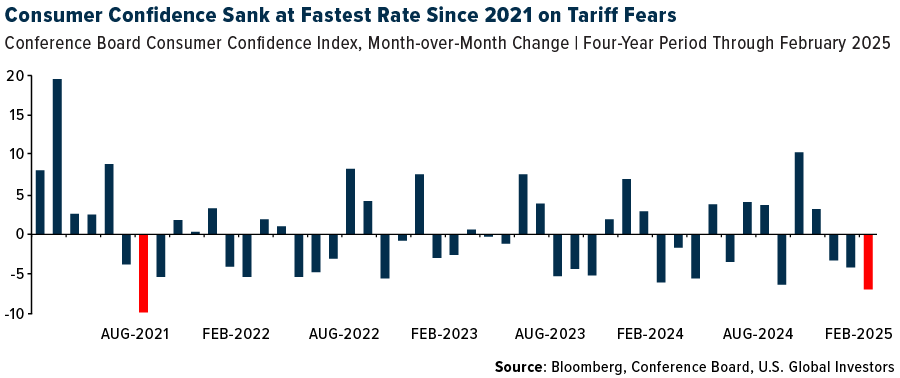
That’s exactly what we’re seeing today. Consumer confidence has been falling, with the Conference Board’s index dropping seven points in February, the largest decline since August 2021.
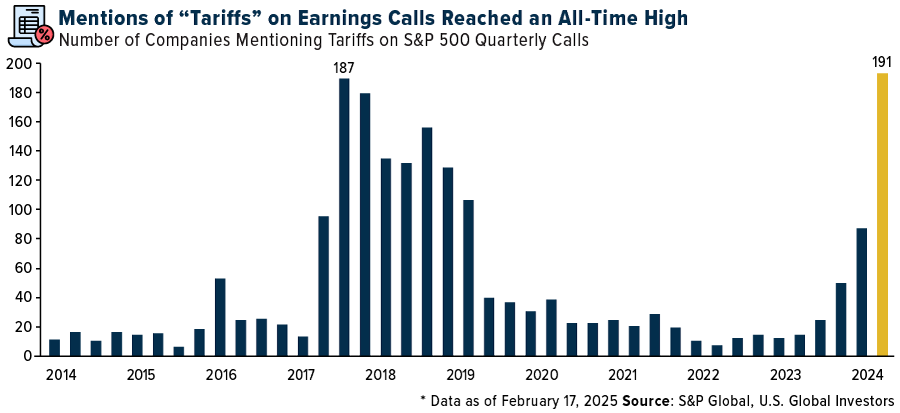
Investors are paying attention: During recent earnings calls, S&P 500 companies mentioned “tariffs” a record 191 times, more than in 2018 or 2019, when Trump first imposed duties on Chinese goods.
Personal computer (PC) and printer manufacturer HP Inc., for instance, warned shareholders during its earnings call this week that “the current U.S. tariff increases on China” would weigh on profitability this year.
How Investors Should Think About Tariffs
I often say that it’s the policies that matter, not the political parties. That said, here are three things to keep in mind when evaluating tariffs:
1. Tariffs Are a Tax—And Taxes Raise Costs
It doesn’t matter who pays the tariff initially—whether it’s foreign exporters or U.S. importers—the additional cost eventually hits Americans’ pocketbooks. History shows that tariffs lead to higher prices for goods, which can hurt economic growth over time.
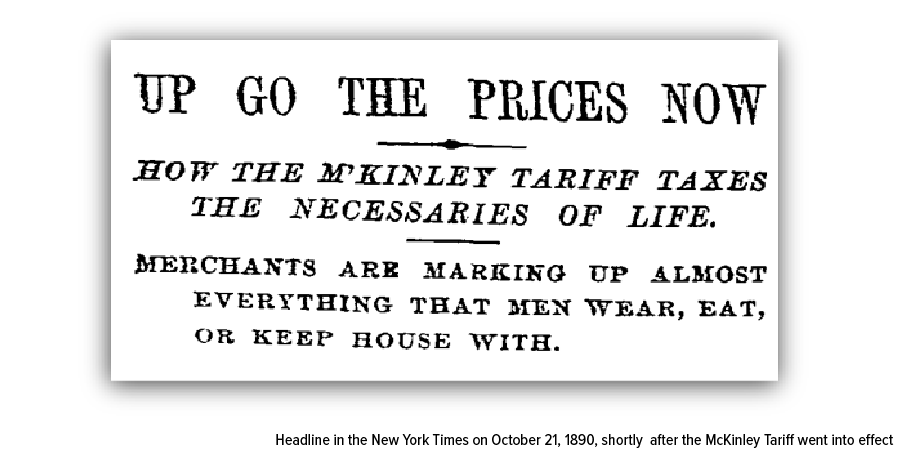
In October 1890, shortly after the McKinley tariff went into effect, the New York Times reported that companies in multiple industries were raising consumer prices across the board, including those in men’s and women’s clothing, groceries, tinware, clocks, books and more.
We’re seeing similar concerns today, with businesses warning about price hikes on everything from electronics to automobiles.
2. Trade Volatility Hurts Business Confidence
When tariffs are used unpredictably, companies hesitate to make long-term investments. This uncertainty can slow hiring, delay capital spending and force businesses to look for alternatives—whether that means shifting supply chains out of China or investing in automation rather than workers.
Investors should watch sectors most affected by tariffs, such as automotive, manufacturing and energy, where companies are exploring mergers and acquisitions (M&A) to hedge against trade risk.
3. Global Trade Relationships Matter
Canada is the United States’ largest trading partner, accounting for $413 billion in imports and $349 billion in exports in 2024. The U.S. also relies heavily on Canadian energy imports, including crude oil, natural gas and electricity.
The unintended consequence of aggressive trade policies could be that Canada—and other key partners—look elsewhere, just as they did after the McKinley Tariff. Several Canadian politicians are now advocating for new pipelines to coastal export terminals, reducing dependency on the U.S. market. Once those trade routes shift, they are not easily reversed.
Investing Without Bias
The lesson here isn’t that tariffs are inherently bad, nor is it to criticize President Trump. The point is that we, as investors, must think independently and assess policies based on their actual effects, not just their stated goals. History has shown that tariffs often come with unintended consequences, and we’re seeing echoes of the McKinley era today.
History doesn’t repeat, but it often rhymes—and smart investors know when to listen.
Index Summary
* The major market indices finished mixed this week. The Dow Jones Industrial Average gained 0.95%. The S&P 500 Stock Index fell 0.98%, while the Nasdaq Composite fell 3.47%. The Russell 2000 small capitalization index lost 1.47% this week. * The Hang Seng Composite lost 2.58% this week; while Taiwan was down 2.85% and the KOSPI fell 4.59%. * The 10-year Treasury bond yield fell 2 basis points to 4.203%.
Airlines and Shipping
Strengths
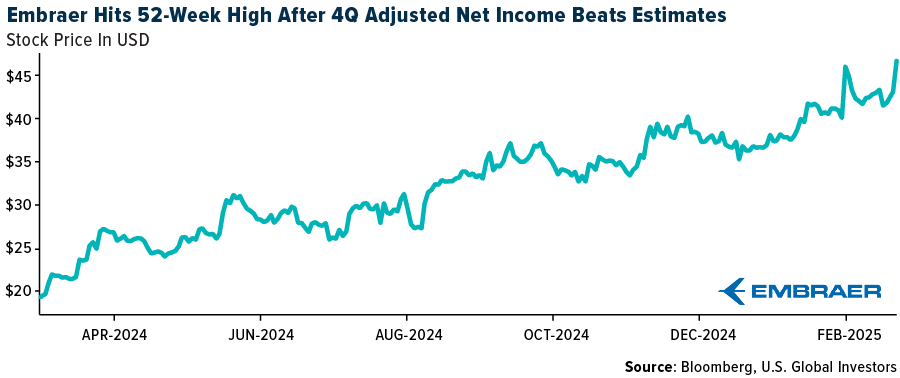
* Embraer hit a 52-week high after the company reported adjusted net income for the fourth quarter that beat the average analyst estimate. Adjusted net income was $173 million versus $77 million year-over-year, estimate was $120.0 million. Net revenue was $2.31 billion, 17% year-over-year, while the estimate was $2.3 billion, writes Bloomberg.
* Air travel in China surged in early 2025, reports the IATA, with over 26.2 million trips by plane for the Chinese New Year holiday. That represents a 4 percent increase from the same time in 2024. * Reuters reports that over 45,000 U.S. dockworkers ratified a new six-year contract this week, securing a 62% wage increase and preventing disruptions until 2030. The agreement, which was reached in October, ended a three-day strike that had caused shipping price hikes and cargo backlogs at numerous ports.
Weaknesses
* A South Carolina man who stripped naked and assaulted a federal officer at Indianapolis international airport in 2023 has been sentenced to 33 months in federal prison. After passing through a screening machine at the checkpoint, the machine indicated that the man required additional screening of his chest, groin, and buttocks, according to Bloomberg. * Turkish Airlines reported net income for the full year that missed the average analyst estimate. Net income was 113.4 billion liras, down 30% year-over-year, while the estimate was 117.6 billion liras, Bloomberg reports. * Gatwick Airport’s second runway delayed by the Transport Secretary despite her pledge to “defy eco-warriors” on the €2.2 billion expansion. As a result, she extended the deadline for the final decision by nine months to October 27, according to Bloomberg.
Opportunities
* According to Simple Flying, Air Service One’s analysis reveals that 2024 marked the first year since the pandemic that European air traffic surpassed pre-2019 levels. However, individual countries show differing recovery rates, with Greece and Poland seeing the best rebounds, both exceeding 2019 traffic by around 21%. Notably, Albania experienced the most significant growth, with a remarkable 220% increase despite being a smaller market. * Elon Musk’s SpaceX is working to deploy Starlink satellite internet terminals to help upgrade the U.S. Federal Aviation Administration’s airspace system, Bloomberg reports. This effort raises concerns about potential conflicts of interest for Musk’s businesses, as Verizon Communications was awarded a $2 billion contract in 2023 for similar infrastructure improvements. Musk recently approved the shipment of 4,000 Starlink terminals to the FAA, with one already installed for testing at the agency’s air-traffic control lab in Atlantic City. * JetBlue Airways said Thursday it will start a new daily summer seasonal route between New Hampshire’s Manchester Boston regional airport and New York’s John F. Kennedy international airport. The route will run daily from June 12 to October 25 using the airline’s Airbus A320 aircraft, JetBlue said in a statement.
Threats
* LNG shipping stocks have experienced heightened volatility recently, with the UP-World LNG Shipping Index (UPI) dropping 1.79%, reflecting broader market trends. Concerns over U.S. policy shifts have increased investor caution, although LNG shipping could benefit from these changes, explains Hellenic Shipping News. * More than 1,000 Syrians died by execution, torture or maltreatment at a military airport outside Damascus, according to a new report that traced their deaths to seven suspected grave sites. * Since Christmas Day, four commercial jets have crashed, killing 300 people and injuring many others. Images of the explosion over the Potomac after a Black Hawk helicopter collided with a plane, and of a Delta flight upside down on the runway in Toronto have spooked people of their next trip, writes Bloomberg.
Luxury Goods and International Markets
Strengths
* Eurozone business confidence improved, with the European Commission’s economic sentiment indicator rising to 96.3 from 95.3 in January, attributed to falling interest rates. Year-to-date Europe, as measured by the STOXX 600 Index, gained 10.5% while stocks listed in the United States only gained 1.2% during that same time period. * European luxury stocks gained momentum as Kepler Cheuvreux reinstated a positive outlook on the sector. The firm upgraded shares of LVMH, Kering, and Burberry to a “buy” rating, while also raising price targets for Richemont, Prada, and Moncler.
* Li Auto, a Chinese EV manufacturer, was the top-performing stock in the S&P Global Luxury Index, with a 15.7% increase over the past five days. JPMorgan upgraded Li Auto shares to an “overweight” rating, saying the company could double its sales by 2027.
Weaknesses
* In the United States, the Conference Board’s Consumer Confidence Index dropped by 7.0 points to 98.3 in February, marking the most significant monthly decline in over four years. This downturn is attributed to concerns over persistent inflation and potential trade conflicts under President Trump’s administration. * Shares of Ferrari dropped this week after news emerged that the Agnelli family is selling a stake valued at around 3 billion euros. The billionaire family will remain Ferrari’s largest shareholder, retaining approximately 33% of voting rights. Additionally, Ferrari plans to buy back about 10% of the shares sold. * Lucid Group, a U.S. EV manufacturer, was the worst-performing stock in the S&P Global Luxury Index, dropping 32.6%. Lucid reported better-than-expected revenue of $807.8 million for 2024 (up 36% from 2023), and the company’s net loss widened by 8.2% to $3.06 billion. Peter Rawlinson, Lucid’s CEO, unexpectedly stepped down from his position.
Opportunity
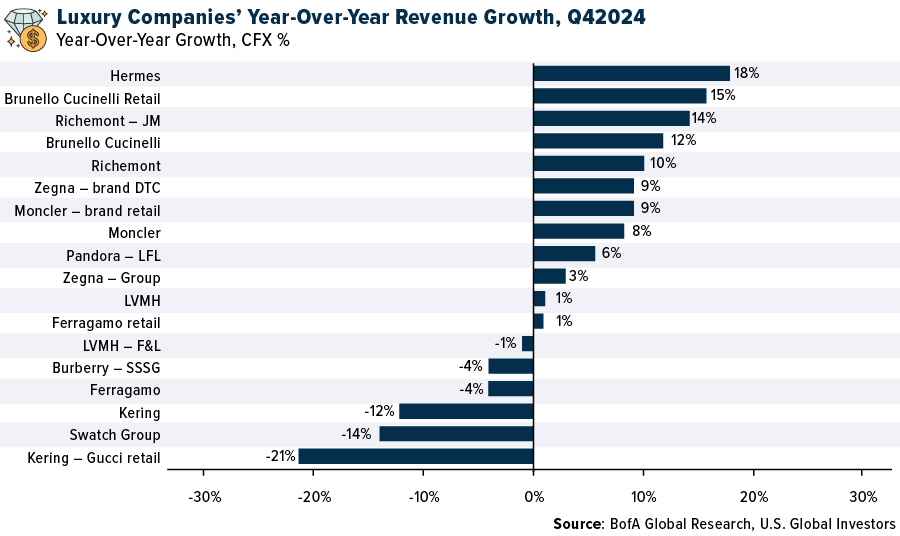
* Bank of America research shows that the fourth-quarter earnings season exceeded expectations, with luxury revenue growing by 1%. The firm believes the worst of the luxury demand decline is behind us and predicts stronger revenue going forward. However, the group warns that luxury stocks have already gained 15%, with significant variations in revenue among top performers and laggards. * Many luxury brands are lowering prices to attract aspirational buyers, particularly those impacted by high inflation and rising interest rates. Burberry has been successful with this strategy. Ahead of the holiday season, the company adjusted its pricing structure to reach a broader audience, offering more accessible products. As a result, Burberry saw its first new customer growth in two years in December and a 4% increase in third-quarter store sales across America. * Tiffany & Co. is preparing to open a new store in Brazil, bringing the total number of its locations in the country to five. The luxury market in Brazil has shown consistent growth in recent years. In 2023, the sector grew by 30%, followed by an 11.7% increase in 2024. The forecast for this year is 15% growth, according to an annual survey by the Brazilian Association of Luxury Brands and Companies.
Threats
* Strong demand for luxury goods in America had previously supported high-end brands; however, recent trends in the U.S. consumer sector show signs of decline. Retail sales in January fell by 0.9%, and consumer confidence dropped by nearly 10% in February. * Germany has a new Chancellor, Friedrich Merz, following last week’s elections. This shift could bring changes to transatlantic relations, with his policy agenda focusing on reducing personal and corporate taxes, cutting regulations, and implementing a stricter immigration policy. However, the process of forming a new government may be challenging due to a fragmented political landscape. The Christian Democratic Union/Christian Social Union (CDU/CSU) secured 28.5% of the vote, the Alternative for Germany (AfD) received 20.8%, and the Social Democratic Party of Germany (SPD) gained 16%. * Xiaomi, a Chinese EV manufacturer, slashed the price of its luxury electric sedan, the SU7 Ultra, by 35% in an effort to compete with other EV makers like BMW, Audi, Mercedes, and Tesla in the market. Following the price cut announcement, Xiaomi received 6,900 orders within just 10 minutes, gaining market share from foreign companies.


 Market Data
  Markets


 AI
AI