One of the 33 settlements in the Golan, currently undergoing a construction boom, is Kidmat Tsvi — currently home to about 220 people, with a goal to build to 400.
"We don't have enough land to give all the residents who want to come here," Yaakov Selevan, deputy governor of the Golan Regional Council said.
Ben Gvir says he prayed on Temple Mount, PM quickly says status quo hasn’t changed
"In the Israeli-occupied Golan Heights, some fear Netanyahu's plans after Assad's fall "Israeli army bans radical 'Messiah' patch from uniforms after staying silent on 'Greater Israel' map "Greater Israel: an Ongoing Expansion Plan for the Middle East and North Africa"" "
Hamas calls for escalation of violenceover national security minister’s visit to holy site, where Jews are banned from praying but lately have done so increasingly openly
By ToI Staff Today, 2:53 pm
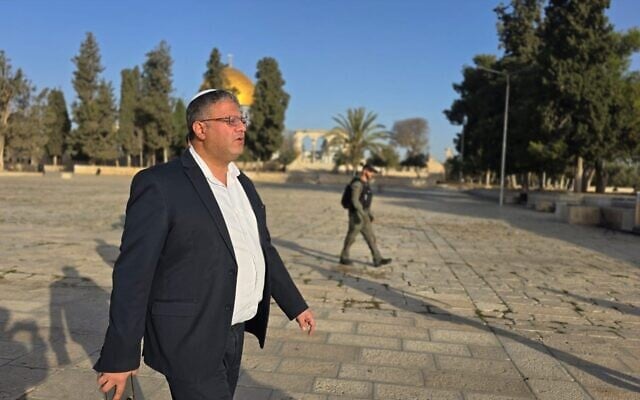
National Security Minister Itamar Ben Gvir visits the Temple Mount in Jerusalem, on December 26, 2024. (Courtesy Otzma Yehudit)
National Security Minister Itamar Ben Gvir said Thursday that he’d visited the flashpoint Temple Mount in the morning and prayed there, whereupon the Prime Minister’s Office swiftly said in a statement that the longstanding status quo — according to which Jews are not allowed to pray atop the mount — had not changed.
“I went up this morning to the place of our holy temple, to pray for the safety of our soldiers, the speedy return of the hostages, and total victory, with the help of God,” Ben Gvir wrote on X, with a photo of himself walking at the site with the Dome of the Rock visible in the background.
In response to Ben Gvir’s announcement, the Prime Minister’s Office quickly issued a statement saying, “The status quo on the Temple Mount has not changed.”
VIDEO
Changes to the status quo on the Temple Mount, the holiest place in Judaism and the third holiest in Islam, evoke strong emotions and are frequently cited as a Muslim motivation for religious violence.
The visit was condemned by Knesset member Mansour Abbas, of the Islamist Ra’am party, who said the far-right minister was “desecrating the sanctity of the Al-Aqsa Mosque,” referring to the Muslim place of worship atop the mount.
The Hamas terror group — which gave the name “Operation Al-Aqsa Flood” to its October 7, 2023, attack on Israel in which invading gunmen killed some 1,200 people and took 251 hostage — responded to Ben Gvir’s visit in a statement calling on “our nation [the Palestinians] to confront the occupation and to escalate the situation.”
Jews are not officially allowed to pray at the Temple Mount — the holiest place in Judaism, which served as the focal point of religious life in ancient Israel — but the Israel Police, which comes under the purview of Ben Gvir’s ministry, has increasingly tolerated limited prayer there.
Religious Jews are escorted by Israeli police as they tour the Temple Mount, in Jerusalem’s Old City during the Jewish holiday of Sukkot, September 24, 2018. (Sliman Khader/Flash90)
It was unclear whether Ben Gvir prayed openly, rather than doing so silently. He has in the past expressed support for a synagogue being placed atop the Temple Mount.
The status quo governing the compound allows Muslims to pray and generally enter with few restrictions, while non-Muslims, including Jews, can visit only during limited time slots and may not pray.
Last Wednesday in a meeting on “Temple Mount studies,” the Knesset’s Education Committee called for changing the public school system’s courses about the holy site from elective to compulsory, but rejected the idea of taking students for visits there.
[Insert: Gawd, when will enough denizens of our planet say enough, give us a break, to all this divisive religious ideology.]
At the hearing, MK Limor Son Har-Melech, of Ben Gvir’s Otzma Yehudit party, said, “In fourth grade, I transferred to a religious school, and until then, I hadn’t learned about the Temple. In this war, we have to raise Israel’s children to understand what we’re fighting for, and what our vision is — the Temple Mount.
“I thank Minister Ben Gvir for the fact that today Jews can pray and prostrate themselves on the Temple Mount,” Har-Melech added.
National Security Minister Itamar Ben Gvir and MK Limor Son Har-Melech arrive for a court hearing at the Supreme Court in Jerusalem, on the petition of Adalah Human rights organization and MK Ahmad Tibi asking to allow the visit of Palestinian prisoners in Israeli jails, on September 11, 2024. (Yonatan Sindel/Flash90)
Ben Gvir has publicized multiple visits to the Temple Mount since taking office in December 2022.
The far-right minister has rebuffed Prime Minister Benjamin Netanyahu’s repeated subsequent insistence that the decades-old status quo remains in force.
In September, Netanyahu told ministers any visits to the site must be coordinated with him ahead of time. It was not clear whether Ben Gvir had done so before his visit on Thursday.
Report: Ben Gvir tried to prevent demolition of illegally constructed Haredi synagogues
In the Israeli-occupied Golan Heights, some fear Netanyahu's plans after Assad's fall "Israeli army bans radical 'Messiah' patch from uniforms after staying silent on 'Greater Israel' map "Greater Israel: an Ongoing Expansion Plan for the Middle East and North Africa""
Paper cites chief of Real Estate Enforcement Division as telling national security minister there could be ‘a second Meron disaster in Bnei Brak’
By Sam Sokol 26 December 2024, 7:03 pm
Illustrative: Hasidic Jews in a synagogue in the central Israeli city of Bnei Brak, March 24, 2024. (Tomer Neuberg/Flash90)
National Security Minister Itamar Ben Gvir attempted to lean on the head of a government unit that enforces building regulations in order to prevent the demolition of illegally constructed ultra-Orthodox synagogues in the central city of Bnei Brak, Haaretz reported this week.
According to the Hebrew daily, Ben Gvir sought to head off the demolition of dozens of houses of worship collectively described by unit insiders as “an immediate safety hazard” that borders on “a second Meron disaster” — a reference to the 2021 incident in which 45 people were killed in a crush at the northern gravesite of a second-century sage.
The newspaper further reported that Ben Gvir had suggested that members of the ultra-Orthodox community opposed to the demolitions send him “a list of illegally built mosques that were not demolished, so we can argue discriminatory enforcement.”
In addition, Ben Gvir was reported to have summoned Real Estate Enforcement Division chief Avi Cohen to a meeting, in which he argued he should “concentrate on enforcement and demolition in the Arab sector” — to which Cohen was said to reply that Ben Gvir was legally prohibited from intervening in the matter, and that “we are facing a second Meron disaster in Bnei Brak.”
While Ben Gvir’s ministry oversees the unit, authority over changes in policy relating to enforcement belongs to the attorney general, Haaretz noted.
Over the summer, the Knesset ratified a government decision to transfer authority over the Finance Ministry’s Real Estate Enforcement Division to the National Security Ministry — after which Ben Gvir declared that “those who break the law will encounter a firm hand and zero tolerance.”
Minister Itamar Ben Gvir speaks during a National Security Committee meeting at the Knesset on November 27, 2024. (Yonatan Sindel/Flash90)
The transfer of the unit was vehemently opposed by Arab lawmakers, who argued that Ben Gvir would focus disproportionately on their communities.
Arab municipalities and neighborhoods have a higher prevalence of unauthorized construction, according to a 2022 study by the Sikkuy-Aufoq nonprofit, whose mission statement is to promote equality between Arabs and Jewish citizens of Israel. In the Haifa District, for example, 55 percent of all illegally constructed structures are concentrated in the predominantly Arab communities of the Wadi Ara area, east of Hadera.
Some advocates of reform in the enforcement of illegal construction in Israel allege that many Arab violators build without permits because of a combination of institutional racism and inefficient bureaucracy that makes it harder for Arabs to obtain permits.
Responding to the Haaretz report, a spokesman for the minister told the newspaper that Cohen “never told [him] that he cannot interfere with enforcement policy, for the obvious reason that the minister is allowed to set policy, especially while his demand is merely to maintain equality before the law.”
A view of the ultra-Orthodox-majority city of Bnei Brak, August 06, 2019. (Gili Yaari / Flash90)
Forty-five men and boys were killed on April 30, 2021, in the crush at the hilltop gravesite of second-century sage Rabbi Shimon Bar Yochai on Mount Meron during the annual Lag B’Omer celebrations, after 100,000 worshipers, mostly members of the ultra-Orthodox community, crowded into the holy site despite longstanding warnings about the safety of the complex.
Following the disaster, several former police chiefs characterized Meron — Israel’s second-most visited Jewish holy site after the Western Wall — as a kind of extraterritorial facility. It was administered by several ultra-Orthodox groups, while the National Center for the Protection of Holy Places, part of the Ministry of Religious Affairs, apparently had some responsibility over it as well, as did the local authority and the police. But ultimately, no single state body had full responsibility.
The disaster occurred on a walkway erected illegally by members of the Toldos Aharon Hasidic sect.
Rescue forces and police at the scene after a mass fatality scene during the celebrations of the Jewish holiday of Lag B’Omer on Mount Meron, in northern Israel on April 30, 2021. (David Cohen/Flash90)
Some large ultra-Orthodox events feature bleachers, known as “tribunas” in Israel, which are packed with standing or dancing parishioners surrounding a central table where community leaders are seated.
The synagogue was located in an incomplete building and had not been approved for use, the police commander of the Jerusalem District told reporters at the time.
The site where a bleacher crowded with worshipers collapsed in a synagogue in Givat Ze’ev, near Jerusalem, at the start of the Jewish holiday of Shavuot, May 16, 2021. (AP Photo/Sebastian Scheiner)
Documents published by Kan news showed police and the Givat Ze’ev municipality tried to enforce an order banning Shavuot services at the unfinished Karlin synagogue.
In the documents, police warned the local council about the danger of allowing services at the building, which did not have an occupancy permit. However, when the local council asked police to step in to enforce the closure, police responded that it was the council’s job.
Fundamentalist religious groups are no good for anyone. They stunt the growth of every member and, by their very existence, do a disservice to the wider community.


 Market Data
  Markets


 AI
AI