"CIA boss says west should not be intimidated by Russia’s nuclear threats"
----- Our related: And the fear of NATO propaganda line, some here as B402 also ran with: "If their RADAR systems can't even track a few drones, they are totally vulnerable and left in a non-defensible position for some real heavy hits. I just wish the US/EU coalition would give them the green light already." To underline the relative paper tiger view - Putin debunks his own propaganda by disarming Russia’s NATO borders https://investorshub.advfn.com/boards/read_msg.aspx?message_id=175063328 .. and .. In his rambling May 31 monologue following his felony convictions, Donald Trump somehow found time to reference the ill-fated Nord Stream 2 natural gas pipeline between Russia and Germany. Trump declared: “I ended the Russian pipeline. It was dead. He [Biden] comes in and approves it.” Trump went on to allege that Biden did so because money from the former mayor of Moscow’s wife was paid to the Biden family. P - Similarly, in a speech at CPAC last year, Trump noted that he “got along very well with Putin even though I’m the one that ended his pipeline. … I ended it. It was dead.” Trump added that “nobody ever heard of Nord Stream 2 until I came along.” P - In fact, Trump did not stop Nord Stream 2 — he enabled it. [...]As the Biden administration took office in 2021, Russian vessels were laying pipe for the final segments of Nord Stream 2. While U.S. sanctions in 2017 would have killed the project, by 2021 it was a fait accompli. The Biden administration denounced Nord Stream 2 as a “bad deal” and a danger to European energy security. But given the unlikelihood of stopping it at this stage and the need to rebuild relations with Germany shredded under Trump, the administration elected to waive sanctions. A supposed payment by the former mayor of Moscow’s wife to the Bidens, as Trump has alleged on various occasions, had nothing to do with it. P - Pompeo termed this waiving of sanctions a “terrible tragedy.” In fact, the tragedy came from the years of inaction on Pompeo’s watch and the encouragement this gave to Putin as he planned to weaponize natural gas exports as part of his full-scale war on Ukraine. https://investorshub.advfn.com/boards/read_msg.aspx?message_id=175064174 -----
The use of contractors in the US ‘war on terror’ inspired Russia and other powers to outsource war.
Ibrahim Al-Marashi Associate Professor of Middle East History at California State University San Marcos
Published On 12 Aug 202312 Aug 2023
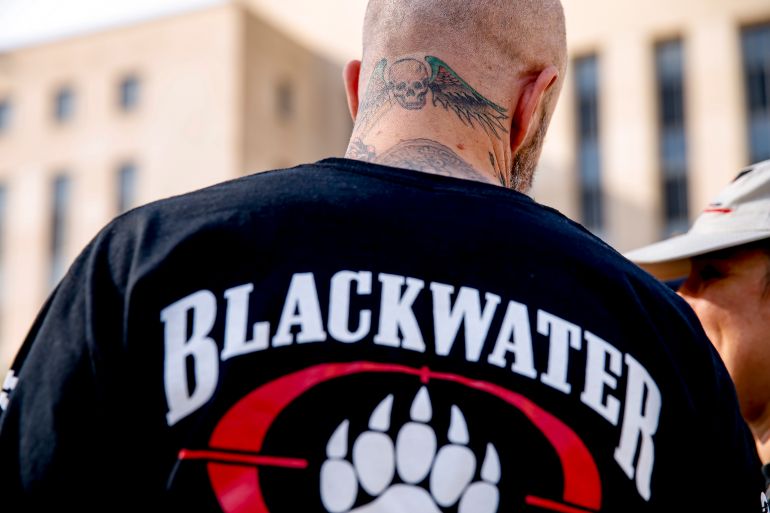
A former member of Blackwater joins family members, friends, and supporters of four former Blackwater security guards outside the federal court in Washington, on April 13, 2015, following their sentencing [File: AP /Andrew Harnik]
In the aftermath of the mutiny by the Wagner private military company (PMC) in Russia, many observers expected that its founder Yevgeny Prigozhin would pay dearly for his actions, perhaps with his life. Instead, the mercenary commander was sent into “exile” in neighbouring Belarus and his fighters continued operations outside Russia and Ukraine. Prigozhin eventually met with Russian President Vladimir Putin personally and then announced that his PMC would focus on its work in Africa.
It is hardly surprising that Putin has decided to preserve a mercenary force that has proven quite effective in pushing forward his foreign policy adventures in Europe, the Middle East and Africa. He has likely learned a lesson or two from another great power – the United States – whose heavy reliance on PMCs paved the way for the growing privatisation and outsourcing of war across the globe.
For the US, Russia, and other powers, military contractors are serving as convenient means for proxy warfare which offer plausible deniability and mitigate potential domestic tensions over foreign wars.
Outsourcing war
The employment of contractors by the US government is not a recent phenomenon, but over the past two decades it has greatly expanded. While in World War II, 10 percent of American armed forces were privately contracted, during the “war on terror”, launched in 2001, they reached some 50 percent, sometimes more.
Needing hundreds of thousands of personnel to carry out military operations in Afghanistan, Iraq and elsewhere, but fearing domestic backlash, the US government had to turn to PMCs.
Since the start of the “war on terror”, the Pentagon has spent $14 trillion .. https://watson.brown.edu/costsofwar/papers/2021/ProfitsOfWar .. , with one-third to one-half of it going to military contractors in combat zones. A lot of this money has gone to contracts related to logistics, construction and weapons supplies, but a sizable chunk has also paid for “hired guns”.
During the height of the 2008 counterinsurgency effort in Iraq, the number of contractors reached 163,400 .. https://sgp.fas.org/crs/natsec/R40764.pdf .. (including people in non-combat roles) compared to 146,800 .. https://sgp.fas.org/crs/natsec/R40764.pdf .. US troops. In 2010, amid the “surge” in Afghanistan, when additional troops were deployed for a renewed offensive against the Taliban, there were 112,100 contractors (including people in non-combat roles) compared to 79,100 troops.
The pouring of trillions of dollars into PMCs has helped create a vast and powerful military contractor industry which has gone global and transformed how great and smaller powers engage in warfare and other violent foreign policy undertakings.
The use of contractors conveniently offers plausible deniability and can help governments pacify electorates reluctant to send national troops on risk foreign missions. They also help dodge responsibility for war crimes.
For example, in 2007, Blackwater killed 14 Iraqi civilians in a melee in Nisour Square .. https://www.brookings.edu/articles/the-dark-truth-about-blackwater/ .. in Baghdad. They were not under the US military chain of command, as they had been privately contracted by the US Department of State to guard their staff.
When the Iraqi government decided to revoke Blackwater’s licence with the government, it found that the company never had one in the first place. Furthermore, the perpetrators of the massacre were not subject to Iraqi law .. https://www.brookings.edu/articles/the-dark-truth-about-blackwater/ , so they could not be tried on Iraqi soil.
The Nisour Square massacre was by far not the only atrocity American mercenaries committed. Ultimately, the violence PMCs were involved in contributed to wide-spread anti-American sentiments in Iraq which undermined US-led counterinsurgency efforts – a major factor that later enabled the rise of ISIL (ISIS).
Despite these troubles, the US did not do away with PMCs and has continued to rely on them, even after it withdrew from Afghanistan and Iraq. The flourishing PMC industry today which enables the outsourcing of war and violence across the globe is one of the morbid legacies of the US “war on terror”.
Plausible deniability
The Kremlin likely watched closely the US government’s use of contractors in Afghanistan and Iraq and understood their utility. According to some observers .. https://foreignpolicy.com/2023/06/24/prigozhin-wagner-rebellion-putin-russia-politics-ukraine-war , Putin likely wanted a Russian version of Blackwater to use in his foreign policy adventures. In following his patron’s orders to create a mercenary group, Prigozhin went as far as emulating the American PMC’s aesthetics. “Wagner mercenaries in Syria and Africa played the part, wearing baseball caps and wraparound sunglasses while toting serious guns,” wrote Lucian Kim, NPR’s former Moscow bureau chief, in Foreign Policy.
Prigozhin’s contractors was first used in 2014 to support Russian aggression in Eastern Ukraine. They were then deployed in Syria to bolster the regime of President Bashar al-Asad, and to Libya, to fight for renegade general Khalifa Haftar. Throughout these conflicts, the Kremlin kept denying the involvement in and existence of Wagner, as PMCs were illegal according to Russian law. Advertisement
The effectiveness of the Russian mercenaries encouraged political and military leaders from across Africa to resort to their services, which strengthened Moscow’s international standing and foreign policy reach.
When in February 2022, Putin decided to launch a full-scale invasion of Ukraine, he also needed a large number of troops, which the Russian army did not have. Wagner was tasked specifically with providing fighters to throw into the bloodiest battles as cannon fodder. Quickly running out of volunteers, Prigozhin went as far as recruiting convicts, who were offered amnesty in return for military service.
Thus, Wagner helped the Kremlin minimise the perceived cost of war for the Russian public which was rather uncomfortable with the full-scale invasion. But its forces were not under the direct command of the Russian army, which also turned into a major problem for the Kremlin.
The mutiny was perhaps an unexpected development for Putin, and it made him look weak, not only to the international community, but also to regime insiders. The fallout of Prigozhin’s rebellion will likely continue to play out in the coming months.
By relying on mercenaries,the US, Russia and other powers have weakened internationally accepted rules of engagement and undermined the international legal regime that seeks to protect civilians in times of war. This has allowed them to get away with violence and atrocities even more easily and misrepresent the true cost of war. Blackwater, Wagner et al ultimately are making the world a that much more dangerous place.
The views expressed in this article are the author’s own and do not necessarily reflect Al Jazeera’s editorial stance.
Ibrahim Al-Marashi is Associate Professor of Middle East History at California State University San Marcos, and an advisory board member of the International Security and Conflict Resolution (ISCOR) program at San Diego State University. He is the co-author of Iraq’s Armed Forces: An Analytical History (2008), The Modern History of Iraq (2016), and A Concise History of the Middle East (2025).


 Market Data
  Markets


 AI
AI