OMOLIVES, The link did not add to putting any real meaning, or significance, into the figures of the chart. Nor did it answer any of my questions to you, noted you didn't either. I had an idea you didn't understand much if any of the real significance or meaning behind the chart you posted, any more than i believed i really did. That why i asked the questions of you, to see it you did. I was hoping from you for something more in the line of:
Has the US Dollar Lost 99% of its Purchasing Power Since 1913?
Cullen Roche - 08/22/2014
Every so often this chart of the US Dollar’s collapsing purchasing power starts making the rounds. It’s usually promoted by gold standard advocates or “sound money” advocates. And yes, it’s true that the USD has lost 96.4% of its purchasing power since 1913 (as of October 2021).
The flawhere is this chart is a misrepresentation of the real investment and output denominated in the Dollar. While this chart implies a declining living standard and reduced real wealth, the reality is the exact opposite.
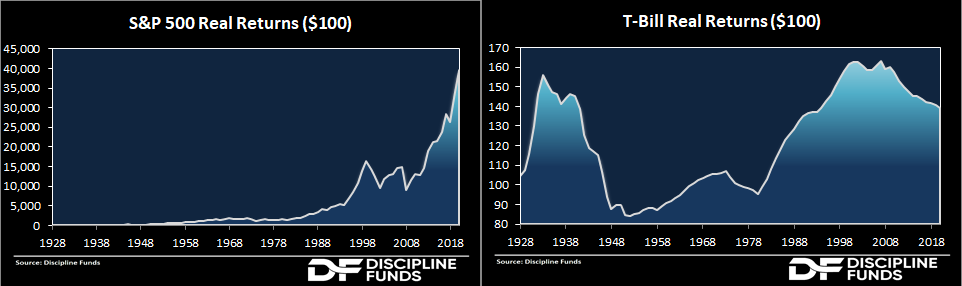
Households don’t leave their dollars under their mattresses. Households invest dollars in instruments that earn cash flows from the real investments that we make in the country. In fact, a household that held just T-Bills maintained their purchasing power through interest payments alone. A household that purchased the real output of US Stocks grew $100 to over $40,000 since 1928 (using first date of reliable historical data). In other words, if you held all of your money under the mattress you did quite poorly. If you diversified across even just T-Bills you maintained your purchasing power. If you invested in the real output of the US economy by owning real assets like stocks you did unbelievably well in real terms.
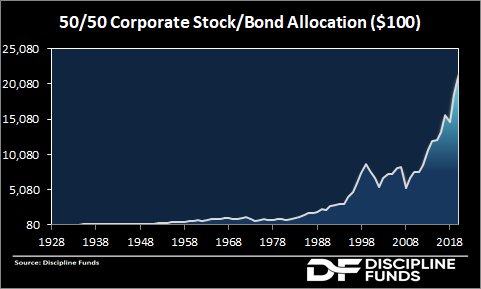
If you had diversified your portfolio across 50% corporate bonds and 50% stocks you would have grown $100 into $21,500.
As you can see, these charts tell a dramatically different story about the well-being of US Dollar denominated assets when compared to cash dollars. Of course, these charts don’t even consider the fact that most people earn an inflation adjusted income over the course of their lives while their savings grows.
Consider these other facts since 1913:
* Household net worth in the USA is the highest in the world. * US Real GDP is the highest in the world. * US Median Real Income ranks 5th in the world. * The median income earner in the USA is in the top 1% of global earners.
More recently we hear that something horrible happened in 1970 when we left the Bretton Woods system. But this too is misleading. $100 invested in US stocks in 1970 is worth $16,670. Inflation adjusted hourly wages are up 65% .. https://fred.stlouisfed.org/graph/?g=16QEz .. since 1970. More broadly, living standards have exploded higher by most metrics .. https://www.pragcap.com/the-myth-of-declining-american-living-standards/ .. over this time period.
Does this sound like a situation where the Dollar has served the US economy poorly?
This data is also consistent with global wealth and income trends according to Branko Milanovich .. https://www.amazon.com/gp/product/0465019749/ref=as_li_ss_tl?ie=UTF8&tag=fopo-20&linkCode=as2&camp=1789&creative=390957&creativeASIN=0465019749 . Hyperinflationsts like to claim that the USD has lost 99% of its purchasing power, when, in fact, the average American earns 50X what the global poor earn. In global terms, the average American is in the top 1% of wealth and income. Not only has the Dollar not been debased over this period, its citizens have enjoyed an unmatched period of prosperity, wealth and income generation. The idea that Americans have suffered at the hands of the US Dollar fiat system is not only factually wrong. It’s preposterously misleading. But yes, if you never work during your life and also choose to hold all of your savings under your mattress in the form of cash then you will suffer a horrible loss of purchasing power over your lifetime.
Now, there’s a reasonable argument that the USA could be even wealthier than it is today had we implemented some sort of more stable or “sound money” currency. This sounds an awful lot like someone who looked at Michael Jordan’s career and concluded “if only he’d practiced a bit more – imagine how great he could have been”. It seems difficult to argue with the economic outcomes of the USA when living standards and economic outcomes have been phenomenal across so many metrics when compared to the early 1900s. This is not to imply that everything is perfect, but objectively speaking, the US economy is far better off than it was in 1913 or 1970.
NB – I am not arguing that inflation is necessarily good. It can be extremely harmful in many ways and we should be mindful of the many ways in which our government can destroy purchasing power, but these “death of the dollar” narratives always exaggerate the issue.
Mr. Roche is the Founder and Chief Investment Officer of Discipline Funds.Discipline Funds is a low fee financial advisory firm with a focus on helping people be more disciplined with their finances.
He is also the author of Pragmatic Capitalism: What Every Investor Needs to Understand About Money and Finance, Understanding the Modern Monetary System and Understanding Modern Portfolio Construction.
OMOLIVES, Your "We are broke." is a common complaint in some circles. Others see it differently:
Is the U.S. going broke? Not remotely.
Jul 06, 2023
Key takeaways
* It’s common to hear the U.S. is going broke and cannot afford its spending.
* But U.S. finances are relatively healthy within compared to total assets.
* Total government debt comprises about 23% of total nonfinancial assets of $143.6 trillion—a manageable amount.
Economics The Real Economy
It is common to hear that the United States is broke and cannot afford to continue spending and borrowing at its current pace.
Indeed, that was the argument put forward by some to justify the fourth debt ceiling standoff over the past 12 years.
While one can make a credible argument to pull back on government spending during a time of inflation, it is simply not true that the U.S. is on the verge of a debt and deficit crisis.
In contrast, the financial health of the United States is relatively healthy within the context of the total value of U.S. assets.
A much different picture appears once one looks at the underlying asset base of the private and public economy.
The total debt of U.S. governments (federal, state and local) is $33.6 trillion, with the federal portion accounting for $31.4 trillion. At first glance, that figure underscores the argument to cut back on spending and the need for a periodic crisis to create the conditions for spending restraint.
But once you consider that figure within the context of the total economy, you obtain a very different outcome.
Total government debt comprises about 23% of total nonfinancial assets of $143.6 trillion. That implies that the U.S. economy—despite large nominal private and public debt—sits on an asset base four times larger and an economy that generated a nominal gross domestic product of $26.4 trillion through the first quarter of this year alone.
When viewed within that context, as well as the annual growth of GDP, $33.6 trillion in government debt, as high as it seems, is manageable.
The plain fact is that the U.S. regularly issues Treasury notes that generate strong domestic and global demand. Investors and other countries line up to purchase U.S. securities.
Not only does that unmask the flawed arguments that look to justify a standoff over raising the nation’s debt ceiling, but it also illustrates the risk around even a technical default on just a part of the roughly $31 trillion American fixed income market.
That’s not to say we should ignore government policy or the mismanagement of government finances. In fact, using fiscal policy, whether higher taxes or lower spending, to cool off the economy during a period of elevated inflation is entirely reasonable, but even today, that’s not being used.
GRAPH -- Total U.S. nonfinancial assets and total government debt
Is a recession on the horizon? Read more perspectives on economic headwinds facing the middle market from RSM US.
It is particularly important to note the long-term consequences to the economy and society of creating conditions in which another financial crisis occurs.
The 1928 stock market crash became a bank run, and then came the Great Depression. High-risk mortgage securitization eventually brought down financial centers across the globe and created the Great Recession.
Government finances were still dealing with the consequences of additional unfunded spending when the pandemic brought on another shock to the global economy.
There have been two jumps in government debt relative to nonfinancial assets since 1980.
The first jump started in the 1980s during a period of high military spending, tax cuts and in an era in which growth averaged 3.5%.
- Total government debt*
Then an era with increased revenues followed, resulting from the 1990s tech boom and a jump in productivity, causing a period of strong tax revenues, balanced budgets and fiscal surpluses.
The Great Recession and the slow recovery after the 2008 financial crisis caused the second jump in government debt relative to nonfinancial assets.
It is also important to note that the economic recovery that followed the financial crisis was slower than it would have been otherwise because of fiscal austerity caused in part by the 2011 debt ceiling agreement.
"U.S. government finances have improved compared to total nonfinancial assets."
The budget and deficit spending
U.S. government finances have improved compared to total nonfinancial assets. And in terms of the budget, expenditures have been receding as the pandemic income assistance programs ended and the economy went into overdrive.
GRAPH - Government deficit spending*
Tax revenues have increased along with higher rates of employment and higher wages for low-income workers. The data presented here should serve as a potent counterweight to the notion that the U.S. is on the verge of debt and deficit crises or can no longer finance its operations in the open global market.
The American economy is not on the verge of a systemic crisis because of government debt.
But as long as a debt ceiling exists, there is always the chance of a miscalculation on one part of the political authority that will plunge the United States into default and a financial crisis.
The debt ceiling is a relic of the past that should be put to sleep. Permanently.
The article is also linked here: livefree_ordie, My point you make in your first sentence. Who cares what 'you can be sure of'. In fact you can't be sure of that. Fact is Trump defunded. Period. Why? Can only think because he knows his base likes to see him cutting funds. Specially funds for the UN and other world efforts. He fed you the the isolationist dribble you people love. Still does. It's not good for anyone any more. https://investorshub.advfn.com/boards/read_msg.aspx?message_id=173434141


 Market Data
  Markets


 AI
AI