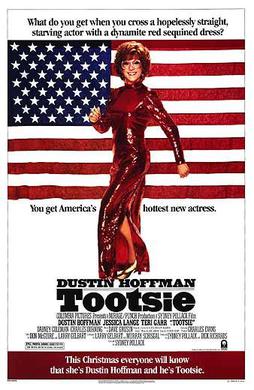
That leads to "Tootsie's" central question: Can a 40-ish New York actor find health, happiness and romance as a 40-ish New York actress? Dustin Hoffman is actually fairly plausible as "Dorothy," the actress. If his voice isn't quite right, a Southern accent allows it to squeak by. The wig and the glasses are a little too much, true, but in an uncanny way the woman played by Hoffman looks like certain actual women who look like drag queens.Dorothy might have trouble passing in Evanston, but in Manhattan, nobody gives her a second look.
Critical response On the review aggregator website Rotten Tomatoes, 91% of 53 critics' reviews are positive, with an average rating of 7.8/10. The website's consensus reads: "Tootsie doesn't squander its high-concept comedy premise, with fine dialogue and sympathetic treatment of the characters"[21] Metacritic, which uses a weighted average, assigned the film a score of 88 out of 100, based on 21 critics, indicating "universal acclaim".[22]
Roger Ebert praised the film, awarding it four out of four stars and observing: "Tootsie is the kind of Movie with a capital M that they used to make in the 1940s, when they weren't afraid to mix up absurdity with seriousness, social comment with farce, and a little heartfelt tenderness right in there with the laughs. This movie gets you coming and going...The movie also manages to make some lighthearted but well-aimed observations about sexism. It also pokes satirical fun at soap operas, New York show business agents and the Manhattan social pecking order."[23]
Box office Tootsie opened in 943 theaters in the United States and Canada and grossed $5,540,470 during its opening weekend.[1] After 115 days, it surpassed Close Encounters of the Third Kind as Columbia's greatest domestic hit of all time.[17] Its final gross in the United States and Canada was $177,200,000,[1] making it the second-highest-grossing movie of 1982 after E.T. the Extra-Terrestrial. Box Office Mojo estimates that the film sold more than 56.9 million tickets in the U.S.[18]
The film grossed more than $64 million internationally[19] and was the highest-grossing film in Germany, with a gross of $19 million.[20] Worldwide, its gross exceeds $241 million.
The sexual ambiguity in the film, and its popularity in presumably W. Germany, reminded me of Cabaret. If that film were redistributed and played in theaters today the right wouldn't know whether to 💩 or go blind.
Although less explicit compared with other films made in the 1970s, Cabaret dealt explicitly with topics like corruption, sexual ambiguity, false dreams, and Nazism. Tim Dirks at Filmsite.org notes: "The sexually-charged, semi-controversial, kinky musical was the first one ever to be given an X rating (although later re-rated) with its numerous sexual flings and hedonistic club life. There was considerable sexual innuendo, profanity, casual sex talk (homosexual and heterosexual), some evidence of anti-Semitism, and even an abortion in the film."[63] It was also rated X in the UK and later re-rated as 15.[37][64]
On the topic of Nazism, there was little consensus among critics about the possibly fascist implications of the film and play. However, critic Steven Belletto wrote a critique of Cabaret in the Criticism journal, published by Wayne State University Press, in which he highlighted the anti-fascist themes in the film present both within and outside of the musical acts. According to Belletto, "despite the ways that the film has been understood by a variety of critics, [Cabaret] rejects the logic of fascist certainty by staging various numbers committed to irony and ambiguity."[41]
MGGA, Make Germany Great Again?
The "Tomorrow Belongs to Me" scene was controversial, with Kander and Ebb, both of whom were Jewish, sometimes being wrongly accused of using a historical Nazi song.[65] According to an article in Variety in November 1976, the film was censored in West Berlin when it was first released there theatrically, with the sequence featuring the Hitler Youth singing "Tomorrow Belongs to Me" having been deleted.[6] This elimination was made "because of the feeling that it might stir up resentments in the audience by showing the sympathizers for the Nazi movement during the '30s."[6] The sequence was restored, however, when the film was shown on West German television on November 7, 1976.[6]
Another topic of discussion was the song "If You Could See Her",[66] which closed with the line: "If you could see her through my eyes, she wouldn't look Jewish at all." The point of the song was showing anti-Semitism as it begins to run rampant in Berlin, but there were a number of Jewish groups who interpreted the lyrics differently.[67]


 Market Data
  Markets


 AI
AI