Experts react: Iran just unleashed a major attack on Israel. What’s next?
"Why do Europe’s strongmen love Trump? "After 50 Years, This Right-Wing Law Factory Is Crazier Than Ever "The Far-Right Christian Quest for Power: ‘We Are Seeing Them Emboldened’"" Please America, don't let Trump take you down his 'it's all about me' sinkhole."
By Atlantic Council experts
The war is out of the shadows. Using drones and missiles, Iran unleashed .. https://www.nytimes.com/live/2024/04/13/world/israel-iran-gaza-war-news .. a large-scale attack on Israel tonight. The two countries have long been engaged in a “shadow war,” with Iran using its proxies and Israel undertaking targeted assassinations. Most recently, an Israeli strike in Syria killed several top commanders from Iran’s Islamic Revolutionary Guard Corps (IRGC), leading to Iran’s widely anticipated response. What will Israel do next? Has a broader regional war begun? What role will the United States play? Our experts weigh in below.
This post will be updated as the news continues to evolve and more expert responses come in.
Click to jump to an expert analysis: Jonathan Panikoff: The Middle East is on the precipice of a regional war no one seems to want Daniel E. Mouton: Israel is leaning on its US insurance policy Gina Abercrombie-Winstanley: The result of Iran’s strike is two wins and a loss Holly Dagres: Iranians react with apparently staged demonstrations—and apprehension Danny Citrinowicz: Iran’s unprecedented attack may not lead to a regional war Tuqa Nusairat: Iran’s response leaves Jordan in a precarious position Thomas S. Warrick: The Iranian regime has just made a huge strategic misjudgment Carmiel Arbit: What happens next will depend on three factors Alex Plitsas: Iranian drones attacked Israel and Ukraine at the same time R. Clarke Cooper: How Israel’s air defenses work, with US support Masoud Mostajabi: US, allies, and regional leaders will be motivated to sidestep expanding conflict
[Insert: The list left just to have there]
The Middle East is on the precipice of a regional war no one seems to want
Iran’s launch of ballistic missiles, in conjunction with over one hundred drones, puts the region on the precipice of a broader war that almost no one seems to actually want; one that most actors—the United States, Arab states, even Hezbollah—have sought to avoid over the last six months.
But the reality is, this is not an expansion of the war in Gaza; it’s a corollary to it. This response by Iran to Israel’s killing of Mohammad Reza Zahedi and six other IRGC officers in Syria almost two weeks ago doesn’t just move the situation up the escalatory ladder—it obliterates the ladder. Iran’s response, supported by Hezbollah, goes far beyond a proportional response.
At best, Israeli Prime Minister Benjamin Netanyahu is almost certain to respond and take steps to attack Iranian targets, probably in Iran, in a manner that will be specific and contained and won’t lead to another significant Iranian response. At worst, the Israeli response will be intense and include the bombardment of important Iranian sites.
The ultimate Israeli response is likely to be determined by the impact on the ground in Israel. Death and destruction of military personnel and especially civilians would massively ratchet up the scale of Israel’s response. As of this writing, what is clear is that this is the beginning of a new era, one in which Iran is willing to respond directly to Israeli attacks and in doing so risk retaliation against the Iranian homeland.
—Jonathan Panikoff .. https://www.atlanticcouncil.org/expert/jonathan-panikoff/ .. is the director of the Atlantic Council’s Scowcroft Middle East Security Initiative. He is a former deputy national intelligence officer for the Near East at the US National Intelligence Council.
Israel’s early April attack was a result of its continued attempts to reestablish deterrence .. https://www.atlanticcouncil.org/blogs/new-atlanticist/the-post-october-7-us-strategy-in-the-middle-east-is-coming-into-focus/ .. against Iran following the October 7 Hamas attack. Israel also is aware that it has the temporary advantage of a surge of US military forces in the region. These US forces are Israel’s insurance policy. It is notable that only one year ago, the United States had a fraction of the military aircraft and warships now in the region.
Where things go next will depend on the relative success of today’s Iranian attack. If Iran feels that it has sufficiently responded to the Israeli attack against its facility, then the region will step back from the brink of a wider war. However, if Iran’s attack is overly successful, then Israel will respond. The inevitable response cycle will include the United States and will likely spread across the region.
Regardless of the relative success of the Iranian attack, there are no guarantees that there won’t be another escalatory cycle. Senior officials at the Pentagon have repeatedly made it clear that they want to pull US forces from the Middle East and recommit them to the Indo-Pacific and Europe theaters. Israel knows of this dynamic. Israel feels it must act while it enjoys a strong US force presence. Thus, today’s attack will not be the end.
Other than the continued threat of Iran, the second biggest unresolved issue is lack of transparency. Israeli leaders did not notify the United States of their early April strike .. https://www.washingtonpost.com/national-security/2024/04/11/israel-damascus-strike-iran/ .. on the Iranian diplomatic facility. US forces are deployed to the region as an insurance policy for Israel while it conducts its campaign in Gaza. There is a real need for Israel to share its plans while US leaders must also acknowledge the need to have a serious conversation about maintaining a sufficient presence in the region to aid in the deterrence of Iran.
—Daniel E. Mouton .. https://www.atlanticcouncil.org/expert/daniel-e-mouton/ .. is a nonresident senior fellow at the Scowcroft Middle East Security Initiative of the Atlantic Council’s Middle East Programs. He served on the National Security Council from 2021 to 2023 as the director for defense and political-military policy for the Middle East and North Africa for Coordinator Brett McGurk.
The result of Iran’s strike is two wins and a loss
It is instructive to separate the outcomes from the strike into two wins and a loss.
Win: With more than two hundred missiles and drones sent directly toward Israel, Iranian honor has been satisfied. Iranian leaders have announced their intentions, and publicly claimed responsibility. While the actual damage appears to be limited, the extraordinary response was fierce enough to cause widespread international alarm. Iranians angered by Israel assassinating fellow citizens on what is legally understood to be sovereign Iranian territory can be satisfied. But the physical damage done to Israeli targets so far has been minimal. The next step does not have to be escalation.
Win: Prime Minister Benjamin Netanyahu got three things he needed badly:
1. Gaza has retreated from the conversation, and he can legitimately hope pressure to end the war and relieve Palestinian suffering has moved decisively to the back burner.
2. He has returned US President Joe Biden’s rhetoric to “rock-solid support” for Israel, even under his leadership. His willingness to chance a region-wide conflict and draw the United States in, removed a weapon from his political opponents who accused him of weakening the bilateral relationship.
3. He may have reunified Israelis again in the face of danger, which will help keep him in power.
Loss: Biden’s position has worsened considerably. His team must work to contain the Israeli response. US forces in the region remain in danger, and the possibility of a wider war is enormous. The United States now seems close to a direct conflict that Biden (and Iran) have worked hard to avoid. A significant portion of the coalition needed to reelect him will not forget Gaza and won’t welcome his renewed embrace of Israel. Whether it’s tempering Israel’s response to Iran, or getting Netanyahu to finally take his wise counsel on Gaza, Biden appears to have once again relinquished his leverage with Israel’s wily prime minister.
—Ambassador Gina Abercrombie-Winstanley .. https://www.atlanticcouncil.org/expert/gina-abercrombie-winstanley/ .. is a nonresident senior fellow at the Scowcroft Middle East Security Initiative of the Atlantic Council’s Middle East Programs and at the Scowcroft Center for Strategy and Security. Abercrombie-Winstanley served as the US ambassador to the Republic of Malta and as special assistant for the Middle East and Africa to the secretary of state. Her Middle East assignments included election monitoring in the Gaza Strip and an assignment where she supported gender equality in the Kingdom of Saudi Arabia as the first woman to lead a diplomatic mission there.
Iranians react with apparently staged demonstrations—and apprehension
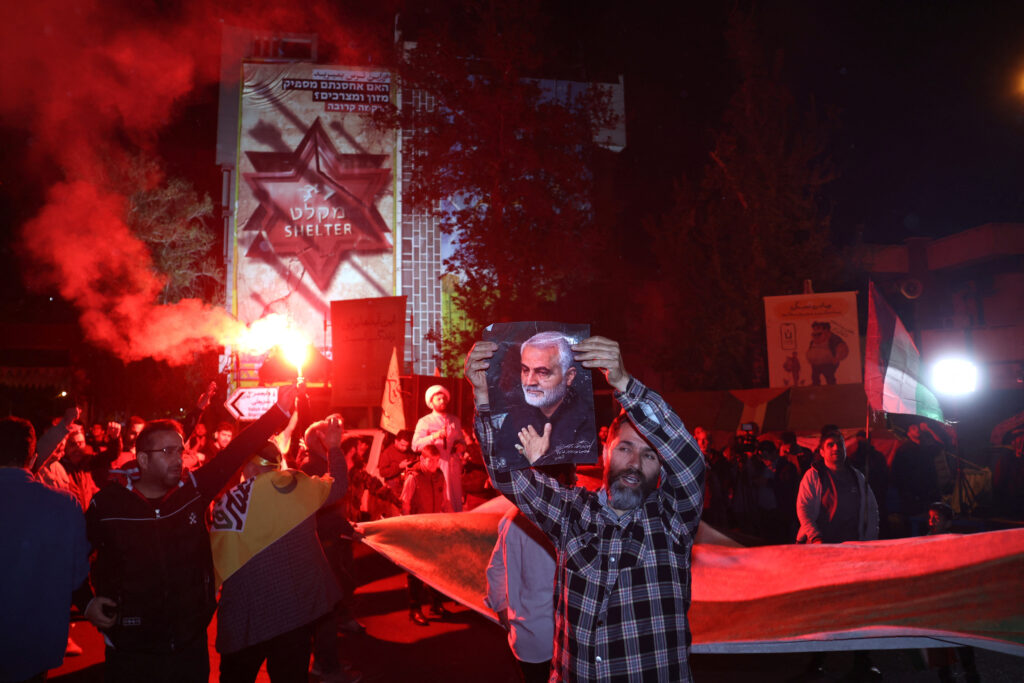
Pro-regime Iranians took to the streets in several cities, including the capital, Tehran, to celebrate the Islamic Republic’s response to the April 1 Israeli airstrike on an Iranian embassy compound that killed several high-ranking members of the IRGC. In Tehran’s Palestine Square, pro-regime Iranians happened to be gathered .. https://twitter.com/hdagres/status/1779270458568765449 .. below a new building billboard with a Hebrew shelter sign and writing that reads: “Die from this fear! Is your storage stocked up with enough food and necessities?”—a reference to Iranian retaliation against Israel. Pro-regime Iranians also gathered at the graves of assassinated Quds Force Commander Qasem Soleimani in Kerman and IRGC Quds Force commander for Lebanon and Syria Brigadier General Mohammad Reza Zahedi, whom Israel had just assassinated, in Esfahan. Given that these events happened way past midnight, it appears that these gatherings were pre-planned and state-organized.
While some celebrated the news, other Iranians worried about whether this would lead to a regional war. Footage from social media .. https://twitter.com/hdagres/status/1779276594743320806 .. showed Iranians lining up at gas stations .. https://twitter.com/hdagres/status/1779276881352634649 .. to fill up their cars and, in some instances, hitting up quickie marts to buy food and supplies, given how late at night the events had transpired.
On the official side, posting on X .. https://twitter.com/Iran_UN/status/1779269993043022053 .. (formerly Twitter), the Permanent Mission of the Islamic Republic of Iran to the United Nations cited Article 51 of the UN Charter to justify its retaliation against Israel but also declared that “the matter can be deemed concluded.” This statement was published before all the drones and missiles had reached their target(s). In essence, the Islamic Republic is suggesting that the events were over before they even started. That may not be up to Tehran.
—Holly Dagres .. https://www.atlanticcouncil.org/expert/holly-dagres/ .. is editor of the Atlantic Council’s IranSource and MENASource blogs, and a nonresident senior fellow with the Middle East Programs. She also curates The Iranist newsletter.
Iran’s unprecedented attack may not lead to a regional war
Following the threats of a leadership that saw the assassination of Mohammad Reza Zahedi in Damascus as crossing a red line, Iran launched an attack on Israel with drones, cruise missiles, and possibly surface-to-air missiles.
Israel and the United States warned Iran not to carry out the attack. Still, it seems that its leadership realized that the price of not attacking is higher than the attack itself, since Iran must restore its deterrence and rebalance the equation of deterrence vis-a-vis Israel.
A lot depends on the attack’s results. Suppose Israel, with the help of the United States, succeeds in intercepting most of the incoming drones and cruise missiles; this will likely allow Israel to respond rationally so that the current conflict between the countries can be “closed.”
In any case, and regardless of the results of the Iranian attack, this is an unprecedented event in the relationship between Iran and Israel. This event highlights the need for Israel to work in coalition with partners against Iran and not rely only on itself in defense, as well as any offensive activities.
If Israel still prioritizes the elimination of Hamas and the release of hostages, any expansion of the current conflict will be counterproductive to these goals. In any case, we are in the preliminary stage of this event, and a lot can change in the upcoming days.
Iran’s response leaves Jordan in a precarious position
Iran’s retaliatory attack against Israel for the latter’s targeting of the Iranian consulate in Syria puts Jordan in a dangerous position that threatens to destabilize the country that has often been called the “island of stability” in a sea of chaos. Over the past six months, Jordan’s leadership has been vocal in calling for a ceasefire in Gaza to prevent an escalation of the neighboring conflict into an all-out regional war. Jordan, with its fragile economy, large Palestinian refugee population and those turned Jordanian citizens, and its precarious geographic location, has a lot at stake. Despite being a stalwart ally of the United States and a beneficiary of significant military and economic assistance, it still must grapple with overwhelming discontent among its population about the decades-old cold peace with Israel.
Indeed, the latest escalation that Jordan and others warned about for months is coming to a head. US economic and strategic interests in the region continue to be threatened as the Biden administration supports Israel’s onslaught on Gaza unequivocally, despite domestic and regional alarm bells. While President Joe Biden started his term aiming to pull the United States away from conflict in the region and reduce its military footprint there, he is ending his term with a carte blanche to Israel that dismisses the grave consequences an all but certain regional conflagration will have on the future of US involvement in the Middle East, and bringing vulnerable allies like Jordan to a most unwelcome position between a rock and a hard place.
—Tuqa Nusairat .. https://www.atlanticcouncil.org/expert/tuqa-nusairat/ .. is an expert on US policy in the Middle East and the director for strategy, operations, and finance at Atlantic Council’s Rafik Hariri Center & Middle East Programs.
[While the statements re Biden supporting Israel are fair i wish at least some would qualify them by stating the fact that Trump would be even more supportive of Israel's warring overreactions than Biden - repeat - could ever be. That position would provide a more accurate picture of the situation.]
The Iranian regime has just made a huge strategic misjudgment
The immediate consequences of the Iranian drone, cruise missile, and ballistic missile attacks against Israel will not be known for several hours, but it looks like the Iranian regime has made a huge strategic misjudgment. Instead of leaving Israelis divided between those who want to defeat Hamas and those who want to see a return of the hostages Hamas kidnapped on October 7, the Iranian regime appears to have made it clear, by overreacting, that Israel needs to go all out to eradicate the threat from Hamas. Otherwise, Israel will face further waves of rocket and missile attacks from next door, not from several hours away.
Iran could have opted for a lesser response to the April 1 strike on a group of IRGC Quds Force leaders who were meeting in Damascus. Regardless of the success or failure of tonight’s attacks from a military perspective, from a political perspective the sheer number of drones and missiles fired—and the fact that they were fired from Iranian territory into Israeli territory—will have more of a lasting impact than the physical consequences that will come into focus in a few hours.
Iran until tonight relied on “plausible deniability” by using proxies to attack Israeli targets in Israel and other countries. That mask is now off. Iranian hopes for Hamas’s survival, which Iran would count as a “victory” no matter how many Israeli and Palestinian civilians died, looks less likely tonight than it did even a day ago. Israeli resolve has been strengthened.
—Thomas S. Warrick .. https://www.atlanticcouncil.org/expert/thomas-s-warrick/ .. is a senior fellow and director of the Future of DHS Project at the Atlantic Council. He served in the Department of State from 1997-2007 and as deputy assistant secretary for counterterrorism policy at the US Department of Homeland Security from 2008 to 2019.
What happens next will depend on three factors
Iran’s strike on Israeli soil is a stunning escalation between the two countries, shifting the conflict between the two from covert to overt. What happens next will depend on three factors: whether Iran’s proxies, including the Houthis and Hezbollah, join in the fighting; whether there are casualties in Israel—or whether its defense systems combined with US support prevent significant damage; and ultimately by how Israel chooses to respond.
The Iranian strikes take place against the backdrop of waning global sympathy for Israel and growing strain in the relationship between Biden and Netanyahu. At time of writing, the United States, United Kingdom, France, and Germany have all declared support for Israel as its citizens retreat to bomb shelters, but as has been the case with Gaza, further escalation may deplete that public support.
Biden, for his part, has made clear that any frostiness that may have emerged between the two leaders is strictly rhetorical: The US partnership with Israel remains ironclad. The shared commitment to addressing the threat posed by Iran also runs far deeper than any divergences the two countries may have regarding the future of the Palestinian Territories. Still the United States may privately encourage Israel to respond with restraint in a continued effort to try to prevent spiraling of a regional war. This will undoubtedly run afoul of Israel’s desire to restore deterrence and assert itself in what it sees as a war against terror that has infringed on its sovereign borders in an unprecedented way.
Iranian drones attacked Israel and Ukraine at the same time
Iranian and other officials in the region have confirmed that Iran launched somewhere between fifty and one hundred one-way attack drones as part of this attack. US and allied forces intercepted many of these drones—as well as Iranian missiles—before they reached Israeli airspace. Israel also has one of the best air-defense systems in the world, known as the Iron Dome, which appeared to intercept more.
Iran has been messaging behind closed doors that the regime feels it has to respond to the attack in Damascus, but not to the point that will escalate the conflict. As the situation unfolds in the coming hours and days, the size and the success of the Iranian attack will determine whether or not the situation will continue to spiral or escalate.
Additionally as Saturday turned to Sunday in the region, Russia launched an Iranian Shahed drone attack against Ukraine at the same time Iran launched its own Shahed drone attack against Israel. These drones have become increasingly common, as Russia has used them to attack civilian targets in Ukraine, while Iranian proxy militias in Iraq and Syria have used them to attack US bases as well. These are essentially one-way attack drones that have a payload in the nose cone, and they hit like a rocket. Iran’s attack was just another example of this new phase of warfare.
The top global recipient of US security assistance, Israel applies much of it to support its sovereign air-defense capabilities. Current US security assistance is guided by a framework that was formalized by a ten-year (2019-2028) Memorandum of Understanding (MOU) .. https://il.usembassy.gov/ten-year-memorandum-of-understanding-between-the-united-states-and-israel/ , but the US commitment to help Israel maintain its qualitative military edge (QME) to counter any credible conventional military threat has been a decades-long policy promise. It was rooted with Israel’s founding and was eventually enshrined into US law.
Then US President Ronald Reagan and then Prime Minister of Israel Yitzhak Shamir announced in 1983 the formation of the Joint Political Military Group (JPMG) .. https://2017-2021.state.gov/joint-statement-of-the-47th-u-s-israel-joint-political-military-group/ .. for bilateral security cooperation and to support preservation of Israel’s QME to counter threats from any individual state or non-state actors. The bilateral civilian and military JPMG forum continues to play an essential line of communication on requirements as well as an implementation role of the current MOU.
Consistent with the MOU, the United States annually provides $3.3 billion in foreign military financing and $500 million for cooperative programs for missile defense ..https://www.state.gov/u-s-security-cooperation-with-israel/ . Since fiscal year (FY) 2009, the United States has provided Israel with $3.4 billion in funding for missile defense. Since FY 2011, for example, the United States has provided $1.3 billion for the Iron Dome system. Further, through FMF, the United States provides Israel with access to some of the most developed military equipment in the world, including the F-35 Lightning fighter jet.
—R. Clarke Cooper .. https://www.atlanticcouncil.org/expert/clarke-cooper/ .. is a nonresident senior fellow with the Atlantic Council’s Scowcroft Middle East Security Initiative. He previously served as the assistant secretary for political-military affairs at the US Department of State from 2019 to 2021.
US, allies, and regional leaders will be motivated to sidestep expanding conflict
Tonight’s attack by the Islamic Republic of Iran (IRI) on Israel was a response to Israel’s targeting killing of a senior IRI military commander, along with six others, at the Iranian consulate in Damascus on April 1—a strike that was in direct violation of international law as put forth in the Vienna Convention. Indeed, the IRI foreign ministry made clear that its actions were an exercise of its inherent right to defense, citing Article 51 of the UN Charter. Regardless, these attacks signify a new phase in the ongoing conflict between the two regional adversaries, likely to transcend what has for years been regarded as a “shadow war,” particularly given the fact this is the first attack stemming from Iranian territory.
The leadership in Tehran, prior to launching these attacks, reasoned that failing to clearly and explicitly enforce deterrence against Israel’s aggressive actions would signal to Israel that such hostile acts would be tolerated by IRI leaders in the future. In essence, if the IRI leadership doesn’t establish deterrence now, it would inevitably have to respond at a later point due to continued attacks from Israel. As of this writing, the retaliation appears somewhat restrained and possibly orchestrated to grant Israel and the US flexibility in sidestepping a wider conflict.
In Israel, attention now shifts to the security cabinet’s assessment of the damage and subsequent decision on how to respond. With the nation already operating in a wartime mindset due to the ongoing conflict in Gaza, many are likely to argue that this presents an opportunity for Israel to retaliate in kind on Iranian soil, potentially targeting critical military, energy, and nuclear installations. Should this line of reasoning prevail, a catastrophic war would become nearly unavoidable.
For regional players, particularly Saudi Arabia and Jordan—who have reportedly intercepted Iranian drones—the argument will be that they are rightfully safeguarding their sovereign airspace. However, if tonight’s attacks escalate into a wider Israel-IRI conflict, regional actors perceived as defenders of Israel may find themselves targeted and dragged into the regional conflagration to a higher degree than shooting down a few drones. Given the incentives at play, it’s likely that regional leaders will be motivated to act between both parties to bring this confrontation to a close.
The United States, for its part, finds itself again in the pivotal position of working to prevent an expansion of turmoil. Washington policymakers, alongside European partners and allies, should be dedicating the coming hours to consultations with Israeli counterparts to prevent the escalation of conflict that the Biden administration has undoubtedly been working to avoid.
—Masoud Mostajabi .. https://www.atlanticcouncil.org/expert/masoud-mostajabi/ .. is a deputy director of the Middle East Programs at the Atlantic Council. In this capacity, he is responsible for managing a robust portfolio of Middle East security issues, policy research, and business development focusing on Iraq and Iran.
Blow to Meloni’s Albania deal as court orders asylum seekers’ return to Italy
"Why do Europe’s strongmen love Trump? [...]For Viktor Orbán, Vladimir Putin, Recep Tayyip Erdogan, Ilham Aliyev, and others, a second Trump term provides strategic openings and a dismantling of a liberal order that troubles their ties with the West. [...]Inside Europe, there are leaders on the far-right, most notably France’s Marine Le Pen and Britain’s Brexit-champion Nigel Farage, who have struck a good relationship with the Trump world and would arguably welcome .. https://www.reuters.com/article/idUSKBN17Y2DM/ .. a Republican White House. Italian Prime Minister Giorgia Meloni is a closet .. https://www.politico.eu/article/giorgia-meloni-europe-donald-trump-ursula-von-der-leyen/ .. Trump supporter (though she has delighted Europeans with her eagerness to stand by Ukraine). The European far-right overlaps with Trump’s MAGA base in several ways, but mostly in its fearmongering on “globalist elites” and discourse on equality, diversity, and immigration. Europe’s far-right insurrectionaries think of themselves as part of the same anti-liberal revolution as Trump."
The last 12 asylum seekers being held in a new Italian migration hub in Albania must be transferred to Italy, a court has ruled, in a heavy blow to a controversial deal between the far-right Rome government and Tirana aimed at curbing migrant arrivals.
The Italian judges’ ruling on Friday means the Rome government’s new facility has essentially been emptied after four of the first group of 16 asylum seekers to arrive at the processing centre were immediately sent back to Italy on Thursday.
Brothers of Italy, the Italian prime minister, Giorgia Meloni’s party, angrily condemned the decision on social media, blaming “politicised magistrates” who “would like to abolish Italy’s borders. We will not allow it.”
Matteo Piantedosi, the interior minister, said: “We will appeal all the way to the court of cassation. We will continue with what Italy is achieving in Albania, and beyond, it will become European law.”
The 16, all of whom the Italian government argue should ultimately be returned to their “safe” home countries of Egypt and Bangladesh, arrived at the Albanian port of Shëngjin from the Italian island of Lampedusa aboard a military vessel on Wednesday.
Under the deal, signed by the far-right prime minister, Meloni, and her Albanian counterpart, Edi Rama, men intercepted in international waters crossing from Africa to Europe will be held at the centre while their claims are processed.
The scheme, which could process up to 3,000 men a month, excludes women, children and vulnerable individuals, who will be taken to Italy. Of the first four men returned to Italy, two were thought to be under-age and two deemed vulnerable.
The remaining 12 were considered by the judges in Rome to be at risk of violence if they were deported to their home countries, in a decision that in effect upheld a 4 October ruling by the European court of justice (ECJ).
Only migrants coming from a list of 22 nations Italy classified as “safe” can be sent to Albania. Egypt and Bangladesh are among them, but the ECJ ruled that a country outside the bloc could not be declared safe unless its entire territory was deemed safe.
The judge Luciana Sangiovanni said: “The rejection of the individuals’ detention in structures in Albania equated to Italian border or transit zones … is due to the impossibility of recognising the states of origin of the detained individuals as ‘safe countries’.”
Opposition parties and national newspapers in Italy said the initiative, which will cost about €1bn (£830m) over five years, was already a failure, noting that the government had spent €250,000 transporting the 16 men to Albania on a military vessel.
The Democratic party said the plan had failed and Meloni should apologise, while the Europe party demanded Piantedosi’s resignation.
A network of NGOs representing 160 organisations that support undocumented people has described the Italy-Albanian deal as “inhumane, absurd and a costly system that breaches international human rights obligations”.
Michele LeVoy, of the Platform for International Cooperation on Undocumented Migrants, or Picum, said the network was “appalled” at growing support among EU member states and the European Commission for offshore migrant hubs.
“Aside from being a logistical and financial nonsense, it’s a cruel system that breaches international and EU law and puts people at risk of being abused with no clear options to get justice and remedies,” LeVoy said in a statement.
The summit’s final statement reflected the bloc’s tough new mood on migration, calling for “determined action at all levels to facilitate, increase and speed up returns from the EU using all relevant EU policies, instruments and tools”.
Activists and researchers have repeatedly questioned whether, compared with a well-funded, EU-based asylum system, offshore hubs or “migrant hotspots” could ever be deemed humane, effective, or even legal under international law.
Besides Albania’s deal with Italy and a small-scale agreement between Denmark and Kosovo, it is in any case unclear which non-EU countries might be willing to host such centres. Some diplomats suspect that for this reason alone, the idea may be a non-starter.
Meloni said after the summit that there were “many countries looking at the Albania model” and several other far-right leaders praised what the Dutch prime minister, Dick Schoof, described as “a different mood in Europe”.
Others, however, were cautious, questioning the expense, complexity and effectiveness of an “offshore” model.
EU irregular immigration has plummeted since the 2015 migration crisis and is down more than 40% this year compared with 2023, but the bloc’s tough approach reflects a string of electoral success by far-right, anti-immigration parties.