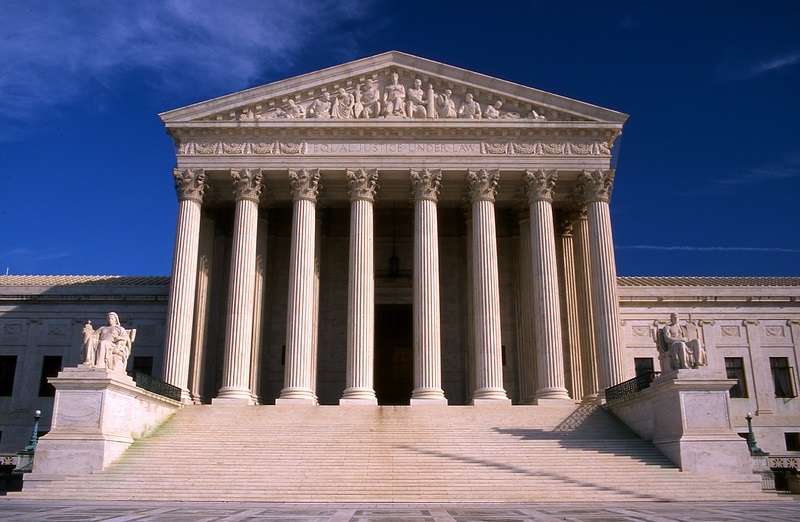
So then, the hunt was on to find a judge who will declare Trump ineligible to be president. And attention turned to two “lean Democratic” states where Democrats dominated the Supreme Court.
Flip it around and this is exactly what shitass' lawyers have been doing for 3 years. Shopping for the most hungry and conservative judges around. Fortunately they got it wrong a lot.
If SCOTUS Won’t Enforce the 14th Amendment, We Should Worry How They’ll Handle the 22nd
"The fraught debate over whether the 14th Amendment disqualifies Trump, explained "The bad-faith argument against good-faith accountability for Trump "One well argued legal opinion seemingly poised to get it wrong - if the conservative justices actually believe in originalism, they must disqualify Trump"" "
Ian Bassin Tuesday, February 6, 2024, 1:24 PM
If the Court won’t impose Section 3 restrictions in favor of “letting the voters decide,” will they let a presidential candidate vie for a third term?
Fast forward to August of this year: The Democrats are convening in Chicago to make their presidential nomination official. Behind the scenes, a secret scramble is in the works. With polling continuing to show the incumbent trailing badly, and protesters in the streets opposing the president’s support for the war in the Middle East invoking images of 1968 .. https://www.politico.com/news/2023/04/11/looking-back-at-the-1968-democratic-national-convention-00091441 , the president and his advisers conclude it would be in the best interests of the country if he stood down. Trying to cast the convention more as the RNC in Chicago in 1860 than the DNC in Chicago in 1968, they decide to throw the nomination open to the delegates so a more competitive candidate can emerge.
After three days of raucous floor argument unlike any seen in nearly a century, the delegates converge on two conclusions: First, the threat Donald Trump poses to the Republic is existential, and all other considerations aside, they must pick the person most likely to beat him; and second, the most popular figure out there with the best track record of unifying the Democratic coalition to win a hard national election is Barack Obama.
Of course, the objection is raised that Obama is ineligible, having already served two terms. The 22nd Amendment to the Constitution is clear: “No person shall be elected to the office of the President more than twice.” Butthat objection is met with a powerful rejoinder: Donald Trump is ineligible as well, barred by Section 3 of the 14th Amendment for having engaged in insurrection and having given aid and comfort to insurrectionists. Earlier this year, bowing to fears that Trump and his supporters might unleash chaos or violence if he was struck from the ballot, and accepting—at least implicitly—the argument that voters, not courts .. https://www.axios.com/2024/01/28/haley-trump-2024-election-ballot-voters .. , should decide who to elect, the Supreme Court declined to enforce the terms of the 14th Amendment against Trump.
Tired of one standard applying to Donald Trump and another to everyone else, Democrats rally behind Obama and, on the fourth day, nominate him by acclamation. States led by Republican officials refuse to place him on the ballot, citing his ineligibility. But states led by Democratic officials, following the Supreme Court’s declination to bar Trump, place Obama on the ballot, putting him on the ballot in enough states to potentially win 270 Electoral College votes.
Trump supporters in Michigan sue, and the case quickly reaches the Supreme Court. What should the Court do? In this imagined future, what is the Court likely to do?
Until recently, the answer to the first question was uncontroversial: It should strike Obama from the ballot. But in this scenario, the answer to the second question is much harder: The Court would have to know that keeping the likely Republican nominee on the ballot but knocking the preferred Democrat off would render it partisan beyond repair.
This scenario is of course solely for purposes of illustration. Joe Biden is not going anywhere. But one aspect of it is not entirely made up. While Barack Obama has never suggested running for a third term, Donald Trump has. Repeatedly.
Notwithstanding the implausibility of this argument as a legal matter, it is not hard to see how, if returned to power, Republicans might rally behind it in 2028 just as Democrats might rally behind Obama in the tale just told, especially if the Supreme Court decides this year that it is not its job to enforce the Constitution to bar popular candidates from the ballot.
Which is just one of many reasons why the Court must do the hard thing this week and apply the terms of the 14th Amendment, regardless of where that leads, notwithstanding numerous good- and bad-faith objections .. https://protectdemocracy.org/work/trump-ballot-eligibility-colorado-supreme-court/ .. about why it would be imprudent for them to do so.
Now wait, some critics might say. The 22nd Amendment is different from the provision of the 14th Amendment at issue. The terms of Section 3, they might argue, are less straightforward than the two-term limit in the 22nd Amendment (or than the other requirements for the presidency, such as the requirements that presidents be at least 35 years old and natural-born citizens).
But to the extent any additional ambiguities exist as to what Section 3 means or how it applies (and I have my doubts as to whether they do—good lawyers can manufacture compelling arguments .. https://news.harvard.edu/gazette/story/2016/02/a-question-of-citizenship/ .. on both sides of even clear-seeming provisions), that doesn’t make it less susceptible to judicial resolution; it makes it more so! Interpreting contested constitutional provisions and determining when and how they apply is the very definition of what courts are for.
Just last week, the Oregon Supreme Court held .. https://www.nytimes.com/2024/02/01/us/oregon-legislators-walkout-supreme-court.html .. that 10 Republican state senators could not seek reelection because they disqualified themselves when, last year, they engaged in a weeks-long walkout in order to deprive the legislature of the quorum necessary to proceed with work. That’s a tactic both parties in Oregon have historically engaged in and so, in 2022, Oregon voters adopted a constitutional amendment designed to punish such behavior. Under the amendment, legislators who have more than 10 unexcused absences are prohibited from seeking reelection.
The voters of Oregon, having lived through a problem with the functioning of their government far less severe than the Civil War, used a democratic process to add a requirement to their Constitution further limiting who they would permit to serve in public office. The provision had some ambiguities in it, but that didn’t stop the highest court in the state from interpreting those and enforcing what it concluded was the purpose for which the provision was enacted.
A Google search of news stories about the Oregon Supreme Court enforcing this decision turned up no hits for the word “anti-democratic.” I suspect that is because the recency of Oregon voters’ expressing their will to add this restriction creates the impression that the court is enforcing the democratic will of voters rather than restricting it.
The 14th Amendment case before the U.S. Supreme Court is no different—it’s just that the democratic will that would be enforced by striking Trump from the ballot is a will expressed by Americans 150 years ago, in response .. https://www.supremecourt.gov/DocketPDF/23/23-719/295994/20240118094034746_Trump%20v%20Anderson.pdf .. to the national crisis of the 1860s. And so it feels to many Americans like, in this case, the Court’s restricting who voters can vote for is less democratic.
But restricting our choices in order to preserve our freedoms is a paradox humans have honored literally for millennia—at least since Homer wrote of Odysseus tying himself to the mast.
The drafters of our Constitution understood this paradox. They knew that giving we the people sovereignty posed risks that we’d make choices that might squander it. To avoid the risk that voters might be tempted by the appeals of dynasty, they required presidents to be at least 35 years old. To avoid the risk that voters might be tempted by the appeals of a British nobleman and brought back under the thumb of the king, they required presidents to be natural-born citizens. To avoid the risk that voters might be tempted by the appeals of a popular long-serving incumbent, they required presidents to serve no more than two terms. And to avoid the risk that voters might be tempted by a demagogue uncommitted to the oath of office, they required presidents to not have violated a previous oath by engaging in insurrection.
The Court’s job is to play the role of Odysseus’s fellow sailors. Odysseus had his shipmates put wax in their ears so they wouldn’t be tempted by the siren’s song, just as our Framers gave the justices life tenure so as not to be swayed by the temporary passions of political majorities. So that he could hear the beautiful singing himself, Odysseus had his shipmates leave his ears open but tie him to the mast. Upon hearing the song, Circe warned, Odysseus would demand he be untied. It was at that moment, the goddess said, that his shipmates would need to yank the lash tighter.
A faction in this country is crying out in response to Trump’s appeals for the Court to loosen the ties when history teaches this is the moment for the justices to tighten them.
Because if the Court isn’t willing to impose the restrictions of the 14th Amendment in the face of today’s siren song of “letting the voters decide,” what does that say about the likelihood that they’ll do so when the 22nd Amendment is at stake? If the justices release us from the constraints we placed on ourselves in the 14th Amendment, limiting our own choices in order to preserve democracy, then our ship of state may, to quote Homer, “smash[] upon rocks as sharp as spears,” and our democracy may “join the many victims of the Sirens in a meadow filled with skeletons.”
Tyranny of the Minority’ warns Constitution is dangerously outdated
""The fraught debate over whether the 14th Amendment disqualifies Trump, explained "The bad-faith argument against good-faith accountability for Trump "One well argued legal opinion seemingly poised to get it wrong - if the conservative justices actually believe in originalism, they must disqualify Trump""" [...] A Trump win this year would be deeply dangerous for American democracy. Yet taking away voters’ option to choose him would pose its own perils. It would inevitably be seen as blatant election theft by much of the country — which would trigger responses, both from Republicans in office and Trump supporters on the ground, that could degrade democracy even more severely. [Insert: i reckon he'll stay on ballots, that's cool by me. It will give us further insight into the American electorate at this time. And it wouldn't take away from the Colorado argument that he shouldn't be there. The big worry about that is Blights and the other concern then that Section 3 would become null and void. That... https://investorshub.advfn.com/boards/read_msg.aspx?message_id=173831804] [...] So let’s zoom out and ask the real question at the heart of all this: Would disqualifying Trump from the ballot in this way be a good idea, or would it be its own sort of affront to democracy? P - Many democracies have struggled with the question of how to deal with a threat to democracy rising through the electoral system, and there are no easy answers. In October, I spoke with Harvard political scientists Steven Levitsky and Daniel Ziblatt, who just co-authored a book, Tyranny of the Minority .. https://www.amazon.com/Tyranny-Minority-American-Democracy-Breaking/dp/0593443071?ots=1&ascsubtag=___vx__p_23644648__t_w__r_google.com__d_D , on the US’s democratic crisis, about the options. P - Ziblatt noted Hans Kelsen, an Austrian legal theorist in the 1930s, who he said “made the case that if you really believe in democracy, you have to be willing to go down on a sinking ship and come back another day.” In Kelsen’s view, the only defensible solution to authoritarians rising in the democratic system is to beat them at the ballot box. P - With the rise of the Nazis, that thinking obviously didn’t age well, said Ziblatt. “I think that’s naive,” he said. “This idea that we need to just stand by and let our democracy come under assault and hope everything will work out — it turned out not to work out.” [...] So the post-World War II German constitution set up a procedure and a legal framework by which certain politicians or parties deemed dangerous to the constitution could be restricted from running for office. “It’s a very complex and highly regulated procedure,” said Ziblatt — involving federal and state offices, a bureaucracy, court approval, and necessary legal steps — because disqualification is such a “potentially dangerous and powerful device.” P - Other countries have adopted similar approaches, which are known as “militant democracy” or “defensive democracy.” The idea is to protect democracy by excluding the threats to it from the political scene. [...] The case against disqualifying Trump Butthe problem with the 14th Amendment option, both Levitsky and Ziblatt told me, is that the US did not establish a consistent procedure or institutional authority for excluding candidates after the Civil War. “We have no agreed-upon institutional mechanism in place, no electoral authority, no judicial body with precedent and practice that all the major political forces agree should be empowered to make this decision,” Levitsky said. P - Long-standing institutions and procedures provide credibility; ideally, they help assure the nation that these decisions aren’t ad hoc, arbitrary, and politicized — as they are in many countries. In Latin America, Levitsky says, disqualification is often “badly abused” to exclude candidates the powers that be simply don’t want to win."
Christy DeSmith Harvard Staff Writer September 12, 2023
Steven Levitsky and Daniel Ziblatt urge institutional reforms, rejection of candidates who violate norms in ‘How Democracies Die’ follow-up
The U.S. Constitution desperately needs updating, say Harvard government professors Steven Levitsky and Daniel Ziblatt.
“We have a very, very old constitution; in fact, the oldest written constitution in the world,” notes Ziblatt .. https://scholar.harvard.edu/dziblatt/home , the Eaton Professor of the Science of Government. “It was written in a pre-democratic era. It hasn’t been amended much compared to other democracies. As a result, we have these institutions in place that most other democracies got rid of over the course of the 20th century.”
In their new book “Tyranny of the Minority,” the comparative political scientists argue that these antiquated institutions, including the Electoral College, have protected and enabled an increasingly extremist GOP, which keeps moving farther to the right despite losing the popular vote in all but one of the last eight presidential elections. The scholars also survey governments worldwide for examples of democratizing reforms. And they draw from history in underscoring the dangers of our constitutional stasis.
Levitsky and Ziblatt’s 2018 bestseller, “How Democracies Die,”drew from global case studies to argue that Donald Trump represented a threat to core democratic principles, even flagging the possibility that he would refuse to cede power. Today, in light of the 2020 election — and the 147 Congressional Republicans .. https://www.vox.com/2021/1/6/22218058/republicans-objections-election-results .. who voted to overturn the results — the authors say it’s clear the threat is larger than Trump.
“The new book makes the case that large segments of the Republican Party leadership have lost commitment to democratic rules of the game,” said Levitsky, the David Rockefeller Professor of Latin American Studies .. https://drclas.harvard.edu/people/steven-levitsky-0 .. and Professor of Government and director of the David Rockefeller Center for Latin American Studies at Harvard. “The fact that the party remains radicalized means the challenge is ongoing.”
GAZETTE: You write that many U.S. institutions have fallen out of step with our peer democracies. What are some examples of this?
LEVITSKY: The United States has a plethora of counter-majoritarian institutions, some of which are essential to democracy. Our independent judiciary and our Bill of Rights are two examples. But we also have a set of counter-majoritarian institutions that don’t exist in most democracies and are arguably antithetical to democracy. The most obvious one is the Electoral College, which allows those who win fewer votes to capture the presidency.
Another is the U.S. Senate, which gives vast overrepresentation to sparsely populated states like Vermont and Wyoming and the Dakotas. It has repeatedly allowed the party that wins fewer votes to win control of the Senate. In addition, the filibuster is a super-majority rule; you need, in effect, 60 votes to pass legislation in the Senate.
ZIBLATT: I would add to that list also this: a federal judiciary with lifetime appointments. This structure allows political minorities from the past to dominate present-day majorities. I want to emphasize that Steve and I are not advocates of untrammeled majorities. But the combination of all these institutions leaves the U.S. in a situation where majorities have a harder time governing than any of our peer democracies — including many that according to all metrics are more vibrant democracies than our own.
--- “The United States did not become what contemporary political scientists would call a democracy until 1965.” Steven Levitsky ---
GAZETTE: You note that our Constitution, drafted in a pre-democratic era, inspired many nascent democracies. But other governments have done more to update their constitutions. What are some of the key reforms seen elsewhere?
ZIBLATT: Most countries began the 20th century with upper chambers, or the equivalent to the Senate — the House of Lords in Britain, Germany’s Bundesrat. In places where they continue to exist, they were made much more proportional to population after 1945.
LEVITSKY: When Latin America became independent in the 1820s, Latin American elites designed their constitutions with the United States as a model. Therefore, the indirect election of the presidency was commonplace across the 19th and into the 20th century. All of these countries, over the course of the 20th century, eliminated their electoral colleges.
GAZETTE: The Electoral College comes off as a real relic in the book. How has it survived?
LEVITSKY: There have been serious efforts to abolish the Electoral College. In the late 1960s, a proposed constitutional amendment to replace it with direct presidential elections was supported by President [Richard] Nixon and leaders of both major parties, and it had majority support in both houses of Congress. It passed the House but failed to get the two-thirds majority needed in the Senate.
GAZETTE: One chapter revisits the United States during the late 19th century amid the backlash to Reconstruction and makes comparisons to the challenges of today. What are some of those parallels?
ZIBLATT: The first is that the pushback was often by political leaders who were interested in protecting their own interests. Southern Democrats were worried about being overwhelmed, in their view, by Black voters, who were majorities in many Southern states and by and large voted for the Republican Party. The second is the passage of various voting restrictions, essentially disempowering huge segments of the population. We call this constitutional hardball, where politicians pass laws to undermine democracy.
LEVITSKY: We don’t tend to focus much on this as Americans, but there were coups during the Reconstruction period — violent seizures of power, stolen elections. And authoritarian rule was consolidated via constitutional hardball, as Southern legislatures violated the 15th Amendment by using poll taxes, literacy tests, and other measures to strip African Americans’ right to vote for more than 70 years. The United States did not become what contemporary political scientists would call a democracy until 1965.
--- “Even if we get through the 2024 election with our democracy intact, unless we reform our democracy, we will remain in this fragile position where every national election is a national emergency.” Daniel Ziblatt ---
GAZETTE: You also write about “semi-loyal democrats.” Who are they, and why do you consider them such a threat to democratic principles and policies?
The real testbetween a loyal and a semi-loyal democrat is: What do they do when a threat to democracy emerges in their own camp? A loyal democrat is willing to cross the aisle and work with political rivals to isolate and defeat authoritarians. Semi-loyalists do not. When an authoritarian threat emerges, they will tolerate and even condone it. They will downplay violence and abuses of power or refuse to speak out against them. And they will refuse to work across the aisle in defense of democracy. That, unfortunately, is exactly what we saw after the 2020 election.
GAZETTE: You write that the U.S. is either becoming a truly multiracial democracy or we will not be a democracy at all. Where do things stand at this moment?
ZIBLATT: America has two different strands in its political life. On the one hand, overwhelming majorities support liberal democracy. Younger Americans also tend to be much more open to the demographic changes taking place. On the other hand, there is always a reaction to efforts to make our society more democratic. What we’re seeing in the lead-up to the 2024 election is a continued battle between these forces.
One of the points of our book is that the latter force tends not to be a majority, but we continue to be vulnerable given our institutions. We got through the 2020 election, just barely. Even if we get through the 2024 election with our democracy intact, unless we reform our democracy, we will remain in this fragile position where every national election is a national emergency.
GAZETTE: What can the individual citizen do to push for some of the reforms you see elsewhere?
ZIBLATT: In the short term, voting is critical. And specifically not voting for people who break democratic norms. In the long run, we have to change the structure of our politics. We propose a set of institutional changes in the book, but institutional reform doesn’t just happen on its own. It requires mass mobilization — generations of people pushing for institutional changes. One of the most inspiring examples for us was tracing the rise of the women’s suffrage movement .. https://www.archives.gov/education/lessons/woman-suffrage .. through the 19th century. It took generations of women to change voting rules in the United States.
LEVITSKY: Don’t get tired. Don’t lose patience. Reconsolidating our democracy is going to take years and maybe decades. There will be wins. There will be losses. The women’s suffrage movement and the Civil Rights Movement show just how hard and long and slow a process this can be.


 Market Data
  Markets


 AI
AI