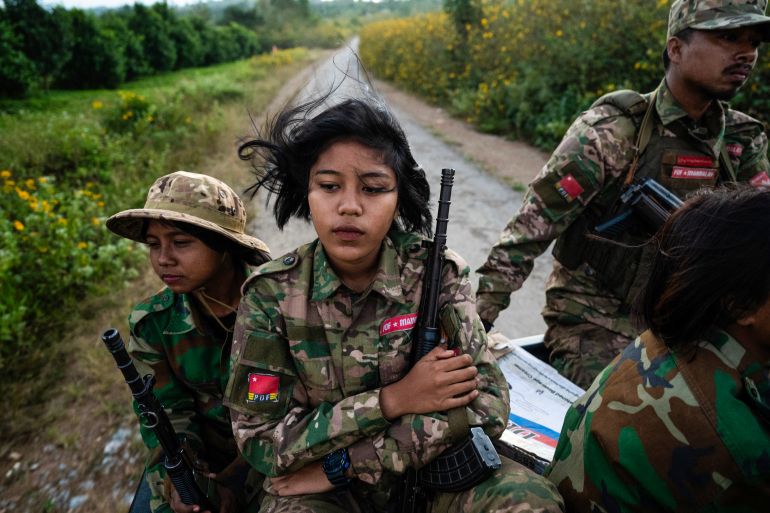
In America Trump et al tear down - ‘Blood and sweat’: Myanmar resistance fights to overturn military coup
"Rebels Are Notching Key Wins Against the Military Junta in Myanmar "Myanmar’s Democratic Vision Depends on Including Rohingya, Other Ethnic Minorities "The Muslim Overpopulation Myth That Just Won’t Die "Aung San Suu Kyi spent her life playing cat and mouse with Myanmar's generals. Did she lose the final round?"" A Genocide Incited on Facebook, With Posts From Myanmar’s Military [...]While Facebook took down .. https://www.nytimes.com/2018/08/31/world/asia/myanmar-genocide-facebook-military.html .. the official accounts of senior Myanmar military leaders in August, the breadth and details of the propaganda campaign — which was hidden behind fake names and sham accounts — went undetected. The campaign, described by five people who asked for anonymity because they feared for their safety, included hundreds of military personnel who created troll accounts and news and celebrity pages on Facebook and then flooded them with incendiary comments and posts timed for peak viewership. https://investorshub.advfn.com/boards/read_msg.aspx?message_id=166296822"
Just heard those who have been fighting the military junta for three years, now control about 80% of the country. The military still has the major population areas, but their control of the country apparently is more tenuous than ever.
Three years after the generals’ power grab, anti-coup fighters say they want them out of Myanmar’s politics.
Myanmar's anti-coup forces have made major gains in recent months [AFP]
By Emily Fishbein, Jaw Tu Hkawng and Hpan Ja Brang Published On 1 Feb 20241 Feb 2024
On February 1, 2021, a military coup in Myanmar sparked widespread nonviolent protests that quickly turned into an armed uprising after the military responded with brutal force.
Resistance forces share not only a common enemy but also a desire to overturn Myanmar’s military-dominated political system and establish a federal democracy that grants the right to self-determination for its ethnic minorities.
Al Jazeera spoke with four people who are part of the armed resistance.
They come from different backgrounds and are serving with different groups, but nonetheless share the same broad political goals, as well as a will to advance a more just and equitable society.
They are using their noms de guerre to protect their families from military reprisals.
Ma Wai, 32, Bamar People’s Liberation Army
The BPLA, established in April 2021 by activist and poet Maung Saungkha, is the country’s only armed resistance group identifying with the ethnic Bamar majority, and which specifically seeks to combat the dominant role of Bamar people in Myanmar society. Since late October, it has taken an active role in Operation 1027, a joint offensive .. https://www.aljazeera.com/news/2023/11/3/northern-offensive-brings-new-energy-to-myanmars-anti-coup-resistance .. that has brought major gains for anti-coup forces.
Ma Wai returned to her village in the Bago region from Dubai during the pandemic, with a plan to go back and resume her job as a chef at a four-star hotel once travel restrictions eased. Then the coup happened, and she joined street demonstrations instead.
Ma Wai, previously a chef in Dubai, joined the forces fighting to remove the military in May 2021 [Supplied]
Weeks later, soldiers and police were firing live rounds, and Ma Wai was tending to a wounded protester. “I saw the blood flowing with my own eyes,” she said. “The incident was so vivid and devastating that it will haunt me for the rest of my life.”
Soon, her peers were taking up arms in the jungle, but Ma Wai initially hesitated to join them. Her job in Dubai had provided the main source of income for her widowed mother and two younger brothers, who are both in their 20s, and she worried about how they would get by if she didn’t go back.
Still, her commitment to resisting the military won out, and she confided her decision to her brother the day before her planned departure for the jungle. “He told me, ‘Sister, you’re a girl, so don’t go. As a boy. I can do more, so I’m supposed to go,’” she recalled.
Ultimately, however, their mother gave them both her blessing. “[She] decided, ‘You both should go as you made this decision for the people,’” said Ma Wai.
In May of 2021, she and her brother enlisted in one of thousands of groups forming across the country at the time, commonly known as people’s defence forces (PDFs). Like many PDFs, theirs was based in the territory of the Karen National Union, Myanmar’s oldest ethnic armed organisation. Although it signed a ceasefire with the military in 2012, it has resumed its fight for self-determination since the coup, while also participating .. https://www.aljazeera.com/news/2022/5/6/holdmyanmar-how-the-karen-became-crucial-to-the-resistance .. in the country’s wider pro-democracy struggle.
Ma Wai joined the resistance intending to fight until the end, but her plans soon began to falter. Her PDF’s leaders seemed not to have a clear plan for its recruits, who began returning to their towns and villages after completing the group’s 10-day military training.
“I knew that the training wasn’t enough for me to fight against the military, but when I thought about returning home, I didn’t want to go back either,” said Ma Wai. “I really wanted to connect with a group that could provide weapons and train us well.”
The opportunity came that August, through a chance encounter with BPLA leader Maung Saungkha. As he spoke about the group’s philosophy and approach, as well as its equal treatment of women and men, Ma Wai’s direction became clear. “I felt that he wasn’t talking like an election campaign, but expressing his determination, vision and mission,” she said. “I realised that this was the kind of group I wanted to join.”
Her brother came to the same decision, and soon after, they were climbing rugged mountains in the heavy rain and linking arms with their new comrades to cross rushing streams. When they reached their new camp, they underwent a training programme far more rigorous than the first – so much so that Ma Wai’s legs became stiff and swollen, and her trainers told her to seek medical attention.
Realising her limitations, she said, was even harder than enduring the ache in her legs. “The trainers didn’t allow me to continue even though I straightened up and tried to force myself,” she said. “It was the most painful moment for me.”
A fighter from the anti-coup People’s Liberation Army forces engaged in a battle with the military government in the Sagaing region in November [Reuters]
She later completed the training after receiving treatment for vitamin B12 deficiency and began serving in a logistical role to manage the distribution of rations to BPLA soldiers. A year later, she was transferred to the finance and support department, and now supervises the BPLA’s administration office.
Ma Wai estimates that while one-tenth of the BPLA’s members are female, women make up about a third of people serving in leadership roles. While Ma Wai said she hasn’t faced any discrimination as a woman, she acknowledged that she initially had to work extra hard to demonstrate her capabilities, especially to some of her male comrades.
“Sometimes … they looked at me as if I didn’t know anything, but that was in the early days,” she said. “When we worked together, they came to understand me more and appreciate my talent.”
“In the past, I neglected to know about the [other] ethnic groups, their suffering and losses, and I acted like it wasn’t my business,” she said. “I also didn’t notice that I was privileged as a Bamar.”
Serving in the BPLA has also offered her the chance to study political theory. “Before this armed revolution, I called and shouted for federal democracy for our country in protests, but honestly, I didn’t really know why this system was important for our country or what federalism or democracy were,” she said. “I became aware of why Myanmar people are asking for it with their blood and sweat … If the political system is bad, I know how much the people of the country will be affected.”
Khun, 31, Karenni Nationalities Defence Forces
The Karenni Nationalities Defence Forces (KNDF) is a coalition of armed resistance groups in Myanmar’s southeastern Karenni State (also known as Kayah State .. https://www.aljazeera.com/news/2024/1/29/in-myanmars-kayah-medics-treat-war-wounded-in-hidden-hospitals ). Peaceful for nearly a decade leading up to the coup, the state has since seen heavy fighting, which despite a major disparity in arms, has resulted in major gains for resistance forces. Since launching a new operation in November, they have been closing in on the state capital and coming nearer to liberating the entire state from military control.
A migrant worker in Malaysia until 2019, Khun returned to his village in Karenni State’s Demoso township at a time when opportunities for young people were opening up under the Aung San Suu Kyi-led semi-civilian government. The coup, however, crushed his optimism. “I lost all my dreams and felt depressed,” he said.
A fighter from the Karenni resistance forces in a building captured from the military in the state capital Loikaw [Myo Satt Hla Thaw/Al Jazeera]
Demoso township was a particular target, and Khun, like most others from the area, has been repeatedly displaced. “The military council always attacks us at irregular times, like when people are asleep,” he said. “These attacks really affect our mentality, and leave us depressed and disturbed.”
Wanting to do more for the resistance, Khun joined the KNDF in January of 2022. “In this revolution, I’m trying my best to participate in every way, whether by saving a life or fetching a bucket of water,” he said, referencing a Burmese proverb: “A single sesame seed cannot produce much oil, which requires the use of many seeds.”
He said the decision was motivated not by vengeance, but by a desire to bring positive change to his society. “Our [Karenni] ethnic people need and want self-determination and autonomy, and to be able to practise our culture and language,” he said. “I want us to have a nation where people of all ethnicities can coexist, and for there to be genuine peace.”
As an armed combatant, he also emphasised the importance of adhering to high ethical standards and international humanitarian law. “I want to have a clear conscience in this revolution,” he said.
Now overseeing rations distribution and fundraising for his battalion, while also helping to coordinate humanitarian support for displaced civilians, his work has become significantly harder since fighting began intensifying in November.
Displacement has surged, while the military has also cut off telecommunications access across the entire state. Khun spoke to Al Jazeera using Starlink, a satellite-based technology owned by billionaire Elon Musk which several resistance forces in Myanmar began using last year.
Members of the Chin National Army train at their headquarters of Camp Victoria in December [Aaakash Hassan/Al Jazeera]
Still, he expressed optimism when considering the state of the Karenni resistance, which began with percussion-lock rifles and other hunting weapons and is now a well-organised force equipped with drones and machine guns.
“In the past, we had to defend ourselves, but now, we’re attacking,” said Khun.
Nehemiah, 23, Chin National Army
Established in 1988, the Chin National Front entered a ceasefire with the military in 2012 but resumed its armed struggle after the coup, while also training and supporting newly-formed resistance groups through its armed wing, the Chin National Army. Since late October, the CNA and allied Chin forces have seized strategic posts at the Indian border and driven out the military from multiple towns and villages.
Nehemiah, from a village in Chin State’s Thantlang township, dropped out of university to join the CNA in 2019, when he was 19, out of a desire to protect the land inhabited by his ethnic people and promote the establishment of an autonomous Chin nation.
Since the CNF was in a ceasefire with the military at the time, he travelled 5,000 kilometres (3,107 miles) to Myanmar’s northeastern border with China, where he trained instead under the Kachin Independence Army, one of Myanmar’s strongest ethnic armed organisations.
When he returned home months after the coup, it was to a dramatically different situation. Anti-military sentiments had merged with a surge in Chin nationalism and the CNA’s numbers had swelled. More than a dozen new resistance groups had also emerged, many with the CNF’s support.
“After witnessing innocent people being killed without reason and experiencing the brutality of the Myanmar military, many people became more accepting of the armed revolution,” said Nehemiah.
[Insert: Think Gaza]
Video Duration 01 minutes 31 seconds 01:31 [As the defenders in Ukraine, the rebels in Myanmar build war drones.]
Now serving as a brigade captain, he has spent most of his time on the front line, applying the skills he learned in Kachin to fight the military on Myanmar’s northwestern front
“The thing I am most proud of is that when we joined the battles, we stood firmly with our young subordinates and supported them with kindness, and that I complied with the chain of command from my seniors,” he said.
But in a state known for its remote, mountainous terrain and high linguistic diversity, coordination has at times been difficult. “When it comes to our strengths and challenges, my response is very simple: unity and disunity,” said Nehemiah.
He also expressed concern that over time, public support for the resistance might wane, and called for Chin people to come together so that the recent momentum on the battlefield could continue to accelerate. “Sooner or later, we will defeat the military if we all are united,” he said. “Many of my people and friends lost their lives during this revolution, and a lot of innocent blood was shed, so I am determined to continue fighting until we win.”
Noble, 24, People’s Defence Force Dawei District
The People’s Defence Force Dawei District, based in Myanmar’s southernmost Tanintharyi region, is one of many resistance forces operating under the command of the National Unity Government, a parallel administration made up of elected politicians and activists who oppose the coup. Although the conflict in Tanintharyi has not reached the levels of intensity seen in many parts of the country, the region has nonetheless seen periods of intense fighting and displacement.
Noble, a university student union leader in Tanintharyi’s regional capital of Dawei before the pandemic, is one of millions of students across Myanmar who boycotted classes after the coup as part of a wider civil disobedience movement. Active in nonviolent protests, she also participated in a campaign to convince the staff of her university to go on strike.
Women from the People’s Defence Forces Dawei District mark the end of their combat training with a graduation ceremony [Supplied]
Fearing arrest, she left home shortly after the military power grab and began moving from place to place. Soldiers and police raided her home that November; unable to find her, they looted her family’s valuables and arrested her mother and 17-year-old sister instead.
Her sister was released three days later, but her mother was given a two-year sentence for incitement, a charge the military has commonly levelled against activists and dissidents since the coup. It has also jailed .. https://www.theglobeandmail.com/world/article-myanmar-military-junta-arrests-family-friends-of-protesters/ .. hundreds of people by association; Noble’s mother served a year and two months before being released in a prisoner amnesty.
Noble, for her part, enlisted in a PDF just a month after her mother’s arrest. Assigned to a non-combat support role, she has since been travelling through remote, coastal areas where even fetching water can be difficult. “Sometimes, I even forget that I’m a woman,” she said.
Just as she was getting accustomed to the new lifestyle, however, disaster struck. In September of 2022, military forces discovered her camp and encircled it as Noble and her comrades watched anxiously and began preparing for battle. They also called for reinforcements, but the military intercepted the attempt and arrested six of her comrades in the process. One escaped; Noble believes the other five are still in military custody.
Clashes erupted a few days later. Noble, who was still in the camp at the time along with two other comrades, received a message by walkie-talkie to begin a retreat. As they gathered the most essential items and fled to a safer place, a PDF member, who was serving as a scout during the camp evacuation, was shot in the hip.
“He tried to go to the place where we were gathering, but he couldn’t reach it,” said Noble. “We received a phone call from him saying that he had been injured and requesting help.” Advertisement
By the time Noble and her comrades reached him, dusk was setting in and rain was falling. As they attempted to dress the wound, they quickly realised they were ill-equipped to treat the 18-year-old fighter.
The next morning, they fastened him into a hammock and attempted to carry him to the nearest medical facility. But they struggled to find a route because there were so many military soldiers, and by the third day, the wound had become infected and the fighter died.
They buried him and continued walking for two more weeks in search of a place to set up camp, foraging for food along the way to supplement the last of their rice rations. They have since been working to regroup and rebuild, while also healing psychologically.
The experience, said Noble, has brought her closer to her comrades and also increased her empathy for displaced civilians. Although at times frustrated and discouraged, she said she gathers her strength by focusing on her comrades who lost their lives.
“Sometimes, it is uncomfortable for me to continue fighting and I want to return home, but when I feel that way, I consider that my fallen comrades would feel I had retreated halfway, and I want to continue,” she said.
Myanmar at standstill as silent strike marks third anniversary of coup
"Rebels Are Notching Key Wins Against the Military Junta in Myanmar [...]A Genocide Incited on Facebook, With Posts From Myanmar’s Military [...]While Facebook took down .. https://www.nytimes.com/2018/08/31/world/asia/myanmar-genocide-facebook-military.html .. the official accounts of senior Myanmar military leaders in August, the breadth and details of the propaganda campaign — which was hidden behind fake names and sham accounts — went undetected. The campaign, described by five people who asked for anonymity because they feared for their safety, included hundreds of military personnel who created troll accounts and news and celebrity pages on Facebook and then flooded them with incendiary comments and posts timed for peak viewership. https://investorshub.advfn.com/boards/read_msg.aspx?message_id=166296822"
Towns and cities empty during protest on anniversary of military takeover and arrest of Aung San Suu Kyi
Rebecca Ratcliffe in Bangkok and Aung Naing Soe Thu 1 Feb 2024 22.53 AEDT Last modified on Fri 2 Feb 2024 00.38 AEDT
A pedestrian crosses an almost empty street in Yangon during the ‘silent strike’. Photograph: AFP/Getty Images
Three years since the military detained political leaders including Aung San Suu Kyi, its grip on power is more uncertain than at any point in the last six decades, according to analysts. The UN says two-thirds of the country is experiencing conflict.
Images taken by independent media on Thursday morning in Yangon showed normally busy intersections empty. Similar scenes were shared on social media from Mandalay, Mawlamyine and Monywa.
“Myanmar people don’t accept the military’s participation in politics, or their human rights violations,” said Nann Linn, a pro-democracy activist currently hiding in Myanmar .. https://www.theguardian.com/world/myanmar . “That’s why there is no way other than the complete surrender of the military. We will accelerate our movement more.” The military coup had failed because the junta has been unable to govern, she added.
On the eve of the coup anniversary, the junta extended a state of emergency by six months, while the US announced further sanctions.
The UN secretary-general, António Guterres, called for “sustained international and regional attention and coherent collective action to support the people of Myanmar”.
The coup, which has been strongly opposed by the public, provoked huge street rallies in 2021 that were brutally suppressed. Many people subsequently joined civilian defence forces to fight back against military oppression, fleeing to the jungle to train to fight, and receiving support from and fighting alongside older, ethnic armed groups seeking independence. Myanmar has since been gripped by spiralling conflict, leaving more than 2.6 million people internally displaced.
Members of Myanmar’s military security force patrol a street during the ‘silent strike’. Photograph: AFP/Getty Images
“Three years on from the Myanmar coup, the military’s hold on power is more uncertain than at any time in the last 60 years,” said Richard Horsey, senior Myanmar adviser to Crisis Group. But, he added, the military seemed determined to fight on “and retains an enormous capacity for violence, attacking civilian populations and infrastructure in areas it has lost, using air power and long-range artillery”.
Rights experts have previously accused the military of committing war crimes .. https://iimm.un.org/wp-content/uploads/2023/08/G2312500-1.pdf , including indiscriminate attacks on civilians from aerial bombing, mass executions and the large-scale and intentional burning of homes.
On Wednesday, the junta head, Min Aung Hlaing, said the military would do “whatever it takes” to crush opposition. It has denied abuses against civilians, saying its operations were designed to tackle terrorists and in the interests of security.
Aung San Suu Kyi, who was detained in the early hours of 1 February 2021, is serving a 33-year sentence over charges that have been widely dismissed as politically motivated. She has not been seen in public since, other than in images taken in a courtroom in Naypyidaw.
Her son Kim Aris, who lives in the UK, told Sky News he had received a letter from his mother in prison, the first communication he has had from her in three years. It said she was generally well but suffering from dental problems and spondylitis, a condition that inflames the joints of the backbone. The letter, which would have been read by the military, contained little detail.
Almost 20,000 political prisoners are detained across Myanmar, according to the Assistance Association for Political Prisoners (Burma), a local monitoring group.
Ko Tayzar Sann, an activist in central Myanmar, said: “The main message that we would like to deliver is that the Myanmar people will never be cowed by the terrorising, power-stealing junta. We rang our bell to the whole world – including the military.”
He recalled the confusion on 1 February 2021, as news of the coup emerged. “We didn’t have phone line and internet, but we could confirm the news in the afternoon,” he said. “Everyone was sad and angry. No one accepted this action.”
Since then, lives have been turned upside down. “We have experienced the terrorist killings, torture and devastation carried out by the military,” he said. At the same time he had also seen the dedication and determination of the public to overthrow the military.
Many people were taking part in the silent strike, despite the military’s intimidation, Ko Tayzar Sann said. “What we have understood from these three years past, is that it is impossible for the military to rule or control the country. “The revolution side must prove that with action.”


 Market Data
  Markets


 AI
AI