What Israel’s video of ‘Hamas tunnel’ under al-Shifa tells us
"Opinion Guest Essay - What I Believe as a Historian of Genocide "International community is ‘failing to prevent genocide’ in Gaza, UN experts warn "For years, only one state solution viable -- Top UN official in New York steps down citing ‘genocide’ of Palestinian civilians" " "
The structure of the tunnel raises questions about whether it is indeed a Hamas-built pathway. An opening to a tunnel that, according to Israel's military, was used by Palestinian militants under Al Shifa hospital in the Gaza Strip as seen in this screen grab taken from a handout video released by the Israel Defense Forces on November 19, 2023.
VIDEO --Video Duration 06 minutes 05 seconds 06:05
By Sarah Shamim Published On 20 Nov 202320 Nov 2023
The Israeli military also released a 3D animated video .. https://www.youtube.com/watch?v=6pTYHBZVgVQ .. on October 28, visualising an extensive network of tunnels that led to an elaborate, multi-storey control centre.
The statement said that the tunnel was found “in the area of the hospital underneath a shed alongside a vehicle containing numerous weapons including RPGs [rocket-propelled grenades], explosives, and Kalashnikov rifles”.
The Israeli military also released a video that was recorded using two separate cameras on November 17. Spokesperson Daniel Hagari told reporters the entrance was uncovered when a military bulldozer knocked down the outside wall of the hospital, revealing a metallic spiral staircase that descended 10m (32ft) and led to a blast door, which is typically a metallic door with strong closures and hinges, designed to resist explosions. Such doors are usually found on facilities such as bomb shelters.
But military analyst Zoran Kusovac quoted a civil engineer from Gaza who suggested that the video is actually clips of two different tunnels spliced together.
The first section of the video shows the vertical shaft that goes down. It shows features such as load-bearing concrete columns. They seem to be built with regular civil engineering techniques, which would have required large and loud machines such as concrete mixers. Advertisement
Such a construction could not have been done in secret, the way Hamas tunnels are usually built. The purpose of this construction remains unknown.
The second part of the clip shows the horizontal tunnel. This displays features characteristic of Hamas tunnels — pre-fabricated pieces connected together section by section.
Was a Hamas control centre found under Gaza’s al-Shifa Hospital?
A control centre has not been found so far. Israeli troops have not yet tried to open the blast door at the end of the tunnel that they claim was under al-Shifa, fearing it could be booby-trapped, said Hagari.
Kusovac said that many different types of traps can be placed to prevent tunnel interceptions. Typically, they are improvised explosive devices (IEDs) connected with detonators that can be triggered by tripwire or even light or pressure. They detect the presence of a person entering the tunnel, setting off the explosive. “IEDs are basically like toys the big boys make. The more creative you are, the more successful you are,” said Kusovac.
If armies suspect the presence of such traps, typical regulations are to call explosion experts who arrive and assess the situation. Kusovac said that this usually takes a few hours, not over a day. This time delay brings the veracity of the Israeli military’s claims into question. “You say smoking gun, you get to it and then you don’t show the smoking gun,” he said.
CNN, among other news outlets, visited the exposed tunnel shaft and confirmed the presence of a tunnel, but could not establish whether or not the tunnel led to a command centre.
Israel placed a blockade on the Gaza Strip after Hamas gained control of it in 2007. Tunnels became the means to bypass the siege and to transport food, goods and weapons. Under Hamas, the tunnels expanded strategically.
The tunnels are also used by Hamas for wired communications, since Israel can intercept wireless communications.
After attacking Gaza in 2014, Israel realised the extent and sophistication of the tunnels, then believed to have surpassed 100km (62 miles).
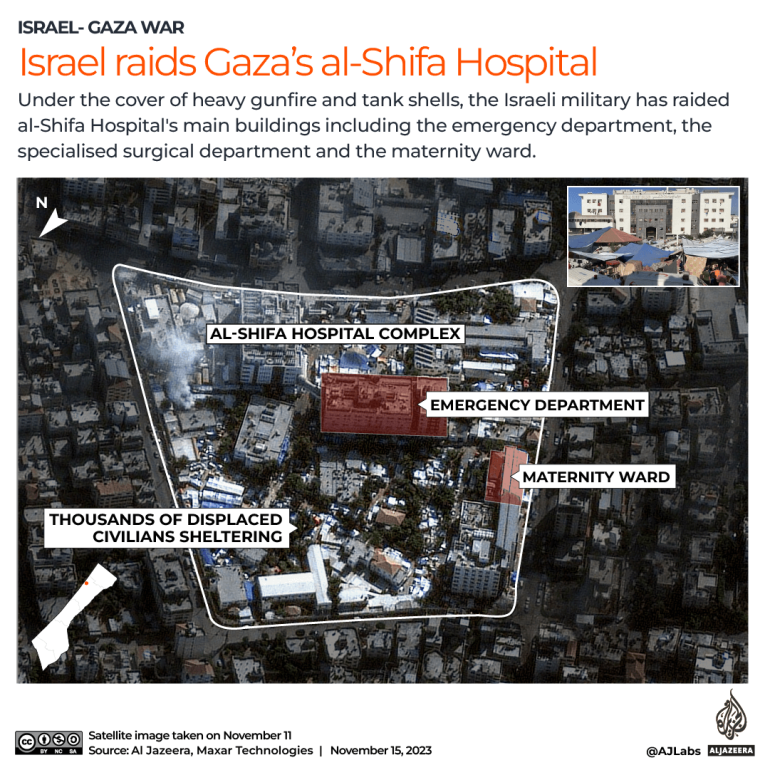
Satellite images and archival photos showed that the hatch that Israel claimed was the tunnel entrance was actually part of a water reservoir system that was used to fill therapeutic pools for amputees, water the grounds, and also was an emergency water source.
"Opinion Guest Essay - What I Believe as a Historian of Genocide "International community is ‘failing to prevent genocide’ in Gaza, UN experts warn "For years, only one state solution viable -- Top UN official in New York steps down citing ‘genocide’ of Palestinian civilians"""
The term is 80 years old. Everyone is still fighting over its meaning.
By David Faris Dec 13, 20235:45 AM
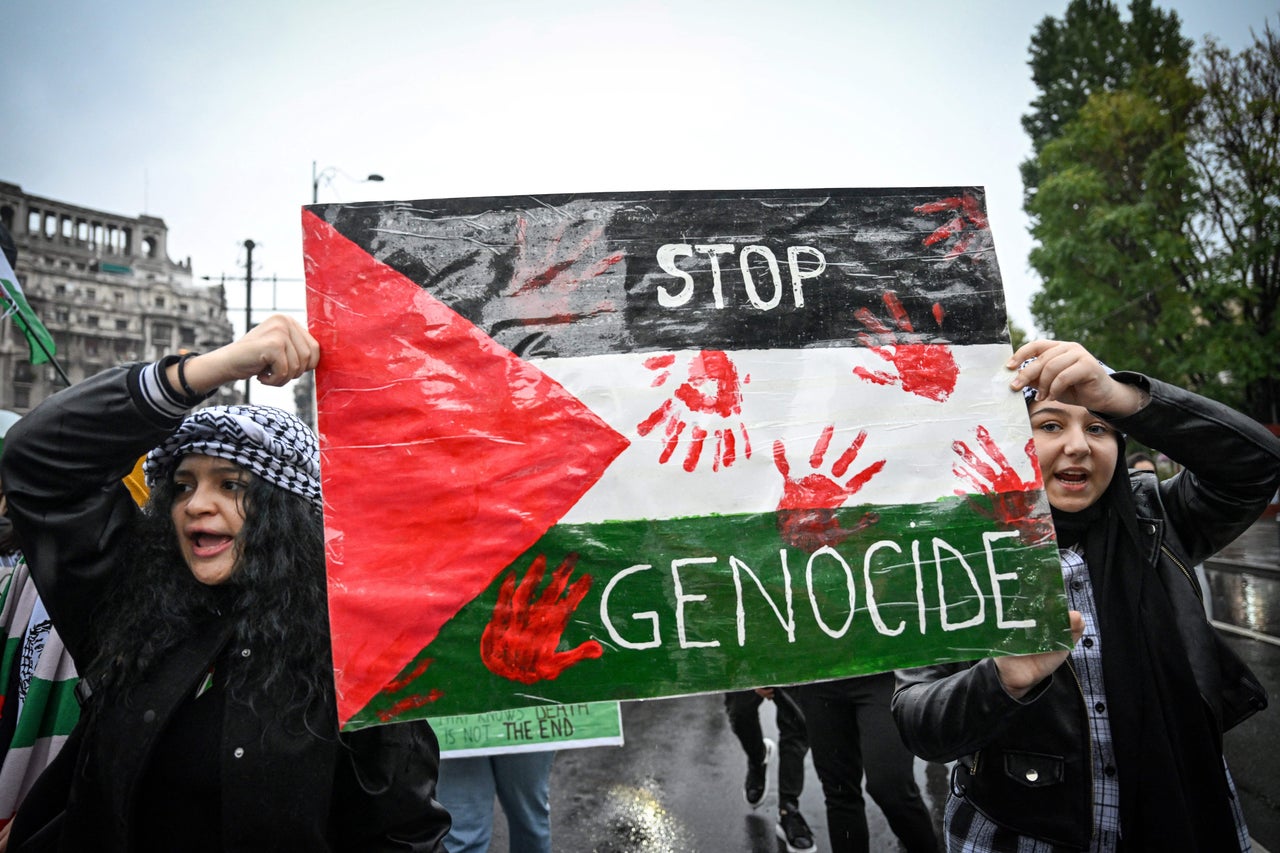
Marchers in Bucharest, Romania, Nov. 4. Daniel Mihailescu/AFP via Getty Images
Since Israel launched its military campaign against the Palestinian militant group Hamas after the horrific attacks of Oct. 7, the situation on the ground for Gazan civilians has deteriorated markedly. Israel ordered Palestinians to evacuate from the northern half of the Gaza Strip on Oct. 13, sparking a mass civilian exodus amid heavy aerial and artillery bombardment. As the ground campaign expanded on Oct. 27, it increasingly looked as if there was nowhere for civilians to go that was safe from violence. At least 17,000 Palestinians, most of them civilians, have already died, leading some activists and scholars to charge Israel with the grave crime of genocide.
The genocide rhetoric is now flying in both directions. At a House Education Committee hearing on Tuesday in which Republicans grilled the presidents of Harvard University, Massachusetts Institute of Technology, and the University of Pennsylvania about antisemitism on campus, New York GOP Rep. Elise Stefanik pressed the claim that activists chanting “From the River to the Sea, Palestine Will Be Free” or even using the Arabic word intifada (which, according to my trusty Hans Wehr Arabic-English Dictionary, means “shaking off” or, more colloquially, “uprising”) constitute “calls for genocide against Jews.” With the idea—both the word and the crime outlined in the United Nations Convention on the Prevention and Punishment of the Crime of Genocide—front and center in debates, it is worth taking the time to think systematically about what this accusation means and how it fits with existing international law. Advertisement
The U.N. Convention on the Prevention and Punishment of the Crime of Genocide was crafted in the aftermath of World War II, as part of an effort to understand the Holocaust, prevent a recurrence, and offer a potential crime for which German officials could be held accountable. The existence of the convention is itself quite remarkable. The term genocide had been coined only a few years earlier, by Polish lawyer Raphael Lemkin .. https://www.unhcr.org/ceu/9486-lemkin-raphael.html , and his advocacy on behalf of the concept has to be considered one of the most successful efforts in world history to give real weight to a neologism.
Yet, from its inception, both the concept and the Genocide Convention were controversial and contested. During negotiations, the legal term was subject to jockeying from the major powers, who wanted carve-outs to avoid culpability for their own actions, past or planned. The final product was, therefore, both extremely narrow in what it defined as outside the scope of the convention, and maddeningly vague. I spoke with Ronan Lee .. https://ronanlee.com/ , a vice chancellor and independent research fellow at Loughborough University London, who called it a “compromised document” due to its inherent limitations. “It’s a document of its time,” he noted. Nevertheless, it was an important innovation. “The very specific nature of genocide is that it’s a crime against a people,” he said.
The main text of the Genocide Convention is brief. It defines the crime as “intent to destroy, in whole or in part, a national, ethnical, racial or religious group, as such” by way of five acts: “Killing members of the group; Causing serious bodily or mental harm to members of the group; Deliberately inflicting on the group conditions of life calculated to bring about its physical destruction in whole or in part; Imposing measures intended to prevent births within the group; Forcibly transferring children of the group to another group.”
Notably excluded from the definition of genocide were political or class groups, at the insistence of the Soviet Union, which did not want its leaders hauled before tribunals for the Great Terror .. https://hum54-15.omeka.fas.harvard.edu/exhibits/show/reconciling_its_oppressive_pas/introduction , the Holodomor in Ukraine .. https://cla.umn.edu/chgs/holocaust-genocide-education/resource-guides/holodomor , or other Stalin-era mass killings. “The Soviet view was that they were destroying classes,” Lee argued. “So class is not listed.” This compromise made it more difficult to charge officials of Cambodia’s Khmer Rouge regime, which carried out a program of mass killing against its own citizens from 1975–79 but did not target any of the groups “as such” as outlined in the convention.
But the United States also contributed to limitations on the term’s scope. I also reached out to Ohio State University sociologist and genocide expert Hollie Nzitatira .. https://sociology.osu.edu/people/nzitatira.1 , who noted that “some countries, including the United States, wanted to exclude cultural groups so they, too, were ultimately excluded in the treaty.” The bracketing of multiple types of potential mass killing has provided, over time, a variety of paths for wrongdoers to escape culpability.
Even more than who was left out of the convention, the question of motivation looms large. The bar of “intent to destroy” leaves out all manner of wartime and peacetime atrocities, like reprisals against civilians, the deliberate targeting of civilian neighborhoods during bombing campaigns, and even so-called campaigns of “ethnic cleansing” and expulsions, which have been a depressingly frequent occurrence in the postwar world. And the establishment of intent remains vexing for those seeking to hold the perpetrators of genocide accountable.
Lee argues that the Nazis left a voluminous and unambiguous paper trail that established their intent to murder every Jew in Europe but that today’s would-be génocidaires are savvier. “Nowadays, people are aware of what the law is,” he told me, “and they are aware that intent to destroy is an issue” that could get you hauled before the International Criminal Court. Nzitatira says, “People often forget that intent can evolve over time and that there may not be a clear documentation of the intent of people implementing the genocide.” Governments have also become adept at driving trucks through the treaty’s holes. Officials of Myanmar, for example, have long claimed that they are not targeting the country’s Rohingya minority as such but rather addressing a security threat.
----- [Still think it would be good if the U.S. would ratify the Rome Statute.
[...]2. Is the US a member of the ICC? The US is not a state party to the Rome Statute. The US participated in the negotiations that led to the creation of the court. However, in 1998 the US was one of only seven countries – along with China, Iraq, Israel, Libya, Qatar, and Yemen – that voted against the Rome Statute. US President Bill Clinton signed the Rome Statute in 2000 but did not submit the treaty to the Senate for ratification. In 2002, President George W. Bush effectively “unsigned” the treaty, sending a note to the United Nations secretary-general that the US no longer intended to ratify the treaty and that it did not have any obligations toward it. However, since then, US relations with the court have been complicated but often positive (see question 7 below).
7. What has been the US relationship with the ICC? In the early years of the ICC, the George W. Bush administration led a hostile campaign against the court. For instance, the Bush administration pressured governments around the world to enter into bilateral agreements requiring them not to surrender US nationals to the ICC. But these efforts did little more than erode US credibility on international justice and gradually gave way to a more supportive US posture, starting in 2005. The US did not veto a UN Security Council request to the ICC prosecutor to investigate crimes in Darfur, Sudan in 2005 and it voted for the UN Security Council referral of the situation in Libya to the court in 2011. P - US support was critical in the transfer to the court of ICC suspects Bosco Ntaganda, a Congolese rebel leader, in 2012 and Dominic Ongwen, a Lord’s Resistance Army commander, in 2015. In 2013, the US Congress expanded its existing war crimes rewards program to provide rewards to people providing information to facilitate the arrest of foreign individuals wanted by any international court or tribunal, including the ICC.
8. What is the US position now on the ICC? Under President Donald Trump’s administration, the US government has said that it will not cooperate with the ICC and has threatened retaliatory steps against ICC staff and member countries should the court investigate US or allied country citizens. Then National Security Adviser John Bolton first announced this approach in September 2018. Two weeks later, President Trump addressed the UN General Assembly stating that the “United States will provide no support or recognition to the International Criminal Court. As far as America is concerned the ICC has no jurisdiction, no legitimacy, and no authority.” P - On March 15, 2019, US Secretary of State Mike Pompeo announced that the US would impose visa bans on ICC officials involved in the court’s potential investigation of US citizens for alleged crimes in Afghanistan. He indicated the same policy may be used to deter ICC efforts to investigate nationals of allied countries, including Israelis, and stated that the US would be prepared to take further actions, including economic sanctions, “if the ICC does not change its course.” The Trump administration confirmed in early April 2019 that it had revoked ICC Prosecutor Fatou Bensouda’s visa. P - Pompeo publicly threatened two staff members of the ICC on March 17, 2020, naming them and stating that he was “considering what the United States’ next steps ought to be with respect to these individuals and all those who are putting Americans at risk.” Pompeo said he wanted to identify people responsible for the investigation – and their family members – and implied he could seek actions against them. P - On May 15, 2020, Pompeo vowed to “exact consequences” if the ICC “continues down its current course” – that is, if the court moves forward with a Palestine investigation. P - Trump issued a sweeping executive order on June 11, 2020 authorizing asset freezes and family entry bans that could be imposed against certain ICC officials. The administration acted on September 2 to designate Fatou Bensouda, the ICC prosecutor, and Phakiso Mochochoko, the head of the Office of the Prosecutor’s Jurisdiction, Complementarity, and Cooperation Division, for sanctions. The executive order also provides for the same sanctions with regard to those who assist certain court investigations, risking a broad chilling effect on cooperation with the ICC. 9. Could the ICC open an investigation in Palestine? https://www.hrw.org/news/2020/09/02/qa-international-criminal-court-and-united-states#2; ] -----
There is no magic process that gets set into motion if a genocide is recognized as taking place.
Countries that have ratified or acceded to the treaty are obligated to “prevent or punish” it. The international community has a better track record, to put it mildly, of punishment than it does of prevention. Since the convention entered into force, there have been multiple instances of violence that appear to clearly fit the definition, including the 1994 mass murder of ethnic Tutsis in Rwanda, the ongoing massacres and expulsion of the Rohingya minority in Myanmar and the 2003–05 killings in the Darfur region of Sudan. None of these atrocities were addressed in a timely fashion by the signatories to the convention, and some campaigns that arguably meet the definition, like China’s mass detention of its Uyghur minority and other crimes against civilians .. https://www.cfr.org/backgrounder/china-xinjiang-uyghurs-muslims-repression-genocide-human-rights .. that remain “free,” are ongoing without much sign of active contestation from other countries.
In addition to those limitations, the Genocide Convention is also misunderstood in a variety of ways. Both Nzitatira and Lee emphasized that there is much more to genocide than mass killing. Lee noted, “You can have genocide very clearly without an obvious mass-killing element. It might involve removing children from the group. It might involve a repression of their ability to express themselves in religious terms or in terms of language.” Nzitatira said, “Raphael Lemkin created the term to try to encapsulate ‘destruction of essential foundations of life.’ This destruction can involve the eradication of language or culture.” She added, “The harms brought by the eradication of culture are very hard to quantify, but they are no less important.”
There is also no magic process that gets set into motion if a genocide is recognized as taking place. Nzitatira says that this trips up people who think that declaring genocide will trigger intervention and that government officials are reluctant to use the term, because they believe that it will obligate them to launch some kind of intervention. She noted, “Nothing officially dictates that states must intervene in ongoing genocidal violence, and efforts at creating norms to encourage intervention—like the Responsibility to Protect .. https://world101.cfr.org/understanding-international-system/building-blocks/rise-and-fall-responsibility-protect —are far from accepted.” Lee points out that in some ways the convention has created “the worst of both worlds,” in that governments are reluctant to act “until the threshold is reached.” However, he says, Myanmar has shifted its behavior in response to a 2020 ruling from the International Court of Justice demanding that the government stop committing acts of genocide against the Rohingya.
Several scholars have noted their frustration with the recent focus on genocide, even beyond as it relates to the war in Israel and Gaza. To them, the attention has crowded out the importance of other war crimes and crimes against humanity. Nzititara says, “Within scholarly circles, there is actually a move away from the term genocide because it can be so politicized and because the crime of genocide has been positioned as the ‘crime of crimes.’ ” Lee thinks that fixating on the niceties of the convention is somewhat beside the point. “I think the only people that really get it in their mind about whether or not a potential perpetrator is going to meet the threshold of the convention are government policymakers at a fairly high level. I actually think governments respond to public opinion.”
For Lee, the question is whether the public is uneasy with what it is seeing; if so, it is going to demand action, “whether that is under the strict rubric of the Convention or not.” Nzititara concurred: “Situations of extreme violence should not need a fancy label to spur people to action.” In a recent appearance on The G-Word: A Podcast on Genocide .. https://the-g-word-a-podcast-on-genocide.simplecast.com/episodes/the-genocide-convention-PyLwwPzP , City College of New York professor A. Dirk Moses .. https://www.dirkmoses.com/ .. argued, “The threshold for that which is shocking and unbearable should be lowered considerably. In doing so,” he added, “this would implicate many of us in ways we might not expect,” pointing to the Saudi war on Yemen and American support for it as an example of what should be considered unacceptable but flies under the radar due to genocide’s position as the only atrocity that tends to compel international action.
And speaking only for myself, it is possible to find Israel’s uprooting of the entire civilian population of northern Gaza under conditions of mass deprivation and violence to be a shock to the human conscience without thinking that it meets the narrow standards of the Genocide Convention. In the all-or-nothing world of genocide discourse, many actions that are in fact illegal according to other statutes and conventions get shunted aside in favor of accusations of genocide, which are thought to carry with them a greater obligation for response than do violations of the Fourth Geneva Convention .. https://ihl-databases.icrc.org/en/ihl-treaties/gciv-1949 , which clearly prohibits .. https://ihl-databases.icrc.org/en/ihl-treaties/gciv-1949/article-49#:~:text=Espa%C3%B1ol-,Article%2049%20%2D%20Deportations%2C%20transfers%2C%20evacuations,prohibited%2C%20regardless%20of%20their%20motive. , among several other things that Israel could plausibly be held accountable for, laying siege to civilian hospitals and their personnel and forcible evacuation of civilians from a conflict zone without “proper accommodation,” as well as the maintenance of “satisfactory conditions of hygiene, health, safety and nutrition” for the displaced. In a 2005 article .. https://heinonline.org/HOL/LandingPage?handle=hein.journals/intcrimlrb5&div=24&id=&page= , international lawyer Peter Quayle wrote .. https://opecfund.org/administrative-tribunal/executive-secretary , “Not all extreme atrocity need be, legally, genocide. Instead they are, more likely, crimes against humanity. These crimes have an underrated descriptive power and a legally provable definition.”
Where does that leave us with the tragedy unfolding in Gaza?It should be fairly obvious that protestors chanting a slogan (“From the River to the Sea”) that they insist means not an ethnic cleansing of Israeli Jews but a call for the establishment of a single, binational state for Jews and Palestinians is very much not a call for genocide. You can even find that phrasing distasteful or counterproductive, but trying to hang the word genocide on it, and to punish anyone who uses it, is tendentious. For anyone wishing to protect Israeli Jews, rather than chase after whoever’s using the slogan, better to keep the focus on Hamas, whose genocidal intent in both word and deed is close to indisputable.
As for Israel,it is getting increasingly difficult to argue that the military campaign in Gaza is not “deliberately inflicting conditions of life calculated to bring about its physical destruction in whole or in part.”That is especially true in the absence of any stated plan from the Israeli government to resettle the uprooted and devastated civilian population back in their homes, which have been mostly destroyed, and in light of ominous statements .. https://www.nbcnews.com/news/world/gaza-nakba-israels-far-right-palestinian-fears-hamas-war-rcna123909 .. from Israeli officials, like Agriculture Minister Avi Dichter’s insistence that the war will result in “Gaza Nakba 2023,” a reference to the term Palestinians use to describe the mass displacement of Palestinian civilians during the 1948–49 war that established Israel.
Using genocide in the context of this particular conflict, though, does come with significant political downsides. For one thing, even many liberal Jews in the United States find this usage to be a stretch. Political scientist Dov Waxman, the director of the Younes and Soraya Nazarian Center for Israel Studies at the University of California, Los Angeles, wrote in mid-October .. https://jewishcurrents.org/letters/on-a-textbook-case-of-genocide .. that leaping to an accusation of genocide at that stage was tantamount to “emptying it of all meaning,” and that while there are worrisome signs of ethnic cleansing in Gaza, in order for “our warnings about this frightening possibility to be taken seriously, we must avoid making unsubstantiated charges of genocide.” Genocide’s association with the singular crime of the Holocaust also complicates any effort to apply its terms to the Israeli government.
Beyond that, charging genocide against the Israeli government has also invited bad-faith counteraccusations from the political right, leveled not just at college students but also at, for example, anti-Zionist Jews or peaceful pro-Palestinian protesters. It may be such a loaded term, in other words, that it obscures the nature of ongoing crimes, leads to an exhausting debate that calcifies rather than moves public opinion, and gives unnecessary ammunition to those who believe that Hamas’ atrocities justify anything Israel chooses to do in Gaza. Pro-peace activists might be wise to choose another framework if the goal is to bring as swift as possible an end to civilian suffering in Gaza.
Likewise, those like the members of Congress who use the word genocide as a cudgel to foment rage and invite opprobrium (in this case on college presidents) should know that their looseness with the term makes it all the more accessible to those they seek to punish. Meeting accusations of genocide with hysterical hypotheticals in the opposite direction is a terrible way to present oneself as the more credible authority on what it is and what it is not.


 Market Data
  Markets


 AI
AI