Seagrass Restoration Is Possible: Insights and Lessons From Australia and New Zealand
Yi Mei Tan1 Oliver Dalby1 Gary A. Kendrick2 John Statton2 Elizabeth A. Sinclair2,3 Matthew W. Fraser2 Peter I. Macreadie4 Chris L. Gillies5,6 Rhys A. Coleman7 Michelle Waycott8,9 Kor-jent van Dijk8,9 Adriana Vergés10,11 Jeff D. Ross12 Marnie L. Campbell13,14 Fleur E. Matheson15 Emma L. Jackson16 Andrew D. Irving16 Laura L. Govers17,18 Rod M. Connolly19 Ian M. McLeod6 Michael A. Rasheed6 Hugh Kirkman20 Mogens R. Flindt21 Troels Lange21 Adam D. Miller1,22 Craig D. H. Sherman1,22*
1Centre for Integrative Ecology, School of Life and Environmental Sciences, Deakin University, Geelong, VIC, Australia 2School of Biological Sciences and Oceans Institute, The University of Western Australia, Crawley, WA, Australia 3Kings Park Science, Department of Biodiversity, Conservation and Attractions, West Perth, WA, Australia 4Centre for Integrative Ecology, School of Life and Environmental Sciences, Deakin University, Burwood, VIC, Australia 5The Nature Conservancy, Carlton, VIC, Australia 6Centre for Tropical Water and Aquatic Ecosystem Research (TropWater), James Cook University, Douglas, QLD, Australia 7Applied Research, Melbourne Water Corporation, Docklands, VIC, Australia 8School of Biological Sciences, The University of Adelaide, Adelaide, SA, Australia 9Department for Environment and Water, State Herbarium of South Australia, Adelaide, SA, Australia 10Evolution & Ecology Research Centre, Centre for Marine Science and Innovation, School of Biological, Earth and Environmental Sciences, University of New South Wales, Sydney, NSW, Australia 11Sydney Institute of Marine Science, Mosman, NSW, Australia 12Institute for Marine and Antarctic Studies, University of Tasmania, Hobart, TAS, Australia 13Environmental Research Institute, The University of Waikato, Hamilton, New Zealand 14College of Science, Health, Engineering and Education, Murdoch University, Murdoch, WA, Australia 15National Institute of Water and Atmospheric Research, Hamilton, New Zealand 16Coastal Marine Ecosystems Research Centre, Central Queensland University, Gladstone, QLD, Australia 17Conservation Ecology Group, Groningen Institute for Evolutionary Life Sciences, University of Groningen, Groningen, Netherlands 18Department of Coastal Systems, Royal Netherlands Institute for Sea Research (NIOZ), Texel, Netherlands 19Australian Rivers Institute – Coasts and Estuaries, School of Environment and Science, Griffith University, Gold Coast, QLD, Australia 20Western Port Seagrass Partnership, Mount Waverley, VIC, Australia 21Department of Biology, University of Southern Denmark, Odense, Denmark 22Deakin Genomics Centre, Deakin University, Geelong, VIC, Australia
Seagrasses are important marine ecosystems situated throughout the world’s coastlines. They are facing declines around the world due to global and local threats such as rising ocean temperatures, coastal development and pollution from sewage outfalls and agriculture. Efforts have been made to reduce seagrass loss through reducing local and regional stressors, and through active restoration. Seagrass restoration is a rapidly maturing discipline, but improved restoration practices are needed to enhance the success of future programs. Major gaps in knowledge remain, however, prior research efforts have provided valuable insights into factors influencing the outcomes of restoration and there are now several examples of successful large-scale restoration programs. A variety of tools and techniques have recently been developed that will improve the efficiency, cost effectiveness, and scalability of restoration programs. This review describes several restoration successes in Australia and New Zealand, with a focus on emerging techniques for restoration, key considerations for future programs, and highlights the benefits of increased collaboration, Traditional Owner (First Nation) and stakeholder engagement. Combined, these lessons and emerging approaches show that seagrass restoration is possible, and efforts should be directed at upscaling seagrass restoration into the future. This is critical for the future conservation of this important ecosystem and the ecological and coastal communities they support.
Introduction
Seagrasses are marine angiosperms that grow in the coastal waters of every continent except Antarctica (Cullen-Unsworth and Unsworth, 2016), providing a wide range of ecosystem services to coastal communities (Nordlund et al., 2018a). Some of the key ecosystem services provided by seagrasses include coastal protection (Ondiviela et al., 2014; Boudouresque et al., 2016), nutrient cycling (Hemminga and Duarte, 2000; McGlathery et al., 2007), pathogen reduction (Lamb et al., 2017), storage of sedimentary carbon (Macreadie et al., 2014; Serrano et al., 2019), and the provision of nursery grounds for many species that support fisheries (de la Torre-Castro et al., 2014; Tuya et al., 2014; Nordlund et al., 2018b). Yet, despite their environmental, socio-economic and cultural value, seagrasses globally are undergoing accelerated rates of decline due to a range of threats including rising sea surface temperatures, extreme temperature events, coastal development, coastal urban and agricultural runoffs, and untreated sewage and industrial waste outfalls (Freeman et al., 2008; Grech et al., 2012; Arias-Ortiz et al., 2018). Declines to date have amounted to an estimated loss of 29% of areal extent, or 3370 km2, since records started in 1879 (Waycott et al., 2009). However, the true extent of seagrass loss remains uncertain due to estimates of seagrass areal extent globally being unknown, with many regions of Southeast Asia, the Caribbean, and the western Indian Ocean still largely understudied and/or undocumented (Gullström et al., 2002; Wabnitz et al., 2008; Fortes et al., 2018). Furthermore, seagrass losses are expected to continue, further exacerbated by climate change impacts. While increased temperatures and carbon dioxide concentrations associated with climate change could potentially increase growth rates in various species (Olsen et al., 2012; Koch et al., 2013), the increased frequency of extreme temperature and storm events is expected to increase mortality (Collier and Waycott, 2014; Rasheed et al., 2014).
The decline in seagrass habitats has clear and detrimental ecological and socio-economic consequences, and stemming this decline through facilitating recovery is urgently needed. Passive restoration efforts, or rehabilitation, have reduced anthropogenic stressors to facilitate natural regeneration, such as the improvement of water quality through removal of sewage outfalls and agricultural run-off to tackle eutrophication (Bryars and Neverauskas, 2004; Riemann et al., 2016). Despite the potential to curb the influence of anthropogenic stressors, rehabilitation efforts on a global scale have seen varying degrees of success. It is widely acknowledged that seagrass rehabilitation is a slow process, often taking years to decades for successful recolonization and meadow establishment (Leschen et al., 2010; Vaudrey et al., 2010; Greening et al., 2011). Rehabilitation failure has been attributed to a variety of factors including limited propagule supply (Orth et al., 1994; Kendrick et al., 2012), biotic and abiotic interactions e.g., predation or physical disturbance (Moksnes et al., 2008; Valdemarsen et al., 2010), shifts to unsuitable environmental conditions e.g., sediment type or sediment resuspension (Munkes, 2005; Carstensen et al., 2013), or failing to fully take into account the original cause of loss. Significant investment in seagrass restoration or the creation of new seagrass meadows where they were previously not found has been used to facilitate recovery of seagrass meadows in different parts of the world including Europe, North America, Australia, and New Zealand (e.g., Campbell, 2002; Bastyan and Cambridge, 2008; Orth and McGlathery, 2012; Matheson et al., 2017; Paulo et al., 2019). Unlike rehabilitation which ultimately relies on natural recolonization (Kirkman, 1989), restoration involves active intervention geared toward returning degraded habitats to a condition resembling their original condition (Paling et al., 2009), while habitat creation establishes new meadows in areas suitable for seagrass establishment but that were historically uninhabited by these plants (Morris et al., 2006). Habitat restoration and creation may include efforts such as the physical planting of seagrasses, distribution or planting of seagrass seeds, or coastal engineering to modify sediment and/or hydrodynamic regimes (Campbell, 2003; Weatherall et al., 2016). In this review, the term seagrass restoration is used to encompass rehabilitation, habitat restoration, and habitat creation.
Historically, marine restoration has trailed behind terrestrial and freshwater ecosystems, owing in part due to the scale of the marine environment and common ownership of resources (e.g., in international waters) which often leads to difficulties in management (Hawkins et al., 2002). Furthermore, marine environments are much more difficult to access and work in compared to terrestrial environments, and the impacts of degradation are not always clearly visible to society (Sinclair et al., 2013). Restoration of terrestrial systems (including forests, lakes, and grasslands) has a relatively long history, developing restoration techniques that are now sufficiently advanced for adequate returns on high levels of investment (Ruiz-Jaen and Aide, 2005). The successes currently experienced in terrestrial restoration have been built upon decades of knowledge and experience gained through numerous studies and experiments, many of which were not successful initially but were invaluable for understanding why early restoration attempts did not work, and allowed for improvements to restoration methods and techniques to be made (Nellemann and Corcoran, 2010). In contrast, restoration of marine coastal ecosystems (seagrasses, macroalgae, corals, saltmarshes, mangroves) is still a maturing area of science (Wood et al., 2019). Seagrass restoration is often deemed too expensive due to a multitude of reasons including but not limited to high labor costs, challenges of propagation, and the need for repeated planting efforts due to losses (Bayraktarov et al., 2016). These high costs have hindered efforts over the years. The median cost of seagrass restoration was estimated at USD 106,782 per hectare based on 64 published studies (Bayraktarov et al., 2016), and this can be 10–400 times higher than the costs documented for terrestrial ecosystem restoration (Jacob et al., 2018).
Seagrass practitioners, indeed all marine restoration practitioners, can benefit from restoration science and practice that has been developed over decades in terrestrial ecosystems and could be applied in marine environments. For instance, mine site rehabilitation practices considerably focus on the preparation, composition, form and microbial community of top soils before planting (Cooke and Johnson, 2002). These parameters are also likely to be important for seagrass colonization, and should be given equal consideration as the more well-known and studied parameters of light, depth and water quality. Yet sediment dynamics are relatively understudied (except see Campbell et al., 2018) and often neglected in seagrass site suitability assessments and preparation. Valuable lessons are still to be learned from the broader field of applied ecosystem restoration and continued exploration of methodologies will yield improved outcomes for some systems. Incorporating knowledge from the broader field of ecological restoration, and particularly seeking out ecosystems and methods that are less familiar to marine ecologists, is likely to yield many benefits and shortcuts for the young yet rapidly maturing field of seagrass restoration.
Initial seagrass restoration studies date back to 1939, with the majority of the work occurring in the United States, Europe or eastern Asia (China, Japan, and Korea). Efforts were largely focused on Zostera marina (van Katwijk et al., 2016). A successful example is the recovery of approximately 1700 ha of Z. marina in the Virginia Coast Reserve (Orth and McGlathery, 2012). These efforts resulted in epifauna invertebrate recovery in the 1990s (Lefcheck et al., 2017). Recent success has also occurred in Whangarei Harbor, New Zealand, with at least 600 ha of Zostera muelleri being rehabilitated due to management actions taken to improve water quality and subsequent restoration planting trials (Matheson et al., 2017). However, many other restoration efforts have seen lower rates of success (van Katwijk et al., 2016). Nonetheless, the knowledge and experience gained from these early studies have proved invaluable for developing the knowledge that has made large-scale seagrass restoration feasible today.
This review aims to highlight some of the recent seagrass losses in Australia and New Zealand, and emphasize the seagrass restoration successes we have experienced. We focus on some of the challenges that remain and need to be overcome to enable large-scale seagrass restoration and highlight emerging tools and techniques being developed that can help achieve restoration success. Lastly, we discuss the need for management strategies that address the threats of climate change and incorporate evolutionary potential for “climate-proofing” remnant and restored seagrass meadows. Heavier emphasis is given to Australian restoration work in this review, largely due to the fact that although there has been recent activity with regards to seagrass restoration in New Zealand, the New Zealand effort to date, lags far behind Australia and the world. With the exception of the research undertaken by Matheson, restoration efforts in New Zealand are typically focused upon shellfish (e.g., Marsden and Adkins, 2010; Hewitt and Cummings, 2013), which are important taonga for Maori (e.g., Paul-Burke et al., 2018). Seagrass research in New Zealand has focused on understanding fundamental community ecology and biology (e.g., Dos Santos et al., 2012; Kohlmeier et al., 2014; Morrison et al., 2014; Sørensen et al., 2018; Cussioli et al., 2019, 2020), macroinvertebrate and fish communities interactions (e.g., Mills and Berkenbusch, 2009; Lundquist et al., 2018) and impacts upon these communities (e.g., Bulmer et al., 2016; Cussioli et al., 2019; Li et al., 2019; Matheson et al., submitted). The fundamental research that is occurring in New Zealand is required to understand how New Zealand seagrass function and thereby formulate a comprehensive understanding of local seagrass dynamics to successfully implement site specific restoration practices (e.g., Matheson et al., 2017).
Seagrass Loss and Restoration: An Australian and New Zealand Perspective
Seagrass losses in Australia follow global patterns, with a reported loss of at least 291,783 ha, representing 5.5% of estimated areal extent, since the 1930s (Statton et al., 2018). These losses include several large-scale declines in Shark Bay, West Australia, Western Port, Victoria, and metropolitan Adelaide, which lost 154,800, 17,800, and 5,200 ha of seagrass habitat, respectively (Tanner et al., 2014; Arias-Ortiz et al., 2018; Statton et al., 2018). Losses have also been documented in New Zealand (Park, 1999, 2016; Inglis, 2003; Turner and Schwarz, 2006; Matheson et al., 2011), with one of the more significant examples being the disappearance of 14,100 ha of seagrass from Tauranga Harbor since 1959 (Park, 1999, 2016). These losses, and the associated losses in ecosystem goods and services, can have major ecological, socioeconomic, and political ramifications (Smale et al., 2019). For example, the recent estimated loss of 36% of seagrass meadows in Shark Bay followed extreme temperature events and resulted in declines of various herbivorous species such as green turtles and dugongs, seagrass-associated fish populations, and closure of scallop and blue swimmer crab fisheries (Nowicki et al., 2017; Kendrick et al., 2019). Similarly, carbon and nutrient cycling was disrupted (Smale et al., 2019). Declining seagrass habitats are recognized as a significant threat to fisheries production, with estimates that seagrasses contribute AUD $31.5 million per year to Australia’s commercial fisheries (Jänes et al., 2019). In the tropics of Queensland, historically, seagrasses have shown a remarkable capacity to recover from large disturbance events without direct intervention (Rasheed et al., 2014; Coles et al., 2015). This is likely due to a combination of relatively well-connected seagrass populations (Grech et al., 2018) and life history strategies of tropical species allowing for rapid colonization and growth (Rasheed, 1999, 2004). However, in recent times this situation has changed, with the relative frequency of La Niña climate events and severe storms leading to sustained losses (McKenna et al., 2015) and cases where natural seagrass recovery is unlikely. These conditions are predicted to become more common with climate change (Rasheed and Unsworth, 2011), making knowledge of how to restore these tropical species increasingly important. Thus, seagrass losses represent a major financial cost that could escalate in the event of complete habitat destruction.
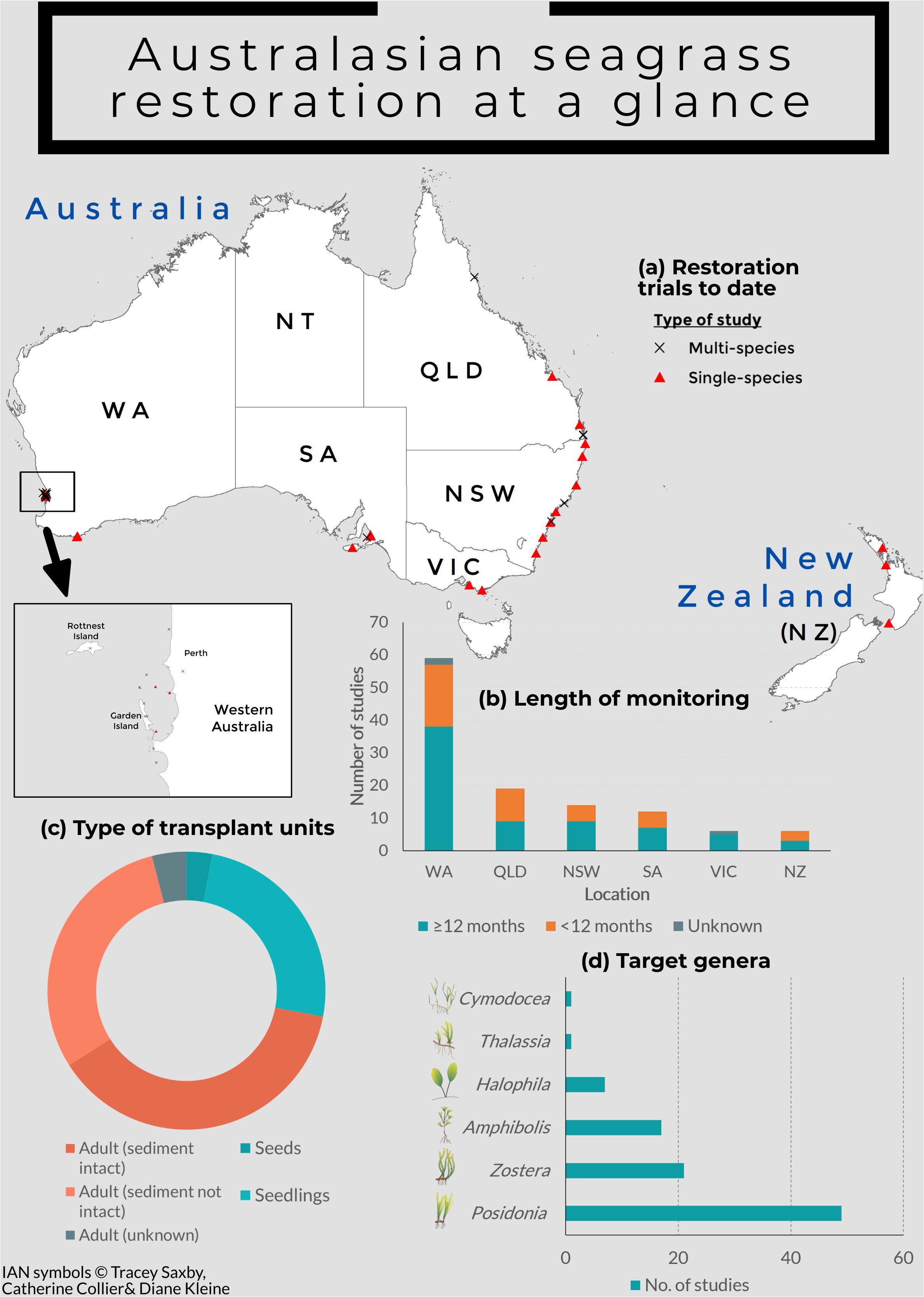
Restoration research in Australia and New Zealand has focused on small-scale experimental tests using a variety of techniques ranging from the planting of sprigs (seagrass fragments) or plugs (seagrass cores) to seed-based restoration (Supplementary Table S1; Figure 1). The majority of seagrass restoration trials to date have used shoot-based techniques, with at least 46 studies since 1986 (Supplementary Table S1). These have ranged from small-scale pilot studies (e.g., Irving et al., 2010) to large-scale transplantation trials (e.g., West et al., 1990; Bastyan and Cambridge, 2008), involving both manual and mechanical planting (e.g., Paling et al., 2001), and a wide range of anchoring methods [e.g., artificial seagrass (West et al., 1990; Campbell and Paling, 2003; Matheson et al., 2017), biodegradable pots (Kirkman, 1999), and hooks or pegs (Bastyan and Cambridge, 2008)]. Although survival of transplanted seagrass fragments or cores was low in many studies, promising results are increasingly reported, with transplant units surviving more than 2 years or showing shoot densities similar to naturally occurring meadows (e.g., Bastyan and Cambridge, 2008; Oceanica Consulting Pty Ltd., 2011, Matheson et al., 2017).
Figure 1. Infographic showing (a) all seagrass restoration trials carried out to date in Australasia, with inset map showing the concentration of studies carried out in Cockburn Sound, Western Australia; (b) length of monitoring of seagrass restoration trials based on states, (c) the proportion of different types of transplant units used in restoration trials across Australasia; and (d) the target genera in restoration trials across Australasia.
There are no published trials of restoration using seeds in Australia and New Zealand to date. However, scientists at the University of Western Australia are currently developing an approach to collect, process, and remotely deliver seeds of Posidonia australis, and have seen some early successes at the trial stages1. Scientists from Central Queensland University in the multicommodity Port of Gladstone (Great Barrier Reef World Heritage Area) have also assessed the practicality of seed collection, storage, and germination for Z. muelleri restoration (E. L. Jackson, Central Queensland University, personal communication). The use of seedlings in restoration is more well-established, especially in the use of hessian bags which act as a substrate for Amphibolis seedling recruitment. Long-term trials involving the use of hessian bags placed on the ocean floor to aid natural seedling recruitment started in 2004, with many showing long-term survival (Irving et al., 2010; Tanner, 2015). Studies on seed-based restoration for other species have been highly variable and less successful, highlighting the need for more in-depth research (Lord et al., 1999; Irving et al., 2010).
The restoration successes seen in Australia and New Zealand today largely come from studies on Posidonia and Amphibolis, as well as Z. muelleri in New Zealand (Figure 1). While these studies have contributed to the overall knowledge of restoration, more species- and habitat-specific studies are required to improve restoration success. Species-specific studies are required to establish clarity around seagrass resilience, especially local adaptive potential in the face of climate change. Successful restoration efforts will rely upon whether transplants or seeds are able to persist under future conditions. Success will require accurate forecasting, which requires rigorous species, site, habitat, and methodological data.


 Market Data
  Markets


 AI
AI