The Saudis are getting ready to execute three men for "terrorism", because they opposed their own displacement from the site where the Prince wants to build his mega vanity project.
The Arab Spring at Ten Years: What’s the Legacy of the Uprisings?
"Arab League: Syria reinstated as Assad rehabilitation continues"
Ten years on, the lives of people in Arab Spring countries have improved in certain aspects but worsened in others. CFR.org visualizes the changes in Bahrain, Egypt, Libya, Syria, Tunisia, and Yemen.
Article by Kali Robinson and Will Merrow December 3, 2020 9:00 am (EST)
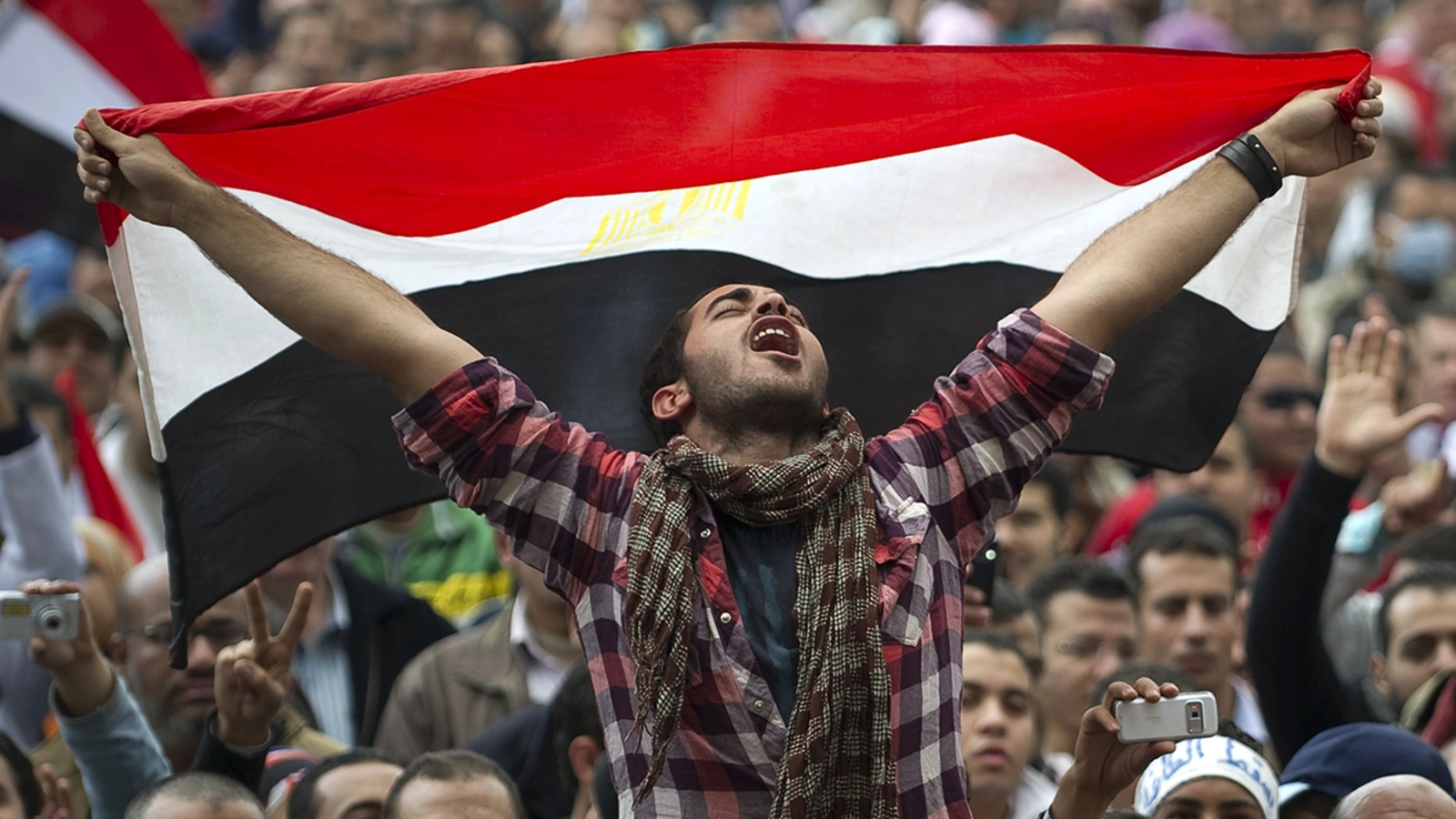
An Egyptian protester holds his national flag as he shouts slogans against President Hosni Mubarak at Cairo’s Tahrir Square in 2011. Pedro Ugarte/AFP/Getty Images
In December 2010, Tunisian street vendor Mohamed Bouazizi set himself on fire in protest outside a government office in the little-known town of Sidi Bouzid. In a matter of days, his act of defiance set off a revolutionary movement that rippled across the Middle East and North Africa, toppling some long-standing authoritarian regimes.
Where the Arab Spring Happened A map of countries where the Arab Spring happened, showing countries that had a leadership change (Egypt, Libya, Tunisia, and Yemen) and countries with protests but no leadership change.
[...]
Looking back, the uprisings, commonly known as the Arab Spring, produced modest political, social, and economic gains for some of the region’s inhabitants. But they also sparked horrific and lasting violence, mass displacement, and worsening repression in parts of the region. These graphics show how the lives of those in six Arab Spring hot spots—Bahrain, Egypt, Libya, Syria, Tunisia, and Yemen—have changed, for better or worse, since the upheaval began a decade ago.
Democracy [...] Protesters were motivated by many factors, but analysts say a common theme was a push for dignity and human rights. In many countries, religious tensions also played a significant role. For instance, Islamist parties gained power in formerly secular Tunisia and Egypt (although only temporarily in the latter). Meanwhile, deep sectarian divisions helped give rise to the anti-government movements in Bahrain, Syria, and Yemen. Only Tunisia made a lasting shift to democracy, whereas Egypt backslid, and Libya, Syria, and Yemen spiraled into protracted civil wars.
Standard of Living [...] Many in the Mideast struggled financially due to declining oil prices, high unemployment, and corruption among political elites who thrived at the expense of ordinary citizens, among other reasons. Poverty rates were high, especially in rural areas. In no country has the standard of living significantly improved since the revolutions, and it has even declined in conflict-ravaged areas.
Youth Unemployment [...] Many of the uprisings were led by students and other young people frustrated by government corruption and the lack of economic opportunities. Youth unemployment in the region remains the highest in the world [PDF] and has worsened in several countries, rekindling protests in some cases.
Freedom of the Press [...] Press freedom in the region is worse today than in the years before the revolts. Many governments have moved aggressively to suppress any criticism in the media, and foreign and local journalists are more likely to be imprisoned, killed, or have their work censored than their peers in most other regions of the world. Egypt has become one of the world’s top jailers of journalists since President Abdel Fatah al-Sisi took power in 2013.
Displacement [...] Post-uprising civil wars in Libya, Syria, and Yemen have caused mass displacement. In many cases, foreign military interventions have exacerbated the violence and disorder. Syria’s conflict alone has created more than five million registered refugees and over six million internally displaced people.
Internet Freedom [...] The internet and social media were vital tools for mobilizing Arab Spring protesters and documenting some government injustices. In the years since, countries such as Egypt have tightened their grip on cyberspace by restricting internet access, enacting laws that facilitate censorship, and jailing people over their anti-government posts online. Only Tunisia has increased internet freedom, particularly by protecting free expression and the press under its 2014 constitution.
Corruption [...] Some countries, such as Tunisia, have attempted to respond to protesters’ calls for better governance, including by creating anticorruption agencies and new laws to protect whistleblowers. However, corruption persists and is worsening regionwide. It is particularly daunting in the countries riven by civil war.
Women’s Empowerment [...] Gender equality was not a primary focus of the Arab Spring, but women took leading roles in the protests despite the threat of gender-based violence. Over the last decade, some countries have seen slight increases in female representation in government, but generally the region has done little to improve the status of women. Still, in countries including Egypt and Tunisia, women are speaking out more against injustices they face.
Syria protests spurred by economic misery stir memories of the 2011 anti-government uprising
"Arab League: Syria reinstated as Assad rehabilitation continues 2011 - ''Scores killed' in day of Syria violence At least 82 people reported dead after heavy fighting in Idlib, days before scheduled visit of Arab League observers." Hopefully, a good move Arab League. It feels the best way to move forward. For those in the UK, the USA, in Syria and elsewhere who say, "no, Asaad needs to be punished", this feels related: The psychology of punishment is key to why people vote against their own interests, says an Oxford neuroscientist https://investorshub.advfn.com/boards/read_msg.aspx?message_id=171859161"
By Kareem Chehayeb?|?AP August 29, 2023 at 2:24 a.m. EDT
(Uncredited/Suwayda24)
BEIRUT — Anti-government protests in southern Syria have stretched into a second week, with demonstrators waving the colorful flag of the minority Druze community, burning banners of President Bashar Assad’s government and at one point raiding several offices of his ruling party.
The protests were initially driven by surging inflation and the war-torn country’s spiraling economy but quickly shifted focus, with marchers calling for the fall of the Assad government.
In a scene that once would have been unthinkable in the Druze stronghold, protesters kicked members of Assad’s Baath party out of some of their offices, welded the doors shut and spray-painted anti-government slogans on the walls.
The protests have rattled the Assad government, but don’t seem to pose an existential threat. They come at a time when government forces have consolidated control over most of the country. Meanwhile, Damascus has returned to the Arab fold and restored ties with most governments in the region.
Still, anger is building, even among Syrians who did not join the initial anti-Assad protests in 2011. Those demonstrations were met with a harsh crackdown and plunged the country into years of civil war.
For some, the final straw came two weeks ago when the Syrian president further scaled back the country’s expensive fuel and gasoline subsidy program. Assad also doubled meager public sector wages and pensions, but those actions did little to cushion the blow, instead accelerating inflation and further weakening the already sinking Syrian pound. The results further piled on the economic pressure on millions living in poverty.
Soon after, protests kicked off in Sweida and the neighboring province of Daraa.
Over the past decade, Sweida had largely isolated itself from Syria’s uprising-turned-conflict. The province witnessed sporadic protests decrying corruption and the country’s economic backslide. This time, crowds quickly swelled into the hundreds, calling out political repression by Assad’s government and stirring echoes of the protests that rocked the country in 2011.
“People have reached a point where they can no longer withstand the situation,” Rayan Maarouf, editor-in-chief of the local activist media collective Suwayda24, told The Associated Press. “Everything is crumbling.”
While Assad’s political fortunes have been on the rise in recent months, life for much of the country’s population has become increasingly miserable. At least 300,000 civilians have been killed in the conflict, half of Syria’s prewar population of 23 million has been displaced and large parts of the infrastructure have been crippled.Ninety percent of Syrians live in poverty. Rampant corruption and Western-led sanctions have also worsened poverty and inflation.
In Daraa — often referred to as the birthplace of the 2011 uprising but now under government control — at least 57 people were arrested in the current protests, according to the Britain-based Syrian Network for Human Rights. Unlike in 2011, government forces did not use lethal force.
In Sweida, the response has been more restrained, with Assad apparently wary of exerting too much force against the Druze. During the years of civil war, his government presented itself as a defender of religious minorities against Islamist extremism.
Over the years, the province’s young men also have armed themselves to defend their villages .. https://apnews.com/article/22e32303351d45809ec57c008e769f56 .. from Islamic State militants and Damascus-associated militias that produce and trade in illegal amphetamine pills, known as Captagon.
Joseph Daher, a Swiss-Syrian researcher and professor at the European University Institute in Florence, believes that this provides a layer of protection for protesters.
“Unlike other government-held areas, Sweida has some form of limited autonomy,” Daher said.
Meanwhile, in Damascus, Lattakia, Tartous and other urban government strongholds, some are voicing their discontent more quietly. They write messages of support for the protests on paper, take pictures of those notes on the streets of their towns, and share them on social media.
Others suffer in silence and focus on daily survival. In Damascus, some have taken to carrying backpacks instead of wallets to carry the wads of cash they need to make everyday purchases amid the rampant inflation, while families struggle to buy basic necessities.
[Insert: Wow. Backpacks. And we complain about inflation.]
“If I buy (my son) two containers of milk, I’d have spent my entire month’s salary,” Damascus resident Ghaswan al-Wadi told the AP while preparing her family dinner at home after a long day at work.
The ongoing protests highlight Assad’s vulnerability as a result of the failing economy, even in areas that tried to withstand the situation and not hold large-scale protests against his rule.
Could the protests eventually threaten his rule?
Daher said this could only happen if the protesters banded together.
“You have forms of solidarity from other cities (with Sweida),” Daher said. “But you can’t say it would have a real effect on the regime, unless there would be collaboration between (protesters in) different cities.”
How Assad’s Brutality Inspired Courage and Compassion Among Some Syrians On the podcast: Members of the White Helmets describe what it’s like to charge to the scene when a bomb goes off. By Dan Ephron, the executive editor for podcasts at Foreign Policy. Members of the Syrian Civil Defence (known as the White Helmets) carry a wounded person after shelling in the town of Khan Sheikhoun in rebel-held Idlib province on Feb. 26. ANAS AL-DYAB/AFP/Getty Images May 10, 2019, 2:17 PM
For eight years now, Syrians have endured bombings, gas attacks, food scarcity, and a general breakdown of social order as President Bashar al-Assad suppressed any challenge to his regime.
But the civil war there has also spawned scenes of courage and compassion. For more than five years, volunteers around the country have been showing up at bombing sites minutes after the bombardments to help the wounded and search through rubble for survivors. The group calls itself the Syrian Civil Defence but is more commonly known as the White Helmets, after the signature headgear its members wear.
On First Person this week, we hear from Raed Al Saleh, the leader of the White Helmets, and his colleague Asaad Hanna. The White Helmets were in Washington to receive the annual Elie Wiesel Award from the U.S. Holocaust Memorial Museum, an honor that recognizes prominent individuals who have confronted hatred, helped prevent genocide, or promoted human dignity.


 Market Data
  Markets


 AI
AI