, and declining wholesale prices suggest that retail prices still have farther to fall.
Food prices are also coming down. Here’s the futures price for wheat:
Wheat futures are way down. Nasdaq
And business surveys are suggesting a broader decline in inflation. For example, the widely cited Institute of Supply Management .. https://www.ismworld.org/supply-management-news-and-reports/reports/ .. survey of purchasing managers shows that prices paid for raw materials are still rising, but at a slower rate than they have in many months:
Purchasing managers see much less inflation. Institute for Supply Management
All of this means that official data on consumer prices will almost certainly show much smaller increases over the next few months than the shocking numbers we’ve become accustomed to lately. But what will this improvement mean?
I’ll get to the implications for economic policy in just a bit. But give me a minute to savor the political implications.
Republican efforts to regain control of Congress have rested almost entirely on blaming Joe Biden for inflation — and gas prices in particular.
Did Donald Trump, who is still the dominant figure in the G.O.P., attempt to overturn a legitimate election? Gas is over $5 a gallon! Are Republican judges and state legislators taking away rights women have had for decades? Gas is $5 a gallon! .. https://www.nytimes.com/2022/07/21/opinion/republicans-gas-price-inflation.html
Now the party’s main election plank — pretty much their only election plank — is being sawed off at the base. I’ve been wondering what they’ll do. After spending many months doing all they can to dumb down the debate, Republicans will have a hard time suddenly pivoting to nuanced arguments about headline numbers versus underlying inflation.
When — I’m pretty sure that’s a “when,” not an “if” — official data also shows a sharp decline in inflation, my guess is that we’ll see denial supplemented by conspiracy theories: claims that the Biden administration is faking the numbers or somehow manipulating the commodity markets.
Should Democrats emphasize the good news on inflation and mock their opponents’ doomsaying? Yes! Any Democratic politician who responds to falling energy and food prices with a discourse about transitory versus underlying inflation should be in a different business.
Policymakers, however — which in this case basically means the Federal Reserve — are in a different business, and they should respond to the good inflation news by keeping calm and carrying on.
Many fashionable economic concepts have failed the test of time, but the concept of core inflation — distinguishing between volatile prices, like food and energy, and slower-moving prices that have a lot of inertia — has been highly successful since the economist Robert Gordon .. https://www.brookings.edu/wp-content/uploads/1975/01/1975a_bpea_gordon.pdf .. introduced it in the 1970s. Time and again, the Fed has steered through crises by ignoring critics who wanted it to panic over blips in inflation caused by temporary jumps in commodity prices.
Now, defining core inflation has gotten harder in the Covid era, because just excluding food and energy seems inadequate at a time when wild swings in things like used car prices and shipping costs have also driven fluctuations in the rate of inflation. At the moment, however, every measure of underlying inflation I’m aware of, from traditional core to measures .. https://www.dallasfed.org/research/pce .. that exclude any large price changes and changes in labor costs .. https://fred.stlouisfed.org/graph/fredgraph.png?g=SuVs , points to unacceptably high underlying inflation.
So why is inflation coming down? Biden administration policy — releasing oil from the Strategic Petroleum Reserve, urging gas stations to pass on declines in wholesale prices, efforts to unsnarl supply chains — may have contributed. But the main story is likely a global economic slowdown: America probably isn’t in a recession, but Europe probably is, China remains hobbled by its zero-Covid policy and so on.
All of which has remarkably little bearing on appropriate U.S. policy. The Fed’s strategy is to bring underlying inflation down by using interest rate hikes to cool off the economy. Despite Friday’s hot labor market report .. https://www.nytimes.com/live/2022/08/05/business/jobs-report-july-economy/a-job-market-slowdown-is-expected-as-the-federal-reserve-taps-the-brakes?smid=url-share , I have no doubt that this strategy will eventually work. But the good news we’re about to get about short-term inflation isn’t evidence that the strategy has already worked, and alas (I’m usually a monetary dove), it offers no justification for a pivot toward easier money.
Does this mean that inflation is going to pop right back up again? Not necessarily. The Fed’s efforts probably will bring underlying inflation down over the next few months, so that by the time the transitory good news from gas prices fades out, it may be replaced by more permanent good news.
In any case, for the moment, inflation is headed down, no doubt to the great dismay of politicians who were counting on gas prices to deliver a red wave in November. Pass the popcorn.
Paul Krugman has been an Opinion columnist since 2000 and is also a distinguished professor at the City University of New York Graduate Center. He won the 2008 Nobel Memorial Prize in Economic Sciences for his work on international trade and economic geography. @PaulKrugman
----- [Insert: hap. You sound like Scalize "And you can explain how a "windfall profit tax" would lower gas prices -- but never mind, the repubs will do it starting immediately after Nov22 hap" P - DesertDrifter, as usual nailed it for you: It would lessen their incentive to price gouge if they were not allowed to keep exorbitant price gouged gains and were taxed on them heavily. P - Repubs have no plan other than another insurrection that they have communicated. No other stated plans for anything other than contesting elections. [...]House Dems pass gas price-gouging bill that faces uphill battle in the Senate Four Democrats joined Republicans in voting against the measure. [...]Joe Biden Didn’t Do This https://investorshub.advfn.com/boards/read_msg.aspx?message_id=169186934 --- The Fed needs to stop raising interest rates Robert Reich Interest rate hikes mean that workers and consumers take the hit. Here are other tools to address inflation ‘The government should use other means to tame inflation. Like what? Windfall taxes.’ Photograph: Brendan McDermid/Reuters Tue 13 Dec 2022 02.02 AEDT Last modified on Tue 13 Dec 2022 15.13 AEDT [...]The Fed’s failure is partly due to events outside the United States – Putin’s war in Ukraine, China’s lockdown and post-Covid demand worldwide exceeding worldwide supplies of all sorts of materials and components. P - But it’s also because domestic inflation is being driven by profits, not wages. And interest rate hikes don’t reduce profit-driven inflation – at least not directly. Instead, workers and consumers take the hit. [...]In fact, rather than slowing corporate price increases, the Fed’s rate hikes seem to be having the opposite effect. P - It’s not hard to see why. If I run a big corporation, I’m not going to lower my prices and profits in the face of a pending economic slowdown. I’ll do everything I can to keep them as high as possible for as long as I can. P - I’ll reduce my prices and profits only when the Fed’s higher rates begin hurting consumers enough that they stop buying stuff at my high prices because they can find better deals elsewhere. [...]The government should use other means to tame inflation. Like what? P - Like windfall profits taxes – as California’s governor, Gavin Newsom, has proposed for oil companies there, and Representative Ro Khanna and Senator Sheldon Whitehouse have proposed nationally (taxing the difference between the current price of oil per barrel and the average cost between 2015 and 2019). P - Like tough antitrust enforcement... https://www.theguardian.com/commentisfree/2022/dec/12/fed-interest-rate-hikes-inflation-robert-reich ] -----
But economists disagree over the role that elevated corporate profits have played in driving inflation, as some say they account for more than half of the increase in prices while others say they have caused little or none of the hikes.
Some who do blame corporate price-gougingfor a portionof the price increases said it arises from market concentration that allows a handful of dominant companies in a given sector to raise prices without fear of competitors undercutting them with lower-priced alternatives. But others doubt that explanation, noting the unlikelihood that a major shift in corporate concentration took place over just a couple years amid the pandemic.
The divideamong economists also owes in part to mixed assessments over whether corporate profits have driven inflation or merely responded to it, since a global market rocked by pandemic-induced supply-demand shocks has created a favorable environment for many companies to hike prices.
“It’s a very intense time for people and their pocketbooks — I understand why these debates are very heated,” Michael Konczal, the director of macroeconomic analysis at the Roosevelt Institute, told ABC News. “A lot of people are on team demand, team supply, team transitory, team corporate gouging.”
“I think there's reflection that there are a lot of causes,” he added. “Even as those causes are evolving.”
Economists agree that inflation owes at least in part to a supply-demand crunch amid the pandemic in which federal stimulus helped consumers purchase goods at the exact time that they got stuck in a production and distribution bottleneck, experts told ABC News.
But economists disagree over how much that supply disruption has contributed to inflation, as opposed to the market environment that it has created, in which companies could raise prices knowing that their competitors faced similar supply shortages that prevented any of them from flooding the market with cheaper alternatives.
“In the case of sector-wide supply chain issues, as during the pandemic, firms know that their competitors face the same bottlenecks as themselves,” Isabella Weber, a professor of economics at the University of Massachusetts Amherst, told ABC News. “The public, too, is aware of the supply issues. Taken together, this presents a pretext to increase prices.”
A separate report .. https://rooseveltinstitute.org/publications/prices-profits-and-power/ .. from the Roosevelt Institute, a liberal think tank, found that companies that imposed higher-than-typical markups before the pandemic were likely to be the same companies that hiked prices during the pandemic, suggesting that certain firms exploited their market position to raise prices during the pandemic. In other words, if a company could mark up prices before the pandemic without fear of competitors, it could do so during it.
[Seems obvious a list of those companies should be compiled. Has that been done? Is some one working on one?]
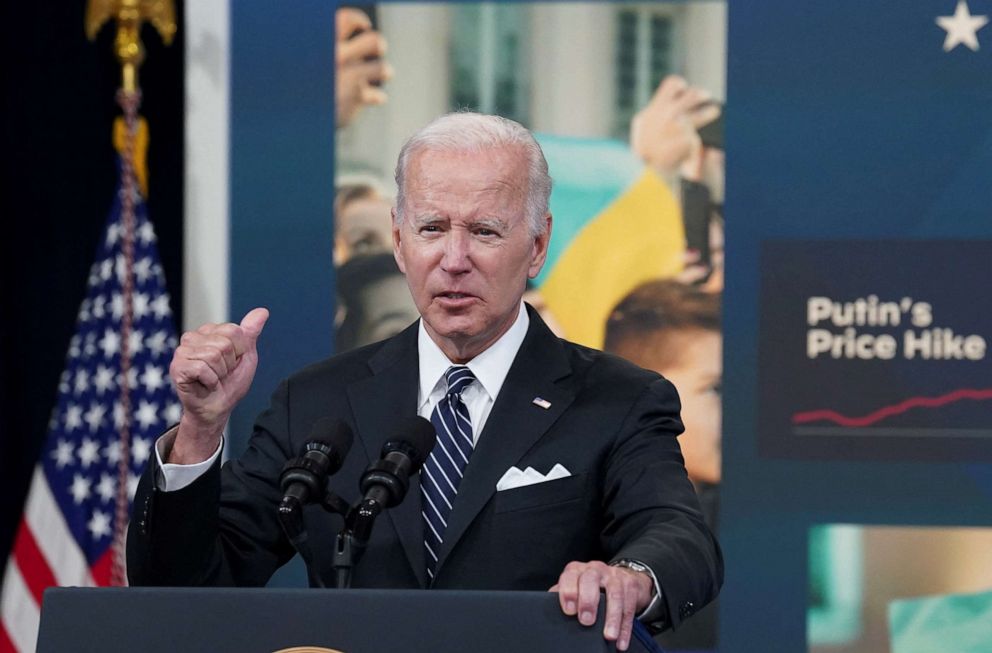
President Joe Biden speaks about gas prices during remarks in the Eisenhower Executive Office Building's South Court Auditorium at the White House in Washington, June 22, 2022. Kevin Lamarque/Reuters, FILE
“This makes us think there’s a small but real role for corporate power to be involved with the increase in inflation,” said Konczal, the economist at the Roosevelt Institute, who co-authored the study.
But other experts contested the explanation that market power or greed has driven companies to exploit market conditions during the pandemic, arguing that high prices reflect forces of supply and demand rather than any misdeed on the part of a company.
Michael Faulkender, a professor of finance at the University of Maryland’s Robert H. Smith School of Business, compared companies charging high prices to an individual who puts his or her home on the market at a favorable time.
“Let’s say I bought a house five years ago, and I’m looking to sell it for whatever reason. Do I price it at what the market will bear or what I bought it for plus a politically correct predetermined markup?” he said. “I’m going to price it at what the market can bear.”
The high prices at the grocery store or the pump are the expected outcome of a market in which individuals have ample money to spend but few products to buy, Faulkender said.
[Ok2 How about that Michael Faulkender .. liberal or conservative .. hehe ;-) .. this could help .. Michael Faulkender is an associate dean of master's programs and professor of finance at the Robert H. Smith School of Business at the University of Maryland.[1] He is known for his research on executive compensation and the corporate tax practices of multinational firms. P - In March 2018, President Donald Trump nominated Faulkender to be Assistant Secretary of the Treasury for Economic Policy.[2] https://en.wikipedia.org/wiki/Michael_Faulkender ]
“The limited supply available goes to those with the highest value,” he said. “The profits then generated are a consequence but not the cause.”
Treasury Secretary Janet Yellen appears to share a view that minimizes the role of corporate profits as a cause of inflation. Earlier this month, at a Senate Finance Committee hearing, Yellen refused an opportunity to blame price hikes on company greed .. https://www.youtube.com/watch?v=G5_1Gj9BODc , citing supply and demand as the primary explanation.
Bivens, the economist at the Economic Policy Institute, criticized the value of recent price hikes as market signals, which typically tell market actors where to invest resources. The pandemic-induced shift to goods like Pelotons and lumber and away from face-to-face services is unlikely to persist for a prolonged period, he said.
“The line between price gouging versus useful market signals is always a pretty tough one,” he said. “I don’t think these are useful signals.”
Where economists come down on corporate profits informs what, if anything, they think should be done about it. Bivens said he supports a tax on windfall corporate profits, a version of which was proposed by Sen. Bernie Sanders, I-Vt.. .. https://www.congress.gov/bill/117th-congress/senate-bill/3933?s=1&r=1 .. , in March. Meanwhile, Faulkender said the government should promote greater supply, especially in the energy sector, as a key way to address high prices.
That fits with the thought he was a conservative.
Personal finances nationwide will depend on the outcome for corporate profits, Konczal said.
“Whether they’re naturally competed away on their own, whether policy intervention is going to help nudge the process along, it does have important consequences for inflation and everyday people’s pocket books,” he said.


 Market Data
  Markets


 AI
AI