The 1990s collapse in birth rates still impacts Moscow’s ambitions.
By Brent Peabody, a current graduate student at the Harvard Kennedy School, where he studies energy and trans-Atlantic policy.
Russian military cadets walk along Red Square in central Moscow on Oct. 1, 2020. YURI KADOBNOV/AFP VIA GETTY
JANUARY 3, 2022, 12:30 PM
As Russia spent much of 2021 amassing troops on its Ukrainian border, an important headline almost escaped notice. While Russian President Vladimir Putin threatened Ukraine, Russia suffered its largest natural population decline since World War II, losing 997,000 people in the yearlong period between October 2020 and September 2021.
Although coronavirus casualties in Russia were severe—and probably highly underreported—this wasn’t a one-time anomaly. Instead, it was the opening shot of a longer-term trend that will manifest in earnest over the next decade.
Russia is about to enter a prolonged and painful period of demographic decline at home—complicating its expansionist ambitions abroad.
The roots of this demographic decline rest in the 1990s and the chaos wrought by Russia’s post-Soviet transition from a centrally planned economy to a capitalist, market-based one. The transition was characterized by economic turmoil, mass unemployment, and alcoholism, all of which combined to briefly give Russia one of the world’s lowest male life expectancies..
The most lasting impact, however, was the concurrent collapse in birthrates. From 1993 to 2007, the fertility rate (defined as the number of children a woman can be expected to have over the course of her lifetime) fell below 1.5, far below the 2.1 replacement rate needed to hold a population steady.
The effects of this dramatic and prolonged collapse in birthrates are now becoming apparent. A brief glance at Russia’s population pyramid illustrates this knock-on effect. There are around 12.5 million Russians between the ages of 30 and 34 who were born around or just before the collapse of the Soviet Union. But there are around 6.5 million people between the ages of 20 and 24 who were born during the chaos of the late 1990s.
This smaller base of people able to bear children means the birthrate is almost destined to decline. And that is exactly what has happened; after a brief period of natural population growth in the mid-2010s, Russia’s population once again began to contract in 2019. It will continue to do so well into the foreseeable future.
This bleak demographic forecast became even more dire with the arrival of COVID-19. The Kremlin’s initial dismissal of COVID-19 and efforts to spread vaccine disinformation across the West appear to have backfired on its own population, resulting in a vaccination rate that ranks as one of the lowest in the developed world.
Low vaccination uptake, coupled with a laissez faire approach to COVID-19 and weak health care system, have contributed to one of the world’s highest COVID-19 fatality rates.
Huh, who does THAT remind us of? Did Pooty say to Trump 'here's what we're going to do about Covid. I don't know why you wouldn't/shouldn't do the same.'
Nah, just two dumb, delusional, authoritarian, autocratic ass-hats being themselves.
Russia’s government counts around 300,000 deaths, but a more reliable estimate from the Economist puts the figure at 1 million, giving Russia the dubious distinction of having more COVID-10 deaths per capita than any other country except Bulgaria.
Russia’s recent population decline predates COVID-19, but the pandemic has done much to exacerbate it.
It is possible that immigration will make this demographic outlook less dismal. Russia has long relied on immigration from ex-Soviet republics to compensate for natural population loss at home, and in recent years, it has stepped up its efforts by encouraging ethnic Russians everywhere—from Ukraine to Uruguay—to immigrate. But even here, there is limited future upside. COVID-19 has kept many would-be migrants grounded at home. Russia’s stagnant economy has sent others searching for economic opportunities elsewhere. And most simply, many of the people likeliest to immigrate already have. Boosting immigration (itself improbable) could mitigate Russia’s demographic decline, but it cannot stop it.
This demographic reality is perhaps the greatest limiting factor for Putin’s expansionist ambitions in Ukraine for two reasons. Any invasion of Ukraine would take a serious cost in Russian life, with Ukrainians prepared and motivated to resist Russian occupation in a way they were not when Russia annexed Crimea in 2014.
Ukrainian Defense Minister Oleksii Reznikov has made this explicit, saying while Ukraine would no doubt suffer in the event of war, it would also “not mourn alone.” And most Russian casualties would be soldiers in their 20s—members of the same small generation born during the 1990s whom Russia can scarcely afford to sacrifice.
The second limiting factor relates to the West’s response to any Russian move on Ukraine. Scholars debate the utility of sanctions in changing behavior, but their economic impact has been clear. Russia’s economy is still smaller than it was in 2014, when Western sanctions in response to Crimea’s occupation helped reduce GDP by more than a quarter.
And the West still has a lot more economic pain to inflict, from freezing Russia out of SWIFT (the system through which international banks make transfers) to canceling Nord Stream 2 (the pipeline delivering natural gas from Russia to Germany).
These sanctions would trigger capital outflows and economic turmoil to an extent not seen since the 1990s—depressing Russia’s birthrate at the moment it most needs it to rise. Rather than being purely a limiting factor, it’s possible to argue Russia’s weak demographic hand has made it even more dangerous.
After all, Russia’s need for more people is no doubt a motivating consideration for its current aggressive posture toward Ukraine, and Putin has said the thought of a depopulated Russia haunts him most—even if the idea that Ukrainians would sign up to be good Russians is largely delusional. But Russia’s demography and the long shadow of the 1990s severely inhibit what the Kremlin can do now. Russia’s future ambitions are still weighed down by its recent past.
U.S., allies plan for long-term isolation of Russia Source: Washington Post
Nearly two months into Vladimir Putin’s brutal assault on Ukraine, the Biden administration and its European allies have begun planning for a far different world, in which they no longer try to coexist and cooperate with Russia, but actively seek to isolate and weaken it as a matter of long-term strategy.
At NATO and the European Union, and at the State Department, the Pentagon and allied ministries, blueprints are being drawn up to enshrine new policies across virtually every aspect of the West’s posture toward Moscow, from defense and finance to trade and international diplomacy.
Outrage is most immediately directed at Putin himself, who President Biden said last month “can’t remain in power.” While “we don’t say regime change,” said a senior E.U. diplomat, “it is difficult to imagine a stable scenario with Putin acting the way he is.”
But the nascent new strategy goes far beyond the Kremlin leader, as planners are continuing to revise seminal documents that are to be presented in the coming months.
Biden’s first National Security Strategy, legally required last year but still uncompleted, is likely to be significantly altered from initial expectations it would concentrate almost exclusively on China and domestic renewal.
The Pentagon’s new National Defense Strategy, sent last month in classified form to Congress, prioritizes what a brief Pentagon summary called “the Russia challenge in Europe,” as well as the China threat.
By: Sam LaGrone May 5, 2022 6:19 PM • Updated: May 6, 2022 5:28 PM
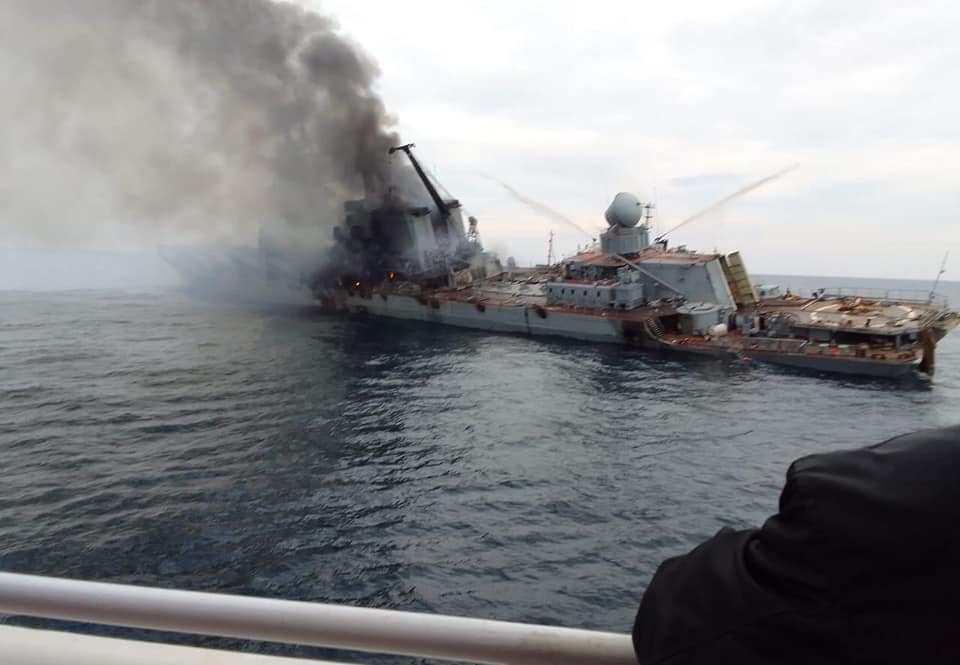
RTS Moskva (121) following an April 13, 2022 strike from Ukrainian missiles. Russian MoD
This post has been updated with additional information on the Moskva’s radar system.
The crew of RTS Moskva (121) was blind to and not ready for the Ukrainian missile attack that sank Russia’s Black Sea flagship, according to a new analysis of the April 13 strike reviewed by USNI News .. https://www.admiraltytrilogy.com/read/Moskva_Damage.pdf .
The review of images following the strike of the two Neptune anti-ship missiles from open-source naval analyst and retired Navy Capt. Chris Carlson told USNI News that the guided-missile cruiser did not have its fire control radars activated and could not see the threat from the two sea skimming weapons.
In the photo of Moskva after the strike, the radars “are in their normal stowed position,” Carlson told USNI News on Monday.
“If you look at the pictures of Moskva, when she’s just dancing around going from place to place, or she’s anchored as a showboat, those directors are all facing aft every time,” he said.
The analysis is based on images of the Slava-class guided-missile cruiser that emerged just after the attack off the coast of Ukraine from what the Ukrainians claim were two Neptune-class anti-ship missiles.
Analysis from Chris Carlson shows how the radars on the ship were in their stowed position in photos following the missile strike. Images used with permission
While the Russian warship had older point-defense systems, they would have been capable of countering the Neptune missiles based on a 40-year-old Soviet design, which was in turn based on the U.S. Navy’s Harpoon anti-ship missile, he said.
“This is like Harpoon. It’s a small missile. Its warhead is about 145 kilograms, travels less than 10 meters off the deck [and has] radar homing,” Carlson said. “This is not, shall we say, a stressing threat for air defense systems. It’s not supersonic.”
In particular, the radar system that would have directed Moskva’s OSA-M surface to air missiles to counter the Ukrainian missiles appears to not have been active with its emitters stowed, based on the photograph.
“If you’re not running it, your point defense [surface to air missiles] are not going to be playing,” Carlson said.
In addition, on Moskva, “you’ve got old stuff, which means it’s temperamental. It’s hard to maintain, and at-sea maintenance has not been a Russian strength.”
While it’s unclear from the photos published from the Russian MoD, the cruiser’s role as part of the air defense mission in the Black Sea would likely mean its two main air search radars were operating, Carlson told USNI News following an earlier version of the post. However, the MR-710M Fregat-M Flag MR-800 Flag air search radars would have had a hard time to detect the wavetop skimming Neptunes. Even if they had detected the missiles, the crew did not react time to employ defensive weapons as the fire control radar were still stowed according to the photo, Carlson said.
Location of where Moskva was hit. Images used with permission
Based on the photographs that circulated following the strike, the two Neptunes hit the warship near its most vulnerable point: the ship’s main propulsion spaces, dead center of the ship, just above the waterline.
“A missile hit in the forward engine room would very likely cause significant damage to the cruise gas turbines and steam turbines and could potentially distort the main shaft sufficiently to cause damage to the reduction gears of the boost turbines,” Carlson wrote. “Heavy damage in the post of energy and survivability compartment could cause a loss of all electrical power, as well as potentially disabling the ship’s automated damage control capability.”
Combined with the Russian Navy’s uneven training for sailors in damage control, Carlson said the photographs lend credence to Ukraine’s explanation that they were able to target, fire missiles and hit the target with their own resources.
Following the initial strike, a Telegram channel with ties to the Russian mercenary Wagner Group said the crew observed Ukrainian Bayraktar TB2s near the ship. The Ukrainian Navy began acquiring the combat drones starting in the last year and they are equipped with an electro-optical system that’s capable of providing the Neptune command system .. https://www.oryxspioenkop.com/2021/08/black-sea-hunters-bayraktar-tb2s-in.html .. enough information via datalink to target the missiles.
“All they have to do is laze once or twice and then they have a feasible targeting solution,” Carlson told USNI News.
Shortly after the sinking, reports emerged that a U.S. Navy P-8A Poseidon was in the area before the attack, suggesting that the U.S. may have provided detailed targeting information to the Ukrainians to target the ship.
Carlson said while the U.S. could give Ukrainian forces a general idea of where the ship was, it could not provide necessary tracking information to the Neptunes because P-8s datalinks were incompatible.
Ukrainian Navy TB2
“There’s no way the P8 has the ability to send direct data via data link right to the Ukrainians,” he said. “You can’t do it by voice. It’s got to be done through a data link.”
On Thursday, following a Wednesday story from The New York Times on the targeting of Russian general officers, Pentagon spokesman John Kirby said the U.S. intelligence sharing with the Ukrainians has limits.
“We do not… participate in the targeting decisions of the Ukrainian military. Ukrainians have quite frankly, a lot more information than we do. This is their country, their territory, and they have capable intelligence collection abilities of their own,” he said. “Ukraine combines information that we and other partners provide with the intelligence that they themselves are gathering on the battlefield and then they make their own decisions, and they take their own actions.”


 Market Data
  Markets


 AI
AI