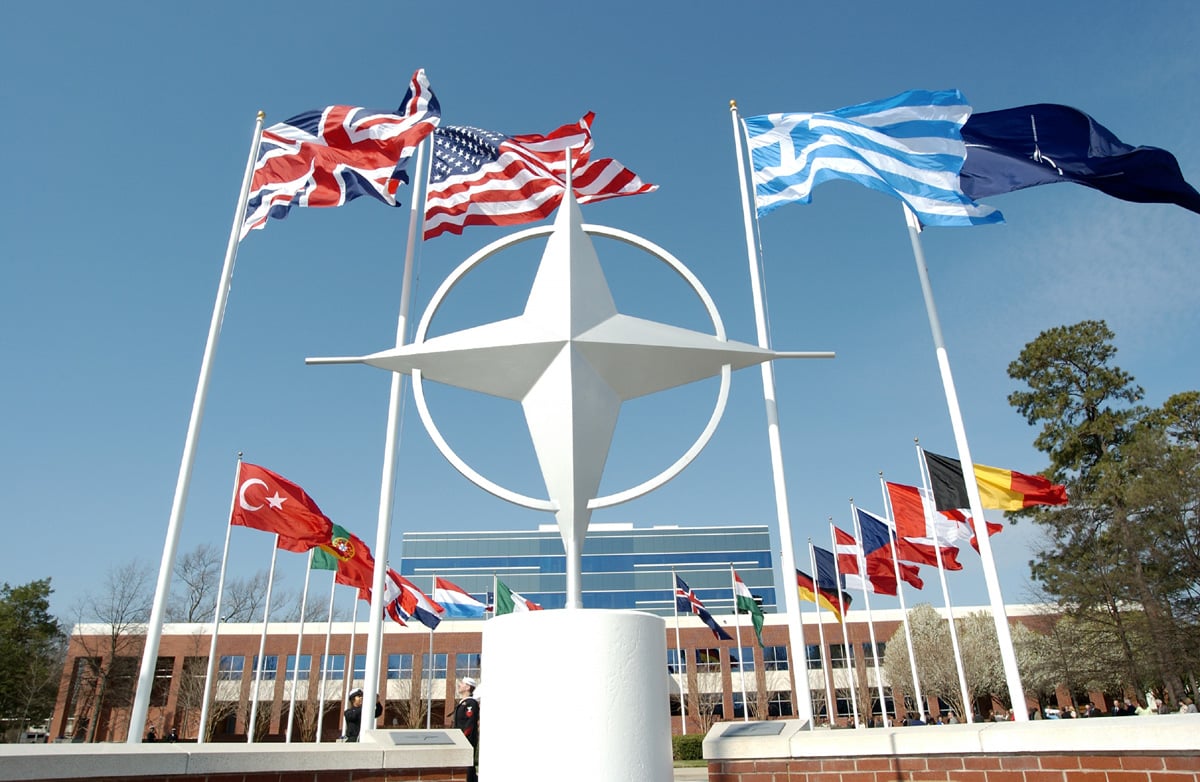
Panel: Rise of Authoritarian Governments Pose Biggest Threat to NATO
By: John Grady June 28, 2019 12:52 PM
Among NATO Members, the rise of populist authoritarian governments eschewing democratic values poses more of a threat to the alliance than an aggressive Russia on its borders or an expansionist China elbowing its way into Europe militarily and economically, a panel of security and diplomatic experts said Thursday.
“NATO should be in this game” of promoting independent judiciaries, free and open political debate and a free press, “and not just the EU” in advocating bedrock freedoms and ways of governing, Charles Kupchan, from the Council of Foreign Relations, said at the Atlantic Council in Washington, D.C.
Nations such as Turkey, Poland, Hungary and Italy needed to be called out by other alliance “members when they see … backsliding” on defending those values domestically and, as an alliance, it should be pushing them overseas, he added.
“If we get this issue wrong, good night” in trying to keep a coalition together on a host of issues — from cyber to migrants to the common defense, Kupchan said. The rise of authoritarianism, reflected in the actions of Russia and China offering themselves as models to follow, “is the premier security issue of our time.”
The alliance needs a restatement of core values in a new strategic document. This would be one way of rebuilding trust among members for the future as the president of the United States often questions the alliance’s value to Americans, said Hans Binnendijk, with the Atlantic Council. He pointed the finger at Russia for undermining trust in political institutions and processes in Europe and the U.S.
“Hybrid warfare is underway and we’re losing it,” particularly on social media and Moscow’s propaganda and disinformation campaigns that have had an impact on elections from the United Kingdom to the Balkans and in the U.S., Binnendijk said.
“Coalitions are not easy” to build and even more difficult to sustain as NATO has done for 70 years,” said retired Army Gen. John Nicholson, former commander of all forces in Afghanistan.
Money cannot buy legitimacy” in pursuing common aims, he said. A different “common aim” for American administrations for decades has been insistence Europeans spending more for their defense and ensuring at least 20 percent of that goes into the modernization of equipment and forces.
“We’re missing the mark on investment,” Nicholson said.
“Two percent was a two-by-four and got some of their attention,” Binnendijk said, referring to the security spending goal set by NATO in the wake of Russian aggression in Ukraine and threats to the Baltic nations. However, the spending goal doesn’t adequately address how to measure members’ effective spending on defense, Binnendijk said.
European members “have to have helicopters that fly,” but that only scratches the surface, Kupchan added. The emphasis should be put on spending wisely. “Europe needs to turn the corner” on security spending — both in amount and where the money goes.
Using the NATO strategic planning model of the alliance being able to respond to two major crises and six lesser problems at the same time as a guide, Binnendijk said one metric for the future could shift the burden to European members to be able to handle one major crisis and three lesser ones simultaneously. The U.S. would be ready and assume the responsibility for the other half.
“NATO will be the cornerstone of European security. I don’t think we need to do what NATO does” in that area, said Dearbhlan Doyle who represented the European Union. Stressing the complementary soft power the EU offers in teaching governance, the rule of law and human rights from the Balkans to Africa to Afghanistan, she said the 28 member nations also realized investment was needed to improve mobility — establish better and standardized rail and bridge sizes, improve highways and add more airfields for their defense. Other steps include breaking down unnecessary barriers at borders and with customs for the movement of military cargo and equipment.
This new interest in continental security is a direct response to Russia’s move of forces into Crimea followed by a rigged election separating it from Ukraine and its backing of breakaway provinces in Georgia and continued military and economic support for separatists in eastern Ukraine.
Looking at the other great power making its presence felt in Europe, Doyle said the EU “would like to work together with the U.S. and NATO, on China.”
Beijing presents an economic challenge to the U.S. and EU working together. However, Beijing also is creating a situation where fissures are appearing between European nations as some consider joining the One Belt/One Road infrastructure initiative, as Turkey, Italy and Greece are contemplating.
“Let’s not start finding us undercutting each other” when it comes to relations with China, Kupchan said
A way to exercise more cooperations among NATO members, Binnendijk said, would be for more EU nations to participate in freedom of navigation operations in the South China Sea. Ideally, EU navies would coordinate their efforts demonstrating these waters are international, instead of creating a situation where just one vessel from France conducts a FONOP, followed by another FONOP conducted by another country.
“Make this more like a multinational statement, Kupchan said.
Orban is trying a daunting balancing act over the Ukraine war
Updated: 17/03/2022 By Marius Dragomir
There is no such a thing as the Ukrainian people and culture, and Ukraine could be split between Russia and “certain NATO member states", an “expert” said during a programme aired on Pesti TV, a privately owned television channel in Hungary, in the wake of the Russian invasion.
He turned out to be a photographer and military engineer rather than an expert on geopolitical issues. But for Pesti TV, a television channel that receives hefty funding from the Hungarian government to wax lyrical about the ruling Fidesz party, and its leader, Prime Minister Viktor Orban, such propaganda fodder is its speciality. Since the invasion of Ukraine last month, the channel has been churning out pro-Russian disinformation at a staggering pace.
But Pesti TV is not alone. Similar coverage -- questioning the rights of Ukrainians over their country and overtly promoting Russian aggression -- are being spread incessantly by Hungary’s pro-government media, a dominant force in the country’s media landscape.
Since the early hours of the war, the state television broadcaster MTVA has been inflaming public opinion against Ukraine, according to analysis from Atlatszo, an independent news outlet. Balázs Németh, an MTVA presenter, implied in a Facebook post last month that the capitulation and resignation of Ukraine’s president Volodymyr Zelenskyy would be a wise decision.
In response, media experts called on the Hungarian media regulator, the National Media and Infocommunications Authority (NMHH), to order the state media to stop airing pro-Russian propaganda. But, given that the regulator is packed with pro-Fidesz staff, nothing happened.
The deep cesspool of propaganda generated by the pro-government media in Hungary is at odds with the Hungarian government’s declared support for sanctions against Russia. Why would Orban play this double game: oppose the war in his public speeches while simultaneously ordering his media to praise Russia and disseminate lies?
The answer seems to be twofold: electoral gains and Orban’s fawning admiration of Putin.
Let’s take elections first. Orban’s strategy, in speaking out against the Russian assault on Ukraine appeases the part of the electorate who fear a further escalation of the conflict. It also satisfies his EU peers who have expressed concerns about the eastward drift in his foreign policy and casts him as a peace-loving leader.
At the same time, the war in Ukraine has been swiftly used by Fidesz as a public relations opportunity in preparation for the Hungarian elections slated to take place on 3 April. Almost all MTVA news programmes have reported in recent weeks that opposition politicians want to send troops and weapons to Ukraine, an idea scorned by the majority of Hungarians. Yet, the opposition parties never said that. It was a smear designed to discredit.
The pro-Kremlin campaign run by the Fidesz-captured media, unlike anywhere else in EU’s mainstream media, is designed primarily to generate votes in the upcoming general election in Hungary. This is percolating down to the electorate. Unsurprisingly, in a recent survey conducted by Pulzus Research, a quarter of Orban supporters described the invasion as a “justified war”. Orban and his party can’t afford to alienate those voters less than a month before polling day, which could potentially mean losing his majority.
But there is another more basic reason that triggers the pro-Kremlin propaganda in Fidesz-supporting media: Orban’s allegiance to Putin.
For nearly a decade, especially after he won back the power in the 2010 elections, Orban has built a cosy relationship with the Kremlin and his leader. In 2014, the Hungarian government awarded €12.5bn to Russian-owned Rosatom to renovate the sole nuclear power plant in Hungary. Russia pledged a loan of €10bn to carry out the project (which in the meantime has been blocked by the EU).
Orban has repeatedly praised Russia for its successful “illiberal” society and routinely joined Putin in slamming the European Union and NATO. The media capture model built by Orban in Hungary, which follows Putin’s blueprint, has seen Fidesz-related businesses come to control almost all of the country’s media landscape.
A recent investigation conducted by Direkt36, a Hungary-based media outfit, shows how the prime minister’s communications team tightly controls the news flow in Hungary. Based on a trove of leaked documents, the report describes how the government uses MTI, the state news agency, to shape the media agenda in Hungary.
The war in Ukraine presents a tough test for Orban, who is doing all he can to win re-election without scaring off anti-war Hungarian voters or upsetting the Kremlin. At a time when most of the right-wing leaders across Europe are distancing themselves from Putin, Orban is attempting a daunting balancing act.
Marius Dragomir is the Director of the Center for Media, Data and Society (CMDS) and a Visiting Professor at the Central European University (CEU) in Budapest


 Market Data
  Markets


 AI
AI