"Trump, Bolsonaro, and Modi, the third major leader to downplay the covid threat.
See - Hindu Nationalists Are Pushing Magical Remedies for the Coronavirus
[...]
As the virus has spread, the chief minister of the state where the Kumbh Mela was held said that “Maa Ganga’s blessings are there in the flow. So, there should be no corona.” A legislator in another state claimed that the purifying properties of cow urine and dung would combat the virus. The chief minister of Uttar Pradesh, India’s most populous state, said that a fit mind and yoga were effective preventative measures. Harsh Vardhan, India’s health minister, attended the product launch of “the first evidence-based medicine for COVID-19,” which, according to the event’s organizers, had been sanctioned by the World Health Organization. (The W.H.O. immediately denied the claim.) And, in one of his monthly addresses to the nation, Prime Minister Narendra Modi played images from a viral video, in which a doctor suggested that a nebulizer was a viable alternative to an oxygen machine. After an outcry from medical experts, the government removed the images from its coronavirus materials.
As confusion spread, desperate patients began taking drugs of any kind. “Indians are self-prescribing steroids,” Sakshi Pandit, a molecular biologist, told me. Some physicians have peddled false elixirs as well. “Doctors seem to be prescribing everything under the sun,” Pandit said. “My dad was given azithromycin ‘just to be on the safe side.’ And don’t even get me started on plasma transfusions. People are taking cancer drugs. They’re running around taking antivirals and antibiotics right now. What if they stop being effective? I don’t know what’s happening. Nobody is being held accountable.”
At first, as COVID-19 overwhelmed other nations, it seemed to miss India, giving rise to theories about the superior immunity of its citizens, the secret advantages of its climate, and the effectiveness of its leaders. In January, as daily cases remained low, Modi declared that India had “saved humanity from a big disaster by containing corona effectively.” Soon after, election officials announced that state-assembly elections would take place in March and April, including eight phases of voting in West Bengal—with an estimated population of a hundred million. (A judge later assailed the move, telling election-commission officials that they “should be put up on murder charges.”) Campaigning in the state proceeded. In April, as the second wave .. https://timesofindia.indiatimes.com/india/first-vs-second-wave-of-covid-19-in-india-things-you-need-to-know/articleshow/82143427.cms .. grew, Modi held a rally for his supporters and told them, “Today, I see people in every direction. It’s the first time I’ve seen such a crowd. You have shown such strength that wherever I look I can see people. You have done something wonderful.”
In a matter of weeks, the coronavirus has torn through the country’s social safety net. It has seemingly spread everywhere, to every family; the wealthy flew abroad, the rest of us hunkered down in fear. Each of the fourteen people I interviewed for this article knew someone who had been infected. I asked one source when a particular acquaintance had died. He replied with one date, then corrected himself: “Wait, last Saturday was another friend. She died the previous week.”
Twitter became a stream of S.O.S.s. Someone’s wife’s father needed plasma, someone needed oxygen, someone else medicines, another an ambulance. Hospital administrators tweeted appeals for oxygen. On the morning of April 29th, administrators at a children’s hospital in Delhi posted that the facility had less than twenty minutes’ worth of liquid oxygen left. Help arrived. Three days later, officials at the same hospital tweeted that their supply was again nearly exhausted. Twelve hours later, they announced that the hospital would no longer accept patients who required oxygen, “due to inconsistent liquid oxygen supply.” On April 28th, seven patients died when hospitals in Uttar Pradesh ran out of oxygen. Three days later, twelve patients died when a hospital in New Delhi did as well. Dr. Prashant Mishra, a senior administrator at a hospital in Lucknow, told me that doctors were rationing oxygen. “Now everybody wants oxygen. I’m working in the capital of a state and here we have managed those things, but in the interior there would have been an issue, because no one was prepared for such a massive outbreak,” he said. “We’re trying to manage the maximum patients with the available resources.” He told me that, on average, he received forty to fifty calls a night from COVID-19 patients or their families.
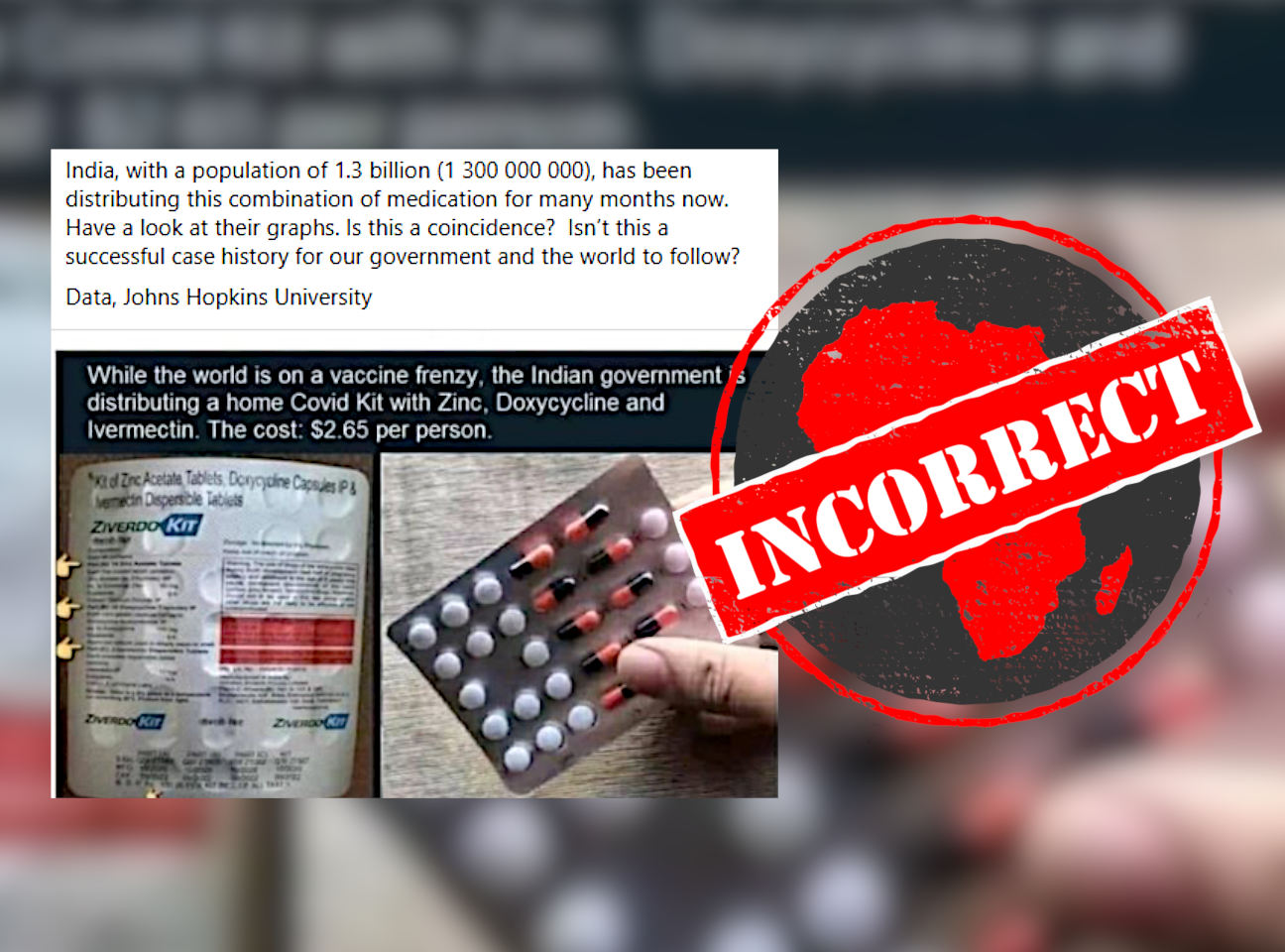
According to a graphic widely shared on Facebook, the Indian government is distributing a “home Covid kit” at a relatively low cost, while “the world is in a vaccine frenzy”.
The Afrikaans caption to the post reads: “Kyk net wat doen India vir Covid behandeling, terwyl die wereld rondsloer en tyd mors, en kyk net die prys?”
This roughly translates to: “Just look at what India is doing for Covid treatment, while the world messes around and wastes time, and just look at the price.”
In the graphic, above two photos of a blister pack of assorted pills labelled “Ziverdo kit”, is written: “While the world is on a vaccine frenzy, the Indian government is distributing a home Covid Kit with Zinc, Doxycycline, and Ivermectin. The cost: $2.65 per person.”
Is the Indian government distributing pill packs including the controversial antiparasitic ivermectin to treat Covid-19? And is this kit responsible for declining death rates in the country? We checked.
Kits launched in Goa state
On 9 October 2020, the government of the small state of Goa, on the southwestern coast of India, announced it was launching home isolation monitoring kits for Covid-19 patients.
A press release from the state government said the kits would include a digital thermometer, pulse oximeter, N-95 masks, alcohol-based sanitiser and gloves, as well as medication such as paracetamol, multivitamins, zinc, doxycycline and ivermectin.
The kits were valued at 2,000 Indian rupees, just over US$27 – 10 times the cost quoted in the graphic – but would be made available for free to Covid-19-positive residents of Goa. Kits only distributed in one state
By 22 January 2021, India had recorded 10,625,428 Covid-19 cases and 153,032 deaths.
According to the Johns Hopkins Coronavirus Resource Center, daily new cases in India peaked at over 97,000 in September 2020 and have since sharply declined to just under 14,000 in January 2021.
But this data is for the entire country. Goa is just one of India’s 28 states and eight union territories. Goa also has a relatively small population of just under 1.5 million people, compared to all of India’s 1.3 billion.
We could find no evidence that this Covid kit was being distributed by the central Indian government or by any other state’s government.
In late October 2020 one of the drugs in the kit, ivermectin, was not included in the Indian health ministry's clinical management protocol for Covid-19. The reason given for this was a lack of sufficient evidence on its efficacy, based on randomised clinical trials.
The South African Health Products Regulatory Authority, or Sahpra, has also said more research was needed before it could approve ivermectin for use in humans.
“There is no confirmatory data on ivermectin available as yet for its use in the management of Covid-19 infections,” Sahpra said in a 6 January 2021 statement. “In terms of safety and efficacy there is no evidence to support the use of ivermectin and we do not have any clinical trial evidence to justify its use.” (Note: See update below.)
It is misleading to attribute the decline of Covid-19 cases and deaths in India to a kit only distributed in one state. And there is not sufficient evidence that this combination of medicine is beneficial in the treatment of the disease.
But Uttar Pradesh has attributed its control of Covid-19 to several factors .. https://indianexpress.com/article/opinion/columns/coronavirus-pandemic-covid-vaccine-tracker-uttar-pradesh-7107756/ , including surveillance and contact tracing, and targeted testing of specific groups. It would therefore be misleading to attribute the decline in Covid-19 cases both in Uttar Pradesh and nationwide to the use of ivermectin without suitable research confirming a causal relationship.
The US National Institutes of Health (NIH) said on 14 January 2021 that there was “insufficient data to recommend either for or against the use of ivermectin for the treatment of Covid-19”.
The NIH Covid-19 treatment guidelines panel’s recommendation was: “Results from adequately powered, well-designed, and well-conducted clinical trials are needed to provide more specific, evidence-based guidance on the role of ivermectin for the treatment of Covid-19.”
The US Food and Drug Administration has also not approved ivermectin for the treatment of the virus, and recommends additional testing of the drug.
On 28 January Sahpra announced that no new “robust scientific information” had become available since earlier in the month and there was still “insufficient evidence for or against the use of ivermectin in the prevention or treatment of Covid-19”.
But the regulatory authority said they would implement a “compassionate use access programme” for the use of the drug in humans ? ivermectin was previously not legally available for human use in South Africa. This was widely reported by local media.
The World Health Organization does not mention ivermectin in its discussion of treatments for Covid-19, and says it “does not recommend self-medication with any medicines, including antibiotics, as a prevention or cure for Covid-19”.


 Market Data
  Markets


 AI
AI