Covid: What’s the best way to top up our immunity?
"Israel shows COVID-19 cases can explode once life returns to 'normal' at 80 per cent vaccination"
This article goes to the question of possible abuse of vaccinations. Specifically to booster shots and to the vaccination of children. Particularly when there are still millions of people worldwide who haven't been fully vaccinated yet. That point was touched on early in the covid experience when many questioned the morality of booster shots while some countries were still struggling to get vaccinations for their people.
James Gallagher Health and science correspondent @JamesTGallagheron Twitter
Published 1 day ago
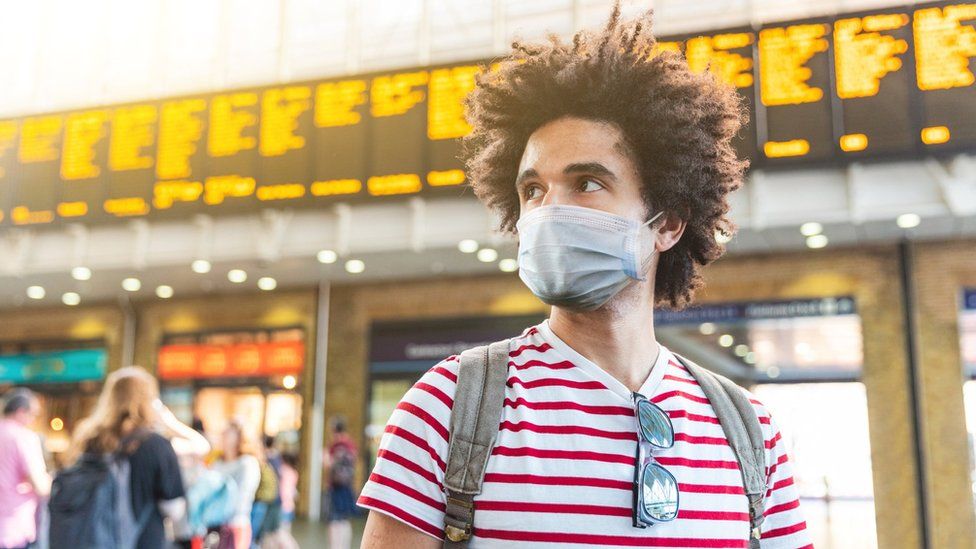
Which direction should we head for to top up immunity? Getty images
There are marked differences in your immune system after a natural infection with coronavirus and after vaccination.
Which is better?
Even asking the question bordered on heresy a year ago, when catching Covid for the first time could be deadly, especially for the elderly or people already in poor health.
Now, we're no longer starting with zero immunity as the overwhelming majority of people have either been vaccinated or have already caught the virus.
It is now a serious question that has implications for whether children should ever be vaccinated. And whether we use the virus or booster shots to top up immunity in adults. Both have become contentious issues.
"We could be digging ourselves into a hole, for a very long time, where we think we can only keep Covid away by boosting every year," Prof Eleanor Riley, an immunologist from the University of Edinburgh, told me.
Prof Adam Finn, a government vaccine adviser, said over-vaccinating people, when other parts of the world had none, was "a bit insane, it's not just inequitable, it's stupid".
The anatomy of immunity
We need to understand a little bit about the key building blocks of both our immune system and the virus it is attacking.
The power-couple of the immune system that clears the body of infection are antibodies and T-cells. Antibodies stick to the surface of the virus and mark it for destruction. T-cells can spot which of our own cells have been hijacked by the virus and destroy them.
For all the trouble the virus has caused, it is spectacularly simple. It has the famous spike protein, which is the key it uses to unlock the doorway into our body's cells. And 28 other proteins that it needs .. https://www.nature.com/articles/s41401-020-0485-4 .. to hijack our cells and make thousands of copies of itself. (For comparison it takes about 20,000 proteins to run the human body).
There are four key areas to compare vaccine and natural infection with the virus.
Breadth
How much of the virus the immune system learns to attack
You get a broader immune response after being infected with the virus than vaccination.
Whether you've had Moderna or Pfizer or Oxford-AstraZeneca, your body is learning to spot just one thing - the spike protein.
This is the critical part of the virus to make antibodies to, and the results - by keeping most out of hospital - have been spectacular.
But having the other 28 proteins to target too, would give T-cells far more to go at.
"That means if you had a real humdinger of an infection, you may have better immunity to any new variants that pop up as you have immunity to more than just spike," said Prof Riley.
Strength
How well it stops infection or prevents severe disease
We know there have been cases of people catching the virus twice (re-infection) and of being vaccinated and catching Covid (known as breakthrough infection).
"Neither gives you complete protection versus infection, but the immunity you get from either seems to protect you pretty well from serious illness," said Prof Finn, from the University of Bristol.
Antibody levels are, on average, higher about a month after vaccination than infection. However, there is a huge gulf in antibodies between those who are asymptomatic (who don't make very much) and those who get a severe bout of Covid.
The biggest immune response comes from people who caught Covid and were then vaccinated. We're still waiting for data on what happens the other way round.
Duration
How long does protection last?
Antibody levels have been shown to decline over time, although this may not be important for preventing severe disease.
The immune system remembers viruses and vaccines so it can respond rapidly when an infection is encountered.
There are "memory T-cells" that linger in the body, and B-cells remain primed to produce a new flood of antibodies on demand. There is evidence of immune responses more than a year after infection .. https://www.nature.com/articles/s41586-021-03696-9 .. and vaccine trials have also showed lasting benefit.
"In terms of durability, we're still waiting to see," said Prof Peter Openshaw, from Imperial College London.
Location
Where in the body is the immunity?
This matters. There is a whole different suite of antibodies (known as immunoglobulin As) in the nose and lungs, compared with those (immunoglobulin Gs) that we measure in the blood.
The former is more important as a barrier to infection. Natural infection, because it is in the nose rather than a jab in the arm, may be a better route to those antibodies, and nasal vaccines are being investigated too.
Prof Paul Klenerman, who researches T-cells at the University of Oxford, said: "The location of an infection makes a difference even if it's the same virus, so we would expect important differences between natural infection and vaccines."
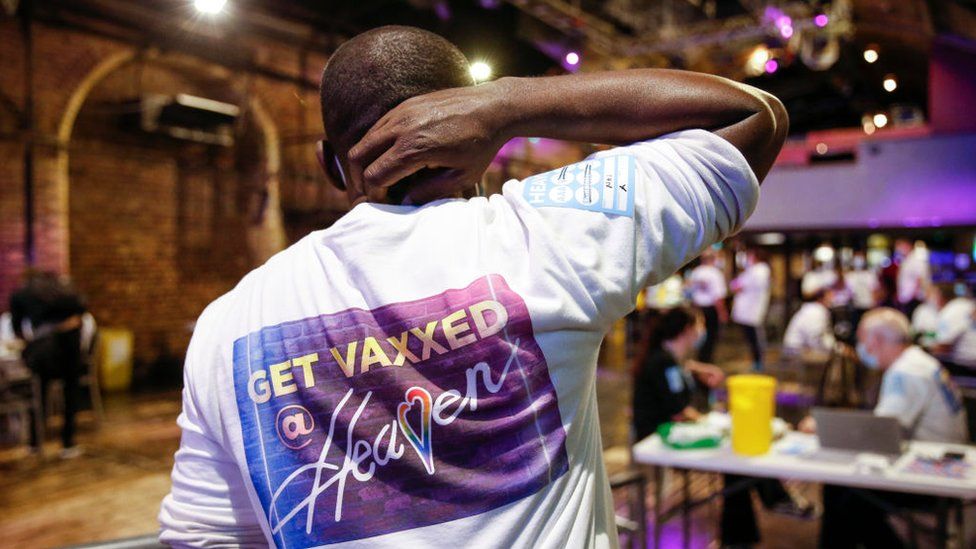
Vaccines have transformed Covid by dramatically reducing the chances of becoming severely ill. Getty images
Where does this leave the balance between more vaccine and virus?
There is clear evidence that adults who have not had any vaccine dose will have stronger immune defences if they do get vaccinated, even if they have caught Covid before.
But there are two big questions:
* do vaccinated adults need to be boosted, or is exposure to the virus enough?
* do children need vaccinating at all, or does a lifetime of encountering build a good immune defence?
The idea of regularly topping up immunity throughout life is not radical in other infections, such as RSV (respiratory syncytial virus) or the four other coronaviruses that infect people and cause common cold symptoms.
Each time you're exposed, the immune system gets a little bit stronger, and this continues until old age, when the immune system starts to fail and the infections become a problem again.
"This isn't proven, but it could be a lot cheaper and simpler to let that happen than spend the whole time immunising people," said Prof Finn, who warns we could end up "locked into a cycle of boosting" without seeing if it was necessary.
However, he said the argument in children had "already been won" as "40-50% have already been infected and most weren't ill or particularly ill".
There are counter-arguments. Prof Riley points to long-Covid in children, and Prof Openshaw to nervousness around the long-term effects of a virus that can affect many of the body's organs.
But Prof Riley said there was potential in using vaccines to "take the edge off" Covid, followed by infection, to broaden the immune response.
She said: "We really need to consider, are we just frightening people rather than giving them the confidence to get on with their lives? We're close to just worrying people now."
Of course, with cases continuing to rumble on, there may not be much choice.
"I'm wondering whether it's inevitable," said Prof Klenerman, as if the virus continues to spread then "there will be this ongoing boosting effect".
There is, of course, also the question of increased covid cases taking hospital beds away from people who need them for other, sometimes very serious, illnesses.
Among older Israelis, serious COVID rate six times as high if unvaccinated
"Israel shows COVID-19 cases can explode once life returns to 'normal' at 80 per cent vaccination "Riots Shatter Veneer of Coexistence in Israel’s Mixed Towns""
As government desperately tries to galvanize 1.1 million who are spurning vaccine, data shows that severe cases also far higher among younger people if they aren’t inoculated
By Nathan Jeffay 10 August 2021, 1:05 pm
Israelis over 60 years old receive their third dose of the COVID-19 vaccine at a Clalit health care center on August 10, 2021 (Miriam Alster/Flash90)
Despite the Delta variant, vaccines are delivering high protection, and the rate of serious infections in Israel is six times higher among older people who fail to inoculate than others in the same age bracket.
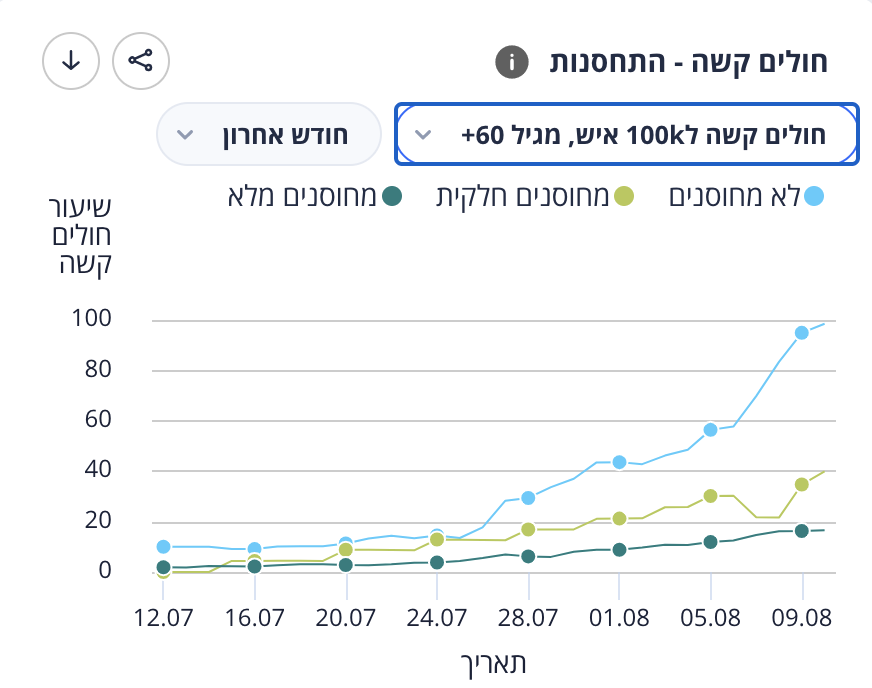
Health Ministry data shows that among Israelis aged 60-plus, there are 16.6 people per 100,000 in serious condition. Among the unvaccinated the figure is 98.5. (There were 394 people in serious condition nationwide as of Tuesday morning, the ministry said.)
But the key parameter is serious illness, and experts say the latest statistics paint an encouraging picture.
“They very clearly show that despite the highly infectious nature of the Delta variant, the vaccine is still kicking in and preventing serious illness,” Prof. Nadav Katz, a coronavirus statistician from the Hebrew University, told The Times of Israel.
An Israeli health worker, poised to give a COVID-19 vaccine, on August 08, 2021 in Jerusalem. (Olivier Fitoussi/Flash90)
“It’s important to show this graph. It shows how extremely effective the vaccine is in preventing morbidity,” Katz said.
In the graph, below, the blue line shows how many unvaccinated people are in serious condition per 100,000 population, and the dark green line shows fully vaccinated people. The light green refers to partly vaccinated people,
This graph, by Israel’s Ministry of Health, shows the number of serious COVID cases among over-60s by date, per 100,000 people. The left axis shows the number of people. The top line shows unvaccinated people, the bottom line shows fully vaccinated people. The bottom line represents partly-vaccinated people.
Under 60s are feeling the benefit of vaccines in avoiding serious illness, as are those above that age. For every 100,000 people under 60 who are not vaccinated, 1.6 are in serious condition with the coronavirus. Among the fully vaccinated the figure is 0.5.
The stats come as Israel’s government is trying hard to convince the 1.1 million citizens who are eligible for vaccines but failing to take shots that they should do so.
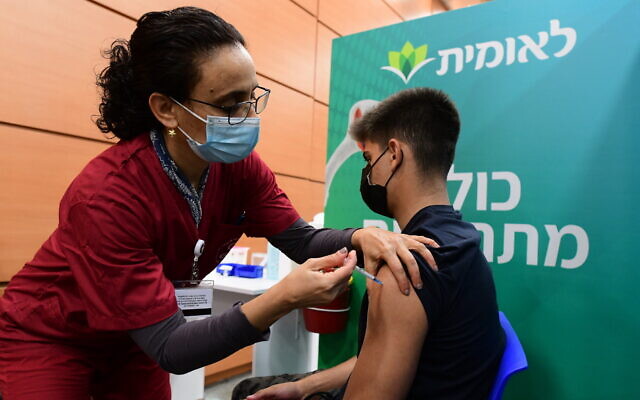
An high school student receives a COVID-19 vaccine injection, at a vaccination center in Tel Aviv, on January 23, 2021. (Avshalom Sassoni/Flash90)
Vaccine holdouts tend to be young, with a particularly high concentration among the under-30s.
Data on vaccination levels in different locales additionally highlights lower take-up in Arab and ultra-Orthodox areas.
Nationally, some 90.2% of Israelis age 90-plus are vaccinated with at least two shots, and for the 80-89 age group the figure is 91.5%. It is even higher, 93.1%, for people in their 70s. But the rates decline among younger age groups: 87.2% for people in their 60s; 84.6 for people in their 50s and 81.2% for people in their 40s. Advertisement
For Israelis in their 30s and 20s, the rates are 77.8% and 72.4% respectively. The 16-19 age group is only 68% vaccinated, and only 26.2% of 12- to 15-year-olds are fully vaccinated.
Prof. Nadav Katz, expert in coronavirus statistics, (Noam Moreno)
“The low rate of youth vaccinating suggests that parents who may well have vaccinated themselves are more hesitant about taking their teenagers for vaccines,” said Katz. He also observed that the younger people are, the smaller they see the risk that COVID-19 poses to their health, and therefore the lower the enthusiasm for vaccines.
In each age group, there is a gap of a few percent between people who are fully vaccinated and those who had a first shot but didn’t get a second.
Katz said that data on rates of serious illness should encourage these people to follow through, as it suggests that people are compromising their protection by failing to show up for a second dose.
Among the 60-plus, the partly vaccinated have 39.9 serious cases per 100,000, higher than the 16.6 for the vaccinated but far short of the 98.5 for unvaccinated.
The number of seriously ill for people under 60 are too small to allow an accurate analysis, though generally, the unvaccinated and partly vaccinated have been more likely to be in serious condition than the fully vaccinated.
“The indication here is that it’s highly recommended to follow through, and go for a second shot as it increases protection,” said Katz.
Bottom line: The young should be vaccinated for the community good. To prevent further lockdowns. And for their own good, as they will be older one day and the virus may well be still around.


 Market Data
  Markets


 AI
AI