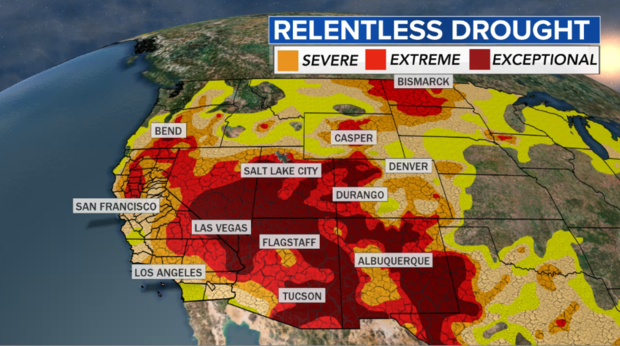
Western U.S. may be entering its most severe drought in modern history
BY JEFF BERARDELLI APRIL 12, 2021 / 6:46 AM / CBS NEWS
Extreme drought across the Western U.S. has become as reliable as a summer afternoon thunderstorm in Florida. And news headlines about drought in the West can seem a bit like a broken record, with some scientists saying the region is on the precipice of permanent drought.
That's because in 2000, the Western U.S. entered the beginning of what scientists call a megadrought — the second worst in 1,200 years — triggered by a combination of a natural dry cycle and human-caused climate change.
In the past 20 years, the two worst stretches of drought came in 2003 and 2013 — but what is happening right now appears to be the beginning stages of something even more severe. And as we head into the summer dry season, the stage is set for an escalation of extreme dry conditions, with widespread water restrictions expected and yet another dangerous fire season ahead.
How young farmers are navigating climate change on their farms
"It's a daily thing that is affecting us, because obviously, we're working with the weather on a daily basis," one farmer said.
April 22, 2021, 8:56 AM CDT By Safia Samee Ali
After farming for over six years, Carolina Mueller has learned how to adapt to the fickle and sometimes unpredictable weather patterns she has experienced over the last several seasons.
Even this winter, when harsher frosts were expected, Mueller, 30, who works at a farm owned and run by her partner in Bastrop, Texas, about 30 miles from Austin, prepared with the rest of the farm's staff by throwing row fabric covers to protect crops from the frost, putting out extra feed for animals and stocking up on propane tanks for the greenhouse.
But a deep freeze — the first in decades — caused a massive shutdown of the state's electrical grid in February, rendering propane heating and water pumps useless as Mueller and her partner were stuck in Austin for a full week because of dangerous road conditions. The couple finally returned to rows of dead crops, as well as other damage totaling over $30,000, including loss of future income.
"It was a really eye-opening experience for a lot of us who realized just how little we were prepared for these kinds of extreme weather events," said Mueller, who is a staff member of the National Young Farmers Coalition, a national advocacy organization, and leader of the Central Texas chapter. "We know about heat and can sort of anticipate how to handle heat, but the freeze is a whole different thing. And considering that the last time was so long ago, a lot of young farmers had no idea what to expect."
Weather patterns are crucial in farming, as they dictate every step of the crop process. As erratic climate changes have become more the norm than the exception, young farmers across the country are feeling their effects and trying to adapt, but some say they fear the future could bring more difficulties.
Some of the signs are globally rising temperatures due to greenhouse gases' trapping more heat in the atmosphere and longer and more extreme droughts, the agency says.
While the effects are far-reaching, farmers feel them firsthand, because agriculture and climate change are so intricately intertwined.
Scott Pelley knows - "Scott Pelley spoke with the then-chief of fire operations for the federal government, Tom Boater, who explained that "ten years ago, if you had a 10,000-acre fire, you were talking about a huge fire...now we talk about 200,000-acre fires like it's just another day at the office.""


 Market Data
  Markets


 AI
AI