"'Inevitable' Google and Facebook will pay for Australian news, treasurer says "Australia is making Google and Facebook pay for news: what difference will the code make? "Australia Moves to Force Google and Facebook to Compensate Media Outlets """
The war between Facebook and the Australian government is over.
Australian news will return to the social media giant's platform, and it will reach deals to pay news groups for their stories.
So, who won this titanic battle and how will that play out around the world?
The former boss of Facebook in Australia is pretty clear.
"I'd say Facebook may have blinked a bit here," Stephen Scheeler told BBC Radio 4's Today programme.
"I think there's no question that global backlash against this was pretty stern.
"And I think Facebook probably observed that governments around the world were taking a harder line maybe than they had anticipated."
Microsoft's intervention
Australia had support not only from other governments, which wanted to see Mark Zuckerberg's company taken down a peg, but even from another tech firm that has previously been in regulators' sights itself.
Earlier this month, Microsoft came out in strong support of the new media law.
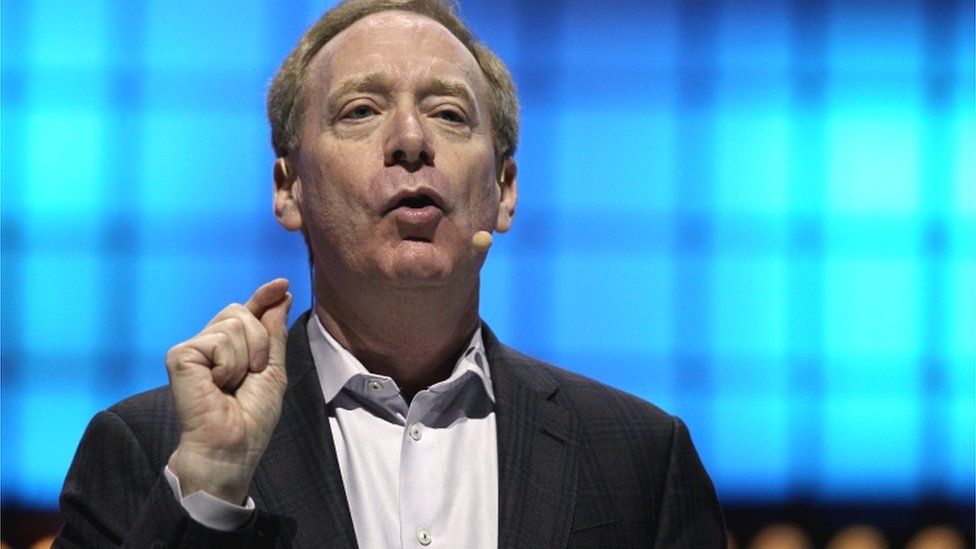
Its President Brad Smith wrote: "The legislation will redress the economic imbalance between technology and journalism by mandating negotiations between these tech gatekeepers and independent news organisations."
Cynics might point out it's not surprising Microsoft backed a law framed specifically to affect two of its biggest rivals.
Microsoft's Brad Smith had backed Australia over Google and Facebook Reuters
After all, at a time when Google was threatening to leave Australia altogether, Microsoft was telling the Australian prime minister that its search engine Bing would be happy to fill the gap and contribute to the news industry.
But a spokesman for the company told me that its stance had always been based on principle.
For its part, Facebook says it's happy with the amendments to the law.
It believes they will put an end to the idea that the government should set the terms of a deal between private companies.
"It gives us the ability to strike commercial deals on terms that make sense which is what we wanted," says one insider.
With both Facebook and Google now striking deals with newspaper groups, the Australian government may not feel the need to go ahead with the legislation.
So should other governments take inspiration from what looks to have been a successful approach to forcing the tech giants to fund news?
'Screwed it up'
Not according to Benedict Evans. The tech consultant and former Silicon Valley venture capitalist has been a ferocious critic of the Australian law.
He says it was poorly framed with unrealistic elements, including the demand that Google give 14 days notice of any change in a search algorithm which is constantly tweaked.
"Google caved to extortion early," he says.
"Facebook stood on principle but screwed up by blocking everything instead of just actual news.
"Australia wrote a law that was physically impossible to comply with, and has now said: 'Oh well it's been a success because we're not applying it to anybody.'"
But he adds the principle of taxing tech companies to subsidise newspapers is set to spread.
"The challenge in this case is that you're sort of pretending it's not a tax and not a subsidy. You're pretending it's a commercial arrangement, which it isn't."
Radical action
The end result seems likely to be that Facebook and Google will strike more deals around the world to pay money for news.
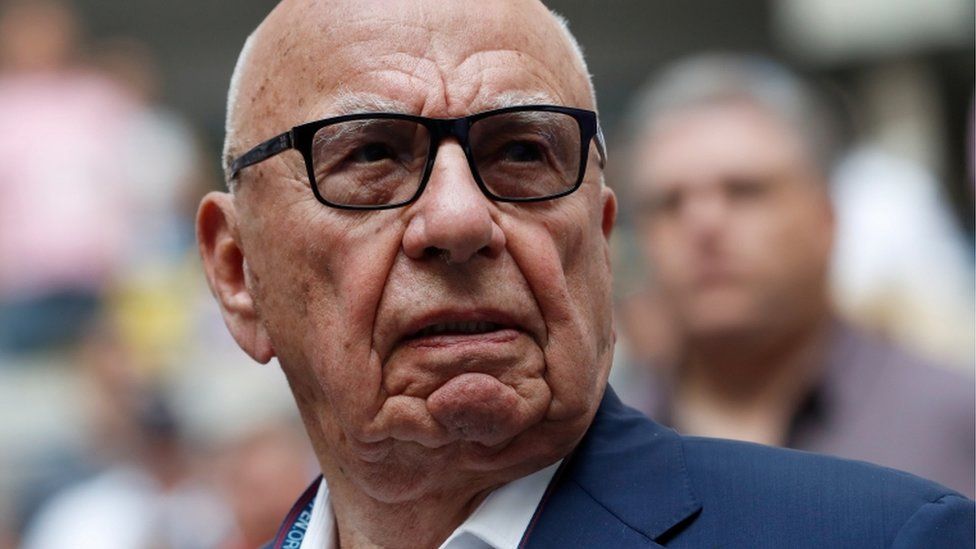
The problem is that this will probably benefit the major newspaper businesses, including Rupert Murdoch's News Corp, rather than struggling regional titles. And it will do nothing to chip away at the dominance of Facebook and Google in online advertising.
Rupert Murdoch's News Corp is now set to receive payments from both Google and Facebook Reuters
So what's the answer?
According to ex-Facebook Australia boss Mr Scheeler, it's time for radical action: breaking up the tech giants.
"I've come around to the view that the scale, size and influence of these platforms, particularly on our minds, our brains, and all the things that we do as citizens, as consumers, are just so powerful that leaving them in the hands of a few, very closely controlled companies like Facebook is the recipe for disaster," he said.
While Facebook certainly lost the PR war in Australia, it has suffered very little damage to its bottom line.
But in flexing its muscles so unwisely, it may have made the breakup of Mr Zuckerberg's empire a little more likely.
AUSTRALIAN election soon.At this gravest of times the Coalition has served up an election budget designed simply to keep itself in power
"'Inevitable' Google and Facebook will pay for Australian news, treasurer says"
Related: Yep. While middle class and those on lower income rungs struggle to feed children and... [...] The argument goes that it's unfair that such a small proportion of the population carries the bulk of the income-tax burden. Given the first two stages of the cuts delivered the goods for low and middle-income earners, surely it's only fair that those in the top tax brackets get some relief too. P - But that's a false argument. The reason the top earners pay more in tax is precisely because they are the top earners. It's not that they are being victimised because they are members of a minority. That's just the way a progressive tax system works. https://investorshub.advfn.com/boards/read_msg.aspx?message_id=167574816
Katharine Murphy
If we move from Josh Frydenberg’s rhetoric to content, we discover this isn’t a serious plan for the future. This is a plan for the next few months
‘Given that this budget is very obviously political, and in Coalition terms, measurably transactional, Josh Frydenberg and Scott Morrison will insist they are about more than surviving an election contest.’ Photograph: Mike Bowers/The Guardian
Tue 29 Mar 2022 19.45 AEDT Last modified on Wed 30 Mar 2022 06.06 AEDT
The opening flourishes of Josh Frydenberg’s budget night speech certainly convey the gravity of our times. “Tonight, as we gather, war rages in Europe,” the treasurer told parliament. “The global pandemic is not over. Devastating floods have battered our communities.”
“We live in uncertain times.”
Indeed, we do.
But if we move from Frydenberg’s rhetoric to content, we discover this budget isn’t a serious plan for the future crafted by serious people in serious times.
This is a plan for the next few months.
This is a budget with one central objective: the re-election of the Morrison government in May.
With wages stagnant and consumer prices on the march, the Coalition’s primary pre-election gift to voters is cash for Australia’s low-and-middle income earners.
As well as cash, the government will cut the fuel excise in half in the hope a price cut at the bowser isn’t swallowed immediately by another adverse shift in the global oil price or an interest rate rise between now and September, when the excise is supposed to revert to its full rate.
This “temporary” assistance assumes there is some future benign political universe where either the current government, or a newly elected Labor one, can give Australians relief at the petrol pump, then take it away without incurring massive political pain – which has to be the working definition of the triumph of hope over experience.
Let’s believe the fuel excise reversion when we see it.
And the cost of “please like me”?
More than $8bn over the next two years.
The treasurer and the finance minister will say the following in their defence: most of the pre-election cash splash in this budget washes through. The spending isn’t baked in and much of the revenue uplift from Australia’s burgeoning post-pandemic economic recovery has been banked rather than spent. Advertisement
Both of these observations are true.
Also true: had the Coalition done nothing in this budget to ease escalating cost-of-living pressures, they would have been belted politically.
The government insists its cash splash won’t feed inflationary pressures, which is obviously a significant risk to manage. But a pre-election handout north of $8bn is still a hefty price tag, however you look, however you measure.
Speaking of hefty price tags, this budget also finally squares the accounts between Scott Morrison, a prime minister who last year needed to land a commitment to net zero emissions by 2050, and Barnaby Joyce, a Nationals leader who wasn’t inclined to sign up unless the terms were favourable.
For graciously declining to humiliate Morrison at the Glasgow climate summit last year, Joyce has been rewarded with “transformational investments” (read many, many billions) for dams, roads and regional communications infrastructure.
“Thank you, Barnaby” includes about $3bn for inland rail, as well as $7.1bn over 11 years to “turbocharge the economies of four regional hubs across Australia”.
It’s probably a coincidence (yes, that is irony) that these hubs are located in the Northern Territory (two marginal seats there), north and central Queensland (Labor has its eye particularly on the electorate of Flynn), the Hunter in New South Wales (where the Nationals would very much like to snatch a seat from Labor) and the Pilbara in Western Australia.
This regional spend is north of $20bn over the medium term. I think the technical term for that is happy days on the Wombat Trail.
Given that this budget is very obviously political, and in Coalition terms, measurably transactional, Frydenberg and Morrison will insist they are about more than surviving an election contest.
I feel certain Exhibit A for future focus will be the national security spend – the magnificently named Redspice, which is (to quote the treasurer) “a $9.9bn investment in Australia’s offensive and defensive cyber capabilities” and “the biggest ever investment in Australia’s cyber-preparedness”.
The government says this initiative is all about meeting the challenges associated with the darkening geostrategic environment – which is very obviously a serious problem.
But take a moment to read the fine print. You’ll discover the investment to deal with this serious problem is loaded largely outside the forward estimates. The budget papers also make clear the expenditure will be “partly offset from the Defence Integrated Investment Program”.
In net terms, the outlay on Redspice over the next four years is actually $588.7m, not $9.9bn. Do remember that over the coming weeks, when Peter Dutton breaks out his loudhailer and throws down tests of patriotism out on the hustings.
Speaking of loudhailers, the 2022 election contest is now in sight. It could be days away. It could be a couple of weeks away. But it is close enough now to be real.
If we cast our minds back to 2007, when Labor was attempting to plot a pathway to government against an ageing Coalition government in whatever-it-takes mode, Kevin Rudd’s cut-through political riposte was “this reckless spending must stop”.
Back then, Rudd savaged John Howard’s “irresponsible spending spree” as a “desperate attempt” to buy a fifth term in government. Back then, the Reserve Bank was warning about government spending fuelling inflationary pressures and interest rate rises.
Audacious and supremely self-confident, Rudd backed himself to weaponise fiscal profligacy against Howard – to make the trinkets and tricks a symbol of a prime minister who cared more about the present than the future.
That effort succeeded.
But Anthony Albanese, ahead in the polls, and in small target mode, seems unlikely to adopt the Rudd playbook.
Given that Australians are struggling with rising prices – this is probably safe politics.
Safe, yes, but not entirely risk free.
Given that there is palpable disenchantment out in voter land, and given that the prime minister is working around the clock to convince people to stick with the devil they know in uncertain times, safe politics does raise one question.
Will Albanese present as sufficiently different from Morrison to be trusted by voters to chart a new course for Australia?


 Market Data
  Markets


 AI
AI