Zorax, Can Dan Bongino Make Rumble The Right's New Platform?
Of course, every individual is responsible for their own fact checking. Thank goodness there are some fact checkers out there who are conscientious and so generally reliable.
The conservative pundit has found a home at rumble.com, a relatively unknown video hosting site.
But instead of sending people to watch the videos on Bongino’s popular YouTube channel .. https://www.youtube.com/user/DanBongino , his page referred them to rumble.com .. https://rumble.com/ , a relatively unknown video site that has become the darling of right-wing figures including Bongino, conservative author Dinesh D’Souza, writer John Solomon, Rep. Devin Nunes, and pro-Trump commentators Diamond and Silk.
One video on Bongino’s Rumble account, “Ted Cruz SHREDS Twitter's CEO - He Wasn't Ready For This,” has racked up over 225,000 views since it was posted on Oct. 28. D’Souza uploaded his own version of the Cruz–Dorsey interaction to Rumble, “Ted Cruz BODIES Twitter’s CEO in Senate Hearing, Sets Trap He Didn't See Coming.” In five days, it received over 190,000 views.
Rumble is the latest in a series of upstart video and social sites — including Gab, Parler, and BitChute — to be promoted by high-profile conservatives who say they’re fed up with Facebook, YouTube, and Twitter. But unlike those, Rumble didn’t set out to court conservatives. During its seven-year existence, Rumble’s content has mostly consisted of harmless viral videos (“Pit Bull's favorite thing ever is jumping into the pool .. https://rumble.com/vaurxr-pitbulls-favorite-thing-is-jumping-in-the-pool.html ”) and news content from mainstream sources such as Reuters .. https://rumble.com/user/ReutersNews .
“We’re the clean YouTube competitor, the place they can feel safe,” Rumble CEO Chris Pavlovski told BuzzFeed News in an interview at the company’s Toronto headquarters last week.
As for his new conservative creators, he said, “I don't like being a one-sided platform, and I want to keep this really open to everybody.’
Bongino did not respond to an interview request.
The sudden traction with right-wing influencers and their fans has unleashed unheard-of growth for Rumble, attracting close to 60 million unique visitors in October, according to a Google Analytics screenshot from Pavlovski. That’s up from 45 million in September.
The growth is breathing new life into Rumble, but it also opens up a Pandora’s box the company may be unprepared to handle.
Rumble employs 12 people in its Toronto office, as well as relying on workers from Cosmic Development, an outsourcing company Pavlovski founded in North Macedonia, the country that in 2016 was home to more than 100 pro-Trump sites .. https://www.buzzfeednews.com/article/craigsilverman/how-macedonia-became-a-global-hub-for-pro-trump-misinfo .. that earned money by spreading false stories. Pavlovski, whose parents and grandparents immigrated to Canada from North Macedonia, said he had nothing to do with those kinds of sites.
“I have nothing to do with that,” he said, adding that the perception of the country as a fake news hotbed has led to “discrimination” against North Macedonians.
Prior to its influx of conservatives, Rumble's partners included news organization Reuters, venerable viral video outfit America’s Funniest Home Videos, television station owner E.W. Scripps, and fact-checking site Snopes. Its new content creators are more controversial. Solomon’s previous work for the Hill resulted in a damning internal inquiry .. https://www.politico.com/news/2020/02/19/hill-john-solomon-failed-disclose-details-115976 ,
That means Rumble will soon have more difficult content moderation decisions to make, according to evelyn douek .. https://www.evelyndouek.com/ , a lecturer at Harvard Law School.
“If Rumble doesn't want to be a haven for hate speech or harmful health misinformation or upset its user base and genuinely wants to moderate responsibly, it needs to think ahead about how it's going to draw lines and, just as importantly, how it's going to clearly communicate those lines to its users,” she told BuzzFeed News. “These decisions can be genuinely hard.”
Pavlovski, meanwhile, is trying to recruit other high-profile political commentators to his site, while also lamenting how “tribal” politics and society have become. “Just like Spotify brought in Joe Rogan, we were looking to bring in some big podcasters,” he said.
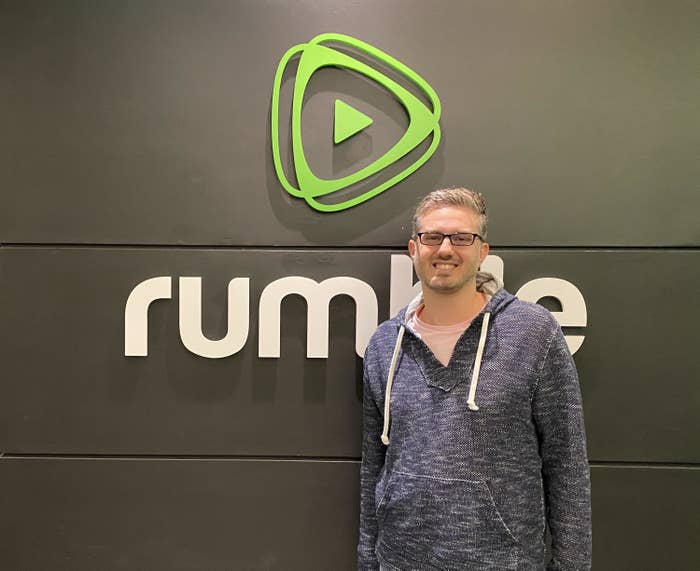
Chris Pavlovski, CEO of Rumble BuzzFeed News
When Google bought YouTube for $1.65 billion in October 2006, Pavlovski was running a viral jokes and video site called jokeroo.com. He said YouTube’s sale to Google ushered in the death of the online video ecosystem.
“It was this great ecosystem, and everybody had a lot of traffic," said Pavlovski. “Then the entire ecosystem completely collapsed. I watched all my friends get destroyed.”
In 2013, Pavlovski decided to take another crack at online video. Rumble paid creators to license their content and also paid them a share of ad revenue it earned from their content.
Pavlovski saw Rumble as a way to help the “little guy” earn money in a marketplace increasingly dominated by big brands and influencers. For seven years, it has chugged along thanks to a steady diet of viral animal and baby content, small individual creators, and deals with content partners, and by licensing its technology.
The Canadian CEO calls it “censorship” that independent creators rarely show up on YouTube’s homepage, and that Rumble gets little search traffic. “We're totally censored any way you look at it, unless Google likes us,” he said.
Pavlovski is making an antitrust argument, not a censorship one. But melding the two together is the kind of thing his new star contributors do as well.
"YouTube is crushing conservative voices. I'm not going to sit around and take their bullshit anymore," Bongino tweeted on Sept. 16. "They think alienating & discriminating against major content producers is a long-term business plan. It’s not.”
Bongino’s chief complaint was that YouTube was demonetizing his videos, preventing him from earning revenue. (It was not removing them or censoring the content.)
But Pavlovski isn’t worried about his new creators running afoul of his site's policies. Rather, it didn’t seem like something he’d thought about. Asked if it was OK for someone to upload a video that spread medical misinformation such as that masks make people sick or that the coronavirus is a hoax, he said, "We don't get reports of that kind of stuff that often.”
“In terms of what information is correct, and what information is not correct, we don't get involved,” Pavlovski said. “We have a pretty strict policy when it comes to adult material, illegal material, obscene material, and like KKK stuff. We don't want any of that stuff on Rumble."
What if someone said in a video that Black people are inferior? He said "racism is not allowed,” though that’s not listed in the site’s terms of service.
Smaller platforms often lack preparation for content moderation issues, douek said.
“Platforms that try and fly by the seat of their pants can make a lot of people very unhappy very fast,” she said.
In a follow-up email, Pavlovski said he now plans to update the site’s terms of service.
“Being that things are happening at an extremely fast rate, we are currently working with our lawyers to update our terms and provide even more transparency for creators,” he said.
Ofcourse - Trump is losing Twitter followers every day after losing the election [...] Parler, an alternative to Twitter that doesn’t fact-check users’ information, has gained traction among right-wingers in recent weeks. It’s reportedly owned in part by Fox News contributor Dan Bongino. https://investorshub.advfn.com/boards/read_msg.aspx?message_id=159735665


 Market Data
  Markets


 AI
AI