Thousands of mask-less Trump supporters rally in D.C., falsely claiming president won election
Supporters of President Trump rally Saturday near Freedom Plaza in Washington. (Toni L. Sandys/The Washington Post)
By Julie Zauzmer, Katie Mettler, Marissa J. Lang, Rachel Chason, Emily Davies, Michael E. Miller, Peter Jamison, Fredrick Kunkle and John Woodrow Cox
November 15, 2020 at 10:00 a.m. GMT+11
President Trump’s supporters had celebrated for hours on Saturday, waving their “MAGA” flags and blaring “God Bless the USA” as they gathered in Washington to falsely claim that the election had been stolen from the man they adore. The crowd had even reveled in a personal visit from Trump, who passed by in his motorcade, smiling and waving.
On stark display in the nation’s capital were two irreconcilable versions of America, each refusing to accept what the other considered to be undeniable fact.
In brief but intense clashes, activists spewed profanity and shouted threats, threw punches and launched bottles. On both sides, people were bloodied, and at least 10 were arrested, including four on gun charges.
The demonstrations were urged on by Trump,
[Insert: As the democracy-destroyer has also been doing for months. Fixed and violence Trump's two insidious, corrupt months-long chants.]
who refuses to concede to Joe Biden or allow a formal transition to begin. On Saturday morning, as the president’s devotees remained in D.C. to fight for him, he headed to Trump National in the Virginia suburbs for a round of golf.
VIDEO - Protesters supporting President Trump in Northwest Washington on Nov. 14 watched as his motorcade circled Freedom Plaza. Some ran alongside the vehicles. (Michael Brice-Saddler/The Washington Post)
Trump had thrilled them when his motorcade appeared on Pennsylvania Avenue shortly after 10 a.m., prompting fans to scramble to the side of Freedom Plaza to catch a glimpse.
“He drove right past me. I saw him. He waved right past me,” one man said, squatting to collect himself.
A group of women huddled around their phone, looking at a video of Trump’s appearance near a Walt Whitman quote inscribed in the stone beneath them: "The President is there in the White House for you, it is not you who are here for him.”
People wave to President Donald Trump's motorcade Saturday as it drives past Freedom Plaza as supporters gathered for the Million MAGA March in D.C.. (Matt McClain/The Washington Post)
Then the appearance of counter-protesters sparked bursts of conflict that could have become far more violent had police not worked so hard to keep the feuding sides separate. When a small group holding bright orange “Refuse Fascism” posters arrived at the corner of Freedom Plaza, they were almost immediately surrounded by Trump fans shouting “USA! USA!” into their faces.
[Intimidation by mostly maskless magahats. Not cool. Ah good, i'm hearing just now it's "remarkably peaceful." Kudos to most for that. Police included, of course.]
The women leading the tiny march fought their way up 14th Street, repeatedly breaking out of the crowd only to be engulfed again.
“Trump pack your s---. You’re illegitimate," they yelled into their megaphone,
One pro-Trump man attempted to gouge the opposition with a flag bearing the president’s name. Another grabbed a woman’s neon orange poster and hit her with it.
A Trump supporter is pushed back by a DC Police officer after trying to make his way towards the crowd gathered at Black Lives Matter Plaza. (Toni L. Sandys/The Washington Post)
Nearby, on the street beside inscriptions from Abraham Lincoln recognizing the District as a place of freedom, people piled atop a U-Haul truck with a flag of a gun and the words, “Come and take it.”
One man, dressed in camouflage and a red “MAGA” hat, waved an American flag attached to a baseball bat.
Later, near Union Station, another altercation broke out.
Roland Biser, a 69-year-old Pentagon employee who had attended a pro-Trump rally, was driving home when he said he saw a young man throw a rock at a group of Trump supporters. The rock grazed a woman, he said, and may have hit someone else.
Biser pulled over as a crowd quickly surrounded the young man and three others with him, all of whom were Black. Nearly a hundred Trump supporters quickly surrounded them before a dozen U.S. Capitol Police officers rushed between them and separated the groups.
As police escorted the four young men away, the crowd taunted them, chanting “USA!”
“I didn’t do anything!” said one of them, who had been handcuffed. The 21-year-old D.C. resident insisted that it was the Trump supporters who had come after him.
A few minutes later, police removed his cuffs off and let him go.
Trump supporters face off with counter protesters along 14th Street in downtown D.C. during the Million MAGA March. (Matt McClain/The Washington Post)
A family of four on Capital Bikeshare bikes — the father with an American flag tied around his neck like a cape — were cut off by a line of counterprotesters as they tried to leave a tense scene outside the Supreme Court around 1 p.m.
“Get out of our city!” a young woman in black yelled.
“You lost, losers!” shouted a man.
The father and his teenage son began to chant “USA," raising their fists as police officers surrounded the family and pushed them out of the crowd.
“Why would you bring your kids here? It’s dangerous,” observed a man nearby, a helmet on his head and respirator hanging around his neck.
On a day when the president’s supporters touted a vast array of falsehoods, his spokeswoman, Kayleigh McEnany, offered perhaps the most ludicrous.
“More than one MILLION marchers for President @realDonaldTrump descend on the swamp in support,” she tweeted, vastly exaggerating the crowd size.
Among the protesters were members of the Proud Boys, an extremist group known for their black and yellow colors and endorsements of violence. Some wore flak jackets and helmets. “Stand Back, Stand By,” read some of their shirts, referencing the president’s directive to them at a September debate.
As conservative speakers at Freedom Plaza derided the news media, including Fox News, the Proud Boys marched down Pennsylvania Avenue, leading hundreds in chants of “f--- antifa” and shouting down stray opponents who yelled “Black lives matter.”
“All lives matter!” they screamed back.
Marching with them was D.C. resident Justin Anthony, who waved a satirical sign that read, “Sue anyone who did not vote for this great American.”
He led chants to the tune of “Count only Trump votes” and danced around in a large mock police uniform with the name “Officer Pudge” on its badge.
Almost no one got it, he said. They joined in, asked for pictures, cheered.
“It’s crazy,” he said. “Like, they really don’t see how insane this is.”
Among the speakers who addressed the aggrieved legions were Alex Jones,a discredited conspiracy theorist most famous for tormenting the families of school shooting victims, and Marjorie Taylor Greene, a recently elected congresswoman from Georgia who has promoted QAnon, which falsely alleges famous Democrats belong to a cabal of Satan-worshipping pedophiles.
A Trump supporter near the White House on Friday. (Bill O'Leary/The Washington Post)
The Trump believers began gathering at Freedom Plaza Saturday morning hours before the official rally.
“They think we’re stupid,” a young White man with a microphone told the crowd. “They’re underestimating the Donald. They’re underestimating the Donald’s supporters.”
“They’re stupid!” a young White woman replied.
At midday, along the east end of Freedom Plaza, a lone counter protester stood on the sidewalk holding a sign that read, “Trump is the fraud.” He wore a gray cloth mask.
A succession of Trump supporters approached the curb, unmasked, to offer their opinions of his solitary demonstration.
“Why didn’t your mother abort you?” one screamed. “You’re mentally disturbed, and you’re a coward, and you’re a f——. I hope you get AIDS."
“I just feel strongly about the disinformation that’s being peddled on the internet about fraud in this election,” said the counter protester, a 40-year-old D.C. man who declined to give his name because he is a federal employee and feared repercussions at work.
A thin film of sweat had formed on his face.An elderly woman in red MAGA gear paused and stared at him, sadly.
“We feel bad for you that you can’t see the truth,” she said.
“I feel the same way about you,” he replied.
Michael E. Miller, Peter Jamison, Michael Brice-Saddler, Peter Hermann, Wm. Justin Moyer contributed to this report.
The science supports that face coverings are saving lives during the coronavirus pandemic, and yet the debate trundles on. How much evidence is enough?
Lynne Peeples 06 October 2020
Illustration by Bex Glendining
When her Danish colleagues first suggested distributing protective cloth face masks to people in Guinea-Bissau to stem the spread of the coronavirus, Christine Benn wasn’t so sure.
“I said, ‘Yeah, that might be good, but there’s limited data on whether face masks are actually effective,’” says Benn, a global-health researcher at the University of Southern Denmark in Copenhagen, who for decades has co-led public-health campaigns in the West African country, one of the world’s poorest.
That was in March. But by July, Benn and her team had worked out how to possibly provide some needed data on masks, and hopefully help people in Guinea-Bissau. They distributed thousands of locally produced cloth face coverings to people as part of a randomized controlled trial that might be the world’s largest test of masks’ effectiveness against the spread of COVID-19.
Face masks are the ubiquitous symbol of a pandemic that has sickened 35 million people and killed more than 1 million. In hospitals and other health-care facilities, the use of medical-grade masks clearly cuts down transmission of the SARS-CoV-2 virus. But for the variety of masks in use by the public, the data are messy, disparate and often hastily assembled. Add to that a divisive political discourse that included a US president disparaging their use, just days before being diagnosed with COVID-19 himself .. https://www.nature.com/articles/d41586-020-02800-9 . “People looking at the evidence are understanding it differently,” says Baruch Fischhoff, a psychologist at Carnegie Mellon University in Pittsburgh, Pennsylvania, who specializes in public policy. “It’s legitimately confusing.”
To be clear, the science supports using masks, with recent studies suggesting that they could save lives in different ways: research shows that they cut down the chances of both transmitting and catching the coronavirus, and some studies hint that masks might reduce the severity of infection if people do contract the disease.
But being more definitive about how well they work or when to use them gets complicated. There are many types of mask, worn in a variety of environments. There are questions about people’s willingness to wear them, or wear them properly. Even the question of what kinds of study would provide definitive proof that they work is hard to answer.
“How good does the evidence need to be?” asks Fischhoff. “It’s a vital question.”
Beyond gold standards
At the beginning of the pandemic, medical experts lacked good evidence on how SARS-CoV-2 spreads, and they didn’t know enough to make strong public-health recommendations about masks.
The standard mask for use in health-care settings is the N95 respirator, which is designed to protect the wearer by filtering out 95% of airborne particles that measure 0.3 micrometres (µm) and larger. As the pandemic ramped up, these respirators quickly fell into short supply. That raised the now contentious question: should members of the public bother wearing basic surgical masks or cloth masks? If so, under what conditions? “Those are the things we normally [sort out] in clinical trials,” says Kate Grabowski, an infectious-disease epidemiologist at Johns Hopkins School of Medicine in Baltimore, Maryland. “But we just didn’t have time for that.”
So, scientists have relied on observational and laboratory studies. There is also indirect evidence from other infectious diseases. “If you look at any one paper — it’s not a slam dunk. But, taken all together, I’m convinced that they are working,” says Grabowski.
Confidence in masks grew in June with news about two hair stylists in Missouri who tested positive for COVID-191. Both wore a double-layered cotton face covering or surgical mask while working. And although they passed on the infection to members of their households, their clients seem to have been spared (more than half reportedly declined free tests). Other hints of effectiveness emerged from mass gatherings. At Black Lives Matter protests in US cities, most attendees wore masks. The events did not seem to trigger spikes in infections2, yet the virus ran rampant in late June at a Georgia summer camp, where children who attended were not required to wear face coverings3. Caveats abound: the protests were outdoors, which poses a lower risk of COVID-19 spread, whereas the campers shared cabins at night, for example. And because many non-protesters stayed in their homes during the gatherings, that might have reduced virus transmission in the community. Nevertheless, the anecdotal evidence “builds up the picture”, says Theo Vos, a health-policy researcher at the University of Washington in Seattle.
More-rigorous analyses added direct evidence. A preprint study4 posted in early August (and not yet peer reviewed), found that weekly increases in per-capita mortality were four times lower in places where masks were the norm or recommended by the government, compared with other regions. Researchers looked at 200 countries, including Mongolia, which adopted mask use in January and, as of May, had recorded no deaths related to COVID-19. Another study5 looked at the effects of US state-government mandates for mask use in April and May. Researchers estimated that those reduced the growth of COVID-19 cases by up to 2 percentage points per day. They cautiously suggest that mandates might have averted as many as 450,000 cases, after controlling for other mitigation measures, such as physical distancing.
“You don’t have to do much math to say this is obviously a good idea,” says Jeremy Howard, a research scientist at the University of San Francisco in California, who is part of a team that reviewed the evidence for wearing face masks in a preprint article that has been widely circulated6.
But such studies do rely on assumptions that mask mandates are being enforced and that people are wearing them correctly. Furthermore, mask use often coincides with other changes, such as limits on gatherings. As restrictions lift, further observational studies might begin to separate the impact of masks from those of other interventions, suggests Grabowski. “It will become easier to see what is doing what,” she says.
Although scientists can’t control many confounding variables in human populations, they can in animal studies. Researchers led by microbiologist Kwok-Yung Yuen at the University of Hong Kong housed infected and healthy hamsters in adjoining cages, with surgical-mask partitions separating some of the animals. Without a barrier, about two-thirds of the uninfected animals caught SARS-CoV-2, according to the paper7 published in May. But only about 25% of the animals protected by mask material got infected, and those that did were less sick than their mask-free neighbours (as measured by clinical scores and tissue changes).
The findings provide justification for the emerging consensus that mask use protects the wearer as well as other people. The work also points to another potentially game-changing idea: “Masking may not only protect you from infection but also from severe illness,” says Monica Gandhi, an infectious-disease physician at the University of California, San Francisco.
Gandhi co-authored a paper8 published in late July suggesting that masking reduces the dose of virus a wearer might receive, resulting in infections that are milder or even asymptomatic. A larger viral dose results in a more aggressive inflammatory response, she suggests.
She and her colleagues are currently analysing hospitalization rates for COVID-19 before and after mask mandates in 1,000 US counties, to determine whether the severity of disease decreased after public masking guidelines were brought in.
The idea that exposure to more virus results in a worse infection makes “absolute sense”, says Paul Digard, a virologist at the University of Edinburgh, UK, who was not involved in the research. “It’s another argument for masks.”
Gandhi suggests another possible benefit: if more people get mild cases, that might help to enhance immunity at the population level without increasing the burden of severe illness and death. “As we’re awaiting a vaccine, could driving up rates of asymptomatic infection do good for population-level immunity?” she asks.
Back to ballistics
The masks debate is closely linked to another divisive question: how does the virus travel through the air and spread infection?
The moment a person breathes or talks, sneezes or coughs, a fine spray of liquid particles takes flight. Some are large — visible, even — and referred to as droplets; others are microscopic, and categorized as aerosols. Viruses including SARS-CoV-2 hitch rides on these particles; their size dictates their behaviour.
Droplets can shoot through the air and land on a nearby person’s eyes, nose or mouth to cause infection. But gravity quickly pulls them down. Aerosols, by contrast, can float in the air for minutes to hours, spreading through an unventilated room like cigarette smoke.
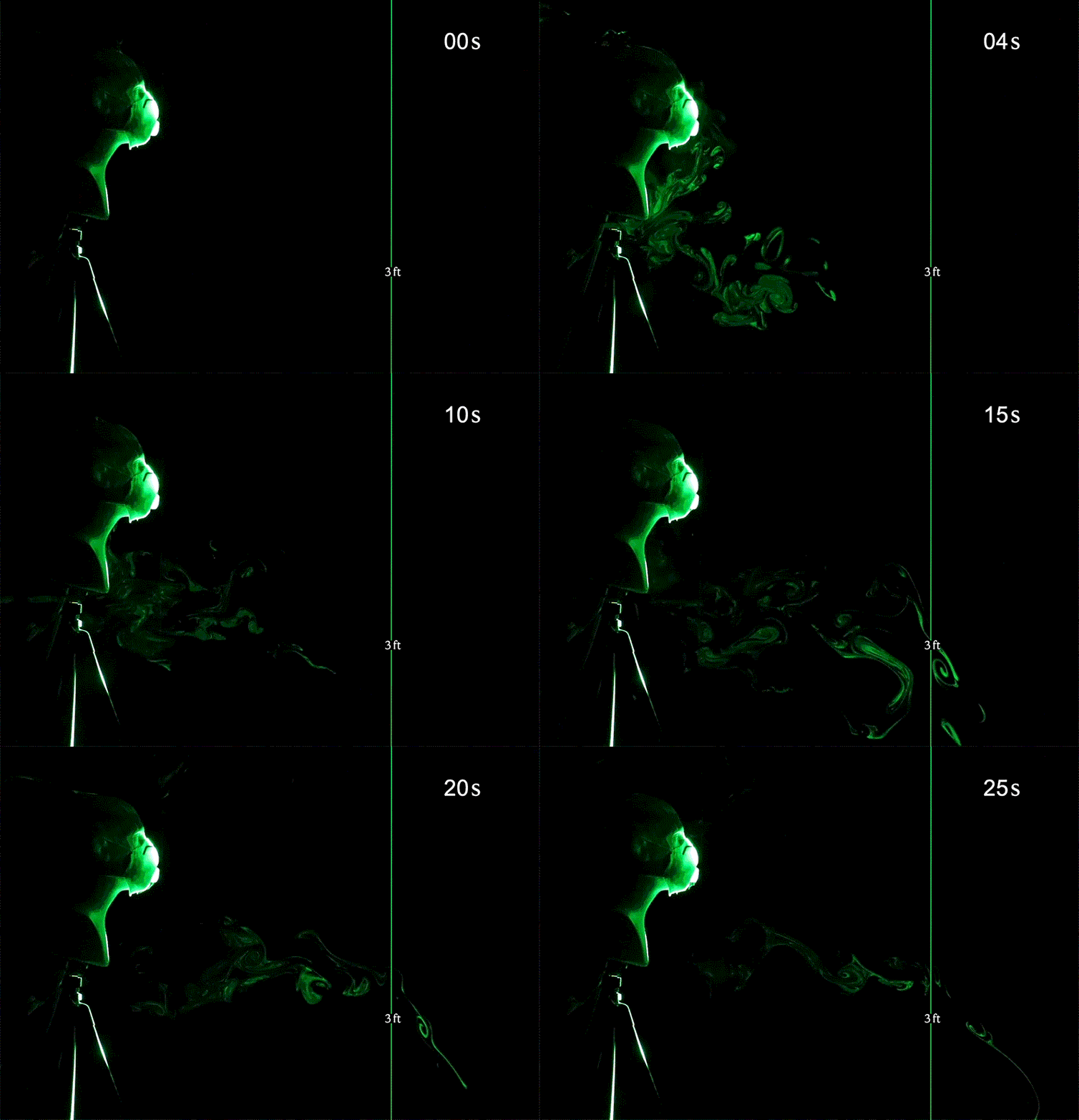
Time-lapse images show how cough droplets spread from a person wearing an N95 mask that has a valve to expel exhaled air. S. Verma et al./Phys. Fluids
What does this imply for the ability of masks to impede COVID-19 transmission? The virus itself is only about 0.1?µm in diameter. But because viruses don’t leave the body on their own, a mask doesn’t need to block particles that small to be effective. More relevant are the pathogen-transporting droplets and aerosols, which range from about 0.2?µm to hundreds of micrometres across. (An average human hair has a diameter of about 80?µm.) The majority are 1–10?µm in diameter and can linger in the air a long time, says Jose-Luis Jimenez, an environmental chemist at the University of Colorado Boulder. “That is where the action is.”
Scientists are still unsure which size of particle is most important in COVID-19 transmission. Some can’t even agree on the cut-off that should define aerosols. For the same reasons, scientists still don’t know the major form of transmission for influenza, which has been studied for much longer.
Many believe that asymptomatic transmission is driving much of the COVID-19 pandemic, which would suggest that viruses aren’t typically riding out on coughs or sneezes. By this reasoning, aerosols could prove to be the most important transmission vehicle. So, it is worth looking at which masks can stop aerosols.
All in the fabric
Even well-fitting N95 respirators fall slightly short of their 95% rating in real-world use, actually filtering out around 90% of incoming aerosols down to 0.3?µm. And, according to unpublished research, N95 masks that don’t have exhalation valves — which expel unfiltered exhaled air — block a similar proportion of outgoing aerosols. Much less is known about surgical and cloth masks, says Kevin Fennelly, a pulmonologist at the US National Heart, Lung, and Blood Institute in Bethesda, Maryland.
In a review9 of observational studies, an international research team estimates that surgical and comparable cloth masks are 67% effective in protecting the wearer.
In unpublished work, Linsey Marr, an environmental engineer at Virginia Tech in Blacksburg, and her colleagues found that even a cotton T-shirt can block half of inhaled aerosols and almost 80% of exhaled aerosols measuring 2?µm across. Once you get to aerosols of 4–5?µm, almost any fabric can block more than 80% in both directions, she says.
Multiple layers of fabric, she adds, are more effective, and the tighter the weave, the better. Another study10 found that masks with layers of different materials — such as cotton and silk — could catch aerosols more efficiently than those made from a single material.
Benn worked with Danish engineers at her university to test their two-layered cloth mask design using the same criteria as for medical-grade ventilators. They found that their mask blocked only 11–19% of aerosols down to the 0.3?µm mark, according to Benn. But because most transmission is probably occurring through particles of at least 1?µm, according to Marr and Jimenez, the actual difference in effectiveness between N95 and other masks might not be huge.
Eric Westman, a clinical researcher at Duke University School of Medicine in Durham, North Carolina, co-authored an August study11 that demonstrated a method for testing mask effectiveness. His team used lasers and smartphone cameras to compare how well 14 different cloth and surgical face coverings stopped droplets while a person spoke. “I was reassured that a lot of the masks we use did work,” he says, referring to the performance of cloth and surgical masks. But thin polyester-and-spandex neck gaiters — stretchable scarves that can be pulled up over the mouth and nose — seemed to actually reduce the size of droplets being released. “That could be worse than wearing nothing at all,” Westman says.
Some scientists advise not making too much of the finding, which was based on just one person talking. Marr and her team were among the scientists who responded with experiments of their own, finding that neck gaiters blocked most large droplets. Marr says she is writing up her results for publication.
“There’s a lot of information out there, but it’s confusing to put all the lines of evidence together,” says Angela Rasmussen, a virologist at Columbia University’s Mailman School of Public Health in New York City. “When it comes down to it, we still don’t know a lot.”
Minding human minds
Questions about masks go beyond biology, epidemiology and physics. Human behaviour is core to how well masks work in the real world. “I don’t want someone who is infected in a crowded area being confident while wearing one of these cloth coverings,” says Michael Osterholm, director of the Center for Infectious Disease Research and Policy at the University of Minnesota in Minneapolis.
US baseball players wore masks while playing during the 1918 influenza epidemic. Underwood And Underwood/LIFE Images Collection/Getty
Perhaps fortunately, some evidence12 suggests that donning a face mask might drive the wearer and those around them to adhere better to other measures, such as social distancing. The masks remind them of shared responsibility, perhaps. But that requires that people wear them.
Across the United States, mask use has held steady around 50% since late July. This is a substantial increase from the 20% usage seen in March and April, according to data from the Institute for Health Metrics and Evaluation at the University of Washington in Seattle (see go.nature.com/30n6kxv .. http://go.nature.com/30n6kxv ). The institute’s models also predicted that, as of 23 September, increasing US mask use to 95% — a level observed in Singapore and some other countries — could save nearly 100,000 lives in the period up to 1 January 2021.
“There’s a lot more we would like to know,” says Vos, who contributed to the analysis. “But given that it is such a simple, low-cost intervention with potentially such a large impact, who would not want to use it?”
Further confusing the public are controversial studies and mixed messages. One study13 in April found masks to be ineffective, but was retracted in July. Another, published in June14, supported the use of masks before dozens of scientists wrote a letter attacking its methods (see go.nature.com/3jpvxpt .. http://go.nature.com/3jpvxpt ). The authors are pushing back against calls for a retraction. Meanwhile, the World Health Organization (WHO) and the US Centers for Disease Control and Prevention (CDC) initially refrained from recommending widespread mask usage, in part because of some hesitancy about depleting supplies for health-care workers. In April, the CDC recommended that masks be worn when physical distancing isn’t an option; the WHO followed suit in June.
There’s been a lack of consistency among political leaders, too. US President Donald Trump voiced support for masks, but rarely wore one. He even ridiculed political rival Joe Biden for consistently using a mask — just days before Trump himself tested positive for the coronavirus, on 2 October. Other world leaders, including the president and prime minister of Slovakia, Zuzana Caputová and Igor Matovic, sported masks early in the pandemic, reportedly to set an example for their country.
Denmark was one of the last nations to mandate face masks — requiring their use on public transport from 22 August. It has maintained generally good control of the virus through early stay-at-home orders, testing and contact tracing. It is also at the forefront of COVID-19 face-mask research, in the form of two large, randomly controlled trials. A research group in Denmark enrolled some 6,000 participants, asking half to use surgical face masks when going to a workplace. Although the study is completed, Thomas Benfield, a clinical researcher at the University of Copenhagen and one of the principal investigators on the trial, says that his team is not ready to share any results.
Benn’s team, working independently of Benfield’s group, is in the process of enrolling around 40,000 people in Guinea-Bissau, randomly selecting half of the households to receive bilayer cloth masks — two for each family member aged ten or over. The team will then follow everyone over several months to compare rates of mask use with rates of COVID-like illness. She notes that each household will receive advice on how to protect themselves from COVID-19 — except that those in the control group will not get information on the use of masks. The team expects to complete enrolment in November.
Several scientists say that they are excited to see the results. But others worry that such experiments are wasteful and potentially exploit a vulnerable population. “If this was a gentler pathogen, it would be great,” says Eric Topol, director of the Scripps Research Translational Institute in La Jolla, California. “You can’t do randomized trials for everything — and you shouldn’t.” As clinical researchers are sometimes fond of saying, parachutes have never been tested in a randomized controlled trial, either.
But Benn defends her work, explaining that people in the control group will still benefit from information about COVID-19, and they will get masks at the end of the study. Given the challenge of manufacturing and distributing the masks, “under no circumstances”, she says, could her team have handed out enough for everyone at the study’s outset. In fact, they had to scale back their original plans to enrol 70,000 people. She is hopeful that the trial will provide some benefits for everyone involved. “But no one in the community should be worse off than if we hadn’t done this trial,” she says. The resulting data, she adds, should inform the global scientific debate.
For now, Osterholm, in Minnesota, wears a mask. Yet he laments the “lack of scientific rigour” that has so far been brought to the topic. “We criticize people all the time in the science world for making statements without any data,” he says. “We’re doing a lot of the same thing here.”
Nevertheless, most scientists are confident that they can say something prescriptive about wearing masks. It’s not the only solution, says Gandhi, “but I think it is a profoundly important pillar of pandemic control”. As Digard puts it: “Masks work, but they are not infallible. And, therefore, keep your distance.”
References
1. Hendrix, M. J., Walde, C., Findley, K. & Trotman, R. Morb. Mortal. Wkly Rep. 69, 930–932 (2020). PubMed Article Google Scholar


 Market Data
  Markets


 AI
AI