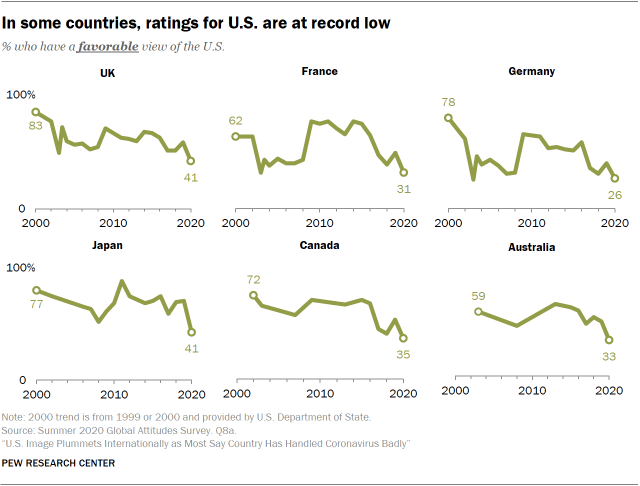
'Moves closer' is vague and it's doubtful that the leaders of countries have a better opinion of the U.S than do their own people. In several countries, the share of the public with a favorable view of the U.S. is as low as it has been at any point since the Center began polling on this topic nearly two decades ago.
Record low = LOWER than under Obama.
U.S. Image Plummets Internationally as Most Say Country Has Handled Coronavirus Badly
By Richard Wike, Janell Fetterolf and Mara Mordecai
This analysis focuses on public opinion of the United States in 13 countries in North America, Europe and the Asia-Pacific region. Views of the U.S. and its president are examined in the context of long-term trend data. The report also examines how people in other countries perceive America’s handling of the coronavirus outbreak and how those perceptions compare to ratings for their own country, the World Health Organization, the European Union and China.
For this report, we use data from nationally representative surveys of 13,273 adults from June 10 to Aug. 3, 2020, in 13 advanced economies. All surveys were conducted over the phone with adults in Canada, Belgium, Denmark, France, Germany, Italy, the Netherlands, Spain, Sweden, the UK, Australia, Japan and South Korea.
Due to the coronavirus outbreak, face-to-face interviewing is not currently possible in many parts of the world, and so surveys were only conducted in countries with robust telephone polling operations.
Here are the questions used for the report, along with responses, and the survey methodology.
Since Donald Trump took office as president, the image of the United States has suffered across many regions of the globe. As a new 13-nation Pew Research Center survey illustrates, America’s reputation has declined further over the past year among many key allies and partners. In several countries, the share of the public with a favorable view of the U.S. is as low as it has been at any point since the Center began polling on this topic nearly two decades ago.
There is a significant gender gap in confidence in 10 of the 13 countries surveyed. This gap is largest in Japan, where 31% of men, compared with 19% of women, trust Trump. The educational divide is relatively small, but significant in seven countries. In Australia, the UK, Italy, Canada, Sweden, the Netherlands and France, those with less than a secondary education have more confidence in Trump than those with more education.
Relative to the gender and educational differences, ideological differences are greater when evaluating confidence in Trump. The largest ideological divide is in Australia. Roughly four-in-ten Australians on the ideological right have confidence in Trump’s handling of global affairs, compared with only about one-in-ten of those on the left. A similar pattern can be seen in every country surveyed except France.
Mirroring the ideological divide, people who have a favorable opinion of right-wing populist parties in Europe also have more trust in the U.S. president than those with an unfavorable view of these parties. In Spain, supporters of the right-wing party Vox (45%) are more than six times as likely to express confidence in Trump as nonsupporters (7%). Backers of the Alternative for Germany party (AfD) are almost seven times as likely non-backers to trust that Trump will do the right thing in world affairs (34% vs. 5%, respectively).


 Market Data
  Markets


 AI
AI