The Selfish Giant, one of our Favorite Fairy Tales, was first published in 1888 as part of Oscar Wilde's collection of children's stories entitled The Happy Prince and Other Tales. That collection of children's stories also includes: The Happy Prince, The Nightingale and the Rose, The Devoted Friend, and The Remarkable Rocket.[links for there inside]
Every afternoon, as they were coming from school, the children used to go and play in the Giant's garden.
It was a large lovely garden, with soft green grass. Here and there over the grass stood beautiful flowers like stars, and there were twelve peach-trees that in the spring-time broke out into delicate blossoms of pink and pearl, and in the autumn bore rich fruit. The birds sat on the trees and sang so sweetly that the children used to stop their games in order to listen to them. "How happy we are here!" they cried to each other.
One day the Giant came back. He had been to visit his friend the Cornish ogre, and had stayed with him for seven years. After the seven years were over he had said all that he had to say, for his conversation was limited, and he determined to return to his own castle. When he arrived he saw the children playing in the garden.
"What are you doing here?" he cried in a very gruff voice, and the children ran away.
"My own garden is my own garden," said the Giant; "any one can understand that, and I will allow nobody to play in it but myself." So he built a high wall all round it, and put up a notice-board.
TRESPASSERS WILL BE PROSECUTED
He was a very selfish Giant.
The poor children had now nowhere to play. They tried to play on the road, but the road was very dusty and full of hard stones, and they did not like it. They used to wander round the high wall when their lessons were over, and talk about the beautiful garden inside. "How happy we were there," they said to each other.
Then the Spring came, and all over the country there were little blossoms and little birds. Only in the garden of the Selfish Giant it was still winter. The birds did not care to sing in it as there were no children, and the trees forgot to blossom. Once a beautiful flower put its head out from the grass, but when it saw the notice-board it was so sorry for the children that it slipped back into the ground again, and went off to sleep. The only people who were pleased were the Snow and the Frost. "Spring has forgotten this garden," they cried, "so we will live here all the year round." The Snow covered up the grass with her great white cloak, and the Frost painted all the trees silver. Then they invited the North Wind to stay with them, and he came. He was wrapped in furs, and he roared all day about the garden, and blew the chimney-pots down. "This is a delightful spot," he said, "we must ask the Hail on a visit." So the Hail came. Every day for three hours he rattled on the roof of the castle till he broke most of the slates, and then he ran round and round the garden as fast as he could go. He was dressed in grey, and his breath was like ice.
"I cannot understand why the Spring is so late in coming," said the Selfish Giant, as he sat at the window and looked out at his cold white garden; "I hope there will be a change in the weather."
But the Spring never came, nor the Summer. The Autumn gave golden fruit to every garden, but to the Giant's garden she gave none. "He is too selfish," she said. So it was always Winter there, and the North Wind, and the Hail, and the Frost, and the Snow danced about through the trees.
One morning the Giant was lying awake in bed when he heard some lovely music. It sounded so sweet to his ears that he thought it must be the King's musicians passing by. It was really only a little linnet singing outside his window, but it was so long since he had heard a bird sing in his garden that it seemed to him to be the most beautiful music in the world. Then the Hail stopped dancing over his head, and the North Wind ceased roaring, and a delicious perfume came to him through the open casement. "I believe the Spring has come at last," said the Giant; and he jumped out of bed and looked out.
What did he see?
He saw a most wonderful sight. Through a little hole in the wall the children had crept in, and they were sitting in the branches of the trees. In every tree that he could see there was a little child. And the trees were so glad to have the children back again that they had covered themselves with blossoms, and were waving their arms gently above the children's heads. The birds were flying about and twittering with delight, and the flowers were looking up through the green grass and laughing. It was a lovely scene, only in one corner it was still winter. It was the farthest corner of the garden, and in it was standing a little boy. He was so small that he could not reach up to the branches of the tree, and he was wandering all round it, crying bitterly. The poor tree was still quite covered with frost and snow, and the North Wind was blowing and roaring above it. "Climb up! little boy," said the Tree, and it bent its branches down as low as it could; but the boy was too tiny.
And the Giant's heart melted as he looked out. "How selfish I have been!" he said; "now I know why the Spring would not come here. I will put that poor little boy on the top of the tree, and then I will knock down the wall, and my garden shall be the children's playground for ever and ever." He was really very sorry for what he had done.
So he crept downstairs and opened the front door quite softly, and went out into the garden. But when the children saw him they were so frightened that they all ran away, and the garden became winter again. Only the little boy did not run, for his eyes were so full of tears that he did not see the Giant coming. And the Giant stole up behind him and took him gently in his hand, and put him up into the tree. And the tree broke at once into blossom, and the birds came and sang on it, and the little boy stretched out his two arms and flung them round the Giant's neck, and kissed him. And the other children, when they saw that the Giant was not wicked any longer, came running back, and with them came the Spring. "It is your garden now, little children," said the Giant, and he took a great axe and knocked down the wall. And when the people were going to market at twelve o'clock they found the Giant playing with the children in the most beautiful garden they had ever seen.
All day long they played, and in the evening they came to the Giant to bid him good-bye.
"But where is your little companion?" he said: "the boy I put into the tree." The Giant loved him the best because he had kissed him.
"We don't know," answered the children; "he has gone away."
"You must tell him to be sure and come here to-morrow," said the Giant. But the children said that they did not know where he lived, and had never seen him before; and the Giant felt very sad.
Every afternoon, when school was over, the children came and played with the Giant. But the little boy whom the Giant loved was never seen again. The Giant was very kind to all the children, yet he longed for his first little friend, and often spoke of him. "How I would like to see him!" he used to say.
Years went over, and the Giant grew very old and feeble. He could not play about any more, so he sat in a huge armchair, and watched the children at their games, and admired his garden. "I have many beautiful flowers," he said; "but the children are the most beautiful flowers of all."
One winter morning he looked out of his window as he was dressing. He did not hate the Winter now, for he knew that it was merely the Spring asleep, and that the flowers were resting.
Suddenly he rubbed his eyes in wonder, and looked and looked. It certainly was a marvellous sight. In the farthest corner of the garden was a tree quite covered with lovely white blossoms. Its branches were all golden, and silver fruit hung down from them, and underneath it stood the little boy he had loved.
Downstairs ran the Giant in great joy, and out into the garden. He hastened across the grass, and came near to the child. And when he came quite close his face grew red with anger, and he said, "Who hath dared to wound thee?" For on the palms of the child's hands were the prints of two nails, and the prints of two nails were on the little feet.
"Who hath dared to wound thee?" cried the Giant; "tell me, that I may take my big sword and slay him."
"Nay!" answered the child; "but these are the wounds of Love."
"Who art thou?" said the Giant, and a strange awe fell on him, and he knelt before the little child.
And the child smiled on the Giant, and said to him, "You let me play once in your garden, to-day you shall come with me to my garden, which is Paradise."
And when the children ran in that afternoon, they found the Giant lying dead under the tree, all covered with white blossoms.
"POLITICIZING COVID - The rightwing groups behind wave of protests against Covid-19 restrictions "Trump's Tea Party: Are right-wing "open the country" protests an AstroTurf operation? Right-wing donors are overtly funding this feeble wave of protests — and it could be a Trump campaign operation" "
May 27, 2020
On May 26th, crowds gathered in Minneapolis, Minnesota, to protest the death of 46-year-old George Floyd at the hands of the city’s police department. Floyd was black. Many of the protesters were people of color.
The department fired four policemen that same day, after footage emerged appearing to show Floyd being strangled by a white officer; the video shows him placing his knee on Floyd, cutting off his air supply. Firing these officers was not enough to defuse anger in the city where less than four years previously, a police officer shot a black man, Philando Castile, dead at a traffic stop after Castile informed him he had a legally purchased firearm.
On the internet, meanwhile, a largely white, and far right movement publicly contended over what risks its members should take to support a black man killed by police.
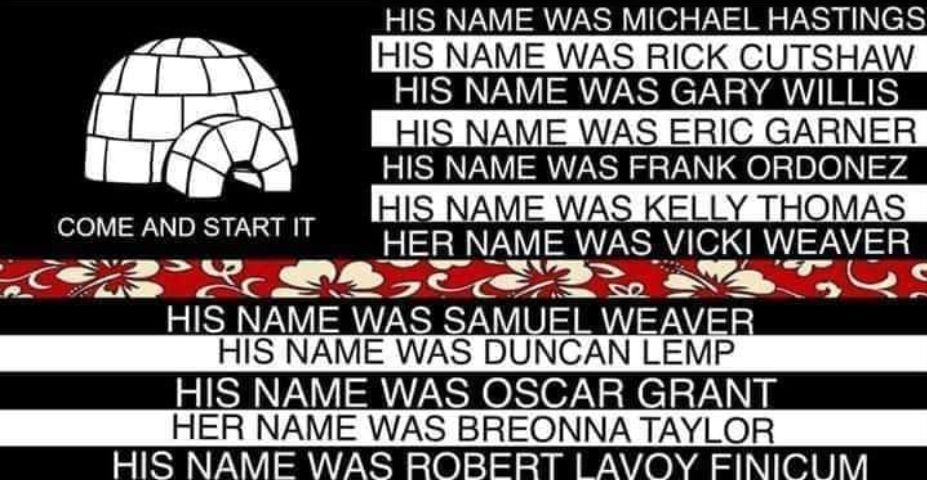
On the Facebook page, Big Igloo Bois, which at the time of writing had 30,637 followers, an administrator wrote of the protests, “If there was ever a time for bois to stand in solidarity with ALL free men and women in this country, it is now”.
They added, “This is not a race issue. For far too long we have allowed them to murder us in our homes, and in the streets. We need to stand with the people of Minneapolis. We need to support them in this protest against a system that allows police brutality to go unchecked.”
One commenter added, “I’m looking for fellow Minneapolis residents to join me in forming a private, Constitutionally-authorized militia to protect people from the MPD, which has killed too many people within the last two years.”
These exchanges offer a window into an extremely online update of the militia movement, which is gearing up for the northern summer. The “Boogaloo Bois” expect, even hope, that the warmer weather will bring armed confrontations with law enforcement, and will build momentum towards a new civil war in the United States.
Mostly, they’re not even hiding it. And for the last several months, their platform of choice has been Facebook.
Like many other novel extremist movements, the loose network of pro-gun shitposters trace their origins to 4chan. What coherence the movement has comes from their reverence for their newly-minted martyrs and a constellation of in-jokes and memes
Above all, though, the movement has gained momentum over the last two years by organising on the world’s most popular social network. At the time of writing, that network’s parent company had added just over $150 billion to its market cap since Boogaloo-friendly anti-lockdown protests began organizing there in mid April. The valuation of the company at $662.8 billion on May 26th beat out it’s previous high of $620.8 billion, set on the same day, January 20th, that the Boogaloo movement made its high profile public debut at Second Amendment protests in Virginia.
For now, Facebook chooses to allow the Boogaloo movement to flourish on their platform.
Open source materials suggest that, for now, the apocalyptic, anti-government politics of the “Boogaloo Bois” are not monolithically racist/neo-Nazi. As we have observed, some members rail against police shootings of African Americans, and praise black nationalist self defense groups.
But the materials also demonstrate that however irony-drenched it may appear to be, this is a movement actively preparing for armed confrontation with law enforcement, and anyone else who would restrict their expansive understanding of the right to bear arms. In a divided, destabilized post-coronavirus landscape, they could well contribute to widespread violence in the streets of American cities.
Mainstreaming Civil War: From /k/ To Facebook
[...]
[...]
His outfit combined references to neo-Nazism with high-powered weapons and internet-poisoned irony. A hastily created Twitter account tried to cash in on the limelight dished out racial slurs, referenced the neo-Nazi numerical code “1488”, and featured a picture of the pseudonymous protester alongside another man who was wearing Nazi regalia.
Armed men embracing a similar set of subcultural reference points began showing up at more public protests. On January 31, a group of armed men, some in Hawaiian shirts, others in face masks and the German “flecktarn” camouflage favored by modern neonazi groups, entered the Kentucky state house.
[...]
Reaction to these posts was not universal, with a fairly even mix of commenters opposing “Auburndale Red”’s racism. The point here is not that the Boogaloo movement is wholly or authentically anti-racist, but that there appears to be a very active struggle within some parts of this movement as to whether or not their dreamed-of uprising will be based in bigotry.
[...]
The Martyrs
At around 4:30 AM on March 12, 2020, a Montgomery County, Maryland SWAT team executed a no-knock raid on the family home of 21-year-old Duncan Socrates Lemp. He was suspected of owning firearms that he was not allowed to legally possess due to a juvenile criminal record. The Maryland police claim Lemp “confronted” them while armed, and that he had boobytrapped his door with a shotgun shell. Lemp’s family claims that he was shot dead while sleeping with his girlfriend, who was wounded in the raid.
What happened during that early morning raid remains bitterly contested, and is beyond the scope of this article. What is undeniable is that Duncan Lemp has become the pre-eminent martyr of the nascent Boogaloo movement. His name and face are constantly referenced, as in this post from the Virginia Knights Facebook group, which claims him as a former member:
[...]
[...]
Naturally, this sentiment is not universally held within the far right Boogaloo movement. In this conversation about the death of Ahmaud Arbery, one user posts the above meme while another scoffs that Arbery’s death is only newsworthy because of how “rare” it is when a white person kills a black person.
[...to end ...]
On May 1, 2020, Facebook and Instagram both updated their “violence and incitement” policy to ban the use of “boogaloo terms” when they occur alongside images or statements depicting or urging armed violence. Our research suggests that this policy has done virtually nothing to curb either the growth of this movement or reduce the violence of its rhetoric. Every new Boogaloo page and group we found led us to new related pages and “liked” pages, each either organizing people for direct armed action or agitating them to anticipate violence.
The world’s largest social network remains a hospitable place for would-be insurrectionists. We now know that Facebook has buried evidence that its platform facilitates the growth of extremism, due to a fear that combatting this would be seen as anti-conservative bias. It is not yet possible to say if the movement that has been nurtured on that platform will ever play a part in an American civil war. But every day, tens of thousands of heavily armed people log on to repeat their hope that it will.


 Market Data
  Markets


 AI
AI