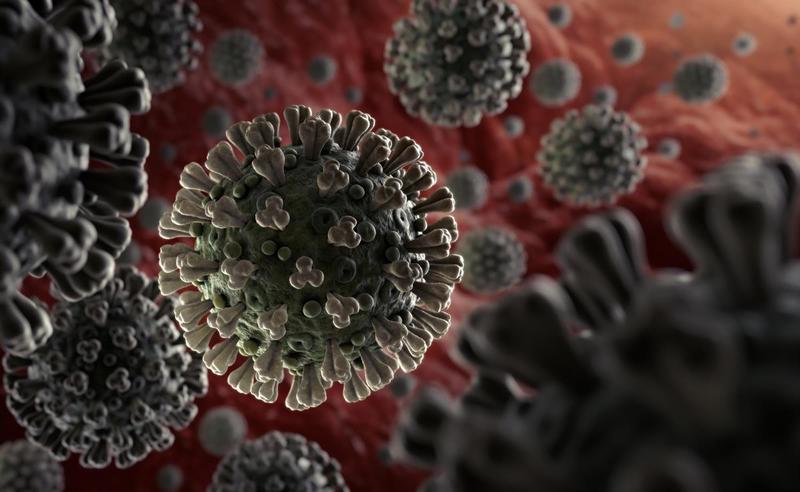
PIG??New research suggests industrial livestock, not wet markets, might be origin of Covid-19
"COVID-19 Vaccine Will Close in on the Spikes"
No the initial PIG reference is not there meant to refer to the president, though it does fit.
Clarity in a situation where there is none.
by GRAIN | 30 Mar 2020 | Corporations
Image credit: World Health Organization/Getty
Let’s be clear: there is no solid evidence that the origin of the SARS-CoV-2 virus, which is the cause of the current Covid-19 disease pandemic, is an open seafood market in Wuhan that also trades in domestic and wild animals. All that we know is that several early cases of people diagnosed with Covid-19 either worked at this market or shopped there in the days preceding their diagnosis. Many media outlets and pundits have seized on this information to claim that Chinese wet markets and the live trade in domestic and wild animals are to blame for the emergence of the disease1. And some are even calling for a ban on wet markets— which are vital to the livelihoods and food security of millions of small farmers, traders and consumers2.
There is a growing body of evidence that points to a different origin story for Covid-19. We now know that none of the animals tested at the Wuhan seafood market tested positive and about a third of the initial set of reported cases in people in Wuhan from early December 2019 had no connection to the seafood market, including the first reported case 3 4 . And we also now know, thanks to the leak of an official Chinese report to the South China Morning Post that the actual first known case of Covid-19 in Hubei was detected in mid-November, weeks before the cluster of cases connected to the Wuhan seafood market were reported5.
Last week, scientists at the Scripps Research Institute published a genomic sequencing analysis of the SARS-CoV-2 virus in the journal Nature that raises more doubts about the possibility of SARS-CoV-2 having originated at the Wuhan seafood market6.
The scientists conclude that SARS-CoV-2 evolved from natural selection and not genetic engineering in a lab, and they say that this natural selection occurred through two possible scenarios. One is that it evolved into its highly pathogenic form within humans. In this case, a less pathogenic form of the virus would have jumped from an animal to a human host and then would have evolved into its current form through an “extended period” of “undetected human-to-human transmission”. Under this scenario, there is no reason to believe that the Wuhan seafood market had anything to do with the evolution of the disease, even if it is quite possible that an infected person at the market could have transmitted it to others.
The second scenario fits with previous coronavirus outbreaks, in which humans contracted deadly coronaviruses after direct exposure to civets, in the case of SARS, and to camels, in the case of MERS. In this scenario, SARS-CoV-2 would have evolved to its present form in an animal host before transfer to humans. Like many other scientists, the Scripps researchers think that it is most likely that the initial transmission would have occurred from bats to an intermediate animal host, where the virus then evolved to its current form.
The Scripps7 researchers go on to say that the particular genetics of SARS-CoV-2 indicate that “an animal host would probably have to have a high population density (to allow natural selection to proceed efficiently) and an ACE2-encoding gene that is similar to the human ortholog,” which is what the SARS-CoV-2 virus binds to in humans.
So which animals fit this criteria?
Another recently published study identifies the most likely intermediate animal hosts for SARS-CoV-2, based on their presence in Wuhan and their having a human-like ACE2 that enables the binding of SARS-CoV-2. These are the animals the study identified: civets, pigs, pangolins, cats, cows, buffalos, goats, sheep and pigeons8.
Many of the animals on this list are industrially farmed in China, even wild animals like civets and pangolins are intensively farmed for their use in Chinese medicines. Suspicions that wild animal farms may have been behind the Covid-19 outbreak have already led the Chinese government to shut down 20,000 wild animal farms across the country9.
But hardly any attention has been given to some other animals on this list, which more clearly meet the “high population density” criteria. Pigs would be one obvious candidate from this list, for several reasons.
For one, pigs and humans have very similar immune systems, making it easy for viruses to cross between the two species, as happened with the Nipah virus outbreak in Malaysia in 199810. Indeed, just three years before the Covid-19 outbreak began, tens of thousands of pigs in four factory farms in Qingyuan county in Guangdong, less than 100 km from the site where the SARS outbreak originated in 2003, died from an outbreak of a new, lethal coronavirus strain (SADS) that turned out to be 98 percent identical to a coronavirus found in horseshoe bats in a nearby cave11 . Luckily transmission to humans did not occur, but subsequent laboratory tests demonstrated that such transmission could have been possible12.
Hubei Province, where Wuhan is located, is one of the top five largest producers of pigs in China. Over the past decade, small pig farms in the province have been replaced by large factory farms and medium-sized contract operations, where hundreds or thousands of genetically-uniform pigs are confined in high density barns. These industrial farms are the ideal breeding grounds for the evolution of new pathogens13.
Hubei’s factory pig farms are still reeling from a massive outbreak of African swine fever that struck the province and other parts of China just over a year ago, wiping out up to half of the national herd14. In these conditions, it is entirely possible that an outbreak of a new coronavirus among pigs in the province could go unnoticed.
GRAIN and other organisations and scientists have been raising the alarm for over a decade now about how the industrialisation and corporate consolidation of meat production has generated increased risks for the emergence of global pandemics such as Covid-1915. But this reality has been completely ignored by governments and the big meat companies they are beholden to. As noted by evolutionary biologist Rob Wallace16, "Anyone who aims to understand why viruses are becoming more dangerous must investigate the industrial model of agriculture and, more specifically, livestock production. At present, few governments, and few scientists, are prepared to do so.” With the growing carnage from Covid-19, a radical change in direction is more urgent than ever.
Most poor nations 'will take until 2024 to achieve mass Covid-19 immunisation'
Feb 2020, posted May 2020 - "COVID-19 Vaccine Will Close in on the Spikes"
Forecast predicts handful of developed countries fully vaccinated by late 2021 while others race to catch up
Michael Safi @safimichael Wed 27 Jan 2021 11.01 AEDT Last modified on Thu 28 Jan 2021 15.37 AEDT
Vaccine delivery will be a global faultline that will run through the first half of this decade, according to Agathe Demarais, of the Economist Intelligence Unit. Photograph: Guillermo Legaria/Getty Images
Most poor countries will not achieve mass Covid-19 immunisation until at least 2024 and some may never get there, according to a new forecast, which maps a starkly divided world over the next few years in which a handful of developed countries are fully vaccinated while others race to catch up.
Countries such as the UK, US, Israel and those in the EU will probably achieve “widespread vaccination coverage” – meaning priority and vulnerable groups, and almost all of the rest of the population – by late 2021, according to analysis from the Economist Intelligence Unit. They will be followed by a slew of other developed countries by the middle of 2022 and then most middle-income countries by the end of that year.
But 84 countries that make up the world’s poorest will not receive enough doses to sufficiently immunise their populations for at least a further year, a global faultline that will run through the first half of this decade, said Agathe Demarais, the unit’s global forecasting director and author of the report.
“It’s going to define the global economy, the global political landscape, travel, pretty much everything,” she said.
Announcements beginning last December that successive vaccine candidates were safe and highly effective provided a light at the end of the tunnel, but the report released on Wednesday underscored that, in most countries, the end of the outbreak is still a year away, at least.
[Interactive map] Which countries have vaccinated the most people? Total vaccinations per hundred people, to date [most zilch]
The key reason is the myriad hurdles in delivering doses into arms: securing vaccine ingredients, production constraints, delays in delivery, poor medical infrastructure in some countries and lack of trained health workers to administer injections, among others.
In countries such as India and China, with vast populations scattered across large landmasses, “reaching everyone in the most remote regions is going to be quite an endeavour”, Demarais said.
The forecast was put together using a model that assessed more than 200 countries based on factors including existing supply deals, production capacity, vaccine deliveries so far, infrastructure to administer doses and vaccine hesitancy rates.
The report was sceptical of forecasts by Covax, a global vaccine-sharing alliance, that it would supply enough doses this year to cover 27% of populations in member countries including more than 92 lower-income ones. The scheme aims to being administering vaccines next month and will announce each country’s first allocations this week.
“There’s a lot of political hope that the targets will be hit … but we can see there are already delays for production and delivery in richer countries, so we can expect some delay in poor countries,” Demarais said.
A study released on Monday found that unequal distribution of vaccines could sap more than $9tn from global GDP this year by depressing consumer demand in unvaccinated countries where normal life had yet to resume.
Ongoing lockdowns and widespread sickness would also interrupt global supply chains, with wealthier, vaccinated countries bearing about half the economic cost, the report from the International Chamber of Commerce (ICC) said. “[Sharing vaccines equitably] is not charity, it is economic common sense,” said the ICC’s secretary-general John Denton.
[Chart: Daily cases per million avg. last 76 days]
The WHO director-general, Tedros Adhanom Ghebreyesus, last week said the world was on the edge of a “catastrophic moral failure” in the unequal distribution of vaccines so far, with more than 40m doses given in about 50 countries, most of them wealthy or upper-middle income.
Medical rights groups have called for patents on Covid-19 vaccines and treatments to be shared so that qualified manufacturers can also begin producing them and ease global shortages. Demarais said that, even if pharmaceutical companies shared their technology, patents and knowhow, there would still be challenges in finding workers trained to produce vaccines.
“There are a number of factories now that are running out of labour supply, experienced workers who can manufacture the vaccines to sufficient quality,” she said.


 Market Data
  Markets


 AI
AI