A Coronavirus Quarantine in America Could Be a Giant Legal Mess America’s defense against epidemics is divided among more than 2,000 individual public-health departments, which makes implementing a national strategy very difficult.
7:00 AM ET Polly J. Price Professor of law and global health at Emory University
For observers in the United States, it was shocking enough when, in January, the Chinese government effectively sealed off Wuhan, larger in population than New York City. Officials shut down public transportation and blocked highways, confining residents and visitors alike in an attempt to stop the spread of the new coronavirus.
But in the weeks since, the measures have become more drastic still. The quarantine-style lockdown has since been extended to include more than 50 million people elsewhere in China. Officials have ordered door-to-door checks in Wuhan to round up the infected for further isolation. Anyone who hides infections, one official said, “will be forever nailed to history’s pillar of shame.”
Putting aside the question of whether such radical measures are even effective, China’s government generally has much more authoritarian control over its population than the American government has over its. If a fast-spreading, deadly epidemic should threaten the United States, could the U.S. government do the same? The answer is yes: American government officials do have extensive authority to implement public-health measures to stop an epidemic, as the Americans on the Diamond Cruise ship in Yokohama, Japan, are now learning. According to The Washington Post, they were told on Saturday that following their two-week quarantine aboard the ship they would face an additional two-week quarantine back in the United States.
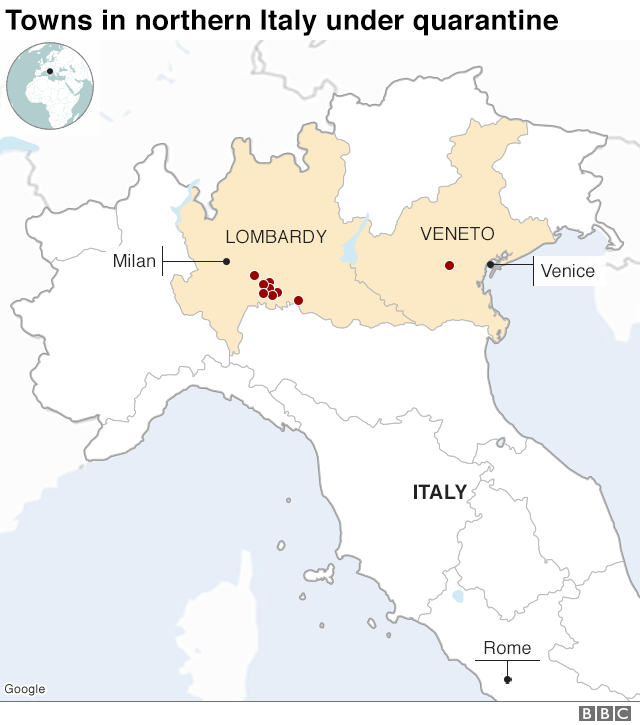
Around 50,000 people cannot enter or leave several towns in Veneto and Lombardy for the next two weeks without special permission. Even outside the zone, many businesses and schools have suspended activities, and sporting events have been cancelled including several top-flight football matches .. https://www.bbc.co.uk/sport/football/51599748 .
Amid the growing restrictions, the last two days of the Venice Carnival, on Monday and Tuesday, were cancelled.
Italy has seen two deaths and the number of confirmed cases has risen to more than 100 - 89 of them in Lombardy.
"The contagiousness of this virus is very strong and pretty virulent," said Lombardy's health chief, Giulio Gallera.
Iran's outbreak of coronavirus has significantly worsened, with the death toll rising to eight on Sunday. The government has acknowledged 43 confirmed cases although officials have warned the virus may have spread to "all cities".
Schools, universities and cultural centres across 14 Iranian provinces have been closed from Sunday.
The new strain of coronavirus, which originated last year in Hubei province in China, causes a respiratory disease called Covid-19. China has seen more than 76,000 infections and 2,442 deaths.
On Sunday, China's President Xi Jinping described the outbreak as the "largest public health emergency" in the country's recent history.
He acknowledged "shortcomings" in China's response and said lessons must be learned.
The combined situation in South Korea, Iran and Italy points to the early stages of pandemic. This means a global outbreak, with the coronavirus spreading in the community in multiple parts of the world.
In each of these countries we are seeing spread of the virus with no connection to China. The lockdown efforts in Italy mirror those that have happened in China.
The situation in Iran is especially worrying because the health authorities have reportedly said the virus has spread to multiple cities, and it appears the first case in Lebanon is linked to a traveller from Iran.
If we have a pandemic, it will still be important to limit the speed of spread of the virus. If countries could hold it somewhat at bay until the end of winter, there is a hope that warmer temperatures will reduce the time the virus can survive in the air, as we see with seasonal flu. But this may not be certain.
On Sunday, health officials revealed a further leap in the number of coronavirus cases with a cluster of infections linked to a hospital and to a religious group near the south-eastern city of Daegu.
The sixth death was confirmed at the Daenam Hospital, in Cheongdo, which treats the elderly and people with mental health issues. The hospital has seen more than 110 people infected including nine medical staff.
Laura Bicker @BBCLBicker As we pass Gumi, just north of Daegu, we get an emergency alert about #coronavirus cases nearby. It tells you where the person with the virus has been and at what time. Incredibly detailed. (This person was playing a Korean version of pool until 1.30am) Copyright @BBCLBicker @BBCLBicker Report Twitter
South Korea has seen the largest number of confirmed cases after China. An outbreak on the Diamond Princess cruise ship in Japan has also seen more than 600 cases.
"The Covid-19 incident faces a grave turning point," President Moon said following a meeting with ministers and experts.
"The next few days will be crucial. The government will raise the alert level to the highest level of 'grave' according to experts' recommendations and drastically strengthen our response system."
VIDEO - People in Daegu have voiced concern over the spread of the virus
[INSERT a different one]
Of the 169 new cases announced in South Korea on Sunday, 95 of them are linked to a Christian sect in Daegu called the Shincheonji Church of Jesus, the Korea Centers for Disease Control and Prevention (KCDC) said. The total number of cases connected to the church stands at 329.
In a video statement, a church spokesman expressed "deep regret" that many of its followers and citizens of South Korea had been infected. The spokesman added that the church had advised about 250,000 members to minimise their outside contact and take precautions.
* Israel refused to allow non-Israelis to disembark from a Korean Air plane at Ben-Gurion Airport on Saturday. It had announced a ban on South Koreans and Japanese visitors, sparking an official protest from Seoul
The head of the World Health Organization (WHO), Dr Tedros Adhanom Ghebreyesus, has expressed concern at the number of new cases with no clear link to China or other confirmed cases.
In a briefing to the African Union on Saturday, he said the greatest concern now was countries with weaker health systems, particularly in Africa.
Dr Tedros said the WHO was working with African governments to train thousands of health workers and to provide equipment to identify and treat infected people.
"Our biggest concern continues to be the potential for Covid-19 to spread in countries with weaker health systems," he said. "We are working hard to prepare countries in Africa for the potential arrival of the virus."
Dr Tedros said some countries, such as the Democratic Republic of Congo, were using experience gained from testing for the Ebola virus to test for the new coronavirus.
"This is a great example of how investing in health systems can pay dividends for health security," he added


 Market Data
  Markets


 AI
AI