In ? years, we will look back and wonder why and who wouldn't process in their minds the danger of these times, all the while scientists having *fireside facepalm chats about the indulgence of ignorance with their grandchildren.
*outside their burning homes.
This marshmallow will be the most roasted during these fireside chats....
11,000 scientists sign declaration of climate emergency
"Climate crisis: 11,000 scientists warn of ‘untold suffering’"
Nov 5, 2019
CBC News
A collection of 11,000 scientists from 153 countries has signed a declaration of climate emergency published in the journal BioScience. The group put forth six "critical and interrelated steps" to reduce the effects of climate change. York University conservation biologist Sheila Colla is one of the scientists who signed the declaration.
Scientist's theory of climate's Titanic moment the 'tip of a mathematical iceberg'
"Climate crisis: 11,000 scientists warn of ‘untold suffering’ "And more... Climate Assessment... New U.S. Climate Assessment Forecasts Dire Effects On Economy, Health"" Formula for climate emergency shows if ‘reaction time is longer than intervention time left’ then ‘we have lost control’
Graham Readfearn @readfearn
Mon 2 Dec 2019 04.00 AEDT Last modified on Mon 2 Dec 2019 13.43 AEDT
‘Knowing how long societies have to react to pull the brake on the Earth’s climate and then how long it will take for the ship to slow down is the difference between a climate emergency and a manageable problem.’ Photograph: Topical Press Agency/Getty Images
When is an emergency really an emergency?
If you’re the captain of the Titanic, approaching a giant iceberg with the potential to sink your ship becomes an emergency only when you realise you might not have enough time to steer a safe course.
And so it is, says Prof Hans Joachim Schellnhuber, when it comes to the climate emergency.
Knowing how long societies have to react to pull the brake on the Earth’s climate and then how long it will take for the ship to slow down is the difference between a climate emergency and a manageable problem.
Rather than being something abstract and open to interpretation, Schellnhuber says the climate emergency is something with clear and calculable risks that you could put into a formula. And so he wrote one.
In a comment article in the journal Nature .. https://www.nature.com/articles/d41586-019-03595-0 , Schellnhuber and colleagues explained that to understand the climate emergency we needed to quantify the relationship between risk (R) and urgency (U).
Borrowing from the insurance industry, the scientists define risk (R) as the probability of something happening (p) multiplied by damage (D).
For example, how likely is it that sea levels will rise by a metre and how much damage will that cause.
Urgency (U) is the time it takes you to react to an issue (t) “divided by the intervention time left to avoid a bad outcome (T)”, they wrote.
Schellnhuber, of the Potsdam Institute for Climate Impact Research in Germany, tells Guardian Australia the work on the formula was just the “tip of a mathematical iceberg” in defining the climate emergency.
“It can be illustrated by the Titanic disaster, but it applies to many severe risks where you can calculate the do-nothing/business-as-usual probability of a highly damaging event,” he says. “Yet there are options to avoid the disaster.
“In other words, this a control problem.”
There is a time lag between the rapid cuts to greenhouse gases and the climate system reacting. Knowing if you have enough time tells you if you’re in an emergency or not.
Schellnhuber used “standard risk analysis and control theory” to come up with the formula, and he was already putting numbers to it.
“As a matter of fact, the intervention time left for limiting global warming to less than 2C is about 30 [years] at best. The reaction time – time needed for full global decarbonisation - is at least 20 [years].”
As the scientists write in Nature, if the “reaction time is longer than the intervention time left” then “we have lost control”.
Schellnhuber says: “Beyond that critical point, only some sort of adaptation option is left, such as moving the Titanic passengers into rescue boats (if available).”
Earlier this month, Oxford Dictionaries announced “climate emergency” as the word of the year, defining it as “a situation in which urgent action is required to reduce or halt climate change and avoid potentially irreversible environmental damage resulting from it”.
This week the European parliament joined them, as did Ballina shire council in northern New South Wales, the 76th local government authority in Australia to make the declaration.
Prof Will Steffen, of the Australian National University and the Stockholm Resilience Centre, and a co-author of the article, says: “Emergency can mean many things to many people. But there are some hard numbers behind why so many people are saying we are in a climate emergency.
“This formula sharpens our thinking. So we have 30 years to decarbonise and to stabilise our pressure on the climate system.”
In the Nature article, the scientists highlight nine “tipping points” that, if crossed, become almost impossible to stop. At least five are already “active”.
Some of them, like melting permafrost or forest degradation, can start to add more greenhouse gases to the atmosphere, making the job of keeping global temperatures down even harder.
“There are a range of these intervention times left,” Steffen says. “How long do we have before [the Greenland ice sheet] goes? Maybe we have 20 to 25 years and then we might be committed to losing Greenland.
“But the time we have left to intervene to stabilise coral reefs, for example, is a lot less than 30 years.
“Our reaction time has to be fast and to decarbonise by 2050 we have to really move now. That’s the point of [Schellnhuber’s] maths.
“To err on the side of danger is a stupid thing to do.”
By Michon Scott Reviewed By Ted Scambos Published June 28, 2023
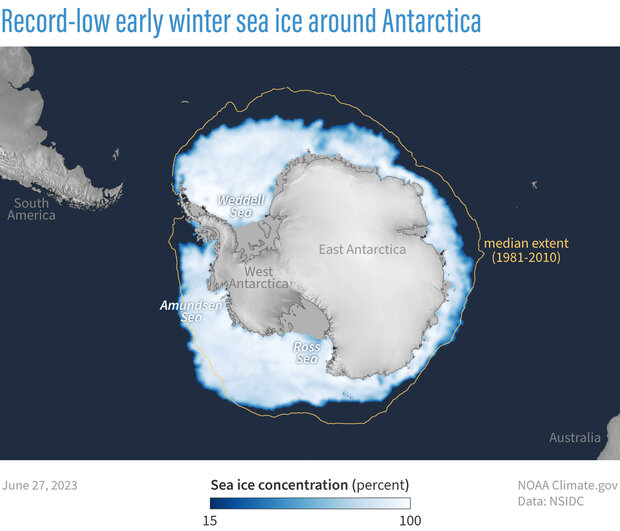
After reaching a record-low summer minimum earlier this year, Antarctic sea ice continues to break records. In the midst of its winter growth phase, it has reached a record-low extent, far below the previous record, for this time of year.
Data archived by the National Snow and Ice Data Center (NSIDC) record Antarctic sea ice extent at 4.5 million square miles (11.7 million square kilometers) as of June 27, 2023. That’s nearly a million square miles (2.6 million square kilometers) below the 1981–2010 average, and approaching a half a million square miles (1.2 million square kilometers) below the previous lowest extent for the day, observed in 2022.
Adapted from NSIDC’s Sea Ice Index .. https://nsidc.org/data/seaice_index , this map shows sea ice concentration on June 27, 2023. Concentration is color coded, with white representing solid ice and dark blue representing open ocean. For reference, this map includes the median ice edge for 1981–2010: half of the years had smaller extents, and half had larger on this date. Map by NOAA Climate.gov, based on data from NSIDC. ------
Comparing late June 2023 sea ice concentration to the median ice edge for the same time of year shows below-average sea ice concentrations around nearly the entirety of the continent. Only in parts of the northern Amundsen Sea near West Antarctica does sea ice spill over the long-term median ice edge.
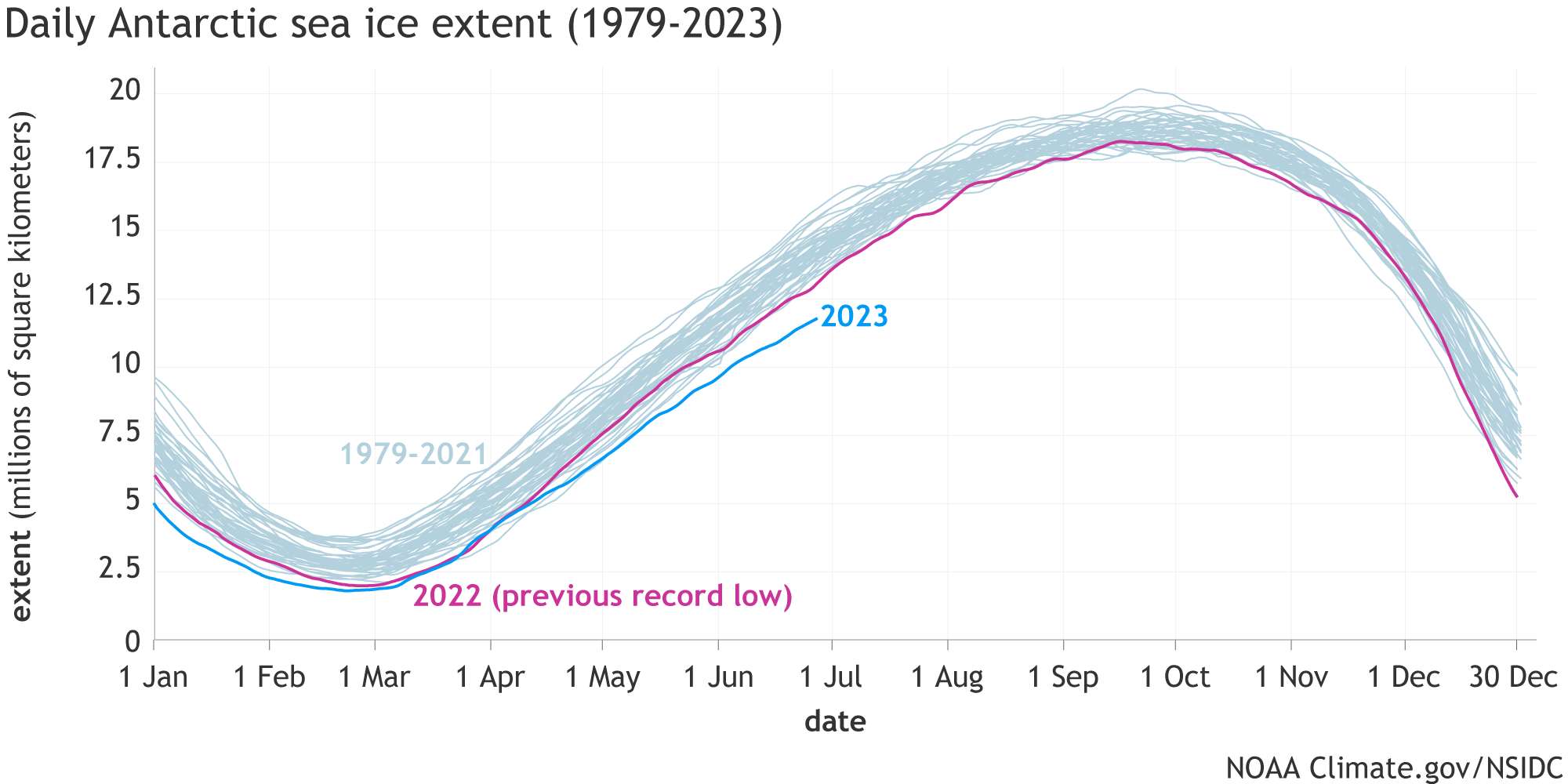
While a map provides a snapshot in time of sea ice conditions, a time series provides even more context. Every year, in both the Northern and Southern Hemispheres, sea ice grows and shrinks with the seasons. Tracking sea ice extent throughout the year yields an S-curved line. Comparing yearly extent lines to each other shows where one year is substantially different—and 2023 is such a year.
Derived from NSIDC’s Charctic Interactive Sea Ice Graph .. https://nsidc.org/arcticseaicenews/charctic-interactive-sea-ice-graph/ , this graph shows daily Antarctic sea ice extent—the area of the Southern Ocean with at least 15 percent sea ice concentration—across the satellite record from 1979-2023. Ice extent in 2023 (bright blue) was slightly smaller than the previous record low (2022, shown in magenta) at the summer minimum in February, but much smaller in late June, the start of the winter ice growth season. All other years in the satellite record (1979–2021) are light gray-blue. Graph by NOAA Climate.gov/NSIDC. ------
Antarctic sea ice extent for June 27, 2023, fell below the previous record low for this date by nearly twice the size of Texas. It fell below the 1981–2010 average for this date by nearly four times the size of Texas.
In contrast to the Arctic, which has shown a decades-long decline in sea ice extent, the Antarctic has not exhibited a significant long-term trend. As recently as 2014, Antarctic sea ice racked up an all-time-high winter maximum extent. Starting in 2016, however, Antarctic sea ice extents have fallen mostly below the 1981–2010 average, and 2023 extents have set daily record lows since April .. https://nsidc.org/arcticseaicenews/2023/06/springing-into-summer/ , even below extents from the previous record holder, 2022. Antarctic sea ice’s current extraordinary behavior raises the question of whether this could be the start of a longer-term trend related to climate or ocean changes, but answering that question will require more time, data, and research.


 Market Data
  Markets


 AI
AI