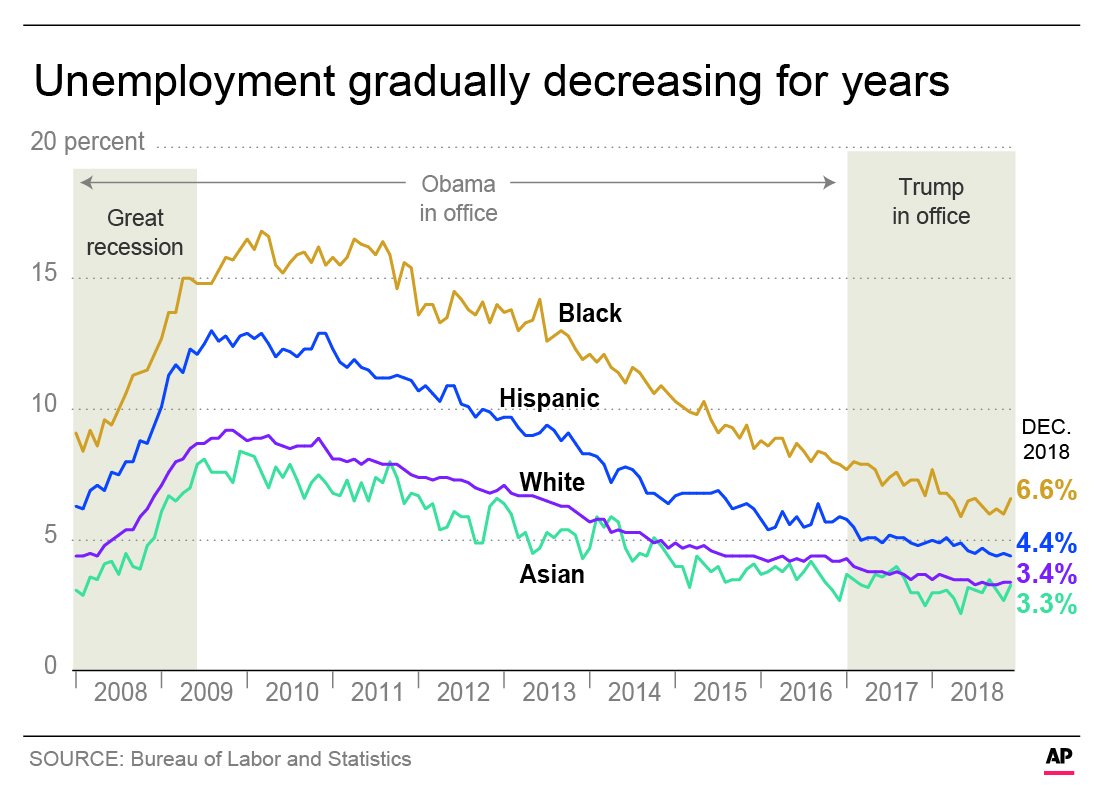
dropdeadfred, Ok, no one suggests Trump's trade war is not hitting China hard. Firstly, China is a developing nation with an emerging economy whilst the U.S. economy is the biggest and the strongest in the world, so they aren't exactly starting, to use a boxing analogy, in an equal weight class. Secondly, Trump is lucky he inherited a strong economic recovery from Obama, and surely you have accepted by now attempts by Trump to claim full credit for unemployment figures, for one, are invalid as, in fact, Trump is riding Obama established trend lines
Your NYT article .. https://www.nytimes.com/2019/09/10/business/china-pork-prices.html .. focuses on pork prices in China which have undoubtedly impacted food price inflation there significantly, yet surely even Trump isn't going to claim credit for the African swine fever which the article suggests is the chief driver of the pork price increase there.
So let's go for more. The first article just read was this one.
which certainly reads good for Trump. Should we take Mr. Schultz's view as being an accurate picture of the situation? Who is he?
James D. "Jim" Schultz is an American lawyer, political pundit, and was an Associate White House Counsel for U.S. President Donald J. Trump, https://en.wikipedia.org/wiki/Jim_Schultz
Right, so now you see why i've asked conix, for one, to include the author in articles she posts in full. Should mention here, to her credit she seems to be doing that now.
So i thought how about a range of economists views. Going for that i ended up with first an article by one from the Economist.
[Insert: Has Trump ever accepted blame for any negative, in any area, he and/or his policies have caused?]
As with many Trump statements, one immediate thought that comes to mind is, how would Republicans have reacted if a Democratic president said something like that? In this case, however, we don’t have to speculate.
As some readers may recall, back in 2012 Barack Obama made the obvious and true point that businesses depend on public investments in things like roads and education as well as on their own efforts. Referring to those public investments, he said, “You didn’t build that .. https://takingnote.blogs.nytimes.com/2012/07/27/you-didnt-build-that/ .” The usual suspects pounced, taking the line out of context and claiming that he was disrespecting entrepreneurs; Mitt Romney made this claim a centerpiece of his presidential campaign.
Attacks on Obama as being anti-business were, of course, made in bad faith. Trump, however, really is denouncing businesses and blaming them for the problems his policies have created. And tariffs aren’t the only policy area where Trump and American business are now at odds.
Some of Trump’s most consequential actions involve his frantic efforts to dismantle environmental regulation. Unlike tariffs, this may at first sound like something business would want.
[WASHINGTON — The Trump administration is expected on Wednesday to formally revoke California’s legal authority to set tailpipe pollution rules that are stricter than federal rules, in a move designed by the White House to strike twin blows against both the liberal-leaning state that President Trump has long antagonized and the environmental legacy of President Barack Obama. https://investorshub.advfn.com/boards/read_msg.aspx?message_id=151195065]
When Trump won his upset victory in 2016, many investors assumed that his rule would be good for business. And he did indeed give corporations a huge tax cut — which has almost entirely been used for higher dividends and stock buybacks, with workers getting essentially nothing.
Aside from the tax cut, however, it’s becoming increasingly clear that Trumpism is bad for business. Or more precisely, it’s bad for productive business.
Imagine yourself as the head of a business that plans and expects to be around for a long time. Sure, you’d like to pay less in taxes and not have to comply with costly regulations. But you also want to invest in your company’s future. And to do that, you need some assurance that the rules of the game will be stable, so that whatever investments you make now aren’t suddenly made worthless by future shifts in policy.
The big complaint business has about Trump’s trade war isn’t just that tariffs raise costs and prices, while foreign retaliation is cutting off access to important markets. It is that businesses can’t make plans when policy zigzags in response to the president’s whims. They don’t want to invest in anything that relies on a global supply chain, because that supply chain might unravel with Trump’s next tweet. But they can’t invest on the assumption that Trump’s tariffs will be permanent, either; you never know when or whether he’ll declare victory and surrender.
Environmental policy, it turns out, is similar. Business leaders aren’t do-gooders, but they are realists. Most of them understand that climate change is happening, that it’s dangerous, and that we’ll eventually have to transition to a low-emissions economy. They want to spend now to secure their place in that future economy; they know that investments that worsen climate change are bound to be long-run losers. But they’ll hold off on investing in our energy future as long as conspiracy theorists who consider global warming a gigantic hoax — and/or vindictive politicians determined to erase Obama’s achievements — keep rewriting the rules.
To be fair, however, some kinds of business do thrive under Trumpism — namely, businesses that aren’t in it for the long run, operations whose strategy is to take the money and run. These are good times for mining companies that rush in to extract whatever they can, leaving a poisoned landscape behind; for real estate speculators sponsoring dubious ventures that take advantage of newly created tax loopholes; for for-profit colleges that leave their students with worthless degrees and crippling debt.
In other words, under Trump it’s springtime for grifters.
You may disagree but to me it's not so much a question of how much Trump is hurting China and it's people (importantly}, but more a question of how much damage Trump's policies are hurting not only America's but the world's economic and social situation.


 Market Data
  Markets


 AI
AI