"British Leaks Describe Trump’s ‘Act of Diplomatic Vandalism’ on Iran Deal "Trump Is Losing His Trade Wars" "
11 June 2019
AFP
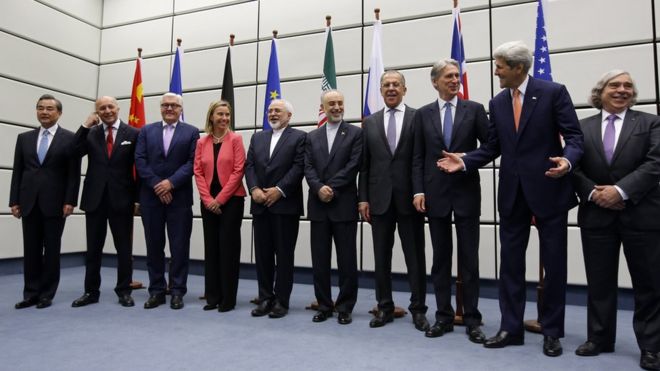
In 2015, Iran agreed a long-term deal on its nuclear programme with a group of world powers known as the P5+1 - the US, UK, France, China, Russia and Germany.
It came after years of tension over Iran's alleged efforts to develop a nuclear weapon. Iran insisted that its nuclear programme was entirely peaceful, but the international community did not believe that.
Under the accord, Iran agreed to limit its sensitive nuclear activities and allow in international inspectors in return for the lifting of crippling economic sanctions.
Here are the commitments set out in the Joint Comprehensive Plan of Action.
Uranium enrichment
Iran's uranium stockpile will be reduced by 98% to 300kg for 15 years Getty Images
Enriched uranium is used to make reactor fuel, but also nuclear weapons.
[...]
[...]
Plutonium pathway
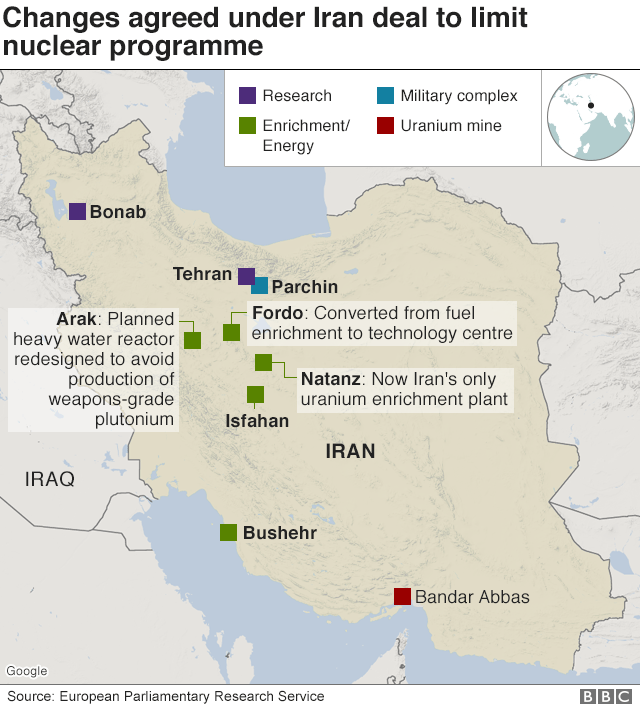
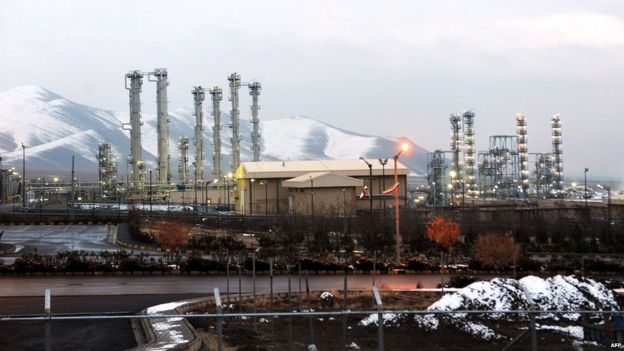
Iran is redesigning the Arak reactor so it cannot produce any weapons-grade plutonium AFP
[...]
Covert activity
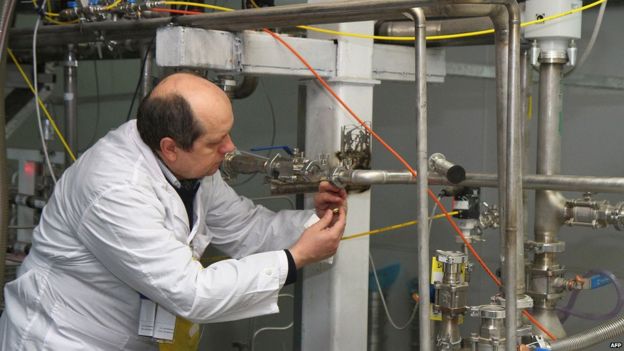
Iran is required to allow IAEA inspectors to access any site they deem suspicious AFP
[...]
'Break-out time'
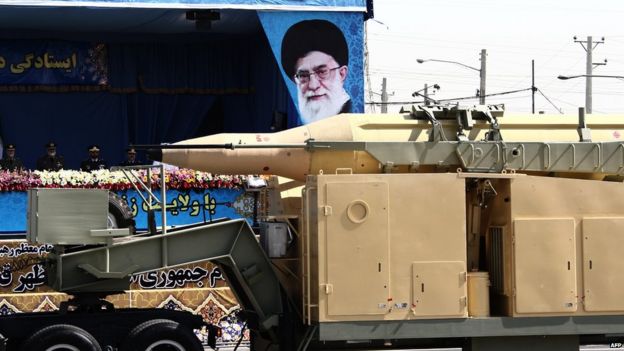
A UN ban on the import of ballistic missile technology will remain in place for up to eight years AFP
Before July 2015, Iran had a large stockpile of enriched uranium and almost 20,000 centrifuges, enough to create eight to 10 bombs, according to the Obama administration.
US experts estimated then that if Iran had decided to rush to make a bomb, it would take two to three months until it had enough 90%-enriched uranium to build a nuclear weapon - the so-called "break-out time".
The Obama administration said the JCPOA would remove the key elements Iran would need to create a bomb and increase its break-out time to one year or more.
Iran also agreed not to engage in activities, including research and development, which could contribute to the development of a nuclear bomb.
In December 2015, the IAEA's board of governors voted to end its decade-long investigation into the possible military dimensions of Iran's nuclear programme.
The agency's director-general, Yukiya Amano, said the report concluded that until 2003 Iran had conducted "a co-ordinated effort" on "a range of activities relevant to the development of a nuclear explosive device". Iran continued with some activities until 2009, but after that there were "no credible indications" of weapons development, he added.
ran also agreed to the continuation of the UN arms embargo on the country for up to five years, although it could end earlier if the IAEA is satisfied that its nuclear programme is entirely peaceful. A UN ban on the import of ballistic missile technology will also remain in place for up to eight years.
Lifting sanctions
Iran estimated that the fall in oil exports was costing it between $4bn and $8bn each month AFP
Sanctions previously imposed by the UN, US and EU in an attempt to force Iran to halt uranium enrichment crippled its economy, costing the country more than $160bn (£118bn) in oil revenue from 2012 to 2016 alone.
Under the deal, Iran gained access to more than $100bn in assets frozen overseas, and was able to resume selling oil on international markets and using the global financial system for trade.
However, in May 2018, US President Donald Trump abandoned the landmark deal and in November that year, he reinstated sanctions targeting both Iran and states that trade with it.
Trump Gives Iran the Soybean Farmer Deal Talking Points Memoby Josh Marshall This is quite astounding. President Trump is considering issuing a $15 billion line of credit to Iran to help them weather the financial chaos created by the sanctions we placed on them after Trump tore up the Iran nuclear deal, according to a new report from the DailyBeast. We would be doing this to get them to come back into compliance with the deal that Obama negotiated and which was working and being complied with until Trump abrogated the deal. That led to sanctions and to Iran eventually ‘violating’ the deal. https://investorshub.advfn.com/boards/read_msg.aspx?message_id=151084793
U.S. sanctions 'severely hamper' Iran coronavirus fight - Rouhani
"British Leaks Describe Trump’s ‘Act of Diplomatic Vandalism’ on Iran Deal"
March 14, 2020 / 10:08 PM / Updated 3 hours ago
3 Min Read
DUBAI (Reuters) - President Hassan Rouhani said Iran’s fight against the coronavirus was being “severely hampered” by U.S. sanctions, as state television reported that the death toll from the illness rose on Saturday to 611, up nearly 100 from a day earlier.
[Rouhani photo]
State media said Rouhani wrote to a number of world leaders, without naming them.
“In (a) letter to counterparts @HassanRouhani informs how efforts to fight #COVID19 pandemic in Iran have been severely hampered by US sanctions, urging them to cease observing them,” Iranian Foreign Minister Mohammad Javad Zarif said on Twitter.
“It is IMMORAL to let a bully kill innocents,” Zarif said.
Iran, the worst-affected country in the Middle East, said on Thursday it had asked the International Monetary Fund (IMF) for $5 billion in emergency funding to combat the coronavirus outbreak.
The escalating outbreak has damaged Iranian businesses and is bound to hit its non-oil exports after many neighbouring countries and trade partners shut their borders.
A Health Ministry official, cited by TV on Saturday, put the total number of infections in the country at 12,729.
Tehran governor general Anoushirvan Mohseni-Bandpey denied that officials were planning a lockdown in the capital, state TV reported, after people posted messages on social media saying that residents would not be allowed to leave their homes from Sunday.
“Tehran’s governor-general rejected any rumour about a lockdown in Tehran as a ‘big lie’,” state television said in a news flash.
Working hours in government offices would not be changed in the next few days and large supermarkets would extend their business hours, Mohseni-Bandpey was quoted as saying by the TV.
Health Minister Saeed Namaki earlier said that officials had approved plans to set up screening stations outside a number of cities.
Officials have expressed concern about the possibility of infections spreading during Nowruz, the Iranian new year starting on March 20, which is usually a period when families travel to vacation spots around the country.
On Friday, state media said security forces would empty the streets of cities across Iran within a day in a drive to fight the spread of the virus, after officials repeatedly complained that many Iranians have ignored calls to stay home and avoid travel.
Iran’s economy was already battered by U.S. sanctions that curb oil and gas exports crucial for government revenues. A slowdown in economic activity caused by the virus outbreak and a sustained closure of its borders are expected to lead to a contraction this year, analysts have said.
U.S. President Donald Trump reimposed sanctions on vital Iranian sectors including oil after withdrawing the United States from the 2015 Iran’s nuclear deal with six world powers.
Trump has said he hopes the sanctions will limit Tehran’s ballistic missile programme and influence across the Middle East. Tehran says its nuclear programme is peaceful and its missiles are for deterrence and defensive purposes.
Reporting by Dubai Newsroom; Editing by Kirsten Donovan, James Drummond and Frances Kerry


 Market Data
  Markets