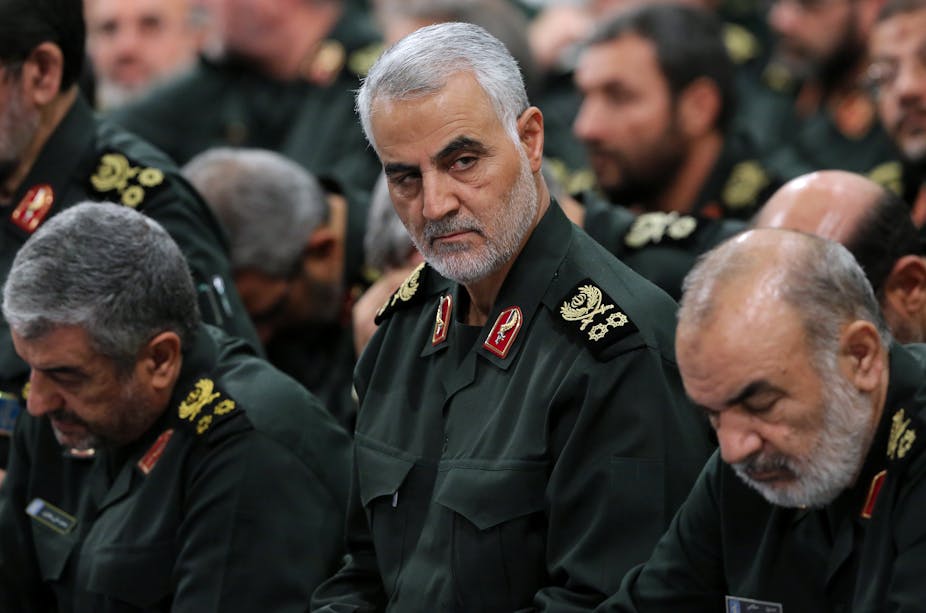
Don't forget the cult-like MeK's GOP connections, over decades.
"Iraq, Fearing Another U.S. War, Warns Militias Against Provocation"
Who is the Iranian group targeted by bombers and beloved of Trump allies?
Cult-like MeK was listed as terrorist group in US until 2012 – but its opposition to Tehran has attracted backing of John Bolton, Rudy Giuliani and others bent on regime change in Iran
Saeed Kamali Dehghan, Iran correspondent @SaeedKD
Mon 2 Jul 2018 13.03 EDT First published on Mon 2 Jul 2018 13.02 EDT
Rudy Giuliani, Donald Trump’s personal lawyer, addresses the MeK rally in Paris that was targeted by a bomb plot. Photograph: Regis Duvignau/Reuters
Its opposition to Tehran’s current rulers, however, has earned the group powerful allies in the west, particularly among Americans bent on regime change.
Rudy Giuliani, Donald Trump’s personal lawyer, addressed an MeK rally in Paris .. https://www.theguardian.com/us-news/2018/jun/30/rudy-giuliani-mek-iran-paris-rally .. on Saturday, calling for regime change in Tehran. On Monday, Belgian authorities said four people, including a diplomat at the Iranian embassy in the Austrian capital Vienna, have been arrested after being accused of preparing a bomb attack in France targeted at the MeK rally.
Many in the crowd of about 4,000 that Giuliani was addressing were eastern Europeans bussed in to attend the event in return for a weekend trip to Paris. He is among a series of high-profile US politicians, including John McCain and John Bolton .. [Why John Bolton is much more like Trump than some think] .. https://www.theguardian.com/commentisfree/2018/apr/02/john-bolton-more-like-trump-than-you-think , who have met the MeK’s leader Maryam Rajavi or spoken at its rallies.
It was only in 2012 that the US delisted it as a terrorist group. But the arrival of John Bolton .. https://www.theguardian.com/us-news/john-bolton, the MeK’s most powerful advocate, as US national security adviser has given the group unprecedented proximity to the White House and a new lease of political life.
“There is a viable opposition to the rule of the ayatollahs, and that opposition is centred in this room today,” Bolton said at an MeK rally .. https://www.youtube.com/watch?v=cenpiO6LMpE
in Paris last year. “The behaviour and objectives of the regime are not going to change, and therefore the only solution is to change the regime itself.”
Bolton’s ascent to the White House has reinvigorated the group, analysts say, raising questions about the dangers of having in the earshot of the US president a group that some experts say uses human rights concerns .. https://lobelog.com/why-addressing-iran-meks-influence-in-eu-politics-matters/ .. to bury its murky past and portray itself as a democratic and popular alternative to the Islamic Republic.
Maryam Rajavi, leader of the Mujahedin-e-Khalq, also wants regime change in Tehran. Photograph: Zakaria Abdelkafi/AFP/Getty Images
Believed to have between 5,000 to 13,000 members, the MeK was established in the 1960s to express a mixture of Marxism and Islamism. It launched bombing campaigns against the Shah, continuing after the 1979 Islamic revolution, against the Islamic Republic. In 1981, in a series of attacks, it killed 74 senior officials, including 27 MPs. Later that year, its bombings killed Iran’s president and prime minister.
During the eight-year Iran-Iraq war in the 1980s, the MeK, by then sheltered in camps in Iraq, fought against Iran alongside the Iraqi dictator Saddam Hussein .. https://www.theguardian.com/world/saddam-hussein . The US-led invasion of Iraq in 2003 was a turning point for the group, which sought to reinvent itself as a democratic force.
Today, it functions as a fringe exiled group with characteristics of a cult that works for regime change in Iran .. https://www.theguardian.com/world/iran , though it has little visible support inside the country. It portrays itself as a democratic political institution although its own internal structure is anything but.
Eli Clifton, a fellow at the Nation Institute, said the MeK’s influence in the US is multilayered. “When [MeK] members go and swarm Capitol Hill and seek meetings with the members of Congress,” Clifton said, “they’re very often the only voices that are heard, because there is simply not a lot of Iranian-American presence on Capitol Hill.”
Clifton said the MeK, which operates under a set of front groups, writes very large cheques to those speaking at their events. Estimates are in the range of $30,000 to $50,000 per speech. Bolton is estimated to have received upwards of $180,000 .. https://twitter.com/OARichardEngel/status/1000190926365646850 .. to speak at multiple events for MeK. His recent financial disclosure shows that he was paid $40,000 .. https://twitter.com/JPecquet_ALM/status/1006287379559337984 .. for one speech at an MeK event last year.
Clifton said the MeK “shares many qualities of a cult”. That description was echoed by Iraj Mesdaghi, a Sweden-based Iranian activist who was jailed in Iran from 1981 to 1991 for his links to the MeK. Mesdaghi left Iran in 1994 and worked for the MeK in its headquarters in Auvers-sur-Oise, France, until 2001.
“In the MeK, everything has to morph into leadership, and leadership means Masoud Rajavi [Maryam Rajavi’s husband, missing since 2003]. Not only your heart belongs to him, any love belongs to him, it’s forbidden to have love for spouse, mother, children,” he said.
He compared working for the MeK to holding an electric wire. “You have to follow the path, you have to transfer what you’re given, you’re not meant to add or reduce anything, you can’t pose any ifs.”
[Working for the MeK is obviously like working for Trump.]
A 2007 state department report included claims that MeK has forced members to divorce. Human Rights Watch, in a 28-page report, has shed light on the MeK’s mistreatment .. https://www.hrw.org/legacy/backgrounder/mena/iran0505/1.htm .. of its members, including claims that those wishing to leave the group have been subjected to “lengthy solitary confinements, severe beatings, and torture”.
John Bolton, as US national security adviser, is the MeK’s most powerful advocate. Photograph: Alexander Zemlianichenko/AP Advertisement
Mesdaghi said MeK members kept in a massive military-style complex in Albania are particularly vulnerable because they are not given refugee status and depend on the group’s leadership for survival. From March 2013 to September 2016, about 3,000 MeK members are believed to have been sheltered in Albania, after being transferred from Iraq.
Djavad Khadem, a co-founder of Unity for Democracy in Iran (UDI), an umbrella group of exiled Iranian opposition groups, said MeK’s “collaboration with Saddam against Iranian people will never be wiped out from the memory of Iranian people”.
Khadem said Bolton’s appointment by Trump may have looked liked a coup for the MeK, but argued that Bolton was bound to act more responsibly in administration. “But Bolton will use them as an instrument of pressure on the regime,” he said. “This is bad tactics, because the Islamic regime will use it to frighten the middle class in Iran, as they have done for the last 40 years.”
Clifton said the MeK’s claims of intelligence revelations about Iran are often “hit and miss”, with “some monumental screw-ups”. The group, however, has revealed intelligence relating to Iran’s nuclear programme, which Clifton said was likely to have been passed on by Israel or Saudi Arabia. In 2016, Prince Turki al-Faisal, a former head of the Saudi intelligence agency, was one of several VIPs .. https://www.theguardian.com/world/on-the-middle-east/2016/jul/12/saudi-talk-of-regime-change-takes-hostility-to-iran-to-new-level .. who attended a MeK conference near Paris.
VIDEO - 2:11 What is the Iran nuclear deal? – video
The MeK, Clifton said, presents a narrative that it is a vibrant, secular, democratic government-in-waiting that has popular support within Iran.
“That’s built on so many falsehoods,” he said. “It’s scary if policymakers listen to that and believe that fairytale.”
Trump orders killing of key Iranian commander in Baghdad airport strike
----- Iraq, Fearing Another U.S. War, Warns Militias Against Provocation "Put Trump's penchant for lying, he says he has no plans to incite conflict, together with Bolton's well known and undisputed zeal for war against Iran, and Trump's replacement of Tillerson a moderate in favor of..."" [...] "It can be difficult to discern Iran’s intentions since its elected leadership and government often sound reasonable, but the Revolutionary Guards and the Quds Force, whose leader Qassem Soleimani is in regular touch with Iraqi figures, take a far more antagonistic stance toward the United States. P - However, Mr. al-Jayashi and other senior Iraqi officials said Iran’s only request to Iraq has been to prevent the United States from using its soil to launch an attack on Iranian territory." -----
Soleimani -- the head of Iran's Islamic Revolutionary Guards Corps (IRGC) Quds Force unit -- and Abu Mahdi al-Muhandis -- the deputy head of the Iran-backed Iraqi Popular Mobilization Forces (PMF) -- were among those killed in the attack early Friday morning local time, according to a statement from the PMF, which said the pair "were martyred by an American strike."
The Green Zone in Baghdad was completely locked down by Iraqi security forces to prevent any emergency following the strike, two Iraqi Security sources told CNN.
Soleimani was "actively developing plans to attack American diplomats and service members in Iraq and throughout the region," according to the Pentagon, which cited the threat to US lives as justification for killing one of Iran's top-ranking military officials.
Soleimani and his Quds Force were responsible for the deaths of hundreds of American and coalition service members, and the wounding of thousands more, the Pentagon added, blaming the Iranian general for orchestrating attacks on coalition bases in Iraq in recent months, including an attack on December 27 .. https://edition.cnn.com/2019/12/27/politics/iraq-rocket-attack-contractor-killed/index.html .. that culminated in the deaths of an American contractor and Iraqi personnel.
The US airstrike killed the commander of Iran's Quds Force at Baghdad International Airport on January 3, 2019.
News of the strike prompted an immediate reaction from Iranian officials who condemned the killing.
"The US' act of international terrorism, targeting & assassinating General Soleimani—THE most effective force fighting Daesh (ISIS), Al Nusrah, Al Qaeda et al—is extremely dangerous & a foolish escalation," Iran's Foreign Minister Javad Zarif tweeted. "The US bears responsibility for all consequences of its rogue adventurism."
Abu Mahdi al-Muhandis, the deputy head of the Iran-backed Iraqi Popular Mobilization Forces (PMF), left, and Qasem Soleimani, the commander of Iran's Islamic Revolutionary Guards Corps (IRGC) Quds Force unit, right, were killed in the US strike.
Formed in 2014 to fight ISIS, the PMF is a Shia paramilitary force made up of former militias with close ties to Iran. It was recognized under a 2016 Iraqi law as an independent military force that answers directly to the prime minister.
Feisal Istrabadi, the founding director of the Indiana University Center for the Study of the Middle East, told CNN that the Iraqi government would be considerably weakened by the fact the strike happened on its soil.
"There will be an opportunity for the destabilization of the country," he said. "This is a huge deal throughout the Middle East. The fact that it was done over the territory of Iraq means that Iraq will become what I feared it would become from the beginning: the battleground between Iran and the United States."
CNN's Arwa Damon and Kareem Khadder reported from Baghdad. CNN's Hamdi Alkhshali reported and wrote in Atlanta. CNN's Steve Almasy contributed to this report.
The US government has killed Iranian general Qassem Suleimani, commander of the Quds Force, the elite wing of the Iranian Islamic Revolutionary Guards, in an air strike that took place in the early hours of January 3.
This is the latest and most dramatic development in the ongoing proxy conflict between the US and Iran. Much of that conflict has taken place on the territory of Iraq, including a recent attack on the US embassy compound. The Trump administration explicitly blamed this recent attack on Iran. In turn, Iranian authorities, including Iranian foreign minister Javad Sharif, have accused the US of committing an act of “international terrorism” in killing Suleimani in what they was described as an “extremely dangerous and foolish escalation”.
While it is too soon to say what the consequences of this latest US operation will be, the killing of the Iranian general certainly signals an escalation in the US policy of assassination and targeted killing. It also establishes a dangerous precedent for international politics.
In a statement, the Department of Defense justified the drone strike by saying Suleimani was “actively developing plans to attack American diplomats and service members in Iraq and throughout the region”. It emphasised that the Quds Force is designated as a foreign terrorist organisation by the US government. It also stressed that the attack was justified to protect US personnel abroad and to deter future attacks.
Julio Rosas @Julio_Rosas11
?????? from the Pentagon: At the direction of the President, the U.S. military has taken decisive defensive action to protect U.S. personnel abroad by killing Qasem Soleimani...General Soleimani was actively developing plans to attack American diplomats and service members...
But Suleimani was also, clearly, a foreign official. It is also not evident that he posed an imminent threat to US nationals. No details are given on this concern. These two points – the type of target killed and the nature of the threat – have traditionally been crucial elements in any decision by the US government to undertake a targeted killing or pre-emptive strikes.
Justifying attack: from Reagan to Obama
Since the mid-1970s, an executive order has prohibited US government agencies from engaging in assassination. However, while upholding the ban on assassination, the Ronald Reagan administration worked to create the legal and political space it needed to kill terrorists when it saw fit. Legal opinions from the CIA and the Pentagon at the time suggested using force in counter-terrorism was a different matter altogether and so fell outside the remit of the ban on assassination.
A key element of the Reagan administration’s justification, as made clear in National Security Decision Directive 138 .. https://fas.org/irp/offdocs/nsdd/nsdd-138.pdf , was that these measures were pre-emptive and were taken in self-defence, against targets that posed an imminent threat to US interests and personnel.
In an important precedent for the Suleimani killing, some members of the Reagan administration also argued that not only terrorists, but also leaders of states supporting terrorism, could be targeted. On this basis, while some disagreement remains, several primary and secondary sources seem to agree that the Reagan administration tried to kill Libyan leader Muhammar Gaddafi .. https://www.nytimes.com/1987/02/22/magazine/target-qaddafi.html .. in an air strike on his headquarters and home in 1986. Gaddafi survived the bombing. While members of the Reagan administration clumsily denied that Gaddafi was an explicit target, they also hoped, like the Trump administration today, that the strike would act as a deterrent.
Trump: a dangerous new precedent.
In the aftermath of 9/11, targeting terrorists and suspected terrorists became a staple of US counter-terrorism policy. The number of drone strikes increased markedly during Barack Obama’s first term in particular.
The drone strike that killed Suleimani, however, goes even beyond recent US policy and seems to make explicit a view that had remained somewhat implicit in the Reagan years. US practice had largely established that the ban on assassination did not apply to non-state terrorist actors who posed an imminent threat. Suleimani was in charge of the undeclared proxy war between the US and Iran. This, however, was not a declared war, something that would make Suleimani a legitimate target (as in the General Yamamoto .. https://nationalinterest.org/blog/buzz/killing-yamamoto-how-america-killed-japanese-admiral-who-masterminded-pearl-harbor-attack .. case during the second world war). While a military figure, he was clearly a foreign official and, thus, his assassination seems to fall within the remit of the ban, or at a minimum to explicitly challenge the prohibition.
Trump’s policy
The justification published by the Department of Defense offers a detailed account of past actions by Suleimani, stating:
He had orchestrated attacks on coalition bases in Iraq over the last several months – including the attack on December 27th – culminating in the death and wounding of additional American and Iraqi personnel. General Suleimani also approved the attacks on the US embassy in Baghdad.
But there is no detailed evidence of why he posed an imminent threat. This might appear to be a minor point, but it’s central to the legal justification for the air strike. It all suggests that he was not killed because he posed an imminent threat, but more as a retaliation for recent events and for the deterrence of possible future attacks.
Indeed, Agnes Callamard, UN special rapporteur on extra-judicial executions, has already suggested that the US may have acted illegally in this case.
Agnes Callamard @AgnesCallamard
#Iraq: The targeted killings of Qasem Soleiman and Abu Mahdi Al-Muhandis are most lokely unlawful and violate international human rights law: Outside the context of active hostilities, the use of drones or other means for targeted killing is almost never likely to be legal (1) 3,424 1:06 PM - Jan 3, 2020 2,497 people are talking about this
The Trump administration has, so far, refused to explain and justify its policy of targeted killing, but this latest operation further undermines international and US domestic norms against assassination is certain to set more dangerous international precedents for targeted killings.
Is Trump's 'maximum pressure' campaign blowing up in Iraq? "Iraq condemns U.S. air strikes as unacceptable and dangerous "Iraqis rise up against 16 years of ‘made in the USA’ corruption "Iraqi Shiite figures warn US-Iran war could ‘burn’ Iraq "What’s the best way to deal with Iran? The nuclear agreement Trump ditched."""" https://investorshub.advfn.com/boards/read_msg.aspx?message_id=153076037


 Market Data
  Markets


 AI
AI