Yep, this didn't happen without money flowing into consumers' hand and then being spent, rapidly.
Since the low point, employment is up 15.6 million jobs. Rising home and stock prices have boosted Inflation-adjusted household net worth by 16%. Gross domestic product - the economy - is nearly 12% higher than before the financial crisis.
I realize from your posts that learning things was never your strong suit, so this is my last vain attempt to educate you out of your reliance on 'fairy dust economics'.
But look, it has a graph and a gif! So even an economically illiterate Trumpanzee has a fighting chance to understand what actually happened.
At the very least it should attract your attention, though with probably no more grasp by you then when your parents jingled the car keys in front of your uncomprehending infant eyes.
Charts: Unemployment Benefits’ Big Bang for the Buck
Spending on jobless benefits and food stamps has a much higher return on investment than tax cuts.
Jaeah Lee, Tasneem Raja and Brett BrownellJanuary 28, 2014 11:00 AM
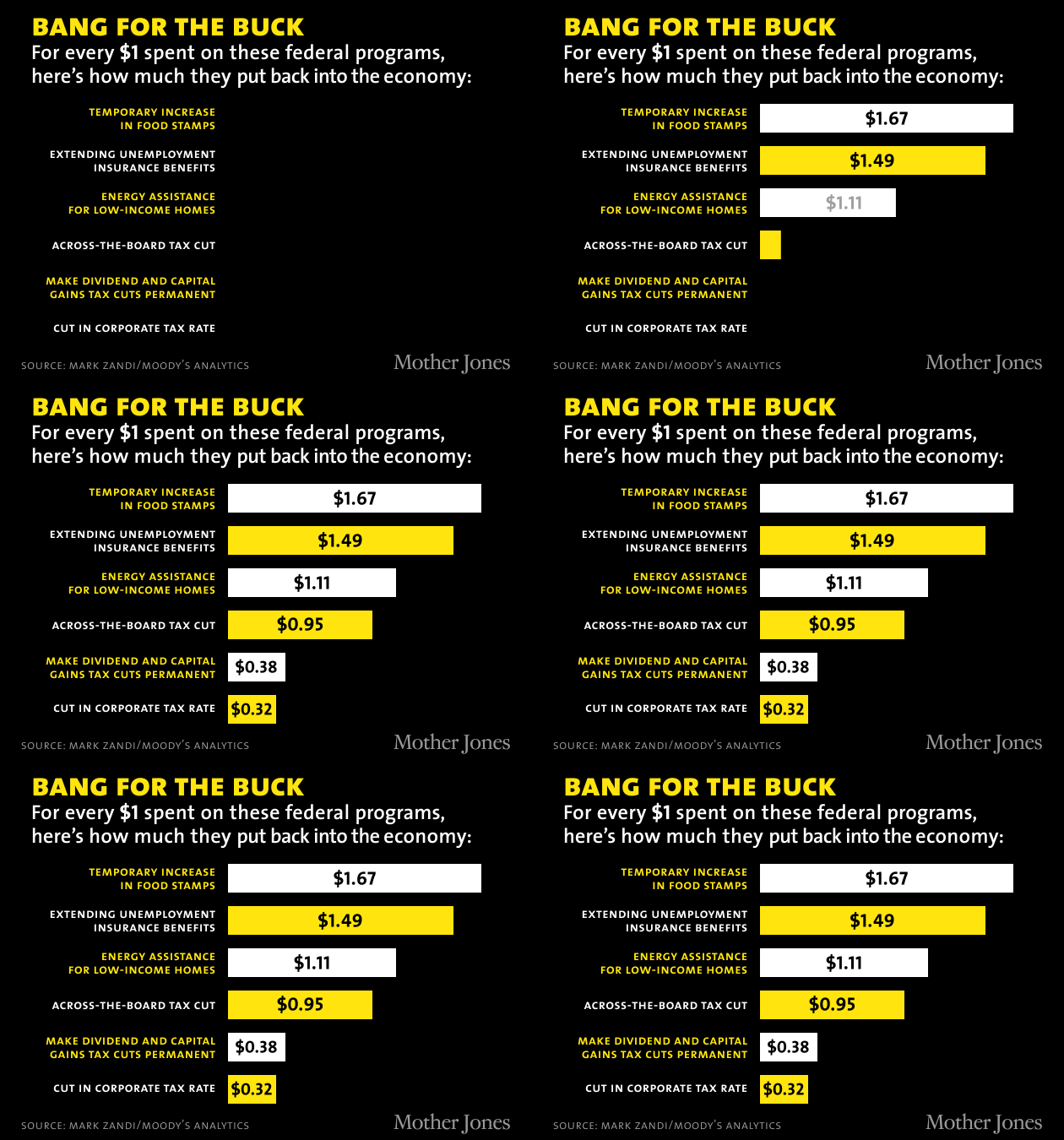
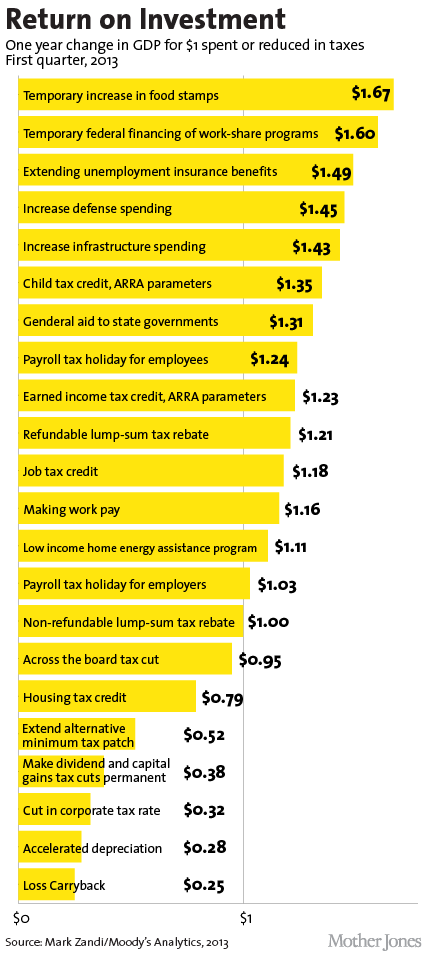
Beyond helping Americans in need, economists say that programs like unemployment insurance and food stamps generate high returns on investment, especially during recessions. According to data from Moody’s Analytics, every dollar spent on a temporary increase in food stamps contributes another $1.67 to the economy. A buck of extended unemployment kicks in $1.49. Compare that with the impact of a corporate tax cut—32 cents on the dollar.
“Using the deficit for something like unemployment insurance—that’s a multiplier—is a good thing,” says Josh Bivens, the director of research and policy at the Economic Policy Institute. “They’re shock absorbers, not bad things.”
Unemployment benefits tend to get spent right away on needs like groceries, for example. Chad Stone, the chief economist at the Center on Budget and Policy Priorities, explains that as long as you don’t raise taxes or cut spending from other programs, this type of spending trickles up, giving the overall economy an added boost.
However, that idea has lost currency, Bivens says, because “the politics are more divisive than they’ve been for a long time.”
Some Republicans have argued against extending federal benefits programs, citing the deficit. But that argument doesn’t hold up, Bivens explains, because the growth of public spending is at a historic low: “We’re undertaking unprecedented austerity on the budget side.” (More on the austerity effect here.)
To see how spending in emergency unemployment benefits compares to other programs and tax cuts, see the chart below:
A 49-year-old Coast Guard lieutenant charged with stockpiling weapons and drugs is being described as a "domestic terrorist" who was planning "to murder innocent civilians on a scale rarely seen in this country," according to court documents filed in U.S. District Court in Maryland on Tuesday.


 Market Data
  Markets


 AI
AI