How a Difficult, Racist, Stubborn President Was Removed From Power—If Not From Office
Members of Congress and some in Andrew Johnson’s own Cabinet wanted him gone. They did the next best thing.
By DAVID PRIESS November 13, 2018
The president of the United States was both a racist and a very difficult man to get along with. He routinely called blacks inferior. He bluntly stated that no matter how much progress they made, they must remain so. He openly called critics disloyal, even treasonous. He liberally threw insults like candy during public speeches. He rudely ignored answers he didn’t like. He regularly put other people into positions they didn’t want to be in, then blamed them when things went sour. His own bodyguard later called him “destined to conflict,” a man who “found it impossible to conciliate or temporize.”
But the nation’s politicians simply had to interact with Andrew Johnson, for he had become the legitimate, constitutionally ordained chief executive upon Abraham Lincoln’s death by assassination.
Their path for managing this choleric man reveals that a president need not be kicked out of office to be removed from holding a firm grip on the reins of power. It also shows that people around the president, from Congress to the Cabinet, have many more tools at their disposal than, say, writing an anonymous New York Times op-ed to stop a leader they consider reckless or dangerous.
This is true even though Johnson’s vice presidency remains historically unique. For his 1864 reelection bid, Lincoln had dumped his first-term vice president, Hannibal Hamlin. To appeal to non-Republicans and show he wasn’t just a Northern leader in the middle of the Civil War, the president instead ran on a new “National Union” ticket. He picked Johnson, a lifelong Democrat from Tennessee who had been the only senator out of 11 Southern states to remain with the Union in 1861 instead of walking out of the Senate and leaving a vacant seat in protest.
But Johnson turned out to be a poor choice, and the new vice president couldn’t have started his term much worse. Feeling ill, Johnson threw down three glasses of whiskey right before his swearing-in ceremony and inaugural speech. “I need all the strength I can get,” he told Hamlin, who was there to hand off the office Johnson would soon assume.
The audience noticed, and not just because Johnson’s face had turned bright red and his planned five-minute address stretched to three times longer. Shouting, gesticulating wildly, stumbling over his words and shaking his fists, he went into stump-speech mode, declaring violently that he was a man of the people and that Tennessee had never left the Union. Hamlin tried to shut him up and pull him away but failed in both. Johnson stammered and had to ask assembled officials nearby who the secretary of the Navy was. During the spectacle, the attorney general leaned over and called it “a wretched mess” to Gideon Welles—who happened to be the secretary of the Navy—who in turn said, “Johnson is either drunk or crazy.”
Johnson finally stopped his meandering and allowed Hamlin to administer the oath of office. Unfortunately, he bungled that, too, stumbling through the words and adding his own befuddled commentary along the way. After putting his lips to the Bible he’d just sworn on and yelling, “I kiss this Book in the face of my nation of the United States!” officials moved him on and asked someone else, on his behalf, to perform the new vice president’s traditional duty and administer oaths to the new senators. Lincoln took it all in stride, denying that his new vice president was a drunkard while acknowledging his “bad slip.” Johnson did the noble thing and kept himself mostly out of the public eye for the next 10 days to let the scandal subside.
That, combined with the tradition of the time that presidents didn’t consider their vice presidents part of the inner circle, meant Johnson and Lincoln didn’t interact much in the six weeks between inauguration and Lincoln’s assassination on April 14. Johnson thus started his time in office without a strong sense of exactly how Lincoln planned to ensure the final surrender of all Confederate forces in the Civil War and rebuild the war-torn nation.
Although Congress had already put in place some features of the post-war period that would serve as flash points with the new administration—like the Freedmen’s Bureau, charged primarily with feeding and caring for former slaves—Johnson came to the top job with a very different conception of post-war reunification. He questioned the federal government’s right to do much of anything in the formerly rebellious states until they had representatives back in Congress, even if those officials were former Confederates. His vision, of course, clashed with the so-called Radical Republicans in Congress, intent on reconstructing the South from Washington in order to guarantee the freedoms of those who had been enslaved for so long.
Johnson rankled most legislators, and the vast majority of Northerners, almost immediately. He released leading members of the Confederate Cabinet from government custody, up to and including the former Confederate vice president, Alexander H. Stephens. He appointed governors in Southern states and allowed their legislatures to meet. Dominated by secessionists, these governments passed “black codes,” allowing slavery in all but name to continue in many areas.
Johnson also made his racist views clear in statements like this one to the federal commissioner of the Public Buildings Service: “Everyone would, and must admit, that the white race was superior to the black, and that while we ought to do our best to bring them . . . up to our present level, that, in doing so, we should, at the same time raise our own intellectual status so that the relative position of the two races would be the same.”
“Is there no way,” declared leading radical senator Thaddeus Stevens of Pennsylvania just months after Johnson’s inauguration, “to arrest the insane course of the president in Washington?” He even mused that by taking actions more properly lying with Congress—like treating southern states as legitimate entities, even as most legislators considered them still occupied territory—the new president was setting the stage to be “crowned king.” Leading legislators urged the president to call Congress into a special session, or at least delay controversial moves until it was scheduled to convene in December. Johnson obstinately ignored them. By the winter of 1865–1866, the president had proved himself “already more disposed to be the political partisan of the Southerners than the ally of those who had elected him,” according to Adam Badeau, a confidant of Army General Ulysses Grant.
This stubbornness and refusal to cooperate with even moderate Republicans escalated once Congress came back into session in December of 1865, still without Southern representation and still dominated by Republicans steadfastly opposed to the leniency the new president was offering to the former Confederate states. Johnson vetoed both a civil rights bill designed to fight back the dreaded black codes and another measure to expand the functions of the Freedmen’s Bureau. His message to Congress about the latter veto included condescending language, like urging legislators to take “more mature considerations.” The vetoes enraged Capitol Hill, especially the author of the bills, to whom Johnson had raised no objections when he’d sought the president’s opinions during the drafting process.
The legislative branch, as a consequence, did something that was then unprecedented in American history on a major piece of legislation: They overturned a presidential veto. Then they did it again. Ultimately, they turned back the president’s rejections of bills a stunning 15 times—a record to this day, even though Johnson served a shorter term than most presidents. The Civil Rights Act’s veto override in the House prompted a spontaneous outburst of applause among both representatives and spectators; the speaker found it impossible to restore order for several minutes.
Also in early 1866, a congressional Joint Committee on Reconstruction developed a constitutional amendment, which presidents have no power to either approve or deny. It sought to prohibit states from depriving citizens of fundamental rights or equal protection under the law and to rescind the constitutional formula by which states had gained the benefit of additional representation in Congress for slaves within their borders, without letting those slaves vote. Both houses of Congress passed it in June, but behind the scenes Johnson obstructed its ratification. The measure would ultimately become the Fourteenth Amendment in 1868.
The president also saw his judicial appointment powers curtailed. When a Supreme Court vacancy came up, Congress eliminated the seat rather than confirm Johnson’s nominee. As a hedge against a potential future Johnson appointment, they went ahead and legislated in advance that the next high court vacancy, too, would not require filling.
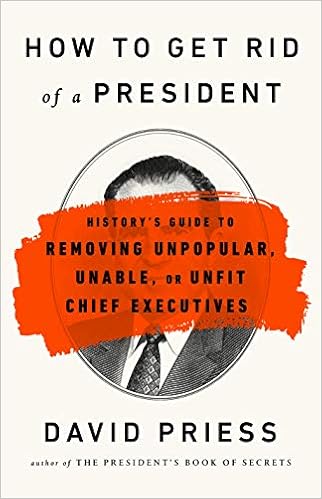
How to Get Rid of a President: History's Guide to Removing Unpopular, Unable, or Unfit Chief Executives Hardcover – November 13, 2018 by David Priess
A vivid political history of the schemes, plots, maneuvers, and conspiracies that have attempted--successfully and not--to remove unwanted presidents
To limit executive power, the founding fathers created fixed presidential terms of four years, giving voters regular opportunities to remove their leaders. Even so, Americans have often resorted to more dramatic paths to disempower the chief executive. The American presidency has seen it all, from rejecting a sitting president's renomination bid and undermining their authority in office to the more drastic methods of impeachment, and, most brutal of all, assassination.
How to Get Rid of a President showcases the political dark arts in action: a stew of election dramas, national tragedies, and presidential departures mixed with party intrigue, personal betrayal, and backroom shenanigans. This briskly paced, darkly humorous voyage proves that while the pomp and circumstance of presidential elections might draw more attention, the way that presidents are removed teaches us much more about our political order.
Yale psychiatrist explains how Trump’s mental issues will cause him to self-destruct
Tana Ganeva 13 Nov 2018 at 14:58 ET Yale psychiatry professor Bandy X. Lee does not diagnose lightly. In fact, she emphasizes that her theory about the mental state of President Donald Trump does not reflect the professional opinion of any of the institutions that she is affiliated with, including the Yale School of Medicine.
Nevertheless, she tells Raw Story that it’s her opinion that rather than acting strategically, Trump’s pattern of behavior shows signs of severe psychological distress and that both Trump and his supporters are self-destructively spiraling in a way that spells dire trouble for the nation and the world.
Conversation edited for clarity below:
Tana Ganeva: Can you explain your theory about Donald Trump’s mental state, that the behavior is pathological rather than strategic?
Professor Bandy X. Lee: What mental health professionals look at are patterns. Patterns of his behavior. Oftentimes Trump’s assertions don’t bring him the advantages that strategy would.
It fits a pattern more of someone acting that is driven by emotional compulsions. It’s the emotional need to reframe situations. For example, the idea that the midterm elections are a win for him and if not, it’s seen as a fraudulent election.
Whereas this reframing may be effective for those who are relatively uninformed and are emotionally predisposed to believing Mr. Trump because of their emotional dependence.
Trump and his supporters … both of their defects fit like a lock and key to fulfill each other’s emotional needs. It’s why we see the phenomenon of his base not abandoning him, even at great cost to themselves. This can be explained through their emotional wounds and it is not necessarily consciously strategic.
In other words, when we say strategy we think of logical, organized planning. And sometimes pathological symptoms can seem very effective, because when you have rationality and logic removed, you have a very, very strong emotional component that takes over.
And that can manifest … that can sometimes be incredibly powerful, not only because it overwhelms and overpowers those who are logical and rational but also the …. lesser of the psyche takes over. The psyche operates in layers.
The lesser layers may be less logical and less healthy … but when they take over they can be very powerful. Far more powerful than logical planning.
Tana Ganeva: Isn’t voting always an emotional decision? Does anyone really vote in their own self-interest?
Professor Lee: Right but those who are healthier can think more logically and rationally in terms of self-interest. Those who are healthier will make choices that are life-affirming in general.
Those who are less healthy may be attracted to courses that are self-destructive. A person’s emotional health can be measured by the degree to which they choose a course that is life-affirming instead of choosing a course that’s destructive. A course that’s destructive to themselves or others.
And it’s almost regardless of intention. It’s regardless of what a person’s stated desire is. When an individual becomes too ill … as mental health professionals we have to act to protect them against the illness, even if it’s against their will sometimes.
Once we treat them they realize how overtaken they were by the illness. Even kicking and screaming they later come back and thank you for the treatment. Their state at the time of illness is not necessarily the person’s conscious thought or desire when they are well.
So this can happen to varying degrees. Individuals can choose courses for themselves that are life-affirming versus course that cause damage and destruction. They may consciously … believe those choices are good for them but they’re actually choosing a self-destructive course.
Tana Ganeva: Would one say that about the President?
In my opinion I believe so because he is driven by pathology rather than healthy choices. He’ll make choices that are self-destructive even if they seem effective at the time and produce results that appear to benefit him. He’s choosing a self destructive course, not just for him but for the nation.
There are many examples of this. He appears to make choices that are deceptive and manipulative of others, that demean others for his apparent benefit. These choices are coming out of pathology and ultimately destructive to him, also.
Tana Ganeva: Do you think he’ll be re-elected?
I’m not an expert at that kind of thing. But one cannot underestimate the power of mental pathology to lure and deceive and to spread destruction. We have seen how his own attraction to conspiracy theories, how powerful is his ability to spin reality into something he wishes to perceive as real. If you collude in that or you’re lured into that then anything is possible.
We’ve seen multiple nations go to their own peril and great destruction due to pathological leaders taking charge and leading entire nations to their destruction.
That’s the power of mental pathology it can hypnotize you almost … to do things in ways you would not otherwise do.
So, we’ve got a group of desperate refuge seekers hundreds of miles away … he spins that into an invasion that’s imminently threatening and that requires thousands of troops at the border, for example, to the point where people were ready to act on those beliefs.
Tana Ganeva: It seems that social media plays a role in a lot of these pathologies, from the President on down.
Social media absolutely has a role. What has happened is when you have conspiracy theories or fabricated news, it functions like a form of brainwashing. It’s the way you control information that gets to certain people.
If you’re isolating information from other sources of information…. social media creates a natural condition for brainwashing to occur. And we often talk about information bubbles. It seems more severe for those on the right than on the left, although I hear it happens on both sides. On the right it’s far more extreme and far more divorced from reality. You have the very conditions that allow for thought reform to happen.


 Market Data
  Markets


 AI
AI