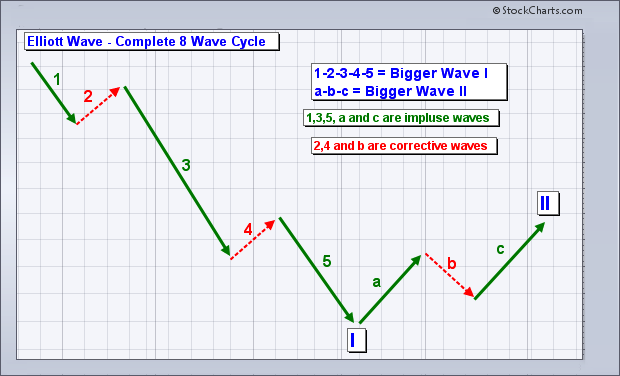
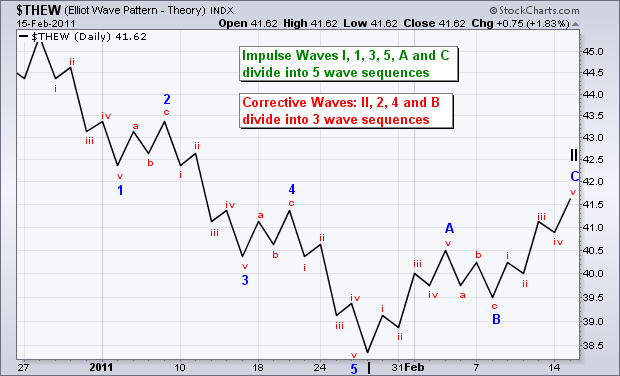
Impulse Wave 1 - The Accumulation Stage the Wave right after a prolonged downtrend.
Wave 1
The stock makes its initial move upwards. This is usually caused by a relatively small number of people that all of the sudden (for a variety of reasons, real or imagined) feel that the price of the stock is cheap so it’s a perfect time to buy. This causes the price to rise.
Wave 2 - Stock Declines
At this point, enough people who were in the original wave consider the stock overvalued and take profits. This causes the stock to go down. However, the stock will not make it to its previous lows before the stock is considered a bargain again.
Wave 3
This is usually the longest and strongest wave. The stock has caught the attention of the mass public. More people find out about the stock and want to buy it. This causes the stock’s price to go higher and higher. This wave usually exceeds the high created at the end of Wave 1.
Wave 4
Traders take profits because the stock is considered expensive again. This Wave tends to be weak because there are usually more people that are still bullish on the stock and are waiting to “buy on the dips.”
Wave 5
This is the point that most people get in on the stock, and is mostly driven by hysteria. You usually start seeing the CEO of the company on the front page of major magazines as the Person of the Year. Traders and investors start coming up with ridiculous reasons to buy the stock and try to choke you when you disagree with them.
This is when the stock becomes the most overpriced. Contrarians start shorting the stock which starts the ABC pattern.
The entire Wave is up as it moves from the lower left to the upper right of the chart.
Waves 1,3 and 5 are impulse waves because they move with the trend.
Waves 2 and 4 are corrective waves because they move against this bigger trend.
A basic impulse advance forms a 5-Wave sequence.
Wave 1
The stock makes its initial move upwards. This is usually caused by a relatively small number of people that all of the sudden (for a variety of reasons, real or imagined) feel that the price of the stock is cheap so it’s a perfect time to buy. This causes the price to rise.
Wave 2
At this point, enough people who were in the original wave consider the stock overvalued and take profits. This causes the stock to go down. However, the stock will not make it to its previous lows before the stock is considered a bargain again.
Wave 3
This is usually the longest and strongest wave. The stock has caught the attention of the mass public. More people find out about the stock and want to buy it. This causes the stock’s price to go higher and higher. This wave usually exceeds the high created at the end of Wave 1.
Wave 4
Traders take profits because the stock is considered expensive again. This Wave tends to be weak because there are usually more people that are still bullish on the stock and are waiting to “buy on the dips.”
Wave 5
This is the point that most people get in on the stock, and is mostly driven by hysteria. You usually start seeing the CEO of the company on the front page of major magazines as the Person of the Year. Traders and investors start coming up with ridiculous reasons to buy the stock and try to choke you when you disagree with them.
This is when the stock becomes the most overpriced. Contrarians start shorting the stock which starts the ABC pattern.
The Pop, Drop and Run always has it's first "Awareness Pop", then it will have a Drop, back-down to the previous Low, then it will have it's Run, taking the stock back above the Awareness Pop Price Level
* Traders move the Price of the stock Down 6-to-9 months in advance, to a Price Level that is seen as, a "Point of Maximum Opportunity" and "Fairly Valued".
* The insiders "pull the price down", for the funding of their operations, by increasing the "shares outstanding", and the "authorized shares",
and when the price of the stock, reaches the price level, where the "VC"s want to "Buy", (0.0001 and 0.0002) the stock finally bottoms, and you then see the accumulation.
The "Shares Authorized", is not used in any fundamental of financial calculation, to determine company value.
OTC companies only have two things, stock for sale and stories of progress.
Dilution: when the company moves shares from the A/S (authorized shares) to the O/S (outstanding shares) or tradeable inventory, for cash investments in the company.
This means there are more shares at the same market price and reduces the size of the EPS.
It doesn't reduce the price or value of the stock. But many pennylanders think it does.
Dilution doesn't change price, it changes EPS. Creating loss in company value, not stock value.
Hardly 1-in-1000 OTC companies have an EPS to effect. So, dilution can't effect their company value in the first place. What's the value of no earnings, thus no EPS.
On the OTC, "dilution" is the best news one can hear !
Not only does it give the company a chance at growth, it doesn't effect their EPS value one bit.
They have no EPS to effect. Plus, every time VCs get there hands on large amounts of shares, they buy a run, and we can trade for profits !
So, "dilution" is a win for the company, a win for the Venture capital firm, and a win for the educated pennyland trader, on the OTC.
Stocks of many start-up companies, bottom at the "Triple 000" price level, before they begin their meteoric rise.
"Venture Capitalists" like to buy the shares of these companies at these low levels.
> What it is. > What it means. > What it looks like.
* They are "Big Percentage Movers", and they can be "Life changing", for the trader who has BIG money in them at their lows.
* They can produce "10 and 20-Fold moves".
* The "Slope Play" where the price falls HUGE over a relatively short period of time.
* All "you" need to remember, is that with ALL "Slope Plays", the "accumulation" starts. This is just the first step!
* "Slope Plays" are OTC game stock. They hover higher for months and months, with NO retail interest or volume.
* The insiders "pull the price down", for the funding of their operations, by increasing the "shares outstanding", and the "authorized shares",
and when the price of the stock, reaches the price level, where the "VC"s want to "Buy", the stock finally bottoms, and you then see the accumulation.
* Most every stock "pennylanders" like these types of stocks. There is another term for trading these "OTC sub" & "Micro stocks". "Bottom feeder" stocks.
* The accumulation is "Bottom Feeders" moving in.
"Venture Capitalists"
* They Load at both, the 0.001 / 0.002 Sub-penny, and 0.0001 / 0.0002 Trips Levels.
* Their Plan: To Sell at: and High Penny Levels ! the High 0.00 the High 0.000
* Embedded Charts
* Buy all of them at,
the Point of Maximum Financial Opportunity !
Where is that ?
At the end of an Elliott Wave 5-Wave Decline Sequence !


 Market Data
  Markets


 AI
AI