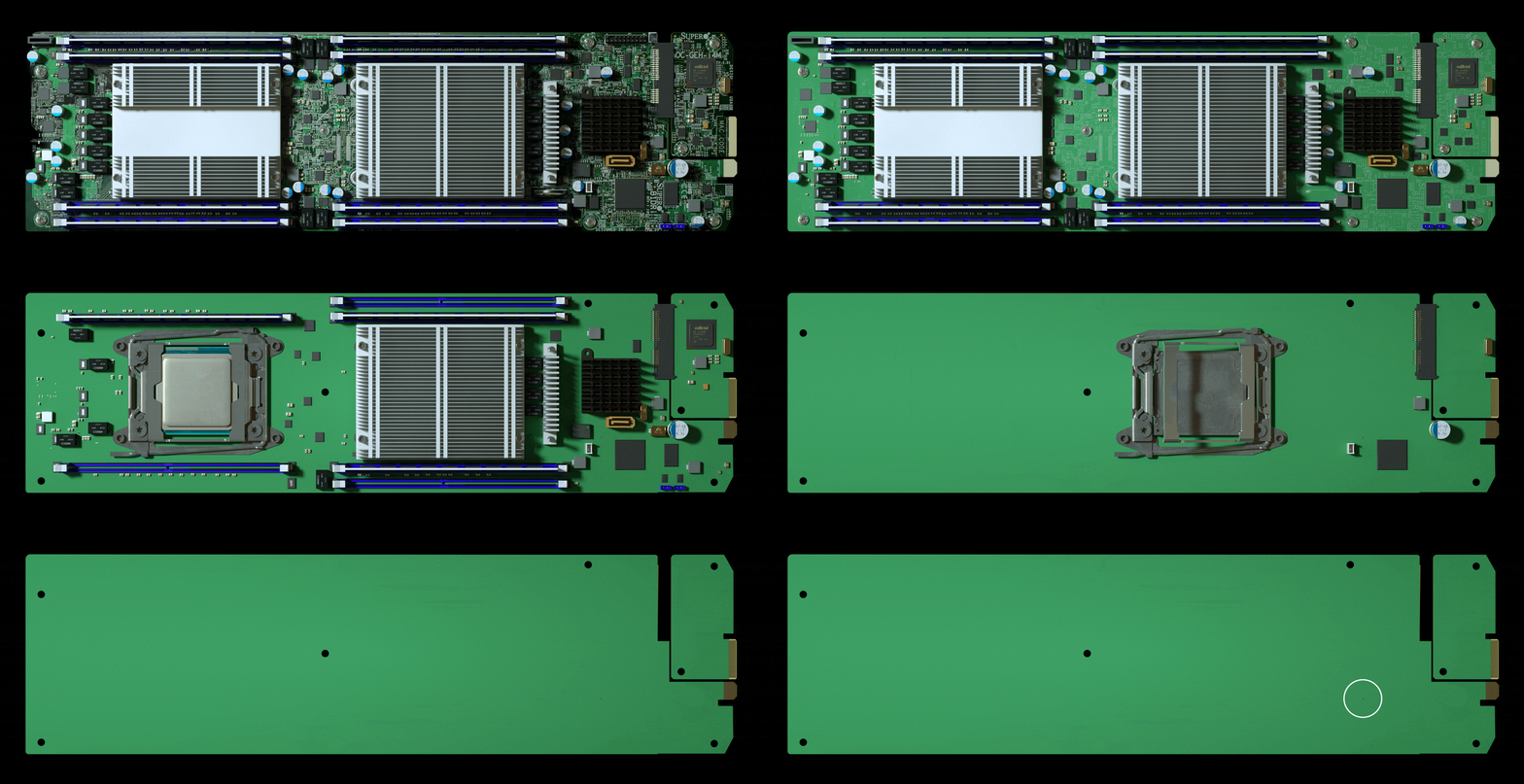
The Big Hack: How China Used a Tiny Chip to Infiltrate U.S. Companies
The attack by Chinese spies reached almost 30 U.S. companies, including Amazon and Apple, by compromising America’s technology supply chain, according to extensive interviews with government and corporate sources.
Illustrator: Scott Gelber for Bloomberg Businessweek
By Jordan Robertson and Michael Riley October 4, 2018, 7:00 PM GMT+10
In 2015, Amazon.com Inc. began quietly evaluating a startup called Elemental Technologies, a potential acquisition to help with a major expansion of its streaming video service, known today as Amazon Prime Video. Based in Portland, Ore., Elemental made software for compressing massive video files and formatting them for different devices. Its technology had helped stream the Olympic Games online, communicate with the International Space Station, and funnel drone footage to the Central Intelligence Agency. Elemental’s national security contracts weren’t the main reason for the proposed acquisition, but they fit nicely with Amazon’s government businesses, such as the highly secure cloud that Amazon Web Services (AWS) was building for the CIA.
To help with due diligence, AWS, which was overseeing the prospective acquisition, hired a third-party company to scrutinize Elemental’s security, according to one person familiar with the process. The first pass uncovered troubling issues, prompting AWS to take a closer look at Elemental’s main product: the expensive servers that customers installed in their networks to handle the video compression. These servers were assembled for Elemental by Super Micro Computer Inc., a San Jose-based company (commonly known as Supermicro) that’s also one of the world’s biggest suppliers of server motherboards, the fiberglass-mounted clusters of chips and capacitors that act as the neurons of data centers large and small. In late spring of 2015, Elemental’s staff boxed up several servers and sent them to Ontario, Canada, for the third-party security company to test, the person says.
Nested on the servers’ motherboards, the testers found a tiny microchip, not much bigger than a grain of rice, that wasn’t part of the boards’ original design. Amazon reported the discovery to U.S. authorities, sending a shudder through the intelligence community. Elemental’s servers could be found in Department of Defense data centers, the CIA’s drone operations, and the onboard networks of Navy warships. And Elemental was just one of hundreds of Supermicro customers.
During the ensuing top-secret probe, which remains open more than three years later, investigators determined that the chips allowed the attackers to create a stealth doorway into any network that included the altered machines. Multiple people familiar with the matter say investigators found that the chips had been inserted at factories run by manufacturing subcontractors in China.
[...]
Since the implants were small, the amount of code they contained was small as well. But they were capable of doing two very important things: telling the device to communicate with one of several anonymous computers elsewhere on the internet that were loaded with more complex code; and preparing the device’s operating system to accept this new code. The illicit chips could do all this because they were connected to the baseboard management controller, a kind of superchip that administrators use to remotely log in to problematic servers, giving them access to the most sensitive code even on machines that have crashed or are turned off.
This system could let the attackers alter how the device functioned, line by line, however they wanted, leaving no one the wiser. To understand the power that would give them, take this hypothetical example: Somewhere in the Linux operating system, which runs in many servers, is code that authorizes a user by verifying a typed password against a stored encrypted one. An implanted chip can alter part of that code so the server won’t check for a password—and presto! A secure machine is open to any and all users. A chip can also steal encryption keys for secure communications, block security updates that would neutralize the attack, and open up new pathways to the internet. Should some anomaly be noticed, it would likely be cast as an unexplained oddity. “The hardware opens whatever door it wants,” says Joe FitzPatrick, founder of Hardware Security Resources LLC, a company that trains cybersecurity professionals in hardware hacking techniques.
U.S. officials had caught China experimenting with hardware tampering before, but they’d never seen anything of this scale and ambition. The security of the global technology supply chain had been compromised, even if consumers and most companies didn’t know it yet. What remained for investigators to learn was how the attackers had so thoroughly infiltrated Supermicro’s production process—and how many doors they’d opened into American targets.
[...]
Amazon, for its part, began acquisition talks with an Elemental competitor, but according to one person familiar with Amazon’s deliberations, it reversed course in the summer of 2015 after learning that Elemental’s board was nearing a deal with another buyer. Amazon announced its acquisition of Elemental in September 2015, in a transaction whose value one person familiar with the deal places at $350 million. Multiple sources say that Amazon intended to move Elemental’s software to AWS’s cloud, whose chips, motherboards, and servers are typically designed in-house and built by factories that Amazon contracts from directly.
A notable exception was AWS’s data centers inside China, which were filled with Supermicro-built servers, according to two people with knowledge of AWS’s operations there. Mindful of the Elemental findings, Amazon’s security team conducted its own investigation into AWS’s Beijing facilities and found altered motherboards there as well, including more sophisticated designs than they’d previously encountered. In one case, the malicious chips were thin enough that they’d been embedded between the layers of fiberglass onto which the other components were attached, according to one person who saw pictures of the chips. That generation of chips was smaller than a sharpened pencil tip, the person says. (Amazon denies that AWS knew of servers found in China containing malicious chips.)


 Market Data
  Markets


 AI
AI