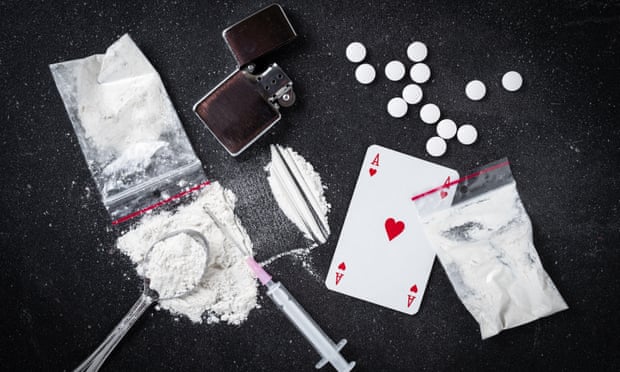
The report, entitled “Can Australia respond to drugs more effectively and safely?”, makes 13 recommendations around minimising drug-related harm and the burden on the criminal justice system.
Among them are reducing and, where possible, eliminating penalties for possession and use; expanding health and social assistance for young people struggling with drug addiction; and undermining the black market with a regulated “white” market.
It recommends pill-testing be trialled to work as “indirect quality control … on the drug market”.
Four former police commissioners and assistant commissioners, two former heads of corrective services, a former supreme court judge and a former director of public prosecution have put their names to the report.
It was born of a roundtable convened by Mick Palmer, former commissioner of the Australian federal police and Northern Territory police, at the University of Sydney in September 2015.
The current system was “badly broken, ineffective and even counterproductive” to the aim of harm minimisation, he said in a statement. “We must be courageous enough to consider a new and different approach.”
The Australia 21 report proposes redefining drugs as a health and social issue, rather than a criminal justice one – an approach that has been adopted in 11 states of the US, several western European countries, India, Brazil, Colombia, Mexico and many other countries around the world.
“Meanwhile, Australia’s drug problems have grown steadily worse.”
It calls for a distinction to be made between “high-end production and trafficking” and personal use and possession, and for the “discretionary approach … already being adopted by frontline law enforcers” to be standardised.
Reform should be slow and incremental, and reevaluated at every step.
“A review of current attitudes and approaches should be a free-ranging attempt to legitimise the existing approach, tinker with it or replace it,” wrote Jack Johnston, former Tasmanian police commissioner.
But there was general agreement that some drugs – “100% pure” heroin, cocaine and ice – “should never and would never be subjected to regulated availability”, the report noted.
This is the third in a series of Australia 21 reports on drug law reform after the first two being released in 2012. All three were funded by an anonymous donor.
According to the Australian Crime Commission, 80,000 drug consumer arrests are made each year.
Senior police and drug users stand side-by-side for law reform
March 20, 2017
Senior police, prison officers and lawyers are today standing side-by-side with drug users calling for law reform, to bring an end to killing and criminalising young Australians.
Drug-related deaths, diseases, injuries, crimes and social costs continue to rise despite more than 80,000 consumer arrests in Australia each year.
[...]
The Australia21 report makes 13 key recommendations, aimed at:
* minimising harms for drug users and those around them,
* reducing the use of untested, unregulated drugs in unsafe environments,
* providing health and social programs to reduce drug-related problems,
* reducing and even eliminating criminal control of the drug market,
* reducing the prison population and its associated progress to hard drug use,
* supporting police and the judicial system to focus law enforcement more usefully.
Ingrid van Beek, who has been at the forefront of providing health care for drug users, sex workers and homeless people in around Sydney's Kings Cross for 30 years, is calling for drug use to be decriminalised.


 Market Data
  Markets


 AI
AI