Jo Cox MP dead after shooting attack UK MP Jo Cox dies after being shot and stabbed, an attack that has led to the European referendum campaign being temporarily suspended.
Jo Cox, Labour MP for Batley and Spen, was left bleeding on the ground after the attack in Birstall, West Yorkshire. A man was arrested nearby.
Vote Leave and Remain have both suspended campaigning in the EU referendum in light of the attack.
Mrs Cox, 41, is the first sitting MP to be killed since 1990, when Ian Gow was the last in a string of politicians to die at the hands of Northern Irish terror groups.
The man taken into custody was arrested in Market Street, not far from Birstall Library where Mrs Cox was holding a constituency surgery. He has been named locally as Tommy Mair.
Hundreds of Mrs Cox's friends and colleagues gathered for a vigil at St Peter's Church in Birstall earlier.
Every pew was full as people packed into the church for the emotional service.
MPs including Yvette Cooper hugged and consoled each other as it ended.
Investors continued to monitor Britain's frenzied debate on whether to leave the European Union. The debate took on a new level of concern after the killing of a member of Parliament.
Investors' focus has increasingly turned to Britain's vote next week on whether to leave the EU. The campaigning became heated this week but was halted after the killing of a British politician in favor of staying in the EU. The vote will be held June 23.
Investors interpreted the assassination as something that could sway more voters to stay in the EU. U.K. and European stocks and the British pound rose against the euro and dollar. The pound traded at $1.4271 compared with $1.4205 the day before.
Global Stocks Rebound As Brexit Odds Decline Following Tragic Death Of UK Lawmaker
Odds on the U.K. leaving the EU slid to 38 percent after hitting a record 44 percent on Thursday, according to Oddschecker calculations based on bookmakers’ quotes. “If you do see uncertainty, that typically will drive voters to the status quo,” said Karl Schamotta, director of foreign-exchange research and strategy in Toronto at Cambridge Global Payments, which hedges currencies for companies. “We’re seeing a trade that’s entirely too crowded -- at the end of the day, the market expectation remains that we will see a stay vote.”
In short, as Bloomberg, DB and Reuters all admit, the tragic death of Jo Cox had a morbidly levitating effect on all risk assets. “The halt in campaigning may just take Brexit off the headlines momentarily, and that may have given an opportunity to just to see a little bit of a retracement in a comparatively quieter environment,” said Orlando Green, a rates strategist at Credit Agricole SA’s corporate and investment-banking unit in London. “We’ll see a choppy environment as we head toward the referendum.”
Ten-year bonds in Japan and the U.K. declined for the first time in more than a week. Global stocks rebounded from a four-week low and commodities advanced with the pound as campaigning in Britain’s referendum on European Union membership was suspended for a second day. Oil rose, paring its biggest weekly decline in more than two months.
German bonds fell for the first time in four days, ending a three-day rally that pushed the yield into negative territory for the first time. The yield was near-zero, from minus 0.02 percent on Thursday. Similar-maturity U.K. debt snapped an eight-day run of gains. Spanish and Italian debt rallied as investors snapped up higher-yielding assets.
Japan’s 10-year bonds fell for the first time in seven days, lifting their yield by five basis points to minus 0.15 percent. It sank to a record minus 0.21 percent in the last session as the BOJ said inflation in the nation may be zero or negative. The rate on similar-maturity bonds in Australia climbed eight basis points to 2.09 percent, after slipping below 2 percent for the first time on Thursday. U.S. Treasuries due in a decade fell, lifting their yield by two basis points to 1.60 percent. It touched 1.52 percent in the last session, the lowest intraday level since August 2012, after the Fed on Wednesday lowered its projections for the path of policy tightening.
As a reminder, it is not just sterling: “With Brexit risks an important driver of currencies in the near term, dollar-yen can track lower next week,” said Joseph Capurso, a senior currency strategist in Sydney at Commonwealth Bank of Australia. “That raises the risk the Ministry of Finance may intervene to stem the recent rapid gains in the yen.” As Shunichi Otsuka, general manager of research and strategy at Ichiyoshi Securities, added “The dollar-yen market has calmed somewhat,” said “We’ll probably see a rebound from the steep fall yesterday. The fact that U.S. shares have risen is also a tailwind for Japanese equities.”
Meanwhile, while it may very well not last and all of yesterday's gains could evaporate instantly if David Cameron announces that the Brexit vote will take place as scheduled, while polling remains unchanged from before Jo Cox's tragic death, all 10 industry groups in the MSCI All-Country World Index advanced, with the index of global equities rising 0.7% trimming the week’s drop 1.6%. The Stoxx Europe 600 Index rose 1.4%. European lenders rallied the most, buoyed by Italian banks. Futures on the S&P 500 were little changed, after equities Thursday snapped their longest losing streak since February.
U.S. stocks close sharply lower after Britain votes for Brexit Nasdaq sees worst one-day percentage drop since August 2011
U.S. stocks plunge Friday, closing slightly above session lows, after U.K. citizens vote to end the country’s membership in the European Union—a historic rejection of Europe’s political order.
http://stream.marketwatch.com/story/markets/SS-4-4/SS-4-111658/ The Dow plunged 611.21 points, or 3.4%, to close at 17,399.86, all 30 blue-chip stocks finishing lower, led by bank stocks. J.P. Morgan Chase & Co., dropped 7% and Goldman Sachs Group Inc. dove 7.1%. Earlier, the average was down by as many as 655 points.
Meanwhile, the Nasdaq Composite Index plummeted 202.06 points, or 4.1%, to finish at 4,707.98, for its worst one-day percentage drop since August 2011.
The Brexit vote will have wide implications for monetary policy round the globe, according to analysts.
“The vote will definitely make it very difficult for the [Federal Reserve] to raise rates this year, and in fact the [Fed fund] futures are currently giving better chances of a rate cut in the U.S. than a rate increase. Lower for longer is what we continue to expect—the global economy is going to face lower growth prospects and rates are therefore going to be kept lower for longer,” said Chris Gaffney, president at EverBank World Markets.
“What is occurring is traders are rushing for the exits and can’t get out fast enough,” said Robert Pavlik, chief market strategist at Boston Private Wealth, in emailed comments. “As investors we must not panic (I realize the argument comes across as weak especially at this time) but keep in mind that the process for the United Kingdom to exit the European Union will occur over a period of two years and not weeks or months.”
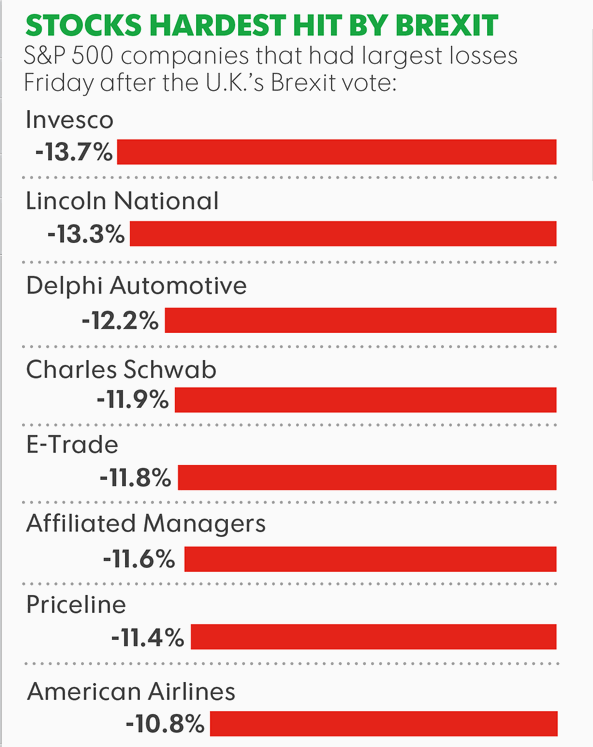
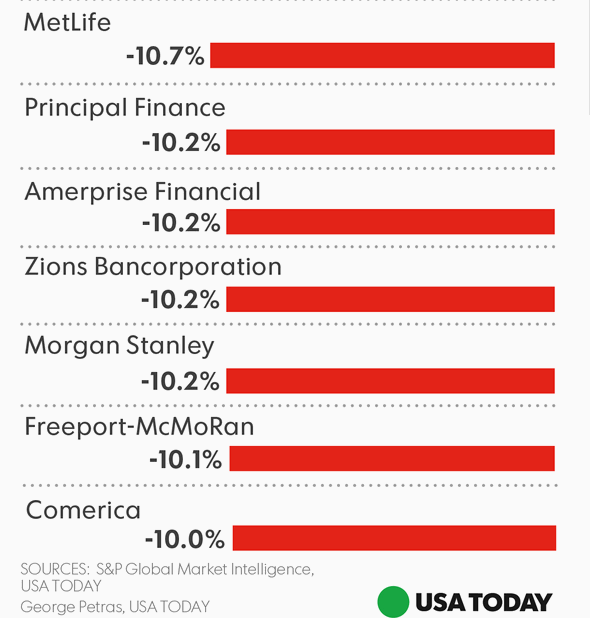
Fifteen stocks in the Standard & Poor's 500 index, including money management firm Invesco (IVZ), autoparts maker Delphi Automotive (DLPH) and global financial Morgan Stanley (MS), closed down 10% or more Friday, making them the worst performers on a bad day.
Investors may be shocked by the events in Europe, but some may take comfort in the fact most U.S. companies get very small percentages of revenue from the nation. Even a global diversified portfolio would't have much more than a single-digit exposure to Great Britain. But the big selloffs in some select stocks inside the S&P 500 highlights the unique exposure some individual companies have to the issue.
Hardest hit is Invesco, a diversified money management firm based in Atlanta, which is seeing its stock drop nearly 14% on the news. The company got a quarter of its revenue, $1.3 billion, from the United Kingdom last year. An additional 13% of revenue was from Europe and Ireland.
Delphi was another hammered stock, dropping 12.2%. The maker of various parts for the automotive industry is also disproportionately exposed to Europe. More than 5% of the company's revenue last year was from the United Kingdom, and another 30% came from Europe and the Middle East.
Stocks and risk assets could continue getting crushed and currency volatility is expected to remain at extreme highs this week as investors weigh the fallout of the U.K. Brexit vote.
But analysts warn the market moves in stocks and bonds and other assets could also be even more exaggerated than normal, as fund managers around the world juggle positions, selling both winners and losers ahead of the end of the second quarter Thursday.
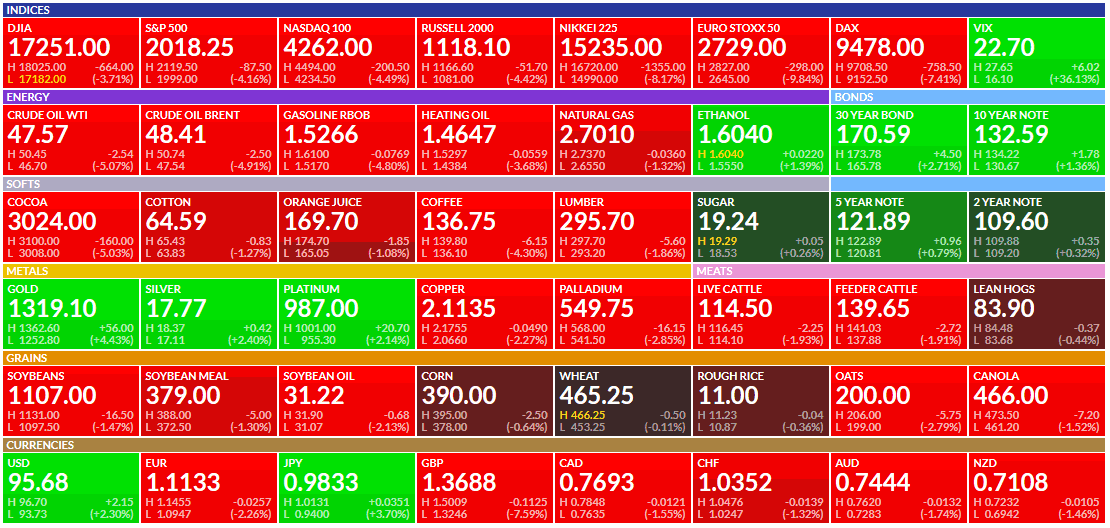
The S&P 500 tumbled 1.5 percent Monday morning to just above 2000, breaking below its 200-day moving average. European stocks were off sharply, as investors moved into bonds and gold as the potential impact on financial markets and the global economy remained unclear. Japanese stocks ended up 2.4 percent after Japanese officials signaled they may take action to control the wild move higher in the yen.
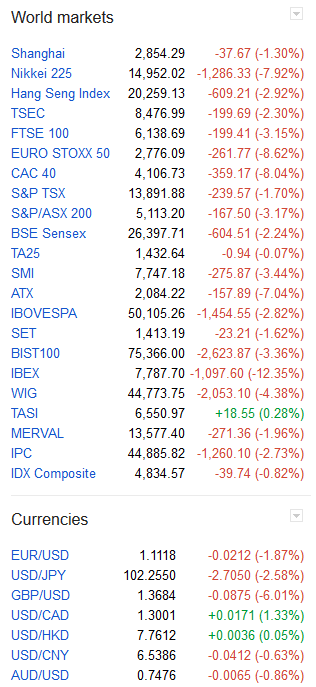
The shock of Thursday's vote by the U.K. to leave the European Union triggered Friday's selling avalanche, resulting in a record $2 trillion wipe out in global stock markets. Currency volatility was at an extreme high, with sterling the most dramatic, swinging from 1.50 to the dollar to a 30-year low of 1.32. It remained under pressure Monday, trading at one point under 1.32.
Stocks and risk assets could continue getting crushed and currency volatility is expected to remain at extreme highs this week as investors weigh the fallout of the U.K. Brexit vote.
But analysts warn the market moves in stocks and bonds and other assets could also be even more exaggerated than normal, as fund managers around the world juggle positions, selling both winners and losers ahead of the end of the second quarter Thursday.
The S&P 500 tumbled 1.5 percent Monday morning to just above 2000, breaking below its 200-day moving average. European stocks were off sharply, as investors moved into bonds and gold as the potential impact on financial markets and the global economy remained unclear. Japanese stocks ended up 2.4 percent after Japanese officials signaled they may take action to control the wild move higher in the yen.
The shock of Thursday's vote by the U.K. to leave the European Union triggered Friday's selling avalanche, resulting in a record $2 trillion wipe out in global stock markets. Currency volatility was at an extreme high, with sterling the most dramatic, swinging from 1.50 to the dollar to a 30-year low of 1.32. It remained under pressure Monday, trading at one point under 1.32.
"Markets are crazy and it's going to be awhile before we can get a sense of security. The important thing is you don't have full participation. You have big volumes going through but a lot of people are going to avoid the market – asset managers, corporations… they don't need to be heroes, let the other guys pick the bottom," said Marc Chandler, chief currency strategist at Brown Brothers Harriman.
Treasury yields were lower, with the 10-year at 1.47 percent, as German 10-year bunds dig deeper into negative territory, yielding about negative 0.9 percent Monday.
"There's going to be aftershocks in the markets for the next few days, but what makes it more tricky is it's running up against quarter end and also this is the quarter end that runs into the long Fourth of July weekend. So there the willingness and the ability to warehouse risk is not going to be that high...for market makers especially," said George Goncalves, head of rates strategy at Nomura. Goncalves said the 10-year could take another run at its low below 1.40 percent.
The Brexit vote has had a direct consequence on Japan, with the yen surging Friday, reaching a level of 99 to the dollar temporarily. The yen weakened slightly Sunday evening, as Japanese Prime Minister Shinzo Abe instructed Finance Minister Taro Aso to watch the currency markets "ever more closely" and take steps if necessary. Traders have been speculating Japan would intervene to weaken its currency if it went below 100.
"Clearly you look at what happens with the yen. The yen is a safe haven currency. If the yen does not weaken, the Japanese economy is going to get destroyed," said Tony Roth, CIO of Wilmington Trust.
The S&P 500 fell to 2037 Friday, a loss of 3.6 percent on the day and now down more than 2.5 percent for the quarter to date with Monday's early losses.
"I think you're going to see managers probably try to close out positions that may already be in extreme loss positions," said Roth. "I think it could be a painful week but we should be able to form a short term bottom for sure…I don't have a specific target but I would expect (the S&P 500) to go through 2000 and head to 1900. I would be thrilled to see it hit 1900 as a long term investor with some dry powder. But I'm not thinking that would happen."
Chandler also said the markets could feel the impact of the end of the quarter as portfolio managers lock in results. "I think real money is not going to participate. We're close to the end of the quarter, the end of the month," he said.
While some economists shaved their growth expectations slightly for the U.S. in the aftermath of the vote, a number of strategists made a case for markets becoming more stable after a period of volatility, with Brexit clearly a bigger issue for the U.K.
Goldman Sachs economists Sunday cut their expectations for U.K. GDP by a cumulative 2.75 percent because of Brexit and said there's a chance the country could enter recession by early 2017.
Both Chandler and Roth said the market reaction is moving from shock to confusion.
"I think that the situation in the U.K. is going to be very confused, I would say for at least the next 30 days," said Roth. Roth said the fact there was no real time frame on the replacement for Prime Minister David Cameron added tot he confusion and market uncertainty.
On Monday, Reuters reported that Britain's Conservative committee chairman said the contest to replace Cameron should begin next week and be concluded by Sept. 2.
Chandler said the next big event for markets is the EU leaders' summit which begins Tuesday. Cameron is expected to explain the U.K.'s plans to the group, but the EU leadership is even divided about how it should be dealt with.
Chandler said the uncertainties include questions of when the U.K. will actually start the separation process with the EU, and what it means for all kinds of things from border issues to who will be the next prime minister. There's also the issue of whether there even could be another vote on whether Britain could stay.
James Paulsen, chief investment strategist at Wells Capital, said once some of the uncertainties are resolved, the sell off could be short lived and stocks could end higher on the year.
"It is interesting where we closed in the United States market (Friday). We basically had a stock market that was a little over 1 percent lower than it was a week ago Friday," said Paulsen. "We had a bond yield that was unchanged and a dollar that was up maybe a percent. My point is a lot of this is emotional consequences and this collapse had more to do with how much it went up in the four days prior."
Paulsen said the selloff could still be rough, but in several weeks from now, markets will likely be a lot more stable.
Investors rush to sell out of UK commercial property
The British pound dropped sharply to a new 31-year low on Tuesday amid concerns that the country’s decision to leave the European Union might cause a steep slide in U.K. commercial real estate values and hurt the wider economy.
Markets were jittery after three financial firms stopped trading in their respective U.K. commercial property funds following a rapid increase in investors trying to sell their holdings. The funds buy commercial property and offer shares to investors.
Some of those investors now appear worried that companies might opt to leave London to move operations to mainland Europe to retain access to the EU market. That would vacate office space and weigh down on real estate values in Britain’s capital.
Aviva Investors, Standard Life and M&G Investments said they froze the funds to protect other investors who wished to remain in the funds.
“Redemptions have now reached a point where M&G believes it can best protect the interests of the funds’ shareholders by seeking a temporary suspension in trading,” the company said of the 4.4 billion pound ($5.8 billion) fund.
The moves come even as the Bank of England moved to reassure markets it would avoid a repeat of the 2007-08 financial crisis, freeing up more money for loans to business and households. Drawing another line under another dramatic day, a group of senior bank leaders — including the chairmen of Barclays, Royal Bank of Scotland and HSBC — met with Treasury chief George Osborne and promised to keep money flowing into the system.
“We have a clear plan. We’re putting measures in place,” Carney said. “And it’s working.”
In a time of political upheaval, Carney offered the counterpoint of confidence and control, announcing changes to the amount of rainy-day funds banks have to hold. That, he hopes, will help the banks lend as much as 150 billion pounds ($199 billion) more, supporting the economy during the uncertainty surrounding the exit from the single EU market of some 500 million.
Carney, however, was direct in explaining that some of the risks to the economy predicted before the referendum had in fact begun to crystalize.
Among them was the concern about the skyscrapers, shopping centers and other big buildings that have come to epitomize London’s growth as a financial powerhouse. The Bank of England had cited the commercial real estate market as one of the risks to the British economy, saying the sector has taken in capital from overseas and had become “stretched.”
The concern is that other funds will have to be frozen as investors look to get their money back.
“The problem these funds face is that it takes time to sell commercial property to meet withdrawals,” said Laith Khalaf, a senior analyst at Hargreaves Lansdown.
The funds have cash buffers to protect them when investors sell their shares. But those seem to have been exhausted, Khalaf said. The fund managers will now have to sell commercial property to return money to the investors.
“These managers will now be adding to the supply of commercial properties on the market, which is likely to put downward pressure on prices.”
The day saw the pound fall another 1.7 percent to $1.3054, its lowest since the vote and the weakest in 31 years.


 Market Data
  Markets


 AI
AI