First mirror image molecule spotted in interstellar space
The chiral molecule propylene oxide (its two mirror image forms shown) is the first such “handed” substance to be detected in deep space. B. Saxton; NRAO/AUI/NSF
By Sid Perkins Jun. 14, 2016 , 1:15 PM
A new find in deep space may explain one of the biggest mysteries here on Earth. Researchers have spotted the first evidence of a chiral molecule—a molecule with two mirror image “twins”—in interstellar space. The molecule, used on modern-day Earth to make polyethylene plastics, was found in a gas cloud about 28,000 light-years away from our planet. And though it isn’t directly involved in biochemical reactions, it may shed light on how the chiral molecules that ultimately led to life on Earth formed in the first place.
Molecules, especially large and complicated ones, can come in mirror image forms even when they have the same chemical formula. These forms, often termed “left-handed” and “right-handed,” behave the same way physically in terms of melting, freezing, and absorbing light. But they can react chemically with other substances in dramatically different ways, with one form combining readily and the other reacting slowly, if at all. For instance, while one form of some pharmaceutical compounds serves a useful purpose, their mirror images aren’t recognized by the body—and in some cases can even be harmful.
All the amino acids found in living creatures—the building blocks of proteins—are left-handed. Some scientists believe the trait is leftover from the soup of prebiotic molecules delivered to our planet from space by asteroids and comets in Earth’s early years. When life got started, the left-handed amino acids incorporated into the first living cells and became the gold standard for all subsequent life, according to the prevailing notion [ http://www.sciencemag.org/news/2003/08/early-chemistry-gets-hand ]. This rendered right-handed forms useless because they didn’t participate in biochemical reactions. Studies of some meteorites have revealed that they contain both forms of various chiral molecules, but that left-handed forms typically are found in larger concentrations—an oddity that can’t yet be fully explained.
No one has ever before spotted a chiral molecule in interstellar space, says Brett McGuire, an astrochemist at the California Institute of Technology (Caltech) in Pasadena. But when he and his colleagues sorted through data gathered by radio telescopes, they spotted signs of one [ http://science.sciencemag.org/cgi/doi/10.1126/science.aae0328 ( http://science.sciencemag.org/content/352/6292/1449 )] called propylene oxide (CH3CHCH2O) in a large cloud of gas near the center of the Milky Way. The signs included three particular wavelengths of radiation that had been absorbed by the substance as they passed through the cloud.
The cloud, called Sagittarius B2 North, lies about 28,000 light-years away near the center of the Milky Way. It’s a little more than 3 light-years across and contains enough gas to make about 250,000 stars the size of our sun. Radio telescope data suggest that the propylene oxide is found in a shell of gas far outside that core, most likely at a temperature of about 5 K (–268°C). That fits well with estimates made from other teams’ observations of other gases in the same cloud, says Brandon Carroll, also an astrochemist at Caltech and co-author of the new study. The team’s observations are reported online today in Science and are also being presented today at a meeting of the American Astronomical Society in San Diego, California.
The finding bolsters the notion that complicated molecules can form on ice grains in diffuse clouds of interstellar gas and dust, as many models of evolving solar systems suggest. However, the team’s observations don’t include any information about which forms of propylene oxide—right-handed, left-handed, or both—exist in the distant gas cloud. Future studies, such as those that look at particular forms of polarized light that have passed through the cloud, may be able to discern whether there’s an imbalance between the left-handed and right-handed forms. That, in turn, would help scientists understand whether imbalances in the proportions of molecule handedness arise while the molecules are forming in space or later, during the evolution of life.
A variety of substances, including simple carbon-bearing molecules thought to be important precursors for life, have been spotted in interstellar space [ http://www.sciencemag.org/news/2015/04/organic-molecules-found-circling-nearby-star ] around nearby stars. But the team’s new finding of a chiral molecule “offer[s] another step of complexity” that suggests that other such substances, including prebiotic molecules, can form in interstellar space, possibly on the surfaces of small grains of ice, says Tom Millar, an astrochemist at Queen’s University Belfast in the United Kingdom, who was not involved in the work. The findings also open up challenges for other teams to further study how life’s earliest ingredients might have formed, he notes.
Life's First Handshake: Chiral Molecule Detected in Interstellar Space Scientists applaud the first detection of a "handed" molecule, (propylene oxide) in interstellar space. It was detected, primarily with the NSF's Green Bank Telescope, near the center of our Galaxy in Sagittarius (Sgr) B2, a massive star-forming region. Propylene oxide is one of a class of so-called "chiral" molecules -- molecules that have an identical chemical composition, but right- and left-handed versions. Chiral molecules are essential for life and their discovery in deep space may help scientists understand why life on Earth relies on a certain handedness to perform key biological functions. Sgr A* in this image indicates the supermassive black hole at the center of our Galaxy. The white features in the composite image are the bright radio sources in the center of our Galaxy as seen with the VLA. The background image is from the Sloan Digital Sky Survey. The two "handed" versions of propylene oxide are illustrated. The "R" and "S" designations are for the Latin terms rectus (right) and sinister (left). Credit: B. Saxton, NRAO/AUI/NSF from data provided by N.E. Kassim, Naval Research Laboratory, Sloan Digital Sky Survey The S (Latin for sinister, left) and R (Latin for rectus, right) versions of the chiral molecule propylene oxide, which was discovered in a massive star-forming region near the center of our Galaxy. This is the first detection of a chiral molecule in interstellar space. Credit: B. Saxton (NRAO/AUI/NSF) Like a pair of human hands, certain organic molecules have mirror-image versions of themselves, a chemical property known as chirality. These so-called "handed" molecules are essential for biology and have intriguingly been found in meteorites on Earth and comets in our Solar System. None, however, has been detected in the vast reaches of interstellar space, until now. 14 June 2016 https://public.nrao.edu/news/pressreleases/2016-chiral-gbt
*
the study:
Discovery of the interstellar chiral molecule propylene oxide (CH3CHCH2O) Science 17 Jun 2016: Chiral molecule discovered in space A chiral molecule is one that has two forms that are mirror images of each other: enantiomers. Biological systems overwhelmingly use one enantiomer over another, and some meteorites show an excess of one type. The two forms are almost identical chemically, so how this excess first arose is unknown. McGuire et al. used radio astronomy to detect the first known chiral molecule in space: propylene oxide. The work raises the prospect of measuring the enantiomer excess in various astronomical objects, including regions where planets are being formed, to discover how and why the excess first appeared. Science, this issue p. 1449 Abstract Life on Earth relies on chiral molecules—that is, species not superimposable on their mirror images. This manifests itself in the selection of a single molecular handedness, or homochirality, across the biosphere. We present the astronomical detection of a chiral molecule, propylene oxide (CH3CHCH2O), in absorption toward the Galactic center. Propylene oxide is detected in the gas phase in a cold, extended molecular shell around the embedded, massive protostellar clusters in the Sagittarius B2 star-forming region. This material is representative of the earliest stage of solar system evolution in which a chiral molecule has been found. http://science.sciencemag.org/content/352/6292/1449
Discovery of the interstellar chiral molecule propylene oxide (CH3CHCH2O) Science 14 Jun 2016 Abstract Life on Earth relies on chiral molecules—that is, species not superimposable on their mirror images. This manifests itself in the selection of a single molecular handedness, or homochirality, across the biosphere. We present the astronomical detection of a chiral molecule, propylene oxide (CH3CHCH2O), in absorption toward the Galactic center. Propylene oxide is detected in the gas phase in a cold, extended molecular shell around the embedded, massive protostellar clusters in the Sagittarius B2 star-forming region. This material is representative of the earliest stage of solar system evolution in which a chiral molecule has been found. http://science.sciencemag.org/content/early/2016/06/13/science.aae0328
Goodbye, Rosetta! Spacecraft Crash-Lands on Comet in Epic Mission Finale
"fuagf -- our sort of life, chemically similar to ours, the evolution of our sort of life, is inherent to, inevitably emergent in, this universe as it is -- just a fancy form of rust"
By Megan Gannon, Space.com Contributor | September 30, 2016 07:25am ET
DARMSTADT, Germany — For the last two years, the Rosetta spacecraft has danced around a comet. Today, it finally made contact with the icy body — and sent its last signal.
The European Space Agency's (ESA) Rosetta probe ended its historic mission with a controlled descent to the surface of Comet 67P/Churyumov-Gerasimenko early this morning (Sept. 30). Scientists here at the European Space Operations Centre (ESOC) received the confirmation of landing from the spacecraft .. http://www.space.com/34260-rosetta-mission-end-confirmed-with-loss-of-signal-video.html .. at about 1:19 p.m. local time (7:19 a.m. EDT/1119 GMT).
"I can announce the full success of this historic descent," said Patrick Martin, Rosetta mission manager, as he declared mission operations ended. "Farewell Rosetta, you've done the job. That was pure science at its best." [Photos: Europe's Rosetta Comet Mission in Pictures] .. http://www.space.com/24266-rosetta-comet-mission-photos-esa.html
Comets are primitive cosmic objects, left over from the time our solar system was just starting to take shape 4.6 [VIDEO inside] billion years ago. Exploring the structure, composition and activity of these icy bodies could shed light on the evolution of our solar system, and help scientists write a more comprehensive history of how the building blocks of life were first delivered to Earth.
Previous robotic expeditions have made close encounters with comets .. http://www.space.com/34236-rosetta-comet-asteroid-missions-history.html . NASA's Stardust mission even captured dust from the cloud around Comet Wild 2 and returned the sample to Earth in 2006. But Rosetta was the first to orbit a comet, the first to follow one around the sun and the first to send a probe to thesurface of a comet's nucleus.
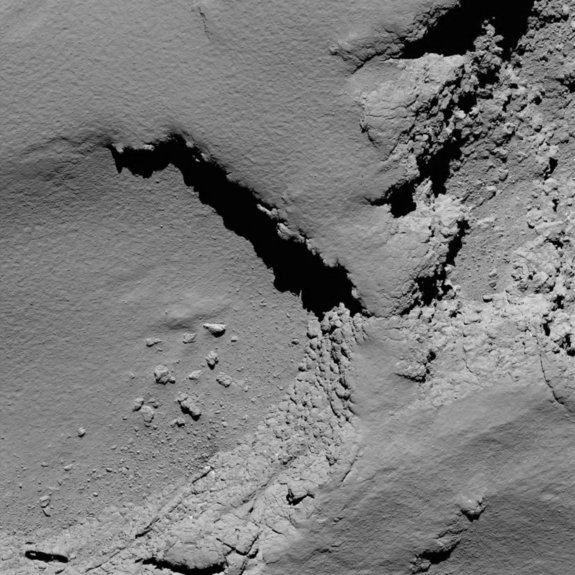
Rosetta’s OSIRIS narrow-angle camera captured this image of Comet 67P/Churyumov-Gerasimenko at 08:18 GMT from an altitude of about 5.8 km during the spacecraft’s final descent on 30 September. Credit: ESA/Rosetta/MPS for OSIRIS Team MPS/UPD/LAM/IAA/SSO/INTA/UPM/DASP/IDA
Today's landing marks the end of an ambitious 1.3-billion-euro ($1.46 billion) mission that spanned more than a decade. The Rosetta spacecraft .. http://www.space.com/24292-rosetta-spacecraft.html .. launched in March 2004, and after a 10-year cruise through the inner solar system covering a distance of 4 billion miles (6.5 billion km), it rendezvoused with Comet 67P in August 2014. Three months later, Rosetta deployed its surface probe Philae. But instead of anchoring to the comet's surface as planned, Philae bounced twice before coming to a stop against a cliff face in the Abydos region. Rosetta only spotted the final resting place of Philae .. http://www.space.com/33971-lost-philae-comet-lander-finally-found-photos.html .. earlier this month.
First observed in 1969, the 2.5-mile-wide (4 km) Comet 67P circles the sun every 6.5 years between the orbits of Earth and Jupiter. Right now the comet is heading back out toward the orbit of Jupiter, and Rosetta, which is solar-powered, wouldn't have enough energy to keep up, so the mission had to come to an end. The spacecraft will stop sending data as soon as it touches down, meaning mission scientists won't know if it tumbles or bounces like Philae did after it lands. [Rosetta Probe's 'Death Dive' Into Comet 67P Visualized] .. http://www.space.com/34222-rosetta-probe-s-death-dive-into-comet-67p-visualized.html
The two-part Rosetta spacecraft is designed to orbit and land on the Comet 67P/Churyumov-Gerasimenko in November 2014. <a href="http://www.space.com/24333-rosetta-spacecraft-comet-landing-explained-infographic.html">See how the Rosetta spacecraft works in this Space.com infographic</a>. The two-part Rosetta spacecraft is designed to orbit and land on the Comet 67P/Churyumov-Gerasimenko in November 2014. See how the Rosetta spacecraft works in this Space.com infographic. Credit: by Karl Tate, Infographics Artist
ESA has already released the final images that Rosetta collected on its way down to the comet's surface.
"It's really great," said Holger Sierks, the principal investigator for Rosetta's OSIRIS camera, as he presented some of the probe's final views. "It’' exciting. It’s working like a charm."
Comet 67P is very porous with low gravity, so Rosetta's landing likely looked more like a slow-motion collision than a violent crash. The spacecraft executed its final maneuver around midnight local time (6:00 p.m. EDT; 2200 GMT) yesterday (Sept. 29) and began a 14-hour, 12-mile (20 km) drop to the comet's surface. ESA officials had calculated that its speed upon impact would be about walking pace, or 2 mph (3.2 km/h).
The controlled impact was designed to give ESA scientists a closer look at surface features they had only spied from afar.
"We got pretty close to the comet .. http://www.space.com/53-comets-formation-discovery-and-exploration.html .. recently with the orbits we were doing," Matt Taylor, Rosetta project scientist with ESA, told Space.com. "We got within about 2 kilometers [1.2 miles] from the surface. But this plummet into the surface gets us in below 2 kilometers. It gets us within the acceleration region, where the comet coma grows and starts being thrown off."
The death dive was also an opportunity for Rosetta's suite of instruments to take measurements as it passes through the layer where the phase transition occurs between ice and gas.
This particular spot has a number of dust-spewing pits — some 330 feet (100 m) across and 165 feet (50 m) deep — that scientists wanted Rosetta's instruments to observe before the mission ended. The walls of these pits appear dotted with "goosebumps" that could be signatures of early comet building blocks known as cometesimals.
The mission has already produced a number of surprising discoveries .. http://www.space.com/28337-rosetta-comet-spacecraft-strange-discoveries.html — that the Comet 67P has big grains of water ice on its surface, molecular oxygen in its coma, diverse landscapes and a fluffy core, just to name a few. But Rosetta scientists still have reams of data to pore over. So, even with today's finale, the work isn't over.
"We have 80,000 images to look at," Mohamed El-Maarry, a postdoctoral researcher with Rosetta's OSIRIS team, from the University of Bern in Switzerland, told reporters yesterday. "It's going to keep us busy for years to come."
Follow Megan Gannon @meganigannon, or Space.com us @Spacedotcom. We're also on Facebookand Google+. Original article on Space.com.


 Market Data
  Markets


 AI
AI