News Focus
News Focus
icon url

fuagf

12/05/15 2:07 AM

#9228 RE: fuagf #9221

State-enterprises under threat if Indonesia joins TPP: Experts

"It is true that Soeharto’s New Order regime had played a crucial role in changing Muslim political attitudes. The shift, however, is not only due to Soeharto who ruled the country repressively, but also due to the long and passionate role played by Muslim intellectuals. What is happening in Indonesia is not happening in Egypt and other Middle Eastern countries. Indonesian intellectuals played an important role in changing Muslim political mindset and attitude.

Through lectures, writings, and actions, they advocated democracy and delegitimized Islamic parties. Unlike in Egypt and other Middle Eastern countries, the Indonesian reform movement has always been through organizations. Intellectuals such as Abdurrahman Wahid (1940-2009), Ahmad Syafii Maarif (born 1935) and Nurcholish Madjid (1939-2005) are Muslim leaders who chaired big organizations. They spread their liberal ideas to Muslim society through these organizations. Wahid did it through Nahdlatul Ulama (40 million members), Maarif through Muhammadiyah (30 million members), and Madjid through Islamic Student Association and its alumnae (over 10 million members).

In Egypt, the Islamic reform movement has developed in a more solitary manner. Great intellectuals such as Jamaluddin al-Afghani (1837-1897) and Muhammad Abduh (1849-1905) did not have any organization where they could spread their ideas. This trend continues until today’s generation of reformers. Intellectuals such as Hassan Hanafi (born 1935) and Nasr Hamed Abu Zayd (1943-2010) are solitary thinkers who do not have big followers. They disseminated their ideas in academic classes, seminars, and scholarly journals. No matter how sophisticated their ideas are, they remain limited and never reached to the grass roots.
"
Anton Hermansyah, thejakartapost.com, Jakarta | Business | Sun, November 29 2015, 7:07 AM"


President Barack Obama listens as Indonesian President Joko Widodo speaks during their meeting
in the Oval Office of the White House in Washington, on October 26, 2015. (AP/Susan Walsh)

Business News

Papua to discuss plans to buy Freeport shares
http://www.thejakartapost.com/news/2015/12/05/papua-discuss-plans-buy-freeport-shares.html

OPEC keeps oil production at current high level
http://www.thejakartapost.com/news/2015/12/05/opec-keeps-oil-production-current-high-level.html

Under pressure from ECB and the Fed, Indonesian market slides into the red
http://www.thejakartapost.com/news/2015/12/04/under-pressure-ecb-and-fed-indonesian-market-slides-red.html

Whether Indonesia should join the Trans Pacific Partnership (TPP) is a topic of debate among the public but some economists have said that based on available trade data, joining the TPP may bring benefits to the country.

Berly Martawardaya, an economist with the Institute for Development of Economic and Finance (INDEF), said that out the 12 current members of the TPP, all them had formed free trade agreements (FTAs) with Indonesia, except the US, Canada, Mexico and Peru.

Based on Trade Ministry data, Indonesia’s total trade with those countries -except the US- is not significant. In 2014, the share of total trade with Canada was just 1.38 percent, while with Mexico and Peru 0.55 percent and 0.15 percent, and the US 13.04 percent. Berly added that there would be limitations to implement protective policy.

"Our state-owned enterprises [SOEs] will be in under serious threat because until now they are under protective policies such as government tender," Berly told thejakartapost.com on Saturday.

Former coordinating finance and industry minister Ginandjar Kartasasmita previously said in an analysis published in Kompas on Nov.9 that Indonesia had sufficient FTAs to reach to reach its export targets, namely the ASEAN Free Trade Area, ASEAN-China, ASEAN-India, ASEAN-Japan, ASEAN-South Korea and the future the Regional Comprehensive Economic Partnership (RCEP), which will facilitate free trade among ASEAN+6 (China, Japan, South Korea, India, Australia, New Zealand).

Ginandjar said that rather than joining the TPP, it would be better if Indonesia focused on RCEP, in which Indonesia had a bigger role.

An economist from the School of Economics and Business at the University of Indonesia, Budi Frensidy, said that the government would not be able to force the policy, such as the obligation of local content, since foreign companies would demand equality.

Budi added that the current ASEAN members of TPP shared common traits. "Singapore, Malaysia, Brunei, and Vietnam are countries with a limited domestic market, they need the developed TPP member countries’ markets," Budi added.

President Joko "Jokowi" Widodo has mentioned the benefits of joining the TPP, including prompting Indonesia to improve the standard and quality of its products. The competition, he said, would make Indonesia work more efficiently, especially in the face of economic downturn. (dan)

http://www.thejakartapost.com/news/2015/11/29/state-enterprises-under-threat-if-indonesia-joins-tpp-experts.html

===

What Indonesia's Support Means for the Trans-Pacific Partnership

COMMENTARY by Alan Wolff November 4, 2015, 4:31 PM EST


Joko Widodo, Indonesia's president-elect, reacts during an interview in Jakarta, Indonesia,
on Tuesday, Sept. 23, 2014. Photograph by Dimas Ardian — Bloomberg via Getty Images

While the U.S. is undecided, the Asian country wants to join the trade deal.

As Congress considers one of the world’s biggest trade deals, many expect a tight vote. A majority of the 2016 presidential candidates, including Hillary Clinton, Bernie Sanders and Donald Trump, have spoken against the Trans Pacific Partnership. Key members of Congress who would normally lead the effort for passage of TPP have expressed initial concerns that the agreement may fall short of some of the rules they had hoped would be included.

But while the U.S. Congress appears undecided thus far, other countries are eager to join the trade deal. Last week, Indonesia’s President Joko Widodo announced that his country intends to join the 12 nations that have agreed to create the TPP. Indonesia alone would add about 250 million potential future customers for U.S. goods and services.

And this week, South Korea’s president reiterated the country’s desire to join the trade agreement (with its 50 million population). This comes as the Philippines and Thailand have also expressed support of the TPP. With Taiwan also interested, that adds an additional half billion potential customers whose economies are not part of TPP.

And while China is not included in the TPP, reformers in the country of 1.4 billion people foresee to some day qualifying to join the TPP, according to last week’s official Chinese Communist Part newspaper.

In short, there is a line at the door for countries seeing open markets and a rules-based system, embodied in TPP, as vital to their future well-being.

The TPP is critical to America’s national security and commercial interests. The turning point for America’s interests in Asia occurred two years ago when Japan decided to join the trade agreement. Before TPP, very few people would have imagined Japan and the United States concluding a free trade agreement, linking two of the largest market-oriented economies – at least not for decades. But even before Japan joined the TPP negotiations, a straw in the wind was Vietnam opting to join in – no country in the region on its face has an economy so very different from that of the United States as Vietnam does, and so willing to change.

While the current deal is huge, with its twelve original participants accounting for about 40% of world’s economic activity, focusing solely on TPP as it stands today would be a mistake. Members of Congress, skeptical of whether there was any reality to the promised “rebalancing of America’s relationship with Asia” should see it in TPP, not just as TPP is now, but as what it is likely to become.

America is not alone in paying greater attention to Asia. Its TPP partners in this hemisphere – Canada, Mexico, Chile and Peru —have the same vision. Their partners in Australia and New Zealand already do so.

Make no mistake. This vote is not just about another trade deal. It is about America’s future economic relationship with the largest and fastest growing part of the world.

Alan Wolff practices law in Washington D.C. with Dentons. He is a former U.S. Deputy Representative for Trade negotiations and is Chairman of the National Foreign Trade Council.

[ short video on Hillary's changed position on TPP ]

http://fortune.com/2015/11/04/indonesias-support-tans-pacific-partnership/

See also:

"How trade deals like TPP fail the global poor"
http://investorshub.advfn.com/boards/read_msg.aspx?message_id=118334228
icon url

fuagf

12/12/15 8:22 PM

#9232 RE: fuagf #9221

A people's tribunal puts Indonesia on trial

Fifty years after mass killings in Indonesia, victims hold a people's tribunal at The Hague.

Benjamin Duerr | 10 Dec 2015 11:50 GMT | Politics, Indonesia, Human Rights


Martono was in his 30s when soldiers from a special force of the Indonesian army broke into his house in Solo and detained him without explanation [Benjamin Duerr/Al Jazeera]

The Hague, Netherlands - Martono might not remember what he had for lunch a few days ago, but he can describe in detail the events of November 10, 1965.

He was in his 30s when soldiers from a special force of the Indonesian army invaded his house in Solo, a town at the centre of the Indonesian island of Java. The soldiers wore dark uniforms and masks over their faces, "like ninjas", Martono remembers.

In just a few minutes, they overpowered him, bound his hands together and dragged him to a waiting car. He had no idea where he was taken, he recalls.

"Nobody has ever told me why I was arrested or imprisoned," Martono told Al Jazeera in The Hague.

Martono was thrown into a prison cell.


Indonesia's killing fields

In the days and weeks that followed, four guards would regularly enter the cell, seize him by his hands and feet and throw him like a ball against the walls and the low ceiling. Cracks emerged in the walls and in Martono. He lost all of his teeth.

Hear the people's voice

Martono is about 81 now. He doesn't know his exact age since births were not recorded properly when he was born.

Half a century after he was arrested, Martono climbed up the lithic staircase to the entrance of a hall a renaissance-era church building that became a temporary court room in November.

For one week the building in the centre of the Dutch city of The Hague was the seat of the International People's Tribunal for Indonesia.

The symbolic court is investigating and prosecuting a forgotten mass murder which left nearly 500,000 people dead in the 1960s.

RELATED: Revisiting an Indonesian massacre 50 years on
http://www.aljazeera.com/indepth/features/2015/09/revisiting-indonesian-massacre-50-years-150930055803832.html

Lawyers and activists have set up the People's Tribunal - a hybrid truth commission created to establish a historical record, collect evidence against the perpetrators and give victims a voice.

Organised by the community of survivors and Indonesians in exile with support from human rights activists, the tribunal seeks .. http://1965tribunal.org/about/concept-note-on-international-peoples-tribunal-on-crimes-against-humanity-in-indonesia-1965/ .. to "break down the vicious cycle of denial, distortion, taboo and secrecy".

Remembering 1965

Fifty years ago, six generals of the Indonesian army were killed by a group calling itself the 30 September Movement .. http://www.aljazeera.com/indepth/features/2015/09/revisiting-indonesian-massacre-50-years-150930055803832.html . The background to and motives for these killings are controversial, but research indicates that key figures of the Indonesian Communist Party (PKI) were involved.

David Henley, a professor of contemporary Indonesia studies at Leiden University in the Netherlands, explained that "their motive was to head off an anticipated coup by rightist generals, or at least to shift the balance of power in Jakarta to the left in the face of a perceived threat from the armed forces to the position of the PKI".

General Suharto, who later ruled the country as president from 1967 to 1998, assumed command of the army and accused the "communists" of being behind the 30 September Movement. "Communists" became an umbrella term for members of the PKI, alleged communists and suspected sympathisers, but also for anybody else perceived as opposing Suharto.

The army used the events to justify a crackdown on rivals.

In October 1965, the military launched a campaign against all those it had branded "communists".

In the weeks and months that followed, around half a million people were detained, tortured, killed or disappeared. Soldiers and other armed groups went after those, like Martono, whom they considered enemies of the state.

Martono was most likely targeted because he openly supported Marxist ideas.

"No one knows how many people have been brutally and inhumanely killed," said Todung Mulya Lubis, an Indonesian lawyer at the tribunal. The most common estimate places the number of deaths at 500,000 but Amnesty International .. https://www.amnesty.org/en/press-releases/2015/09/indonesia-millions-of-victims-and-families-still-abandoned-50-years-after-mass-killings/ .. says the true count could be as high as one million.

RELATED: Lasting legacy of Suharto
http://www.aljazeera.com/focus/indonesia/2008/01/20086150541562370.html

The events of 1965 remain a highly sensitive issue in the country. "Anti-communism, along with developmentalism, was an ideological pillar of Suharto's authoritarian New Order regime, which saw and styled itself as having saved the country from the menace of the radical left," Henley explained.

"The murderers were part of an establishment which did not decry violence as such, and indeed based its own legitimacy on the allegedly necessary and purifying violence of 1965."

The People's Tribunal

Today impunity surrounds the events of autumn 1965. The Indonesian government prosecuted 34 people for gross human rights violations, which included the 1965 mass murders. Only 18 of them were actually convicted, however, and of these all were acquitted on appeal, Indonesian human rights group Tapol .. http://tapol.org/sites/all/modules/custom/tpl_sorry/docs/Indonesias_unresolved_mass_murders.pdf .. reported in 2012.

"A chilling culture of silence has prevailed in Indonesia, where even discussing the killings of 50 years ago has been largely impossible for victims," Amnesty International stated .. https://www.amnesty.org/en/press-releases/2015/09/indonesia-millions-of-victims-and-families-still-abandoned-50-years-after-mass-killings/ .. in 2015.

Lawyers and activists want to change this fact through the People's Tribunal. As the tribunal wasn't set up by an international treaty or by the UN Security Council, its decisions are not legally binding. Its aim, instead, is to use the law to draw attention to a much-ignored part of Indonesian history.

And, instead of charging individuals, the tribunal has put the entire Indonesian state on trial.

The prosecutors allege that in the months after October 1965 crimes against humanity were committed, among them murder, torture and enslavement. Many were held for several years in camps where they were forced to work.


Censorship returns to Indonesia

Even though the crimes were committed by individuals, in accordance with International Law Commission case law .. http://tinyurl.com/jf2t8ry .. a state can be held responsible under the principle of state responsibility for facilitating and aiding and abetting the commitment of an internationally wrongful act, such as those that constitute crimes against humanity.

The United States, the United Kingdom and Australia have also been charged with complicity in these crimes in the People's Tribunal. According to the indictment, "several Western countries ... provided small arms, radio communications, money and even lists of people they would like to see eliminated".

The Indonesian state, which is the main player accused before the tribunal, did not participate in the proceedings which ended in November, and the Indonesian embassy in The Hague did not react to a request for comment.

The panel of judges, made up of lawyers, political scientists and human rights experts from South Africa, Iran, the UK, France and other states, is currently deliberating on the case. They hope to present their final report and judgement to the United Nations Human Rights Council in Geneva in 2016.

'Five times I almost died'

The People's Tribunal is filling the space where the Indonesian government has failed to act. The democratic transformation of 1998 left much of the old elite in place, Henley said. Hence there was a reluctance to talk about the events or to punish those responsible.

Censorship and crackdowns have continued through the years. Authorities have targeted activists daring to speak about the past by blocking events .. http://america.aljazeera.com/articles/2015/7/16/the-past-is-never-dead-an-unflinching-look-at-indonesias-bloody-past.html , publications .. http://www.thejakartapost.com/news/2015/10/20/student-magazine-withdrawn-publishing-about-1965-massacre.html , and media covering these events.

"The censorship ... is part of a broader crackdown in recent months," says film-maker Joshua Oppenheimer, whose documentary about the killings, "The Look of Silence .. http://thelookofsilence.com/ ", was not shown at this year's Ubud Writers and Readers Festival in Bali following pressure from the Indonesian authorities.

OPINION: 'The Act of Killing' and the consequences of forgetting
http://www.aljazeera.com/indepth/opinion/2013/10/act-killing-consequences-forgetting-201310211415845850.html

Oppenheimer told Al Jazeera the crackdown was led by the army. He believes, some of the alleged perpetrators of 1965 still exert influence in the military, but that "many parliamentarians are business partners of military people, so nobody has an interest in investigations of the past or in prosecutions".

The Indonesian lawyer who acted as a prosecutor in The Hague agrees with him. "We don't know what will happen to us when we return home," said Lubis. Communist sympathisers or those who speak openly about the killings are threatened and "regarded as traitors of the nation", he added.

But Martono is not afraid. "Five times I have almost died," he said of the torture he endured. What more should he be afraid of, he asked.

When Martono took the stand as a witness on the first day of the tribunal, he told the seven judges his story in detail and expressed his satisfaction with the opportunity to finally speak out.

Establishing the facts is a first step to acknowledging the past and honouring the victims, prosecutor Lubis said in court. "Only by knowing the truth we can start healing the wounds and the pain."

Source: Al Jazeera

http://www.aljazeera.com/indepth/features/2015/12/people-tribunal-puts-indonesia-trial-151201051119025.html

.. any action which could serve as even a tiny deterrent to unwarranted violence is good to see ..

===

Bush Convicted of War Crimes in Absentia

by Yvonne Ridley May 12, 2012

Kuala Lumpur — It’s official; George W Bush is a war criminal.

In what is the first ever conviction of its kind anywhere in the world, the former US President and seven key members of his administration were yesterday (Fri) found guilty of war crimes.

Bush, Dick Cheney, Donald Rumsfeld and their legal advisers Alberto Gonzales, David Addington, William Haynes, Jay Bybee and John Yoo were tried in absentia in Malaysia.
.. more .. http://www.foreignpolicyjournal.com/2012/05/12/bush-convicted-of-war-crimes-in-absentia/

See also:

Justice for Timor War Criminals?
By David Loyn BBC February 18, 2005
http://investorshub.advfn.com/boards/read_msg.aspx?message_id=37138053

U.N. chief Ban Ki-moon calls for Israel to halt all settlement activity
Sunday, March 21, 2010
http://investorshub.advfn.com/boards/read_msg.aspx?message_id=48064964

icon url

fuagf

01/10/16 11:07 PM

#9242 RE: fuagf #9221

Indonesia turns to China as ethnic Uighurs join would-be jihadis

"Indonesia as a Model of Muslim Democracy
Developments, Problems, and Opportunities
"

Wed Jan 6, 2016 4:34am EST

JAKARTA | By Randy Fabi and Agustinus Beo Da Costa


Saud Usman Nasution, the head of the National Counter-Terrorism Agency, gestures
during an interview at his office in Bogor, January 5, 2016.
Reuters/Beawiharta

Indonesian authorities are working with their counterparts in China to stem a flow of ethnic Uighur militants seeking to join Islamist jihadists in the world's most populous Muslim country, Indonesia's counter-terrorism chief said.

Saud Usman Nasution's comments come amid mounting concern in Indonesia about possible attacks by sympathizers of the Islamic State group and follows the arrest of 13 men across the island of Java, including a Muslim Uighur with a suicide-bomb vest.

The appearance among Indonesian militant networks of Uighurs, who come from the Xinjiang region in far-western China, is likely to add to Beijing's concerns that exiles will return to their homeland as experienced and trained jihadists.

China says Islamist militants and separatists operate in energy-rich Xinjiang on the borders of central Asia, where violence has killed hundreds in recent years.

Rights groups say much of the unrest can be traced back to frustration at controls over the Uighurs' culture and religion, and that most of those who leave are only fleeing repression not seeking to wage jihad. China denies repressing rights.

Nasution, who heads the National Counter-Terrorism Agency, told Reuters in an interview on Tuesday that several Uighurs had responded to a call last year by Santoso, Indonesia's most high-profile backer of Islamic State, to join his band of fighters.

Islamic State and human trafficking networks helped them travel via Myanmar, Thailand and Malaysia to Santoso's hideout in an equatorial jungle of eastern Indonesia, he said.

However, the would-be suicide bomber arrested on Dec. 23 was hiding in a house just outside the capital, Jakarta.

"We are cooperating with China and investigating evidence such as ATM cards and cellphones," Nasution said, adding that an Indonesian team went to China to interview members of the man's family, who would not confirm that they were related to him.

There was no immediate comment from China's foreign ministry on whether Beijing is collaborating with Indonesia.

"As far as China is concerned, these people are running off, some of them taking part in jihad and planning to strike back," said Pan Zhiping, a terrorism expert at the Xinjiang Academy of Social Sciences.

"Of course we must stop them. I believe, in terms of jointly guarding against extremism, it is necessary that we cooperate."

Bilveer Singh of the Rajaratnam School of International Studies in Singapore said the direct involvement of Chinese Uighurs in Southeast Asian militancy added "an external dimension to the existing home-grown terrorist threat".

"It could also complicate ties with a rising China, which may want to play a bigger counter-terrorism role in the region," Singh said in a Eurasia Review article.

'SERIOUS CONCERN FOR CHINA'

Indonesia's security forces have given Santoso, who styles himself as the commander of the Islamic State army in Indonesia, until Jan. 9 to surrender along with his force of about 40 men on the far-flung island of Sulawesi.

However, security analysts believe a larger threat is emerging across the populous island of Java as networks of support for Islamic State grow.

Indonesia has been largely successful in disrupting domestic militant cells since the bombing of two nightclubs on the resort island of Bali in 2002, and sporadic attacks have been mainly targeted at the police.

The government is now worried that the influence of Islamic State, whose fighters hold swathes of territory in Syria and Iraq, could bring a return of jihadi violence and strikes against foreigners and soft targets.

Officials believe there are more than 1,000 Islamic State supporters in Indonesia, and say that between 100 and 300 have returned from Syria, though this includes women and children.

Nasution said that monitoring of radical groups had revealed plans to launch attacks on Christmas Eve and around the New Year holiday but the situation was now under control.

"They cannot attack like in the Middle East or Europe because we anticipate before they attack. We monitor their activities every day," he said. "Their capability has not increased because their personnel is limited, their funding is limited and explosives are limited."

Police spokesman Suharsono said the Uighur arrested just outside Jakarta was part of an Islamic State-affiliated group based in the Central Java city of Solo.

Officials declined to comment on media reports that two other Uighurs from the same group were on the run, but they did confirm that three Uighurs were with Santoso.

Four others were sentenced last year to six years in prison for conspiring with Indonesian militants.

Todd Elliott, a Jakarta-based terrorism analyst for Concord Consulting, said many Uighurs will see Indonesia as more accessible than Turkey or Syria and are exploiting entrenched smuggling and human-trafficking networks to travel around the region undetected.

"I am sure returning Uighur fighters are a serious concern of the Chinese government," he said, adding that Islamic State's hardline ideology has gained traction among small minorities in both Xinjiang and Indonesia, binding them closer together.

(Additional reporting by Michael Martina in BEIJING; Writing by John Chalmers; Editing by Robert Birsel)

http://www.reuters.com/article/us-indonesia-security-idUSKBN0UK0SE20160106

==

Why is there tension between China and the Uighurs?

26 September 2014

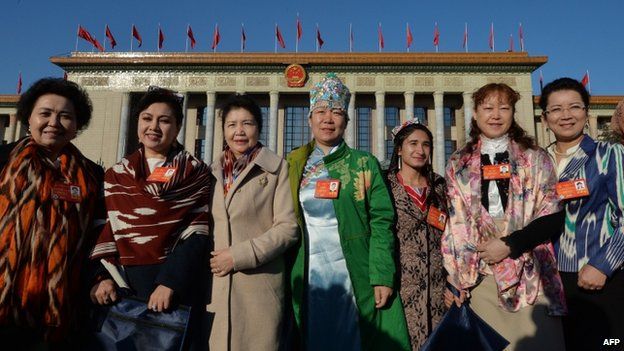
The Xinjiang autonomous region in China's far west has had a long history of discord between
the authorities and the indigenous ethnic Uighur population. The BBC sets out why.

Who lives in Xinjiang?


The ethnic Uighur population used to be the majority in China's Xinjiang region

The largest of China's administrative regions, Xinjiang borders eight countries - Mongolia, Russia, Kazakhstan, Kyrgyzstan, Tajikistan, Afghanistan, Pakistan and India - and until recently its population was mostly Uighur.

Most Uighurs are Muslim and Islam is an important part of their life and identity. Their language is related to Turkish, and they regard themselves as culturally and ethnically close to Central Asian nations.

The region's economy has largely revolved around agriculture and trade, with towns such as Kashgar thriving as hubs along the famous Silk Road.

But development has brought new residents. In the 2000 census, Han Chinese made up 40% of the population, as well as large numbers of troops stationed in the region and unknown numbers of unregistered migrants.

Has Xinjiang always been part of China?


Xinjiang officially became part of Communist China in 1949

The region has had intermittent autonomy and occasional independence, but what is now known as Xinjiang came under Chinese rule in the 18th Century.

An East Turkestan state was briefly declared in 1949, but independence was short-lived - later that year Xinjiang officially became part of Communist China.

In the 1990s, open support for separatist groups increased after the collapse of the Soviet Union and the emergence of independent Muslim states in Central Asia.

However, Beijing suppressed demonstrations and activists went underground.

Profile: Xinjiang autonomous region
http://www.bbc.com/news/world-asia-pacific-16860974

What is at the heart of the unrest?


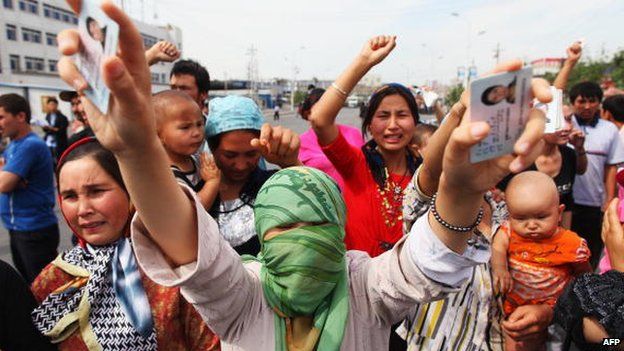
China's critics say authorities have stepped up a crackdown on Uighurs in recent years

While the situation is complex, many say that ethnic tensions caused by economic and cultural factors are the root cause of the recent violence..

Major development projects have brought prosperity to Xinjiang's big cities, attracting young and technically qualified Han Chinese from eastern provinces.

The Han Chinese are said to be given the best jobs and the majority do well economically, something that has fuelled resentment among Uighurs.


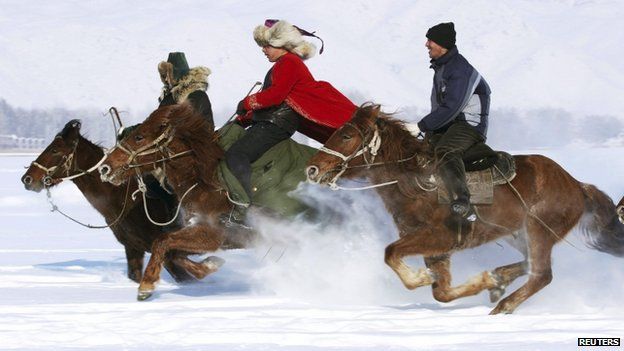
The Uighur culture leans more towards Central Asia than China

[ oh yeah, is that a supa picture or what!! ]

Activists say Uighur commercial and cultural activities have been gradually curtailed by the Chinese state. There are complaints of severe restrictions on Islam, with fewer mosques and strict control over religious schools.

Rights group Amnesty International, in a report published in 2013 .. http://www.amnesty.org/en/library/asset/POL10/001/2013/en/b093912e-8d30-4480-9ad1-acbb82be7f29/pol100012013en.pdf , said authorities criminalised "what they labelled 'illegal religious' and 'separatist' activities" and clamped down on "peaceful expressions of cultural identity".

In July 2014, some Xinjiang government departments banned Muslim civil servants from fasting .. http://www.bbc.com/news/world-asia-china-28123267 .. during the holy month of Ramadan. It was not the first time China had restricted fasting in Xinjiang, but it followed a slew of attacks on the public attributed to Uighur extremists, prompting concerns the ban would increase tensions.

Making sense of the unrest from China's Xinjiang
http://www.bbc.com/news/world-asia-china-26414016

Death on the Silk Route: Violence in Xinjiang
http://www.bbc.com/news/world-asia-pacific-14384605

How has the violence developed?


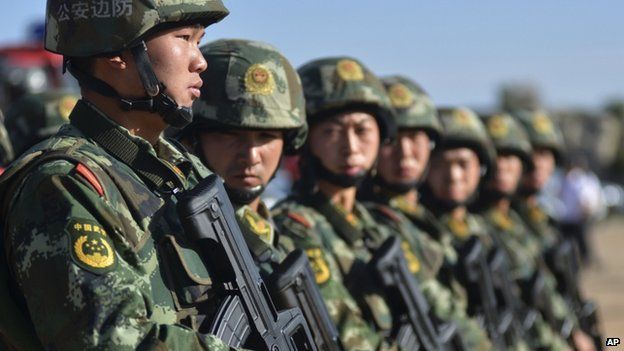
China has poured troops into the region in recent years as unrest has rumbled

China has been accused of intensifying its crackdown on the Uighurs after street protests in the 1990s and again in the run-up to the Beijing Olympics in 2008.

But things really escalated in 2009, with large-scale ethnic rioting in the regional capital, Urumqi. Some 200 people were killed in the unrest, most of them Han Chinese, according to officials.


Xinjiang's economy has largely revolved around agriculture and trade

Security was increased and many Uighurs detained as suspects. But violence rumbled on as right groups increasingly pointed to tight control by Beijing.

In June 2012, six Uighurs reportedly tried to hijack a plane from Hotan to Urumqi before they were overpowered by passengers and crew.

There was bloodshed in April 2013 and in June that year, 27 people died in Shanshan county after police opened fire on what state media described as a mob armed with knives attacking local government buildings

Establishing facts about these incidents is difficult, because foreign journalists' access to the region is tightly controlled, but in recent months, there appears to have been a shift towards larger-scale incidents where citizens have become the target, particularly in Xinjiang.

At least 31 people were killed and more than 90 suffered injuries in May 2014 when two cars crashed through an Urumqi market .. http://www.bbc.com/news/world-asia-china-27554067 .. and explosives were tossed into the crowd. China called it a "violent terrorist incident".

It followed a bomb and knife attack at Urumqi's south railway station in April, which killed three and injured 79 others.

In July, authorities said a knife-wielding gang attacked a police station .. http://www.bbc.com/news/world-asia-china-28558290 .. and government offices in Yarkant, leaving 96 dead. The imam of China's largest mosque, Jume Tahir .. http://www.bbc.com/news/world-asia-china-28586426 , was stabbed to death days later.

In September about 50 died in blasts in Luntai county outside police stations, a market and a shop. Details of both incidents are unclear and activists have contested some accounts of incidents in state media.


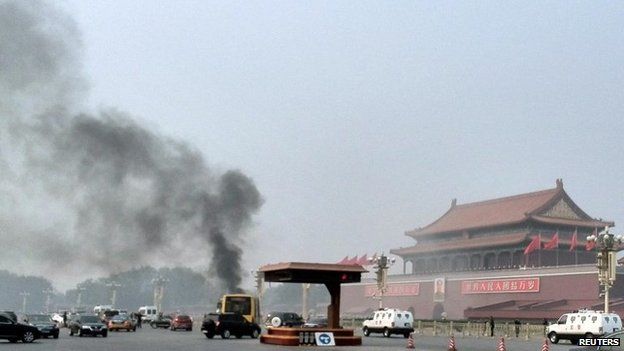
Chinese officials blamed the attack at Tiananmen Square on separatists from Xinjiang

Some violence has also spilled out of Xinjiang. A March stabbing spree in Kunming in Yunnan province that killed 29 people was blamed on Xinjiang separatists, as was an October 2013 incident where a car ploughed into a crowd and burst into flames in Beijing's Tiananmen Square .. http://www.bbc.com/news/world-asia-china-24768037 .

In response to the latest slew of attacks, the authorities have launched what they call a "year-long campaign against terrorism", stepping up security in Xinjiang and conducting more military drills in the region.

There have also been reports of mass sentencings .. http://www.bbc.com/news/world-asia-china-27600397 .. and arrests of several "terror groups". Chinese state media have reported long lists of people convicted of extremist activity .. http://www.bbc.com/news/world-asia-china-28258983 .. and in some cases, death sentences.

[ INSERT: Iranian Protesters Ransack Saudi Embassy After Execution of Shiite Cleric
http://investorshub.advfn.com/boards/read_msg.aspx?message_id=119595240 ]

High-profile Uighur academic, Ilham Tohti was detained and later charged in September 2014 on charges of separatism .. http://www.bbc.com/news/world-asia-29321701 ., sparking international criticism .. http://www.bbc.com/news/world-asia-china-29339178 .

Shock and anger after Kunming brutality
http://www.bbc.com/news/blogs-china-blog-26380542

China tries to block Xinjiang blast memorial
http://www.bbc.com/news/blogs-china-blog-27557027

Who's to blame?


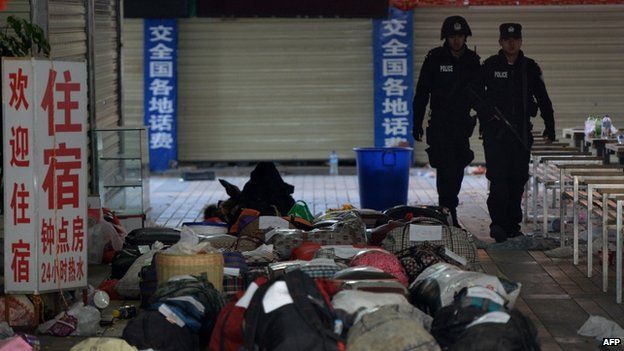
China also blamed Xinjiang separatists for the brutal attack in March 2014 at Kunming station

China has often blamed ETIM - the East Turkestan Islamic Movement - or people inspired by ETIM for violent incidents both in Xinjiang and beyond the region's borders.

ETIM is said to want to establish an independent East Turkestan in China. The US State Department in 2006 said ETIM is "the most militant of the ethnic Uighur separatist groups".

The scope of ETIM's activities remains unclear with some questioning the group's capacity to organise serious acts of extremism.

ETIM has not said it was behind any of the attacks. Chinese authorities said the Turkestan Islamic Party - which it says is synonymous with ETIM - released a video backing the Kunming attack, however.

With the recent apparent escalation in Xinjiang-related violence, the question of who and what is driving it is likely to attract greater scrutiny.

Q&A: East Turkestan Islamic Movement
http://www.bbc.com/news/world-asia-china-24757974

http://www.bbc.com/news/world-asia-china-26414014

See also:

World Reaction to Donald Trump’s Proposal Banning Muslims: Befuddlement and Despair .. bit ..

But Mr. Trump’s position also had its admirers. His stance on Muslim immigration drew several hundred favorable comments on China’s Twitter-like social media site, Weibo, where supporters linked his idea to their own fears of the Uighurs [ http://topics.nytimes.com/top/reference/timestopics/subjects/u/uighurs_chinese_ethnic_group/index.html ], a minority Muslim group in China’s northwestern region, some of whom have resorted to militancy and violence.
http://www.nytimes.com/2015/12/09/world/europe/donald-trumps-call-to-bar-muslims-reverberates-abroad.html
.. 2-3 inches from bottom here .. The GOP on the Eve of Destruction
http://investorshub.advfn.com/boards/read_msg.aspx?message_id=119029379