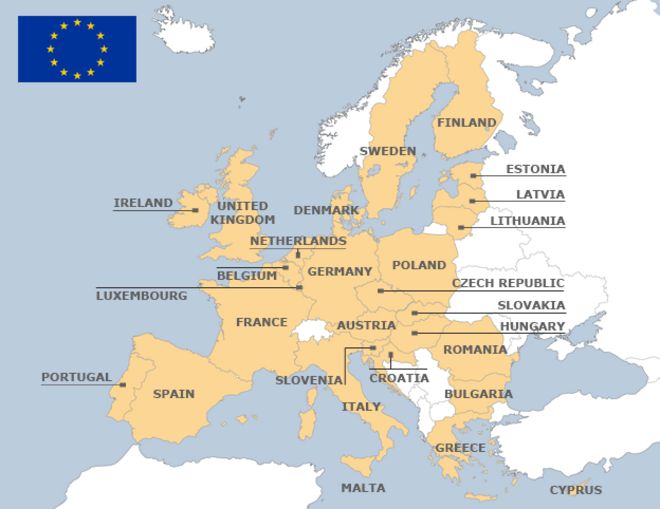
EU politicians are threatening to dismantle the bloc’s free-movement rights amid calls to revamp asylum rules, due to the surge in the number of people seeking refuge in Europe.
On Thursday (27 August), the bodies of up to 50 people, who had suffocated, were found in the back of a refrigerated food truck on the outskirts of Vienna.
News of the tragedy came the same day EU and Western Balkan leaders and ministers met in the Austrian capital for a summit on migration issues.
“We cannot continue like this with a minute of silence every time we see people dying”, the EU’s foreign policy chief, Federica Mogherini, said, referring to previous EU gestures of respect for migrant deaths.
Earlier the same day, Sebastian Kurz, Austria’s foreign minister, warned media the EU’s asylum regime, the so-called Dublin regulation, which requires point-of-entry countries to process claims, risks collaspe.
“I believe that we will need a quick solution for the entire system because otherwise countries will go at it alone and no longer adhere to spirit of the European Union,” he said.
He added the EU should consider letting people apply for asylum from their home countries.
“We should think about the possibility of making an asylum request in the country of origin in order to ensure better redistribution to European Union countries”.
Earlier on Wednesday, Kurz said that a European Union “without borders inside is in danger” if its external borders aren’t secure.
Italy’s foreign minister Paolo Gentiloni made similar comments in Italian daily Corriere della Sera.
“The way things are going, there is a risk of Schengen [the EU’s border-free zone] being called into question and having to go back to the old frontiers,” he said.
Beginning of the end of current rules
Maintaining open internal borders is sacrosanct to the European Commission.
But the Brussels executive is now becoming more vocal on the possibility of reforming the so-called 'Dublin' rules, which, if applied correctly, would require EU states to return the vast majority of asylum seekers to their EU point-of-entry - Hungary and Italy.
Commission spokeswoman Natasha Bertaud on Thursday said “structural changes” will have to be introduced into the system.
Returns to Greece are banned following a 2011 European Court of Human Rights ruling on “degrading” conditions in its migrant holding centres.
The “structural changes” involve relocation and redistribution of asylum seekers in times of crisis.
The commission has already proposed a new mechanism to cover Italy and Greece for the next two years. But it’s planning to propose a more permanent solution by the end of the year.
“This would imply a change to the Dublin rules,” said Bertaud.
Other changes
Other changes to the rules may also be possible once the commission terminates an evaluation of the entire system sometime next year.
But most member states have shown little appetite for the commission’s Italy and Greece relocation ideas.
EU leaders at summit in July rejected mandatory quotas, opting instead for a voluntary system, which then fell short of what the commission wanted.
The commission had called for 40,000 asylum seekers to be relocated.
EU states have pledged 32,256 places. Austria and Hungary have pledged zero.The UK opted out. Denmark was never involved to begin with.
Urgency
Meanwhile, the need for asylum reform and for immediate action was underlined by Germany on Thursday.
Chancellor Angela Merkel said in Vienna the “Dublin system isn’t working”.
German vice-chancellor Sigmar Gabriel and foreign minister Frank-Walter Steinmeier said the same in an op-ed published in French daily Le Figaro on Thursday.
“What you are witnessing now is the end of the Dublin system”, Kris Pollet, a policy advisor at the Brussels-based European Council on Refugees and Exiles, told EUobserver.
The solution to this refugee crisis? A revised EU treaty
Daniel Johnson
The principle of free movement with the EU was conceived in a different world. We need a new agreement that fits the times we are living in
Angela Merkel: her solution of a system of quotas ‘will never work’, says Daniel Johnson. Photograph: Action Press/REX Shutterstock
Saturday 5 September 2015 19.04 EDT Last modified on Monday 7 September 2015 03.22 EDT
Comments 230
All rational considerations are jettisoned in the prevailing emotional atmosphere. British policy hitherto has been based on the principle that it is better to help refugees from Syria and elsewhere on the spot, rather than encouraging an exodus by granting asylum to large numbers over here. That policy still has much to be said for it. Now, though, Britain will apparently take thousands of refugees directly from their camps. This obviates the need for a perilous journey at the mercy of people-traffickers and the elements, but also creates a new “pull factor” for migrants.
The problem for Cameron, however, is that public opinion in Britain is not ready to accept hundreds of thousands of asylum seekers, even if such an influx were desirable. As long as immigration is running at record levels of between 300,000 and 400,000 a year, with the majority remaining in the crowded south-east and public services already struggling to cope, public attitudes won’t change. Once people realise that their children are competing for school places with the new arrivals, or queues in hospitals get longer and pressure grows on housing, they will blame refugees just as, fairly or unfairly, they blame other immigrants now. Unlike Germany, a larger country with a rapidly ageing and shrinking population, Britain is living through a baby boom and has no shortage of young people.
What is the solution? The European migration system – Schengen, Dublin and the rest of the regulatory apparatus – is evidently broken beyond repair. The choice is stark. Either we turn the EU into a fortress, while still allowing free movement within its borders, or we allow each country to reach its own accommodation, taking into account economic prosperity, public acceptance and, of course, geography.
Some countries – Italy, Greece, Hungary – are overwhelmed simply because they happen to be en route to the refugees’ preferred destinations. Others are resistant because they are too poor or lacking in cultural diversity. Richer countries can afford to be more “compassionate”, but such toleration may evaporate if, as in the UK, sheer numbers undermine the social solidarity necessary to underpin a welfare state.
What will never work, in my view, is the solution proposed by Angela Merkel and the European Commission: a system of quotas, centrally determined in Brussels and imposed on the nations of the EU. Such a solution is bound to be arbitrary – the figures bandied about in Berlin take no account of population density or mobility – but most importantly it is profoundly undemocratic.
Unless the EU can agree on a much more flexible system, allowing countries to control their borders and fix their criteria for asylum, welfare and work, I predict that this chaos will result in social unrest and a political upheaval that could see Marine Le Pen replace Merkel as Europe’s most powerful woman.
The principle of free movement within the EU was conceived in a different world, when the EU was a smaller, more homogenous customs union, rather than the sprawling, porous patchwork it has become. It would be better to acknowledge that the facts have changed and negotiate a new treaty that fits the times we are living in.
It goes without saying that Merkel, Hollande and even Cameron are so wedded to the status quo that they are most unlikely to rise to the challenge of the migration crisis. In that case, though, Brexit will become more likely – and with it, the possibility that the EU as we have known it will disintegrate.
There is nothing inevitable about this scenario. But the failure of European statesmanship so far has been very striking. Unless our leaders can be persuaded to lead, rather than improvising from day to day, we shall not only fail the unfortunate victims whose suffering we watch helplessly on our screens – we shall also find ourselves thrown into a political maelstrom that can only end in tears.
With new Yorkshire accents, Syrian refugees adapt to life in Britain
By Joseph D'Urso Tue Sep 22, 2015 7:27am BST
BRADFORD, England (Thomson Reuters Foundation) - Arrested and tortured back home, Khalil, one of the first Syria .. http://uk.reuters.com/places/syria .. n refugees to be resettled in Britain, is finding it harder to adapt to a new life in chilly northern England than his children.
In the vanguard of Britain's resettlement scheme for Syrian refugees, Khalil is grateful to have avoided a perilous Mediterranean sea crossing and overland trek through unwelcoming nations in southeastern Europe. But challenges lie ahead.
"I find learning a new language at my age a little bit difficult," said the 40-year-old former shop owner through an Arabic translator. "My kids are really amazing, they are learning English very quickly, I am learning from them."
Because of the horrific abuse he had suffered, Khalil's family was put on a United Nations ..
--- .. insert from link provided the first below ..
Iran says documents on alleged atom bomb research are full of mistakes VIENNA | By Fredrik Dahl
list from which the British government takes Syrians deemed most in need. About 200 have arrived so far, half of them to Bradford, a former industrial city with a long history of immigration.
"In nine or twelve months (refugee children) are speaking English fluently with little Yorkshire accents, which is lovely to see," said Gudrun Carlisle of Horton Housing Association, which helps settle the Syrian families in the city.
Prime Minister David Cameron announced on Sept. 7 the resettlement scheme would be expanded, responding to public clamour for his government to help those fleeing civil war in Syria, with 20,000 refugees set to come over five years.
FAMILY FLED
Khalil owned a mobile phone shop in Zabadani near Syria's border with Lebanon when, after the war began, he was arrested by government security forces four separate times, and tortured. He suffers from severe pain in his right hip as a result.
The family fled to Lebanon where they spent two years living in a tiny ramshackle garage. His family was hassled by officials to pay for needless documents, and suffered discrimination as Sunni Muslims in a predominantly Shi'ite area.
"When I travelled to Lebanon I had no work," he told the Thomson Reuters Foundation. "There was no way to heat that place with my kids, the walls were made of mud."
Khalil, who gave only his first name for fear of reprisals against his family in Syria, was eventually identified by the U.N. refugee agency UNHCR as particularly vulnerable.
He was flown to Bradford with his pregnant wife and children in June, reluctantly leaving his brother and elderly parents behind.
YORKSHIRE ACCENTS
Syria's civil war, which erupted in 2011, has killed about 250,000 people, uprooting some 7.6 million within Syria and creating 4 million refugees, most of them living in camps in nearby Jordan, Lebanon and Turkey.
At least 182,000 Syrians have crossed the Mediterranean to Europe so far in 2015, almost 40 percent of the total of refugees and migrants making the sea crossing.
Of the small number of Syrians resettled in Britain so far, half are in Bradford. The city has a proud history of welcoming refugees, with Jews, eastern Europeans and Pakistanis arriving in the 20th century, said David Green, leader of the council.
Officials meet refugees at the airport and slowly induct them into British life, providing translators as well as helpers to sort out schools, healthcare and housing.
Khalil, wearing a thick black jacket, sits in an English lesson provided for the refugees.
"Can you pass the scissors please?" he and his classmates say in turn, some already speaking with a hint of their teacher's Yorkshire accent.
Though children learn quickly, adult refugees are often slow to pick up the language, limiting their employment options even though many are highly qualified, said Gudrun Carlisle. "We have a doctor here, we have a woman who started her own business."
PHONING HOME
Khalil currently lives off government benefits, but wants to work when he has a better grasp of the language. "I used to have a shop," he said. "I don't think I'd be able to do that here, but I plan to work in restaurants or find another kind of job that suits me."
He likes taking his children to see the parks and old buildings in Bradford, but is apprehensive about his first British winter.
But his main worries are about his family back home. His parents are still in Lebanon, his mother very ill, while his cousin's family are stuck in the town of Madaya near Zabadani, trapped in fighting between government forces and rebels.
"We try to contact them every day, but the communications are cut all the time. Whenever we do, we hear the bombing and the shooting.
"My kids all the time ask me: What about our grandma and grandpa? Are we going to see them again?'" Khalil does not know, but is looking for positives where he can find them.
"I am settled now, I feel safe, people are welcoming," he said. "I live in dignity here."
(Writing and reporting By Joseph D'Urso, additional reporting by Tristan Martin; Editing by Ros Russell; Please credit the Thomson Reuters Foundation, the charitable arm of Thomson Reuters, that covers humanitarian news, women's rights, trafficking, corruption and climate change. Visit www.trust.org)
.. from extreme hardship to a much happier situation .. it's always great to see good stories spring from within a sea of relative misery .. am sure we all wish Khalil and his family the very, very best ..


 Market Data
  Markets


 AI
AI