Jewish Extremists Make Me Embarrassed to Be Jewish
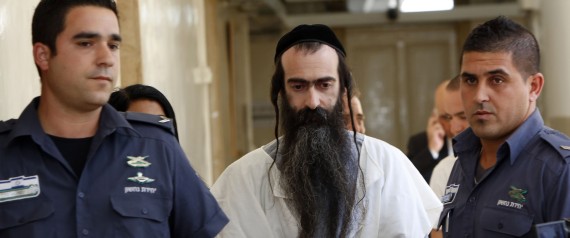
Israeli ultra-orthodox Yishai Shlissel (C), suspected of stabbing six Gay Pride marchers the previous day, is brought handcuffed to the Jerusalem Magistrate's Court on July 31, 2015. Shlissel was released from jail three weeks ago after completing a 10-year sentence for a similar attack in 2005. Police said the suspect's detention was extended for 12 days while investigations continue into July 30 night's attack. AFP PHOTO / GALI TIBBON via Getty Images
By Rabbi Jason Miller Posted: 08/03/2015 8:19 am EDT Updated: 08/03/2015 10:59 am EDT
Last night, together with my wife and children, I volunteered at my synagogue's annual Housing the Homeless program -- a week-long homeless shelter that takes over the congregation's large building in suburban Detroit. As we served dinner to our guests and then I watched as my kids headed outside to the playground with their new friends, I thought to myself that this is what Judaism is about. This is God's intention. We are to follow the path of the righteous.
Only a few days earlier I was lamenting how embarrassed I am to be Jewish. While I have lived my entire life as a proud Jew and I certainly wear my Judaism on my sleeve, I found myself shaking my head in disbelief at the horrific acts of violence and hatred committed at the end of last week by Jewish extremists in Israel.
Yishai Schlissel (may his name be forgotten), a Haredi Orthodox man from the West Bank, stabbed six marchers in the annual gay pride parade in Jerusalem after serving ten years for a similar attack at the same gay pride parade a decade earlier. Shira Banki, of blessed memory, a 16-year-old girl who was stabbed during the parade has died from her wounds. An LGBT advocate, Shira participated in the parade to support her gay friends. In a statement, her family said, "For no good reason and because of evil, stupidity and negligence, the life of our beautiful flower was cut short."
Just as the week was ending and word of the shocking attack at the gay pride parade was making its way around the world, our stomachs were unsettled once again by more tragic news spurred by hatred. Israeli extremists set fire to a home in a West Bank village and an 18-month-old Palestinian child was burned to death. The attack in the village of Duma was carried out by a group of masked people from a nearby settlement. Lehava, or the Price Tag organization, an anti-Arab Jewish extremist group which operates in West Bank Israeli settlements, was believed to be responsible for the violence.
These violent acts of senseless hatred occurred only days after the annual observance of Tisha B'Av, a solemn day of fasting and mourning in commemoration of the destruction of the two temples which once stood in Jerusalem. Traditionally, on this day Jewish people lament the destruction of the temples, but we also use the day as a clarion call against baseless hate -- both internal and external. How men who consider themselves religious Jews can so grossly violate the core principles of the Jewish religion is beyond me.
It is both shocking and embarrassing that these extremists cite my Torah as the blueprint for their brutality. If we Jewish people are to call on Muslims to rail against Islamic extremism, then we in the Jewish community must heed our own call. We must stand in opposition against those who tarnish Judaism through their hate and bloodshed. We must distance ourselves from these warriors and show the world that Judaism is about love -- the love of our own people as well as the love of the other.
In an op-ed titled "We Are At War [ http://blogs.timesofisrael.com/we-are-at-war/ ]," Yair Lapid, a member of Israel's Knesset and the chairman of the Yesh Atid party, wrote a poetic reproach of these Jewish extremists: "He who burns a Palestinian baby declares war on the State of Israel. He who stabs young people at a Pride March declares war on the State of Israel. He who burns down a church declares war on the State of Israel. He who threatens to attack the Supreme Court with a D-9 bulldozer declares war on the State of Israel. He who throws rocks at the security services declares war on the State of Israel."
Indeed, these hateful terrorists are not my own. They are my enemies. Just as I encourage peace loving Muslims to rebuke the extremists that claim to be of their same religion, I stand in sharp opposition of these contemptible terrorists. As we learn in Psalms, the Lord regards the way of the righteous, but the way of the wicked shall perish.
More cracks develop in the Trump, Moore, evangelical Republican support base.
"Leaving Her Ultra-Orthodox Past Meant More Than Losing Her Family. It Meant Redefining Her Womanhood."
Even though some of what Peter Wehner says here is arguable there is at least one position of his, and others in the evangelical group, which most all of a diametrically opposite philosophy could agree with.
Why I Can No Longer Call Myself an Evangelical Republican
Peter Wehner DEC. 9, 2017
Despite accusations of sexual misconduct, Roy Moore is leading among evangelicals in the Alabama Senate race. Credit Brynn Anderson/Associated Press
There are times in life when the institutional ground underneath you begins to crumble — and with it, longstanding attachments. Such is the case for me when it comes to the Republican Party and evangelicalism.
I’ve been a part of both for my entire adult life. These days, though, in many important ways they are having harmful effects on our society.
A bit of personal history may be in order here. As a young man I embraced conservatism as a political philosophy and the Republican Party as its political home. The first vote I cast was in 1980 for Ronald Reagan. I had spirited debates with classmates at the University of Washington in Seattle, which was hardly a hotbed of conservatism. They couldn’t begin to understand what I was doing. Yet I was proud to make the case for Reagan and consider myself fortunate to have worked in his administration in its second term.
At roughly the same time, I was in the midst of a pilgrimage of faith that started as vague deism but eventually led me to evangelicalism. Both the Republican Party, which was created to end slavery and preserve the Union, and evangelicalism, a transdenominational effort to faithfully represent Christ in word and deed, shaped my life and outlook, helping me to interpret the world.
Politics and faith are hardly synonymous. They occupy different realms, and my faith has a far more important and cherished place in my life than politics. Yet both are significant to me, and the two spheres are not entirely distinct.
Some of the most impressive moral movements in American politics — the efforts to abolish slavery and to end segregation and the struggle to protect unborn life — have been informed by Christianity. Two of the monumental figures in the latter half of the 20th century, Reagan and Pope John Paul II, together helped to bring down one of the most malevolent political movements in history: Soviet-led Communism.
More recently, the global AIDS and malaria initiative is one of President George W. Bush’s greatest legacies; more than 13 million people are on lifesaving antiretroviral treatment as a consequence. This, too, was a policy that came about in response to human sympathies that were shaped in large part by the faith of Mr. Bush and some of his key advisers.
I don’t mean to imply that politics and religion are a perfect fit. Often they’re not, and over the years Christians, myself included, have not gotten the balance right. But overall I felt that the Republican Party and the evangelical movement were imperfect forces for good, and I spent a large part of my life defending them.
Yet the support being given by many Republicans and white evangelicals to President Trump and now to Mr. Moore have caused me to rethink my identification with both groups. Not because my attachment to conservatism and Christianity has weakened, but rather the opposite. I consider Mr. Trump’s Republican Party to be a threat to conservatism, and I have concluded that the term evangelical — despite its rich history of proclaiming the “good news” of Christ to a broken world — has been so distorted that it is now undermining the Christian witness.
Just the other day I received a note from a friend of mine, a pastor, who told me he no longer uses the label “evangelical” to describe himself, even though he meets every element of its historical definition, “because the term is now so stained as to ruin my ability to be what evangelicalism was supposed to be.”
Another pastor who is a lifelong friend told me, “Evangelical is no longer a word we can use.” The reason, he explained, is that it’s become not a religious identification so much as a political one. A third person, who heads a Christian organization, told me the term evangelical “is now a tribal rather than a creedal description.” In October, the Princeton Evangelical Fellowship, a campus ministry for more than 80 years, changed its name to the Princeton Christian Fellowship. “We’re interested in being people who are defined by our faith and by our faith commitments and not by any sort of political agenda,” according to Bill Boyce .. http://www.christianitytoday.com/news/2017/october/princeton-christian-fellowship-drops-evangelical-name.html , who has led the campus group for decades.
There are of course a great many honorable individuals in the Republican Party and the evangelical movement. Those who hold different views than I do lead exemplary lives. Yet I cannot help believing that the events of the past few years — and the past few weeks — have shown us that the Republican Party and the evangelical movement (or large parts of them, at least), have become what I once would have thought of as liberal caricatures.
Assume you were a person of the left and an atheist, and you decided to create a couple of people in a laboratory to discredit the Republican Party and white evangelical Christianity. You could hardly choose two more perfect men than Donald Trump and Roy Moore.
I hoped the Trump era would be seen as an aberration and made less ugly by those who might have influence over the president. That hasn’t happened. Rather than Republicans and people of faith checking his most unappealing sides, the president is dragging down virtually everyone within his orbit.
In the latest example of this, a rising number of Republicans are attempting to delegitimize the special counsel’s investigation into whether there were links between Mr. Trump’s presidential campaign and Mr. Putin’s Russia because they quake at what he may find. Prominent evangelical leaders, rather than challenging the president to become a man of integrity, have become courtiers. What’s happening with Mr. Moore in Alabama — with the president, the Republican National Committee, the state party and many white evangelicals rallying around him — is a bridge too far for many of us. Where exactly is the bottom? And at what point do you pull back from associating yourself with a political party and a religious term you once took pride in but that are now doing harm to the things you treasure?
Institutional renewal and regeneration are possible, and I’m going to continue to push for them. But for now a solid majority of Republicans and self-described evangelicals are firmly aboard the Trump train, which is doing its utmost to give a seat of privilege to Mr. Moore. So for those of us who still think of ourselves as conservative and Christian, it’s enough already.
Peter Wehner (@Peter_Wehner), a senior fellow at the Ethics and Public Policy Center, served in the previous three Republican administrations and is a contributing opinion writer.


 Market Data
  Markets


 AI
AI