News Focus
News Focus
icon url

marketmaven

06/05/06 10:02 AM

#477932 RE: Stock #477906

HOV-Tough to buy back stock when selling more
GAPPER DOWN on FOTW

News Breaks
June 5, 2006
09:40 EDT HOV
theflyonthewall.com: Gappers Report for June 5th 2006
This is a list of stocks making unusual moves on the open versus the prior day close. Gapping stocks often have excessive movements during the day and in the days thereafter. We use 5% for filter criteria and scanned for stocks that traded above $10 the prior day. GAPPING DOWN: ONXX (-10.19%), AMMD (-7.83%), CVTX (-6.91%), HITK (-6.61%), HOV (-5.66%), STSA (-5.29%), CHTT (-4.89%). GAPPING UP: ESLR +5.65%, ELOS +6.37%, DXPE +7.32%, FBNW +13.44%, ECPG +15.98%, ADZA +24.03%, CUTR +33.76%, LSCP +43.20%. :theflyonthewall.com
08:52 EDT HOV theflyonthewall.com: Hovnanian Enterprises Inc-HOV Files To Sell Shares Under Form S-3ASR :theflyonthewall.com

June 2, 2006
04:55 EDT HOV
theflyonthewall.com: Hovnanian-HOV downgraded to Mkt Underperform from Mkt Perform@JMPS
The firm has downgraded shares following HOV's Q2 report & guidance and lowered estimates based on lower gross margins and higher than expected SG&A expense. :theflyonthewall.com

June 1, 2006
07:29 EDT HOV
theflyonthewall.com: Hovnanian-HOV June implied volatility above average into 2nd Q revenue of $1.57B
HOV, the eighth largest homebuilder, with 16,274 home sales in fiscal 2005, announced a 2nd quarter profit of $1.55 verses consensus estimates of $1.43. UBSW has a Buy on HOV with a $52 price target. UBSW say's "as management slow land purchases, we would favor additional capital be dedicated to share repurchases." HOV June option implied volatility of 54 is above its 26-week average of 39, suggesting larger price fluctuations or risk. :theflyonthewall.com
07:00 EDT HOV
theflyonthewall.com: On TheFLY: Morning Report
Globex SP'M futures trading 3.30 below previous night's SPX cash close. Nikkei 225 15,503.74 up 0.24%. DAX 30 5,636.39 down 0.99%. Crude oil $70.90 down 0.55%. Gold $638.90 down 1.56%. Copper $359.50 down .94%. International Financial Head Line Stories: Bank of China raised $9.7 billion in its IPO. Man Group PLC, the world's largest hedge fund company, reported a full year profit increase of 15%. U.S. Financial Head Line Stories: Alcoa-AL, the world's biggest aluminum producer, reached a labor agreement with the United Steelworkers, ending a strike threat, reports Bloomberg. Hovanian Enterprises-HOV announced a 2nd quarter profit of $1.55 verses consensus estimates of $1.43. Sun Microsystems-SUNW announced plans to reduce its workforce by 11-13% and eliminate its stockholder rights plan. :theflyonthewall.com
05:25 EDT HOV
theflyonthewall.com: Hovnanian Enterprises-HOV estimates lowered due to margin declines-Buy@UBSW
The firm is lowering its 2006 estimate to $7.00 from $7.25 and 2007 estimate to $7.25 from $7.50. :theflyonthewall.com

May 31, 2006
17:20 EDT HOV
theflyonthewall.com: Hovnanian Enterprises-HOV reports Q2 EPS of $1.55 vs consensus estimate of $1.43
Reports Q2 revenue of $1.57B versus consensus estimate of $1.39B. :theflyonthewall.com
14:21 EDT HOV
theflyonthewall.com: On TheFLY: Afternoon Report
DJIA trading up +19.21 to 11,113.64. NASDAQ trading up +7.11 to 2,0171.85. SPX trading up +3.53 to 1,263.37. Russell 2000 trading up +4.81 to 715.85. U.S. dollar strength is up +0.23% against the Yen, down -0.24% against the Euro. Light Crude Oil is down -1.37 to 70.66. Natural Gas is up +0.31 to 6.43. Gold is down -10.90 to 643.00. Economic data released this morning included the MBA Purchase Applications for the week of May 26th, which came in at 395.5; ICSC-UBS Store Sales W/W change for the week of May 27th came in at -1.0%, Store Sales Y/Y came in at 3.6%; Redbook for the week of May 27th came in at 2.5%; NAPM-Chicago for May 2006 Business Barometer Index level came in at 61.5 vs. consensus of 55.8; ADP Nonfarm Private Payroll Employment for May 2006 came in at 122,000 M/M difference; ADC Telecom (ADCT, -4.28) is down -19.1% after they announced intent to buy Andrew Corp (ANDW) for $2B in stock. NNR Energy (NRG, +6.69) is up +15.5% after they had rejected an $8B acquisition offer from Mirant (MIR). The more followed companies reporting after the close today include Dress Barn (DBRN), Hovnanian Enterprises (HOV) and Novell (NOVL). For the latest breaking news, listen to Fly Radio :theflyonthewall.com

May 30, 2006
15:47 EDT HOV
theflyonthewall.com: Hovnanian Enterprises Inc-HOV: Earnings Release Technical Preview
BULLISH CASE: On better than expected news/outlook the stock could trade to the upper limit of the bearish price channel at $32.90. On a bullish breakout above the price channel the following resistance levels would become upside objectives: $33.05, $33.58, $35.06, $36.01, $36.60, $37.25, $38.38. BEARISH CASE: Classically bearish chart. Large Head and Shoulders pattern in progress (objective: $12.50, neckline broke below $41 area). On worse than expected news/outlook the stock could trade to the midpoint of the price channel at $31.40 and to the lower limit of the price channel at $30.17. On a bearish breakdown below the price channel the following support levels would become downside objectives: $30.05, $29.09, $27.61, $26.97, $25.50. NOTE: Moderate short-base (5.02 days to cover). Reactions on a surprise may be extended. :theflyonthewall.com
10:45 EDT HOV theflyonthewall.com: Hovnanian Enterprises-HOV lunch w/management in NY 6/2 sponsor UBSW :theflyonthewall.com

May 24, 2006
13:42 EDT HOV
theflyonthewall.com: Homebuilding: April new home sales solid but inventories rise@JPMS
JPMorgan believes the housing market is on track for a "soft landing" which is being helped even more by pricing trends that are stabilizing. However, inventories are rising and JPMorgan reaffirms their near-term concern regarding high inventory levels that could drive downside risk to Q2 order trends and earnings guidance. They recommend exposure to the sector on a more selective basis. Pulte (PHM) is their top pick. :theflyonthewall.com

May 22, 2006
07:42 EDT HOV
theflyonthewall.com: Homebuilding: remain cautious, cutting est &reducing tgts by 20% on average@BOFA
The firm has lowered its 2006 growth rate for the Homebuilding Sector to 5% from 8% and has lowered targets by approximately 20% on average and reducing estimates. The broker sees risk to 2007 due to higher material costs and weaker home pricing. Sees a 22% decline in 2007 EPS vs. 7% previously. The analyst is most cautious on NVR(Sell tgt $500), TOL(Sell tgt $24), and MTH(Sell tgt $48), and sees continued risk for HOV(Neutral tgt $33), and CHCI(Neutral tgt $7). MDC upgraded to Neutral from Sell on relative valuation. :theflyonthewall.co
icon url

marketmaven

06/05/06 11:13 AM

#477953 RE: Stock #477906

The End of Excellent Earnings

John P. Hussman, Ph.D.
http://hussmanfunds.com/wmc/wmc060605.htm

In recent months, I've emphasized that stocks are far more richly valued than price/earnings ratios seem to imply. The robust earnings growth rates of recent years largely reflected a trough-to-peak move in earnings, right back up to the 6% growth channel that connects S&P 500 earnings from economic peak-to-peak as far back as one cares to look (see the March 20, 2006 comment for a recent chart). With the exception of the late-1990's bubble, if we examine periods where earnings were within 10% of that long-term growth line, the price to peak earnings multiple on the S&P 500 has averaged less than 10. Moreover, once earnings approach that long-term trend line, they have typically contracted at an average rate of -3.39% annually over the subsequent 3-year period.

If investors ignore the position of earnings in the economic cycle, P/E ratios seem benign – certainly not extreme in comparison with the late-1990's bubble valuations. And it's a small step from there to argue that valuations are even bullish. If you watch the financial channels for more than about 20 minutes, you'll typically hear some analyst saying that “stocks are still cheap relative to bonds” – which is analyst-speak for the “Fed Model.” The Fed Model simply compares the earnings yield of the S&P 500 (based on estimates of future operating earnings) to the 10-year Treasury yield. If the earnings yield is higher, the Fed Model is bullish. Suffice it to say that the model has virtually zero predictive value for subsequent stock returns. However, I found several years ago that the model does have some slight redeeming value. It turns out that when earnings yields are low, and Treasury bond yields are even lower, it's not a useful buy signal for stocks, but it's often a pretty good sell signal on bonds.

Why worry about earnings?

There's a clear historical tendency for earnings to drop over the 3-years following an approach of that long-term 6% growth channel. But it would seem almost superstitious to believe that earnings ought to weaken this time around on that basis alone, especially with the economy still seemingly resilient. As always, the difference between analysis and superstition is in asking why a particular relationship should exist, and in understanding the mechanism behind it.

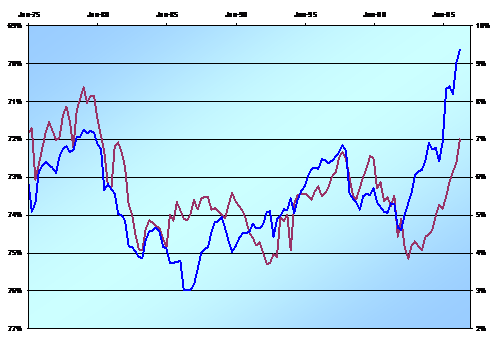
With that in mind, we put together the following chart last week (thanks to Bill Hester for research assistance). The blue line (right scale) depicts U.S. corporate profits as a percentage of nominal GDP. The violet line (left scale, smoothed) depicts U.S. personal disposable income as a percentage of nominal GDP, using an inverted scale – a rising line means a falling disposable income share. Notice that increasing corporate profits as a share of GDP generally come at the expense of wage earners' share, and vice versa. The recent upleg in corporate profits since 2003 reflects a corresponding drop in personal income as a share of GDP (a rising violet line) from 75% to 72% of GDP.


Corporate profit margins (profits as a percentage of corporate revenues) trace out a similar picture. The extent of this widening in profit share and profit margins is unprecedented, and isn't something that's likely to be sustained in a competitive economy. Historically, profit margins have been strongly mean reverting, with large swings as the economy moves between recessions and recoveries. Importantly, it doesn't take a plunging economy or falling revenues to hurt profit margins – even a deceleration of growth is typically enough to put downward pressure on margins.

So while profit margins are at record highs, disposable income as a percentage of GDP is closing in on record lows. The disposable income share was slightly lower in 1980 than it is today. Of course, in 1980, unemployment exceeded 7%, so it was possible to squeeze wage earners to a slightly lower share, but even that was short-lived, as labor compensation grew and profits fell in the next few years.

The effects of profit margins and employment conditions on subsequent earnings growth are important. Once profits become a large share of GDP and unemployment falls to relatively low levels, earnings growth is typically disappointing over the following 2-3 years. In contrast, when profits are a small share of GDP and unemployment is high, subsequent earnings growth tends to be well above-average.

To put some numbers on this, since 1963, when the profit share of GDP has been greater than 6% and the unemployment rate has been less than 6%, profits have crawled along at just 2.13% annually, on average, over the subsequent 3-year period. In contrast, when the profit share of GDP has been smaller than 6% and the unemployment rate has been above 6%, profits have enjoyed an average growth rate of 9.94% over the subsequent 3-year period.

With corporate profits pushing above 9% of GDP, the unemployment rate at just 4.6%, and S&P 500 earnings at the top of their 6% long-term growth channel, investors should not be at all surprised to see “surprising” wage inflation, accompanied by disappointing profit margins and weak earnings growth in the next few years.

Market Climate

As of last week, the Market Climate for stocks remained characterized by unfavorable valuations and unfavorable market action, holding the Strategic Growth Fund to a fully hedged investment stance. Stocks have enjoyed a typical fast, furious, prone-to-failure advance in recent days, coinciding with a period that tends to have modestly favorable (though less than reliable) seasonality. That period ends about Wednesday, for what it's worth. Given an unfavorable Market Climate, no longer oversold, and without the benefit of seasonal influences, a hedged position remains both comfortable and appropriate for now.

On a medium-term basis, profit margins are high, producing high earnings, on which stocks trade at high multiples (which is a bit like building a human pyramid on stilts). All of these are increasingly vulnerable here. Buy-and-hold investors, enamored with recent earnings, may be standing on far less solid ground than they might believe. Note that this argument isn't about the next quarter or two, which may or may not enjoy reasonable earnings reports. Looking toward the next few years, however, profit margins are more likely to revert toward the mean rather than extend an already overextended run.

In bonds, the Market Climate was characterized by relatively neutral valuations and unfavorable market action, holding the Strategic Total Return Fund to a duration of about 2.5 years, mostly in Treasury inflation protected securities, as well as a continued allocation of about 10% of assets to precious metals shares.